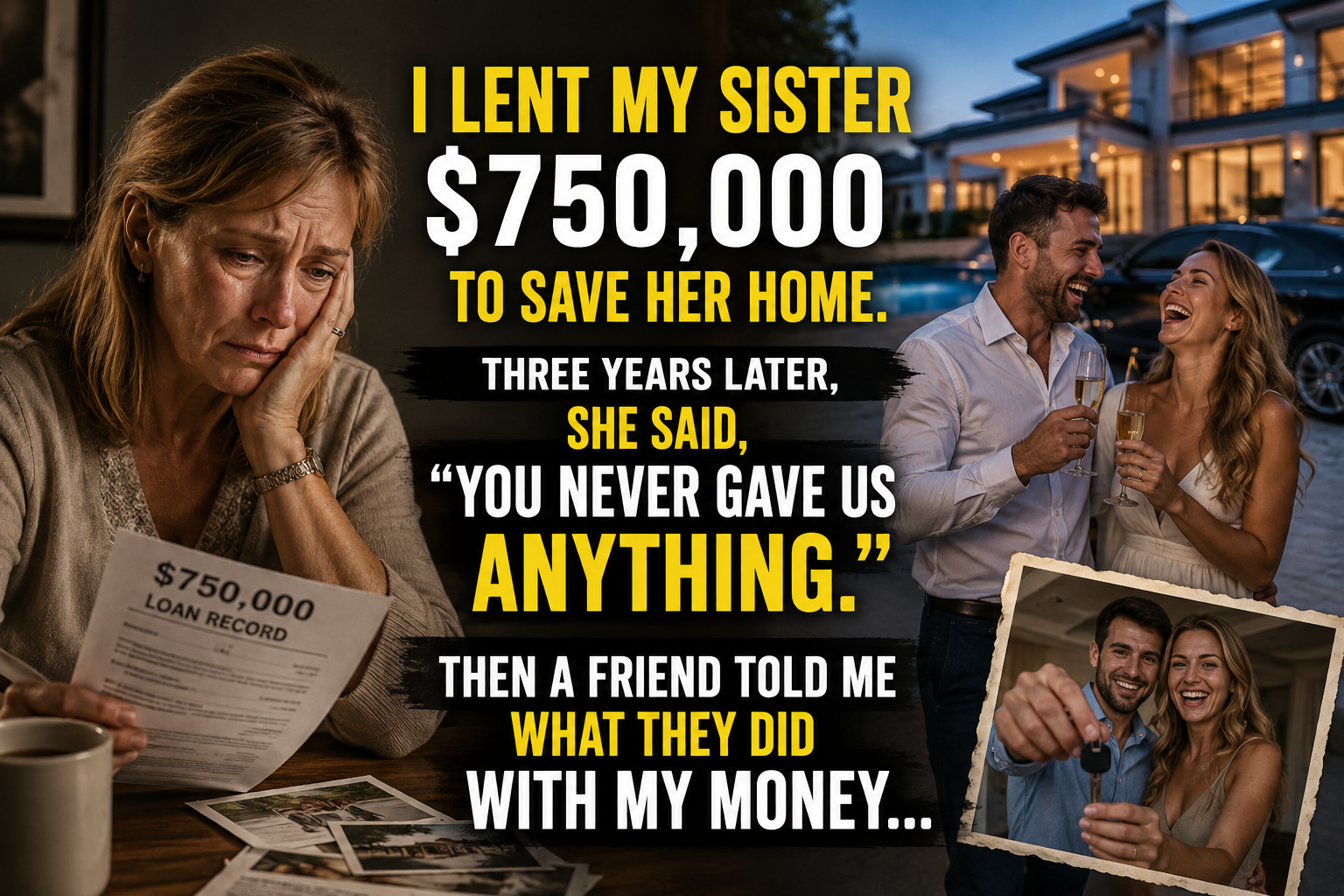
The day my sister looked me straight in the eyes and said, “You never gave us anything,” was the day I learned that family can break your heart more completely than any stranger ever could. Three
years earlier, she had been sitting across from me at my kitchen table, crying so hard she could barely speak. Her husband, Mark, had both hands covering his face. Their home was about to be
foreclosed. They had less than thirty days to come up with $750,000 or lose everything. Their children were still living at home. My sister told me she couldn’t imagine telling them that they would
have to leave the house they had grown up in. She begged me for help. Mark begged too. “Please,” he said. “You’re the only person who can save us.” I had $750,000 sitting in an investment account.
It was money I had spent decades saving. I had no children of my own. I had always believed that if the day came when my family truly needed me, I would be there. So I transferred the money to
them. No contract. No signatures. No lawyer. Just family. Just trust. Three years later, when I politely asked when they could start repaying me, my sister stared at me as if I had insulted her.
“Repaying you?” she said. “Yes,” I replied. “The $750,000.” Mark leaned back in his chair and actually laughed. “What $750,000?” I thought he was joking. Then my sister said the words that would
haunt me for years. “You never gave us anything.” I couldn’t speak. “What do you mean?” I whispered. “You never gave us money,” she repeated. “You helped us when we were struggling, but there
was never a loan.” “A loan?” I asked. “You begged me to save your house.” “We never signed anything.” Mark folded his arms. “There is no proof.” I looked from one face to the other. “There are bank
records.” My sister shrugged. “That doesn’t prove you expected us to repay it.” “You promised me.” “We never promised anything in writing.” Then they got up and left. No apology. No explanation.
No conversation. Nothing. That was the last time I saw them. No calls. No messages. No family gatherings. Nothing. For weeks, I barely slept. I kept replaying that conversation in my mind. I had
given them everything they asked for, and now they were pretending it had never happened. Then, one afternoon, I ran into an old mutual friend named Daniel at a grocery store. The moment he
saw me, his face changed. “Wait,” he said. “You seriously don’t know?” My stomach dropped. “Know what?” He looked around as if he were afraid someone might hear him. Then he leaned closer
and said, “What happened to your sister and Mark… after they took your money.” I froze. “What happened?” Daniel stared at me. “You really don’t know?” “Daniel, please.” He swallowed. “Your
sister and Mark didn’t use your money to save the house.” I felt the floor disappear beneath me. “What did they do?” He lowered his voice. “They sold the house.” I couldn’t breathe. “What?” “They
sold it. Months after you gave them the money.” “That’s impossible.” “I saw the listing.” “No.” “They sold it for over $1.4 million.” My hands began trembling. “Then where did the $750,000 go?” Daniel
looked at me with an expression I will never forget. “That’s the part you’re not going to believe.” I stood there in the middle of that grocery store, holding a bag of oranges, while Daniel told me the
truth about what my sister and her husband had done with the money I had sacrificed almost my entire adult life to save. And the worst part wasn’t the house. It wasn’t even the money. It was the
reason they had done it. To understand why I trusted them so completely, you have to understand my relationship with my sister. Her name was Laura. She was three years younger than me, and
when we were children, I practically raised her. Our father died when I was seventeen and she was fourteen. Our mother worked long hours, so I became the person who made sure Laura ate
breakfast, finished her homework, and got home safely. I remember walking her to school in the snow. I remember giving her my winter coat because she had forgotten hers. I remember saving
birthday money to buy her the shoes she wanted. We weren’t wealthy. Not even close. But we had each other. When I left home at nineteen, Laura cried for two days. She told me I was abandoning
her. I promised I never would. That promise stayed with me for decades. We grew older. I became an accountant and built a stable career. Laura married Mark, and they had two children. They
bought a beautiful house in a quiet neighborhood. I was happy for them. I attended birthdays, graduations, holidays, and family dinners. I became the aunt who bought too many Christmas
presents. When my mother died, Laura and I held each other at the funeral. She said, “You’re all I have left.” I told her, “And I’m not going anywhere.” I meant it. Over the years, I became financially
comfortable. I wasn’t rich. I simply saved carefully. I lived below my means. I invested. I didn’t take extravagant vacations. I drove an ordinary car. I didn’t have children, so I had more flexibility with
money. Eventually, my investments grew. By the time I was in my late fifties, I had accumulated enough that I could comfortably retire if I wanted. I never told Laura the exact amount. She knew I
was doing well, but she didn’t know I had $750,000 in one account. Then one rainy evening, she called me. Her voice sounded strange. “Can I come over?” “Of course.” “I need to talk to you.” “Is
everything okay?” She began crying. “No.” Twenty minutes later, she arrived with Mark. I knew immediately that something was terribly wrong. Mark looked exhausted. Laura’s eyes were swollen.
She sat at my kitchen table and whispered, “We’re losing the house.” I reached across and held her hand. “What happened?” Mark explained that a business deal had collapsed. They had taken out
loans against the house. Interest had accumulated. They had fallen behind. The bank had issued a foreclosure notice. They needed $750,000 immediately to stop it. “Why didn’t you tell me
sooner?” I asked. Laura shook her head. “We were embarrassed.” “You’re my sister.” “We didn’t want to ask.” Mark looked at me. “We wouldn’t ask if we had another option.” I asked how much they
needed. “Seven hundred and fifty thousand.” The number shocked me. It was almost exactly what I had available in my investment account. I sat silently. Laura began crying again. “Please don’t feel
obligated.” Mark said, “If you can’t, we understand.” But I could. And they knew it. I looked at my sister. “I’ll help.” She stopped crying. “What?” “I’ll give you the money.” Mark stood up. “Are you
serious?” “Yes.” Laura threw her arms around me. “I love you. I love you so much.” I hugged her tightly. “It’s okay.” Mark was crying too. “We’ll pay you back,” he said. “Every penny.” I waved my hand.
“We’ll work out the details later.” That was my mistake. I should have stopped right there. I should have written a contract. I should have called an attorney. I should have protected myself. Instead, I
trusted family. The next morning, I transferred the money. The bank confirmed the transaction. $750,000. Gone from my account. Laura called me crying. “You saved us.” I told her, “Just take care of
your family.” Mark called later. “I don’t know how we’ll ever repay you.” “You will,” I said. “When things stabilize.” He promised. I believed him. For the first few months, everything seemed fine. They
thanked me constantly. Laura sent pictures of the children smiling in their rooms. She called me “the reason we still have a home.” I felt good. I thought the crisis had brought us closer. Then
something changed. The calls became less frequent. When I visited, Laura seemed distracted. Mark stopped mentioning repayment. I didn’t push. I knew they were recovering financially. One year
passed. Then another. I occasionally asked how things were going. “We’re getting there,” Mark would say. “Business is finally improving.” I believed him. Then, shortly after the third anniversary of
the transfer, I received a letter from my financial advisor. He reminded me that my investment account was lower than expected and suggested I review my retirement plans. I suddenly realized
how much the $750,000 had affected my own future. I had originally planned to use that money to purchase a small retirement property. I had postponed the purchase because I wanted to give
Laura time. Now I was approaching sixty, and I needed to think about myself. So I called Laura. “Can we talk about the loan?” She went silent. “What loan?” I laughed because I assumed she was
joking. “The $750,000.” Another pause. “Oh.” “I was wondering when you might be able to start repaying it.” Her voice became cold. “Repaying what?” “The money I gave you.” “You gave it to us.”
“Yes, as a loan.” “No.” “Laura…” “We never agreed to a loan.” “You said you’d repay every penny.” “I don’t remember saying that.” Mark suddenly came onto the phone. “There was no agreement.” “You
both promised me.” “Promises aren’t contracts.” I felt my chest tighten. “Are you seriously saying you don’t owe me anything?” “That’s what we’re saying.” I couldn’t believe it. I asked to meet in
person. They agreed. That’s when they repeated it to my face. “You never gave us anything,” Laura said. “We never made a loan.” “You begged me to save your home.” “And you helped us.” “With
$750,000.” “You chose to give it.” Mark leaned forward. “There are no signed documents.” I stared at my sister. “Do you really want to do this?” She looked away. “There’s nothing to do.” Then they
left. I never saw them again. Weeks passed. Then Daniel found me in the grocery store. He told me about the house. Laura and Mark had sold it less than a year after receiving my money. They had
purchased a luxury condominium in another city. “Why?” I asked. Daniel hesitated. “Because they weren’t broke.” “What?” “They had already decided to sell the house.” “But they told me the bank
was going to foreclose.” “It was.” “Then why would they sell it?” “Because the foreclosure pressure was part of the story.” I shook my head. “That doesn’t make sense.” Daniel explained that Mark had
been planning to sell the property and use the equity to start another business. The $750,000 gave them enough cash to stop the foreclosure temporarily and improve their credit position. Then
they sold the house at a huge profit. “So my money saved their house so they could sell it?” “Apparently.” “Where did they go?” Daniel said they bought a luxury condominium in another state and
invested the remaining money into a new business. “What business?” “A private investment company.” I stared at him. “With my money?” “That’s what I’ve heard.” I thanked him and went home.
That night, I couldn’t sleep. I searched public records. Daniel was right. The house had been sold. The sale price was $1.48 million. The mortgage had been cleared. The remaining proceeds had gone
somewhere else. I contacted my attorney. This time, I did it immediately. She reviewed the bank transfer, emails, messages, and every conversation I could document. She told me something painful.
“The absence of a written agreement makes this difficult.” “But the transfer is documented.” “Yes. But the legal question is why the money was transferred.” “Because they promised to repay me.”
“Do you have anything in writing where they acknowledge the loan?” I searched everything. There were texts. “Thank you for saving us.” “We’ll never forget what you did.” “We’ll pay you back.” But
no formal contract. My attorney said we might have a case depending on the jurisdiction and circumstances, but it could be expensive and uncertain. “Do you want to pursue it?” she asked. I looked
at the documents. “I don’t know.” I wanted justice. But I also wanted something else. I wanted to understand why my sister had done this. So I began investigating quietly. I contacted people who
had known Mark professionally. One former business partner told me Mark had been planning a major investment. Another person said Laura had bragged about receiving “a family bailout.” Then I
discovered something that made me sick. The $750,000 had not simply gone toward their home. A portion had been used to purchase a luxury vehicle. Another portion had been invested in Mark’s
new company. And some of it had been used for an expensive vacation. I stared at the receipts. I remembered my own life during those three years. I had canceled my retirement property purchase.
I had stopped traveling. I had worked longer than planned. I had told myself it was worth it because my sister needed me. Meanwhile, she had been spending my money as if it were a prize. But
there was still something I didn’t understand. Why deny the loan completely? Then Daniel called again. “I found something,” he said. “What?” “You should see it yourself.” We met at a coffee shop.
He gave me a folder. Inside was an email from someone who had worked with Mark. The email said Mark had privately discussed the $750,000. He had called it “free family money.” My hands
shook. “Where did you get this?” “A friend of mine was involved in the business.” “Can I use it?” “That’s why I gave it to you.” I brought everything to my attorney. She reviewed it carefully. “This
helps,” she said. “But I want to know more.” We continued investigating. Eventually, we found a financial adviser who had spoken to Mark shortly after the transfer. He had records showing Mark
had described the money as a “temporary family loan.” That was the first major breakthrough. It wasn’t just my word against theirs anymore. There was evidence that Mark had acknowledged the
loan to a third party. My attorney contacted them formally. Suddenly, Laura called me. It was the first time I’d heard her voice in months. “Why are you doing this?” she asked. “Doing what?” “Trying
to take our house.” “You don’t own the house you bought after selling the old one?” “You know what I mean.” “I want my money back.” “We don’t have it.” “You sold the house for $1.48 million.”
Silence. “How do you know?” “Because property records are public.” “We used the money to build a new life.” “With my money.” “It wasn’t yours anymore.” I closed my eyes. “Laura, I gave you that
money because you told me you were going to lose everything.” “We would’ve.” “Then why did you sell the house?” “Because we needed to.” “And why did you deny the loan?” “Because you gave it to
us.” “No,” I whispered. “I trusted you with it.” She hung up. A few days later, Mark’s attorney responded. They claimed the money had been a gift. My attorney sent them the evidence. Then
something unexpected happened. A former employee of Mark contacted us. She said she had been uncomfortable with the way he described the money internally. “He told us your sister had given
him the money temporarily,” she said. “He said they had to keep the story simple.” “What story?” “That the money was a gift.” “Why?” “Because he didn’t want investors asking questions.” My
attorney looked at me. “This is becoming much bigger.” The case moved forward. But the legal battle wasn’t what consumed me. It was the emotional betrayal. I started remembering every moment
with Laura differently. The childhood memories. The funeral. The Christmases. The promises. I wondered whether she had ever loved me or whether she had simply learned that I was the sister
who would always rescue her. That question hurt more than the money. One evening, I found an old photograph of us as children. Laura was fourteen. I was seventeen. We were standing outside
our childhood home. I remembered holding her hand after our father died. I remembered telling her, “I’m not going anywhere.” Tears filled my eyes. I realized that promise had shaped my entire
relationship with her. I had spent decades trying to protect the little girl I remembered. But that little girl was gone. In her place was an adult woman who had made a terrible choice. Eventually, the
court process forced Laura and Mark to disclose their financial records. That’s when the truth became undeniable. Their records showed that after receiving my money, they paid off the immediate
foreclosure threat. Then, within months, they prepared the property for sale. After selling it, they transferred significant amounts into accounts associated with Mark’s new company. They had not
used my money exactly as they had claimed. The money had been part of a larger financial strategy. My attorney presented the evidence. Their attorney tried to argue that the transfer was a gift.
But the messages, emails, third-party statements, and financial records told another story. During mediation, Laura finally sat across from me again. She looked older. So did I. For a long time,
neither of us spoke. Finally, she said, “I’m sorry.” I looked at her. “For what?” “Everything.” “That’s a big word.” She nodded. “I know.” “Why did you do it?” Tears filled her eyes. “Because I was scared.”
“So you lied to me?” “Yes.” “Why?” “Because I thought if I admitted we couldn’t repay you, you’d take the money back.” “I wouldn’t have.” “I know that now.” “You knew me for your entire life.” She
cried. “I was selfish.” I nodded. “Yes.” She looked at me. “I thought once we sold the house and invested the money, we’d make enough to pay you back.” “Then why did you tell me you didn’t owe me
anything?” She couldn’t answer. Finally, she whispered, “Mark convinced me.” I looked toward him. He sat across the room with his arms folded. “And did you believe him?” She nodded. “Why?”
“Because I was afraid.” I shook my head. “You weren’t afraid of losing your house. You were afraid of losing money.” She began crying. “I’m sorry.” “You didn’t just take $750,000.” She looked up. “You
took three years of my life. You took my trust. You took something from me that money can’t replace.” She whispered, “I know.” The mediator asked whether we were prepared to settle. My
attorney had negotiated a repayment plan. Laura and Mark would have to repay a substantial portion of the money, with assets and investments placed into a structured agreement. They would
not be ruined, but they would finally be held accountable. Mark fought it. Laura eventually agreed. The settlement was signed. This time, there were contracts. Pages and pages of them. Every
obligation was documented. Every payment was recorded. I almost laughed when I signed. The woman who had once given away $750,000 with nothing but trust now had an entire legal file
protecting her from the people she had trusted most. The repayment took years. But it came. Slowly. Consistently. And with every payment, I felt less like someone waiting for money and more like
someone reclaiming a piece of herself. Laura and I remained distant. We didn’t speak often. Eventually, she sent me a letter. In it, she apologized without blaming Mark. That mattered. She admitted
she had made the decision herself. She admitted that she had betrayed me. She said she understood if I never forgave her. I read the letter several times. Then I put it away. Forgiveness took time. I
eventually forgave her, but not because what she did was acceptable. I forgave her because I didn’t want anger to control the rest of my life. But I never trusted her with money again. And I never
would. Mark and Laura eventually separated. Their new business failed. They lost much of what they had built. Laura moved into a smaller home. She got a job and began rebuilding her life. Years
later, she called me. “Can I see you?” I agreed. We met at a quiet restaurant. She looked nervous. “How are you?” I asked. “Better.” She smiled sadly. “You?” “Better too.” She reached across the table
but stopped before touching my hand. “I miss my sister.” I swallowed. “I miss mine too.” “Do you think we can ever go back?” I thought for a long moment. “No.” Her face fell. “But maybe we can go
forward.” Tears filled her eyes. “I’d like that.” We talked for two hours. Not about money. Not about the court case. We talked about our childhood. Our mother. Our father. The things we
remembered. When we left, she hugged me. It wasn’t the same as before. It couldn’t be. But it was honest. And sometimes honesty is the first step toward healing. I eventually bought my
retirement property. It wasn’t the one I had originally planned to purchase. I found a small house near a lake. It had a porch, a garden, and enough room for my grandchildren from friends and family
to visit. I planted roses outside the kitchen window. I bought a rocking chair. I hung the old photograph of Laura and me in the hallway—not because I had forgotten what happened, but because I
didn’t want betrayal to erase the good memories that came before it. The $750,000 taught me lessons I wish I had learned without paying such a high price. Family is precious, but family isn’t a legal
agreement. Love doesn’t replace documentation. Trust doesn’t mean refusing to protect yourself. And helping someone doesn’t mean allowing them to destroy your future. If I could go back to that
rainy evening when Laura first sat at my kitchen table, I would still help her. But I would do it differently. I would hire a lawyer. I would write everything down. I would make sure everyone
understood the terms. And I would never again confuse being generous with being unprotected. Years after the settlement, I ran into Daniel again. We were at the same grocery store where he had
first told me the truth. He smiled. “How are you?” “Good.” “Really?” I nodded. “Really.” “Did you ever get your money back?” “Most of it.” “And your sister?” I smiled faintly. “We’re speaking again.” He
looked relieved. “That’s good.” “It took a long time.” “Some things do.” I thought about the night Laura begged me for help. “You know what hurt the most?” I asked. “What?” “Not losing the money.”
“Then what?” “Finding out she thought I was someone she could lie to.” Daniel nodded. “Sometimes betrayal isn’t about the thing taken. It’s about discovering what the other person thought you
were worth.” I looked at him. “Exactly.” He smiled. “But you know what else?” “What?” “You didn’t let it turn you bitter.” I looked at the grocery cart in front of me. “I almost did.” “But you didn’t.” He
was right. I had learned to be careful without becoming cruel. I still helped people. I still donated to charities. I still supported friends when they needed me. But I no longer handed over everything I
had because someone shared my last name. I helped with boundaries. I loved with boundaries. I trusted with boundaries. And strangely, my relationships became healthier because of it. A few
years later, Laura’s daughter graduated from college. She invited me to the ceremony. I almost didn’t go. Then I remembered holding her as a baby. I remembered the little girl she had been. I went.
After the ceremony, Laura hugged me. “Thank you for coming.” “Of course.” Her daughter approached me. “Aunt Claire?” “Yes?” “Mom told me what happened.” I looked at Laura. She nodded. “She
said you saved our family.” I shook my head. “I tried.” “She said you taught her something.” I smiled. “What?” “That family isn’t about what you can take from each other. It’s about what you’re willing
to do for each other.” I looked at Laura. She was crying. I hugged her daughter. “Your mother learned that lesson the hard way.” She smiled. “So did I.” That evening, as I drove home, I thought about
the strange path my life had taken. I had started with a sister who needed saving. I had given her everything she asked for. She betrayed me. I nearly lost my faith in people. But somehow, I came out
the other side stronger. The money eventually returned. My retirement was secure. My home was mine. My life was peaceful. But the greatest thing I recovered wasn’t financial. It was my ability to
trust myself. I learned that kindness does not require blindness. Compassion does not require surrender. And being a good sister does not mean sacrificing your entire future without protection.
Sometimes the most loving thing you can do for someone is help them responsibly. Put the agreement in writing. Set boundaries. Make expectations clear. Because when money enters a family
relationship, silence can become a weapon. And promises can disappear when people realize there is nothing forcing them to keep those promises. My sister once looked me in the eyes and said,
“You never gave us anything.” I believed for a while that those words erased everything between us. They didn’t. They revealed something. They revealed who she had become when she thought
she could get away with hurting me. And they also revealed who I needed to become afterward. Stronger. Wiser. More careful. But not harder. Today, when someone asks me for financial advice, I
tell them the same thing my attorney told me after the betrayal: “If the relationship is important enough to risk money over, it’s important enough to protect with paperwork.” I wish I had known
that before I transferred $750,000 to my sister. I wish I had understood that love and documentation are not opposites. They can exist together. In fact, sometimes documentation is what protects
the relationship when emotions change. I lost three years believing my sister had taken my money. In the end, she had taken something more valuable: my innocence about family. But she didn’t
take my future. She didn’t take my ability to love. She didn’t take my kindness. And she certainly didn’t take my ability to start over. The little house by the lake became my favorite place. On
summer mornings, I sit on the porch with coffee and watch birds land near the water. Sometimes Laura visits. We sit together quietly. There are still things we don’t talk about. Some wounds don’t
need constant examination. They simply need time. One morning, Laura asked me, “Do you regret helping me?” I thought about it. “No.” She looked surprised. “After everything?” “I regret not
protecting myself. But I don’t regret helping someone I loved.” She began to cry. “I don’t deserve you.” I smiled. “Don’t say that.” “Why?” “Because this isn’t about deserving. It’s about choices.” She
nodded. “I made the wrong ones.” “Yes.” “And you still helped me.” “Because that’s who I am.” She looked at me for a long moment. “I wish I had been more like you.” I shook my head. “Don’t be like
me.” She looked confused. “Be better than me.” “How?” “Help people, but don’t forget yourself.” She smiled through her tears. “I think I’m finally learning.” I reached across the table and held her
hand. For the first time in years, it felt like my little sister’s hand again. Not the woman who had betrayed me. Not the person who had denied a $750,000 loan. Just my sister. Imperfect.
Complicated. Human. And perhaps that was the final lesson. People can hurt you deeply and still be people you once loved. Forgiving them doesn’t mean pretending it didn’t happen. It means
refusing to let what they did become the definition of your entire life. I still have the original bank statement showing the $750,000 transfer. I keep it in a file. Not because I need proof anymore. But
because sometimes I look at it and remember how much I was willing to give for someone I loved. Then I look around my little house by the lake and remind myself that generosity wasn’t my
mistake. Trusting without protection was. There is a difference. A very important one. And if you are reading this because someone in your family has asked you for a large amount of money, I hope
you remember my story. If you choose to help, help with love. But put it in writing. Get legal advice. Make sure everyone understands whether it is a gift or a loan. Don’t assume that because
someone shares your blood, they will share your sense of responsibility. And never let anyone shame you for protecting your future. My sister and her husband once thought they had taken
$750,000 from me and gotten away with it. They thought silence would erase the debt. They thought family loyalty would prevent me from fighting back. They were wrong. But the biggest surprise
wasn’t that I eventually recovered much of the money. It was what Daniel told me that day in the grocery store after revealing their secret. He said, “You know what I think?” “What?” “They thought
they took $750,000 from you. But they actually lost a sister who would have done anything for them.” He was right. The money could be earned again. The trust could not. And perhaps that’s the
saddest part of the entire story. My sister didn’t lose her house because she was poor. She didn’t lose her future because she needed help. She lost something far more valuable because she
believed that betraying the person who loved her most was worth the price. As for me, I learned to live without the sister I once thought I couldn’t live without. I learned to forgive without
forgetting. I learned to help without destroying myself. And I learned that sometimes the greatest victory isn’t getting your money back. It’s reaching the day when you can remember what
happened without letting it poison the life you’re living now. Today, I wake up grateful. I walk outside. I water my roses. I make coffee. I sit on the porch and watch the sun rise over the lake. And
sometimes, when I see my sister’s name on my phone, I smile before answering. Not because everything is the way it used to be. It isn’t. It never will be. But because we finally learned something we
should have known from the beginning: family isn’t defined by what you can take from someone when they trust you. Family is defined by what you refuse to take when you know they would give
you everything. And I gave my sister $750,000 because I believed she would never betray me. She did. But in the end, she couldn’t take away the most important thing she once taught me as a little
girl holding my hand after our father died: that even when life breaks your heart, you can choose what kind of person you become afterward. I chose not to become bitter. I chose to remain kind—
but wiser. And that, more than the money, was what I finally got back.
THE END! THANKS FOR READING!