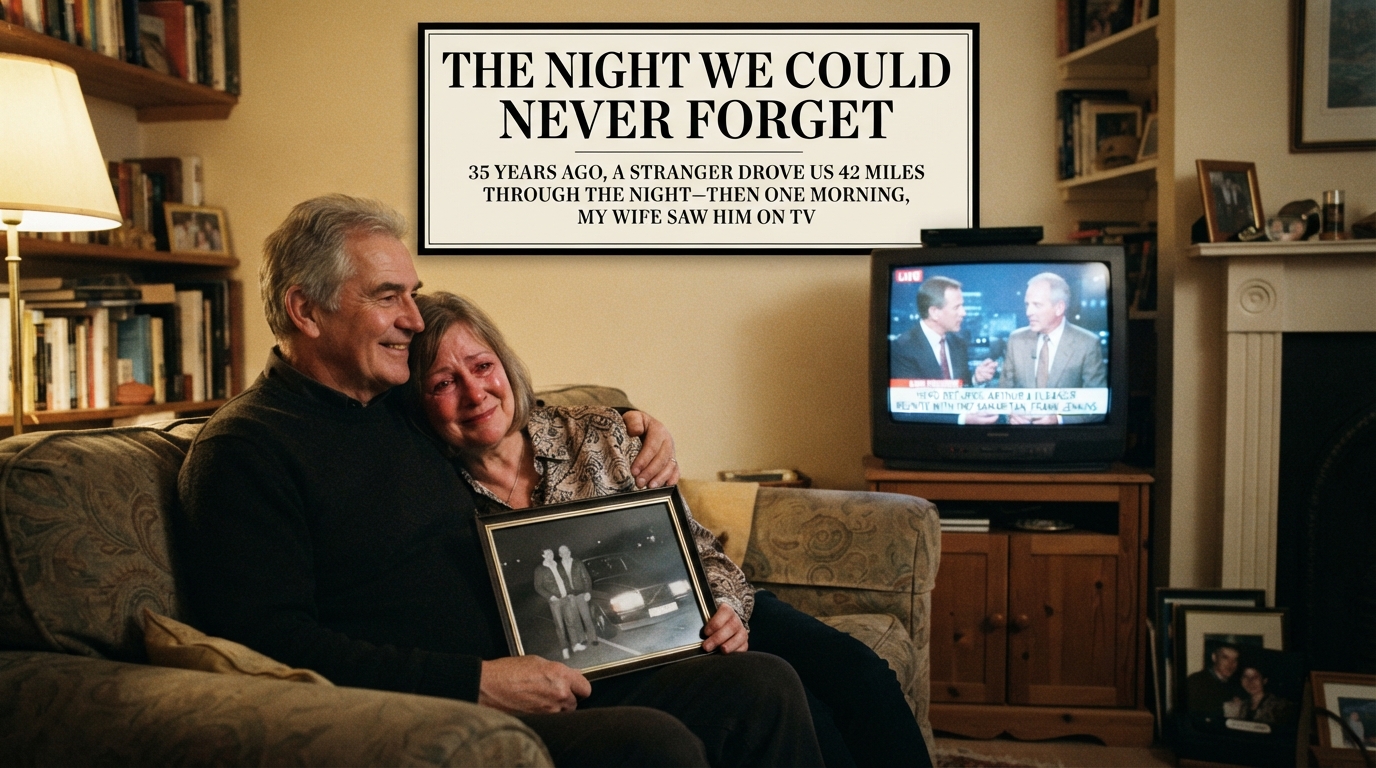
More than thirty-five years ago, my wife and I were driving home shortly after 2:15 in the morning when our car suddenly died on a deserted highway. There were no gas stations, no working
phones, no houses, and no other cars anywhere in sight. The temperature had dropped so low that our breath fogged the windows. We had been sitting there for almost two hours, wondering
whether we would have to spend the night in that freezing car, when a beat-up pickup truck finally appeared in the distance. It slowed down, pulled onto the shoulder, and stopped behind us. A
young man climbed out. He looked like a college student. Maybe twenty or twenty-one years old. He was wearing an old denim jacket, faded jeans, and boots covered in mud. He walked toward our
car with his hands raised so we wouldn’t mistake him for a threat. “Are you folks okay?” he asked. I rolled down the window just enough to hear him. “We’re fine,” I lied. My wife, Margaret,
immediately said, “No, we’re not.” The young man smiled. “I figured.” He looked at the dead car, then at the empty highway. “How long have you been here?” “Almost two hours,” I said. He shook his
head. “You can’t stay here.” “We don’t have much choice.” He glanced toward his truck. “Get your things.” “What?” I asked. “I’ll take you to town.” I stared at him. “How far?” “Forty-two miles.” My
wife looked at me. “Is your truck reliable?” He laughed. “Not exactly.” I looked at the rusty pickup. One headlight was dimmer than the other, the passenger door had a dent the size of a basketball,
and the exhaust sounded like a lawn mower. “Are you sure?” I asked. “Sure enough.” We climbed into his truck. For the next forty-two miles, this complete stranger drove us through the darkness
toward the nearest town. He didn’t ask for money. He didn’t ask for anything. He simply kept driving. When we reached the town, I found a motel and arranged for our car to be towed the following
morning. Before the young man left, I pulled out my wallet. I had just received a bonus from work, and I was carrying more cash than usual. I counted out ten hundred-dollar bills. “Please,” I said.
“Take this.” He stared at the money. “No, sir.” “You saved us.” “I helped you.” “That’s worth something.” He gently pushed the money back toward me. “Keep it.” “At least give me your name so I can
repay you someday.” He smiled. “My name’s Daniel.” “Daniel what?” He hesitated. “Just Daniel.” I laughed. “You can’t disappear with only a first name.” He shrugged. “I guess I can.” My wife stepped
forward. “Why won’t you take the money?” Daniel looked at her and said something I’ll never forget. “Because somebody helped my family once. He didn’t ask for anything either. He just told my
dad that when the time came, we should help somebody else.” He looked at the highway behind him. “So I’m just passing it along.” I held the money in my hand. “Then what can I do for you?” Daniel
smiled. “Promise me something.” “What?” “Someday, when you see somebody who needs help, don’t walk away.” My wife reached out and squeezed his hand. “We promise.” Daniel nodded. “Then
we’re even.” He climbed into his pickup and disappeared into the night. We never learned his full name. We never found out where he lived. We never discovered which college he attended. We
didn’t even know whether Daniel was his real first name. But we kept our promise. And that promise changed our lives in ways we couldn’t have imagined. My wife and I had been married for
eleven years at the time. We had two young children. Our life wasn’t perfect, but it was good. We both worked hard. We paid our bills. We tried to teach our children to be kind. And after that night,
whenever we saw someone in trouble, we helped if we could. Sometimes it was something small. A stranded motorist. A mother struggling with groceries. An elderly man whose car wouldn’t start.
Sometimes it was more. Once, we paid for a young couple’s motel room after they were stranded during a storm. Another time, we helped a college student who had lost his wallet and needed
money to get home. We never told people why. We simply remembered Daniel. Years passed. Our children grew up. Our daughter became a teacher. Our son became an engineer. Margaret and I
grew older together. We celebrated anniversaries. We buried friends. We welcomed grandchildren. We moved into a quieter house. We replaced the old car several times. The beat-up pickup
truck from that night became nothing more than a memory. But every December, Margaret and I would bring it up. “I wonder what happened to that young man,” she would say. “I wonder too.”
Sometimes we’d imagine him. Maybe he became a mechanic. Maybe he became a professor. Maybe he moved across the country. Maybe he had children of his own. We would never know. Or so we
thought. Then, one morning more than thirty-five years after that night, everything changed. I was sitting at the kitchen table reading the newspaper when Margaret came rushing down the stairs.
She was crying. Not quietly. She was sobbing. “Turn on the television,” she said. “Right now.” I stood. “What happened?” “Just turn it on.” I grabbed the remote. The morning news was already
playing. There was a live broadcast from Washington. A crowd had gathered outside a large building. Cameras were everywhere. Reporters were talking excitedly. Then the screen changed to a
close-up of a man stepping out of a black SUV. He was older now. His hair was silver at the temples. He wore a dark suit and carried a folder under one arm. The reporter said, “Daniel Mercer, one of
the country’s most recognized philanthropists and the founder of the Mercer Foundation, arrived this morning to announce a major national initiative to help stranded families, veterans, students,
and low-income communities.” I stopped breathing. Margaret covered her mouth. “That’s him.” I stared at the screen. “What?” “That’s Daniel.” I shook my head. “Margaret…” “It’s him.” She pointed
at the television with a trembling hand. “Look at his eyes.” I stepped closer. The camera showed the man’s face. Older. More distinguished. More confident. But those eyes. I knew those eyes. I
remembered them under the pale headlights of that rusty pickup truck. “It can’t be,” I whispered. The reporter continued. “Mr. Mercer, now 57, built his fortune in technology before dedicating
much of his wealth to charitable causes. His foundation has provided scholarships to more than 18,000 students and emergency assistance to thousands of families.” Margaret was crying harder
now. “That’s him.” I sat down. “We have to find him.” “How?” “We’ll figure it out.” The television showed Daniel walking toward a podium. I listened to him speak. “My father taught me that wealth
means nothing if it doesn’t make somebody else’s life better. My mother taught me that no one should be left alone in a crisis. I learned those lessons when I was young, and I’ve carried them with
me ever since.” Margaret looked at me. “He said the same thing.” “I know.” I watched the interview. The reporter asked him about his foundation. “Why did you choose emergency assistance as one
of your priorities?” Daniel smiled. “Because I once found two people stranded on a dark highway. They had no way home. I helped them. They tried to give me money. I refused it. Instead, I asked
them to help someone else someday.” Margaret grabbed my arm. “He remembers.” The room went silent. Daniel continued. “I never expected to see them again.” My wife began sobbing. I felt tears
in my own eyes. We had spent thirty-five years wondering whether Daniel remembered us. He had. But the story was about to become even stranger. That afternoon, we called the Mercer
Foundation. We explained who we were. We didn’t expect anyone to believe us. To our surprise, the receptionist asked us to hold. Five minutes later, a woman came on the line. “Mr. Carter?” “Yes.”
“This is Daniel Mercer’s assistant.” My heart started pounding. “He received your message.” “Is he there?” “Yes.” There was a pause. Then a man’s voice came through the phone. “Is this the couple
from the highway?” Margaret burst into tears. I couldn’t speak. “Daniel?” I finally said. He laughed softly. “I knew it was you.” “How?” “You both have distinctive voices.” Margaret laughed through
her tears. “You remember us?” “I never forgot you.” We talked for nearly an hour. Daniel told us what happened after that night. He had been twenty-one and attending a community college. His
father had recently lost his job. His mother worked nights. Their family had struggled financially. Daniel had been driving home after helping a friend repair a truck when he saw our car on the
roadside. “I almost kept driving,” he admitted. “Not because I didn’t want to help. I was exhausted. But then I remembered my dad.” “What about your father?” I asked. “When I was sixteen, our car
broke down during a snowstorm. A stranger stopped. He drove my family to a motel and paid for the room. My father offered him money. The man refused. He said, ‘When you’re able, do it for
someone else.’ My father never forgot it. He taught me that kindness is a debt you repay by passing it forward.” I smiled. “That’s exactly what you told us.” “I know.” “What happened to the thousand
dollars?” he asked. “We kept it.” He laughed. “Good.” “Actually,” Margaret said, “we almost gave it to charity.” Daniel laughed. “That would’ve been appropriate.” Then I asked him something that had
bothered me for years. “Why wouldn’t you tell us your full name?” There was a long pause. “Because I didn’t want you to feel obligated.” “You were just a kid.” “Exactly. I didn’t want you thinking you
owed me.” “We wanted to thank you.” “You did.” “How?” “You kept your promise.” I looked at Margaret. “How do you know?” Daniel laughed. “Because I started the Mercer Foundation twenty-two
years ago. One of the first letters we received came from a couple who anonymously paid for a stranded family’s motel room. They wrote, ‘Someone once helped us and asked us to pass it on.’”
Margaret covered her mouth. “That was us.” “I know.” “How?” “You signed the check.” We both laughed. It felt surreal. Three decades of separate lives had somehow connected again. Daniel invited
us to visit him. We accepted. Two weeks later, we flew across the country. When we arrived at the foundation’s headquarters, Daniel met us at the entrance. He walked toward us slowly. For a
moment, none of us spoke. Then he smiled. “You look exactly like I remember.” I laughed. “You don’t.” He laughed. “Fair enough.” Margaret hugged him. Daniel hugged her tightly. Then he hugged
me. “Thank you,” he whispered. “For what?” “For keeping your promise.” We spent the afternoon talking. Daniel showed us photographs of his family. He had three children. His oldest daughter was
a doctor. His son worked with the foundation. His youngest was studying environmental science. He told us about his career. After college, he had started a small software company with two
friends. They nearly failed three times. Eventually, their business succeeded. Investors came. The company expanded. Daniel became wealthy. But instead of buying a mansion or yachts, he began
funding scholarships and emergency programs. “I never forgot that highway,” he said. “That night taught me something.” “What?” “You never know what a small act of kindness can become.” He
opened a drawer and pulled out a photograph. It was an old picture of a rusty pickup truck. I stared at it. “Is that…?” “The truck.” “You kept it?” “For years.” I laughed. “Why?” “Because it was the first
vehicle I ever used to help a stranger.” “What happened to it?” “I restored it.” “You still have it?” “Yes.” He took us outside. Sitting beneath a covered structure was that same old pickup. It had been
restored beautifully. The dents were gone. The paint was polished. The engine had been rebuilt. But the shape was unmistakable. Margaret touched the hood and began crying. “I can’t believe this.”
Daniel smiled. “I call it the Promise Truck.” I laughed. “The Promise Truck?” “That’s what my kids call it.” “Do you drive it?” “Sometimes.” He opened the driver’s door. “Want to take a ride?” We
climbed in. For a moment, I was twenty years younger. I could hear the old engine. I could almost smell the cold night air. Daniel drove us down a quiet road. “There’s something else,” he said.
“What?” “The initiative I announced on television this morning?” “Yes.” “It’s named after you.” I stared at him. “What?” “The Carter-Mercer Roadside Promise Initiative.” Margaret shook her head.
“You can’t be serious.” “I am.” “Why our name?” “Because the program is built around the promise you made that night.” The initiative provided emergency assistance to stranded motorists, elderly
drivers, low-income families, and students traveling long distances. It funded roadside emergency kits, motel vouchers, transportation, and temporary housing. Daniel wanted it to become a
national program. “You don’t have to do that,” I told him. “I know.” “Then why?” “Because you taught me that the best way to honor kindness is to multiply it.” I didn’t know what to say. That evening,
Daniel invited us to dinner with his family. His wife, Susan, greeted us warmly. She had heard the story many times. “I’ve known about you for years,” she said. “Daniel always wondered if he’d ever
find you.” Their children asked questions. “Was Dad really driving that ugly truck?” “Yes,” I said. “It was terrible.” Everyone laughed. “Did he really refuse a thousand dollars?” “He did.” “Why?” I
looked at Daniel. “Because he was taught better than that.” Daniel smiled. After dinner, his daughter asked me something unexpected. “Did you really help other people because Dad asked you to?”
“Yes.” “How many?” I thought about it. “I don’t know.” “You should.” I smiled. “Why?” “Because Dad says you were his first example that kindness can travel farther than you ever see.” That night,
Margaret and I stayed at a hotel. We couldn’t sleep. We kept talking about Daniel. “Can you believe it?” she whispered. “No.” “He became famous.” “Apparently.” “And he remembered us.”
“Apparently.” She smiled. “I’m glad we kept our promise.” I reached for her hand. “Me too.” The next morning, Daniel called us. “I have one more surprise.” “What now?” “Come to the foundation.”
When we arrived, there were dozens of people waiting. Families. Students. Veterans. Elderly couples. College students. Mechanics. Nurses. Teachers. Daniel stood on a stage. Behind him was a
large photograph of an empty highway at night. “Thirty-five years ago,” he began, “I stopped to help two strangers whose car had broken down.” The room became silent. “They tried to give me
money. I refused. Instead, I asked them to promise that someday they would help someone else.” He looked at us. “They kept that promise.” People applauded. I felt embarrassed. “Those two people
taught me that kindness isn’t a transaction. It’s a chain. One person helps another. That person helps someone else. And eventually, you have an entire community connected by one simple decision
not to walk away.” He announced the launch of the initiative. Then he invited us to stand beside him. Margaret cried. I tried not to. The applause lasted for nearly a minute. Afterward, a young man
approached me. He was maybe nineteen. “Mr. Carter?” “Yes?” “I was helped by this foundation last year.” “I’m glad.” “My car broke down while I was driving to college. I didn’t have money for a hotel.
The foundation paid for my room and helped repair my car.” I smiled. “Then pass it on.” He nodded. “I will.” Another woman approached. She had two children. She told us the foundation had helped
her when she became stranded during a medical emergency. Then an elderly couple told us they had received roadside assistance after their car broke down during winter. Each story reminded me
of that night. A stranger stopping on an empty road. A small decision. A promise. A lifetime of consequences. Months passed after our reunion. Daniel’s initiative expanded rapidly. Newspapers
wrote about it. Television stations interviewed him. People began sharing their own stories of kindness. The phrase “pass it on” became associated with the program. But Daniel never took credit
for everything. Whenever reporters asked him where the idea came from, he always said, “It began with a promise between three people on a highway.” One day, Margaret and I were sitting in our
living room when a package arrived. Inside was a small wooden plaque. It read: “A Kindness Given Is Never Lost. It Travels.” Beneath the words were our names and Daniel’s. Margaret hung it above
the fireplace. “I think it belongs there,” she said. I agreed. Years later, Daniel continued expanding the foundation. He never forgot where he came from. He still visited community colleges. He still
talked to students. He still drove the restored pickup truck on special occasions. And every year, on the anniversary of the night he found us, he would call. “Happy Promise Day,” he’d say. “Happy
Promise Day,” we’d answer. Eventually, our children learned the whole story. Our grandchildren did too. They loved the Promise Truck. Whenever Daniel visited, the grandchildren would fight over
who got to sit in the driver’s seat. Daniel always let them. One afternoon, my youngest grandson asked him, “Grandpa Daniel, why did you stop for Grandma and Grandpa?” Daniel looked at me and
smiled. “Because they needed help.” “But you didn’t know them.” “That’s the point.” The boy thought about it. “So you help strangers?” “Sometimes.” “Even if they can’t pay you?” Daniel nodded.
“Especially then.” My grandson looked at me. “Did Grandpa help people too?” I laughed. “Yes.” Daniel corrected me. “He did more than help people. He kept his promise.” That sentence meant more
to me than any award ever could. Because Daniel had become wealthy. Famous. Powerful. His name appeared on buildings and scholarships. He could have forgotten a random couple from a dark
highway. Instead, he remembered. And I realized that maybe the miracle wasn’t that we found him again. Maybe the miracle was that three people who had no reason to know each other had
created a chain of kindness that lasted for decades. The night we met him, he was just a young college student in a beat-up truck. He didn’t know he would become a famous businessman. We didn’t
know our children would grow up, that we’d become grandparents, or that we’d spend our later years telling this story. None of us knew what the future held. Daniel simply saw two people who
needed help. He stopped. That’s all. But sometimes “that’s all” is everything. The older I get, the more I understand that life isn’t measured only by the houses we buy, the money we earn, or the
titles we collect. It’s measured by the people whose lives became slightly better because we were there. Daniel didn’t need our thousand dollars. He needed us to keep a promise. And we did. We
didn’t always get it right. Sometimes we were tired. Sometimes we were busy. Sometimes we didn’t know how to help. But whenever we could, we stopped. And perhaps that’s why the story came
full circle. Because one morning, after thirty-five years, my wife turned on the television and recognized a face from a forgotten night. The stranger who had once driven us forty-two miles through
the darkness had become one of the most famous philanthropists in the country. But when we finally met again, he wasn’t interested in talking about his fortune. He wanted to know whether we
had kept our promise. “We did,” I told him. He smiled. “I knew you would.” Before we left that day, I asked him one final question. “Daniel, after all these years, do you ever regret not taking the
thousand dollars?” He laughed. “Not for a second.” “Why?” He looked toward the restored pickup truck. “Because if I’d taken the money, it would have ended that night. Instead, you gave me
something worth much more.” “What?” “Proof that kindness works.” I nodded slowly. “And what did we give you?” He smiled. “A reason to keep going.” Margaret stepped beside me and took my
hand. “Then I guess we’re even.” Daniel laughed. “We were even thirty-five years ago.” As we drove home, Margaret leaned against the window and watched the landscape pass. After several miles,
she turned to me. “Do you remember what he said before he left?” “Exactly.” “What?” “Just promise you’ll help someone else someday.” She smiled. “We did.” I looked at her. “Yes, we did.” And then I
realized something. Maybe the story didn’t really begin when our car broke down. Maybe it began years before that, when someone helped Daniel’s family and asked for nothing in return. Maybe it
continued when Daniel stopped for us. Maybe it continued when we helped someone else. Maybe it continued when that person helped another family. Maybe it will continue long after we’re
gone. That’s the beautiful thing about kindness. You rarely get to see where it ends. Sometimes you don’t even know where it begins. You simply do one good thing and hope it matters. More than
thirty-five years ago, a young man in a beat-up pickup truck stopped on a deserted highway at 2:15 in the morning. He didn’t know our names. He didn’t know our story. He didn’t know whether
we’d ever see him again. He only knew that two strangers needed help. He drove us forty-two miles through the darkness and refused a thousand dollars. Instead, he asked for one promise. We
kept it. And decades later, that promise came back to us in the most unexpected way. The young stranger had become one of the most famous philanthropists in America. But standing beside him
that day, I realized something even more important. He hadn’t really changed. He was still that young man on the highway. Still the person who saw someone in trouble and stopped. The suit had
changed. The truck had changed. His bank account had changed. His life had changed. But his heart hadn’t. And maybe that’s the greatest success any person can achieve. Not becoming rich. Not
becoming famous. Not having your name on television. But becoming the same kind person when nobody is watching as you are when everyone is. That night, thirty-five years ago, Daniel had no
idea anyone would ever remember his kindness. But we did. And because we did, we passed it on. So if you’ve ever wondered whether a small act of kindness matters, I can tell you from experience:
it does. You may never see the result. You may never know whose life you changed. You may never hear the thank-you. But somewhere, sometime, someone may be telling your story. And perhaps
one day, decades from now, someone will look at a television screen, recognize a familiar face, and realize that a single act of kindness they thought was forgotten had quietly changed the course of
their life. That is what happened to us. A dead car. An empty highway. A rusty pickup truck. A young stranger. A thousand dollars he refused. One promise. Thirty-five years. And a friendship none of
us ever expected. I used to think Daniel saved us that night. Now I understand the truth. He didn’t just save us from spending a cold night on a deserted highway. He reminded us what kind of
people we wanted to be. And that lesson lasted far longer than the forty-two miles he drove us that night.