Chapter 1: The Architecture of Deceit
Staring down at the decree of dissolution, I didn’t even bother to smooth out the creases. My immediate reaction wasn’t to collapse into a weeping mess, nor was it to frantically dial the man who
had spent the last seven months dismantling our vows. Instead, I simply, quietly unlocked my phone and tapped open my wealth management application.
Less than thirty seconds later, a cascade of digital padlocks fell into place. Three obsidian-black elite credit lines and two supplementary authorized-user cards all flashed the identical, glorious
mandate: Privileges Revoked. Accounts Frozen.
I stared at the glowing retina display and allowed a faint, genuine smile to ghost across my lips—the first true expression of joy I’d felt in seven years of holy matrimony. If an observer had tapped my
shoulder in that quiet moment and asked if I harbored any remorse, my answer would have been an unequivocal no. I possessed the absolute, mathematical certainty that within a matter of days,
the architect of my misery was going to experience a financial free-fall so violent, it would shatter his reality.
They say the most insidious poison in a marriage isn’t a lack of funds, but the slow, silent normalization of your sacrifices. It happens when the person you love begins to view your bleeding heart as
a bottomless reservoir, assuming that no matter how blatantly they disrespect you, your loyalty remains an indentured servitude. It cost me nearly a decade of my youth to learn that brutal lesson.
That morning, the Chicago skyline was washed in a bruised, pale gray following a torrential autumn storm. Raindrops clung stubbornly to the foliage lining the Magnificent Mile, fracturing the
anemic morning light. As my sedan glided to a halt outside a towering glass monolith in the heart of the Loop, I checked my vintage watch. Seven-forty-five. Fifteen minutes until I was due to chair
the executive board meeting.
I inhaled the sharp, ozone-scented air, grabbed my battered leather briefcase, and stepped onto the pavement. Dressed in a tailored but utterly unbranded cream pantsuit, my hair pulled into a
severe chignon, I was a ghost among the swarm of corporate drones. Practically no one in that lobby knew that this remarkably plain woman was the Chief Financial Officer of a sprawling
manufacturing conglomerate. Even fewer could fathom that my monthly compensation was enough to comfortably float a middle-class family for an entire fiscal year.
But wealth, to me, was a quiet utility, not a megaphone. Raised by two public school educators, I was indoctrinated with the belief that capital generated through sheer competence was a tool for
security, not a weapon for social posturing. Consequently, I drove a reliable sedan instead of an imported SUV, wore modest garments, and discreetly handled my own affairs. I firmly believed
money was meant to construct value, not to masquerade as one’s personality.
Tragically, it was this exact philosophy of stealth wealth that allowed my husband’s family to completely misinterpret the ecosystem of our lives.
A decade prior, I had crossed paths with Julian Caldwell at a tech incubator summit. Back then, he was magnetic—a visionary orator bursting with disruptive ideas. I still recall the evening he
grasped my hands, his eyes burning with ambition, and whispered, “Claire, my pockets are empty right now, but I swear on my life, I will build an empire so you never have to worry about a price tag
again.”
I didn’t fall for the monetary promise; I fell for the raw, unpolished sincerity radiating from his gaze. Two years later, we exchanged rings in a modest ceremony. No cascading orchids, no string
quartets—just the warmth of our chosen people. I naively assumed I was crossing the threshold into a sanctuary of mutual partnership.
But the reality of domestic life is rarely the fairy tale we project onto it. Julian promptly resigned from his stable job to launch a consumer electronics venture. When his inaugural prototype
crashed and burned, I quietly sold my newly acquired car to neutralize his outstanding debts. When his second iteration hemorrhaged capital, I liquidated our joint savings to plug the holes in his
sinking ship. By his third catastrophic failure, I was taking out a high-yield equity line on the modest condominium my parents had gifted me, just to keep his LLC out of bankruptcy court.
After every disaster, Julian would bury his face in my neck and murmur, “I’m so sorry, Claire. The next one is the golden ticket. I swear it.” And like a fool in love, I would stroke his hair and reply, It’s
alright. As long as we stand together, the balance sheet can be fixed.
That single sentence remains the most exorbitant mistake of my adult life.
While Julian played at being a Silicon Valley titan, my own trajectory skyrocketed. I evolved from a senior financial analyst to a VP, and by our sixth anniversary, I was crowned CFO. My income
didn’t just grow; it multiplied exponentially. Private wealth managers courted me, bestowing premium portfolios and elite, high-limit credit facilities upon me.
Yet, every evening, I would return to our suburban home, tuck my jaw-dropping pay stubs into a hidden file, and quietly play the role of the invisible benefactor. I paid the exorbitant mortgage. I
covered the commercial lease for Julian’s failing office. I quietly wired the private school tuition for his nephew and settled the co-pays for my mother-in-law’s boutique medical treatments.
I operated under the delusion that in a true partnership, the stronger swimmer simply carries more weight.
My mother-in-law, Margaret, was a creature forged entirely of vanity and societal optics. During family gatherings, she would proudly hold court, declaring, “My Julian is an absolute genius. His
enterprise is expanding so rapidly, the boy barely has time to sleep!”
I would merely sip my wine and offer a placid smile. I never corrected the narrative. I never wanted to castrate my husband’s pride in front of his matriarch. But my polite silence fertilized a massive,
toxic delusion. The luxury vehicles, the lavish vacations, the imported Italian leather sectionals—everything was implicitly credited to Julian’s phantom business acumen. I was merely the lucky,
drab wife riding his coattails.
I never cared for the applause. But I also never anticipated that my humble deference was secretly sharpening the blade they would eventually bury in my spine.
The first tremor of the earthquake happened on a Tuesday. I had just arrived at my executive suite when my intercom buzzed.
“Ms. Hayes, your relationship director from Vanguard Trust is waiting in the VIP lounge.”
I descended to the thirty-fourth floor. The director, a meticulously groomed man, offered a tight, professional smile. “Claire, we simply needed verbal authentication on a sudden surge of activity
regarding your supplementary authorized-user accounts.”
I felt a subtle knot tighten in my stomach. “The supplementary cards? The ones issued to my husband?”
“Precisely.” He slid a heavily redacted dossier across the mahogany table. “Over the trailing eight weeks, the expenditure velocity has become… aggressive.”
I flipped open the folder. The alphanumeric data blurred, then sharpened into a horrifying mosaic of betrayal. A $12,000 charge at a Swiss horologist. A $4,500 weekend retainer at a coastal
wellness retreat. A $9,000 invoice for a chartered yacht. Michelin-starred dinners. High-fashion boutiques.
I stared at the paper, the HVAC unit humming a sudden, deafening roar in my ears. I hadn’t seen a single one of these items. I hadn’t been to any of these restaurants.
Who was Julian entertaining on my dime?
Chapter 2: The Ghost in the Ledger
That afternoon, I bypassed my usual route home and navigated toward the aging commercial park where Julian’s “headquarters” was located. The receptionist, a young woman who looked
perpetually bored, perked up.
“Oh, hi Ms. Hayes. Are you looking for the boss?”
“Is Julian available?” I asked, keeping my vocal cords perfectly slack.
“He actually just stepped out for a late lunch. About twenty minutes ago.” She paused, chewing her lip. “With Aubrey.”
Aubrey. The name tasted like ash. “And Aubrey is…?”
“The new Director of Public Relations. She joined us a few months back.”
I thanked her, retreating to the leather-scented sanctuary of my sedan. I tried to intellectualize the panic away. It’s a client lunch. It’s a strategy meeting. But as I navigated out of the sprawling lot, I
spotted them.
They were seated on the terrace of an upscale bistro two blocks away. Julian was leaning across the wrought-iron table, his posture entirely captivated by the woman opposite him. Aubrey was
young, draped in an elegant, bone-white sundress that screamed careless wealth. She threw her head back, laughing at something he said, and Julian reached across the table.
He didn’t just touch her hand. He gently, intimately tucked a stray curl of hair behind her ear.
It was a microscopic gesture. But for a wife of seven years, it was an atomic bomb. My blood turned to freon. I didn’t slam the car into park. I didn’t storm the patio and flip the table. I simply
recorded the data point in my mind, shifted into drive, and merged into the suffocating Chicago traffic.
Some truths do not require an interrogation; they only require eyes.
When Julian returned home that evening, the phantom scent of a floral, sickly-sweet perfume clung to the lapels of his jacket. I set a plate of roasted chicken in front of him. “How was the client
dinner?”
“Productive,” he lied smoothly, refusing to lift his gaze from his phone. “Very productive.”
In the weeks that followed, the metamorphosis was undeniable. The man who couldn’t remember our wedding anniversary was suddenly obsessing over his macros, dousing himself in Tom Ford
cologne, and guarding his smartphone as if it contained nuclear launch codes.
The killing blow, however, didn’t come from Julian. It came from Margaret.
She summoned me to the den one Sunday evening. The air was thick with the scent of her expensive Merlot. “Claire,” she began, her tone dripping with rehearsed sorrow, “you and Julian have been
married for seven years now.”
“We have,” I replied, my spine rigid.
“And still… empty arms.” She sighed heavily. “A woman can climb the corporate ladder all she wants, but if she cannot cultivate a family, she has fundamentally failed her husband. Julian needs a
legacy. He needs an heir to his empire. If you two have grown so emotionally bankrupt, perhaps it is time to do the merciful thing and release him.”
The sheer audacity of her words felt like a physical strike. His empire? The empire I had single-handedly financed through panic attacks and eighty-hour work weeks? I looked at Julian, who was
seated in the corner armchair. He was staring at the floorboards, utterly mute. He was letting his mother perform his execution.
That night, lying beside the stranger I had married, I listened to the rhythmic hum of the city outside our window. Around 1:00 AM, Julian’s phone buzzed. Thinking I was comatose, he slipped out of
bed and crept into the hallway.
Through the sliver of the open door, I heard his hushed, tender voice. “I know, baby. I promise, I’ll take you to the Oakbrook Estates tomorrow. We’re getting that house. Just trust me.”
I squeezed my eyes shut, letting the hot tears soak into the high-thread-count pillowcases I had purchased. He wasn’t just having an affair; he was actively utilizing my financial bedrock to construct
a fantasy world for his mistress.
The next morning, I arrived at my office before the sun had fully crested Lake Michigan. I didn’t open my operational dashboards. Instead, I accessed the mainframe of my personal wealth portals. I
aggregated every credit line, every authorized user agreement, every routing number attached to my name.
I printed the entirety of his betrayal and placed the stack of papers inside a fireproof blue folder. As a CFO, I operate under one cardinal rule: emotions lead to bankruptcy, but paper trails lead to
victory.
My phone buzzed. It was Rachel, a commercial real estate broker in my inner circle.
“Hey Claire, quick question. Are you and Julian closing on a property out at Oakbrook Estates? My associate just saw him out there touring an eight-million-dollar custom build with some blonde
girl.”
My grip on the phone whitened my knuckles. “No, Rachel. We aren’t.”
I swiveled my ergonomic chair to face the sprawling metropolis below. The storm clouds were gathering over the lake, dark and violent. I realized then that if a marriage was built on parasitic
exploitation, the objective wasn’t to salvage the relationship. The objective was to amputate the infected limb and save the host.
I pulled up the Vanguard Trust application. My thumb hovered over the ‘Terminate All Authorized Users’ button. I could end his charade with a flick of my wrist. But I didn’t.
Not yet. I wanted the timing to be absolutely, devastatingly perfect.
Chapter 3: The Ink and the Algorithm
Three days later, the Illinois sky was a piercing, cloudless blue. The brisk winds whipping off the lake rattled the heavy brass doors of the Cook County Circuit Court.
I sat in my idling car for ten minutes, watching the theater of broken promises unfold on the concrete steps. I had navigated corporate litigation and hostile takeovers, but walking into a municipal
building to legally sever myself from the man I once adored required a different breed of armor. I checked the rearview mirror. No heavy foundation, no dramatic lipstick. Just the familiar cream
suit and the icy composure of a woman who had already mourned the dead.
Julian was waiting in the fluorescent-lit corridor, flanked by Margaret. He was wearing the bespoke Italian dress shirt I had imported for his thirty-fifth birthday, oblivious to the tragic irony.
When Margaret spotted me, a smug, victorious smirk played at the corners of her mouth. “Ah, Claire. Let’s make this swift, shall we? Julian has a very bright future ahead of him, and we’d hate to
delay it.”
I didn’t dignify her delusion with a response. I merely nodded at the mediator and took my seat.
Because Illinois is a no-fault state, and because I had weaponized my corporate attorneys to draft an airtight, uncontested separation agreement—claiming no interest in his “business” and
requesting zero alimony—the paperwork was startlingly brief.
Julian signed his name with an eager flourish, refusing to make eye contact.
When the mediator slid the parchment toward me, I picked up the heavy Montblanc pen. Two thousand, five hundred and fifty-five days of my life. The nights I stayed awake balancing his ledgers.
The vacations we never took because his company was always “on the brink.” All of it, reduced to a sloppy signature in blue ink.
I signed. It was done.
As we exited the chambers, I heard Margaret’s theatrical voice echoing in the hallway. “Don’t look so grim, darling! A wealthy, brilliant CEO like yourself will have the women lining up around the
block. Your real life begins today.”
I pushed through the revolving glass doors and stepped out into the blinding sunlight of Washington Street. I didn’t look back. I simply walked to the corner, pulled my smartphone from my blazer,
and initiated the facial recognition login for my banking matrix.
The dashboard materialized. Three black cards. Two authorized supplementary accounts.
Are you sure you wish to initiate a total lockout on all supplementary privileges? the screen prompted.
I smiled. A cold, feral expression. I have never been more certain of anything in my entire life.
I then navigated to the primary security settings, rotating the PIN codes, invalidating the verbal passphrases, and flagging the accounts for high-level security holds. Within forty-five seconds, the
financial life support Julian had survived on for seven years was unilaterally unplugged.
A barrage of SMS confirmations flooded my screen, confirming the digital slaughter.
Later that afternoon, I returned to the suburban house to extract my final pieces of luggage. I took only my tailored clothing, my professional documents, and my dignity. I left the wedding album on
the bookshelf to gather dust.
As I dragged my Rimowa suitcase toward the foyer, my phone vibrated in my pocket.
ALERT: Vanguard Trust. Attempted transaction of $3,450.00 on deactivated supplementary card. Status: DECLINED.
Twelve seconds later.
ALERT: Vanguard Trust. Attempted transaction of $3,450.00 on deactivated supplementary card. Status: DECLINED.
I looked at the notifications, a symphony of ruin playing out in my palm. Somewhere in the city, Julian was standing at a register, sweating through his custom shirt, realizing his magic plastic had
lost its spell. But that was merely a localized tremor.
The true tsunami was scheduled to make landfall in exactly three days, inside the most exclusive real estate gallery in the state.
Chapter 4: The Symphony of Ruin
Seventy-two hours later, I was comfortably ensconced in my new, glass-walled penthouse in River North. I was savoring a pour-over coffee, the weekend sun warming the hardwood floors, while
miles away, the trap I had set finally snapped shut.
The sales gallery at Oakbrook Estates was a temple to new money. It smelled heavily of Madagascar vanilla, polished cedar, and desperate ambition. By 9:15 AM, a sleek black town car pulled into
the circular driveway.
Margaret emerged first, dripping in vicarious arrogance. She brandished a Birkin bag—a bag I had quietly paid the credit card statement for two Christmases ago. Behind her trailed Julian and his
prize, Aubrey. Aubrey looked radiant in a champagne silk dress, already mentally mapping out where she would put the infinity pool loungers.
The lead broker, a man with too many teeth and a slicked-back mane, practically genuflected as they entered. “Mr. Caldwell! Welcome back. I have the contracts for the Lakeside Manor prepped
and ready for your autograph.”
Margaret laughed, a booming, obnoxious sound that echoed off the marble tiles. “My boy doesn’t dawdle when he sees what he wants. Capital is of absolutely no concern today.”
Julian offered a stiff, practiced smile. Beneath the veneer, a cold panic was beginning to gnaw at his intestines. Over the past three days, his card had been declined at a gas station, a florist, and a
high-end steakhouse. He had convinced himself it was merely a fraud-prevention glitch. It had to be. He was Julian Caldwell; the bank wouldn’t dare cut him off.
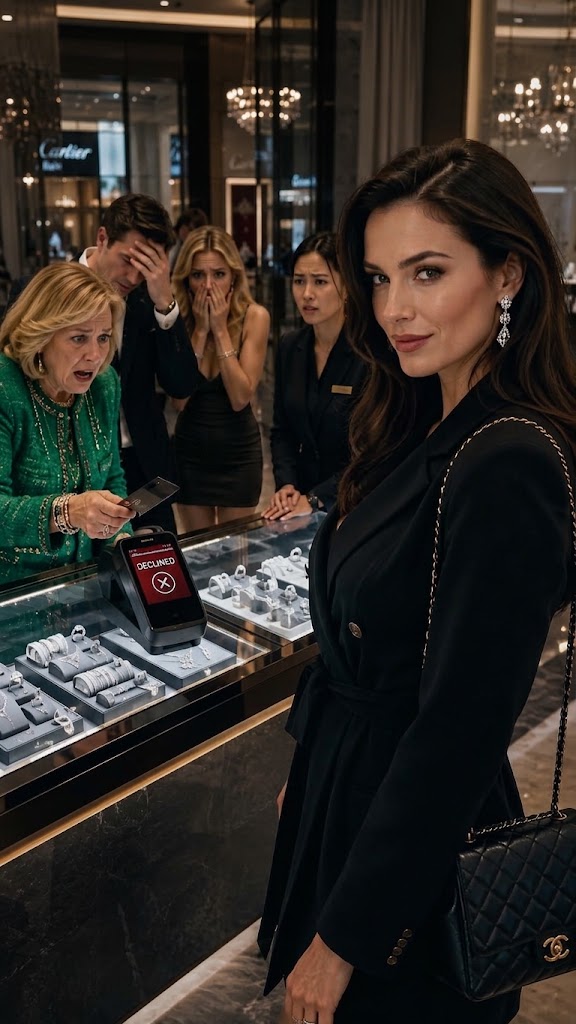
At exactly 10:00 AM, the escrow officer, a sharply dressed woman wielding a brass point-of-sale terminal, approached the mahogany desk. “Everything is in perfect order, Mr. Caldwell. We just
need to process the initial earnest money deposit to secure the deed. Three hundred thousand dollars, as discussed.”
Julian nodded with practiced nonchalance. He slid the heavy, metal obsidian card from his leather wallet and handed it over. Aubrey leaned in, her eyes shining with predatory delight.
The officer inserted the chip. A sharp beep pierced the hushed ambiance of the room.
The screen blinked. PROCESSING. Then, it flashed an angry, glowing crimson. TRANSACTION NOT AUTHORIZED.
The officer frowned, her professional mask slipping for a fraction of a second. “Apologies, sir. Sometimes these high-limit chips can be temperamental. Let me try the magnetic stripe.”
She swiped it. Beep.
INVALID TENDER.
The triumphant smile on Aubrey’s painted lips began to curdle. Margaret scoffed loudly, waving a hand. “Your machine is clearly defective. Julian, just give her your other black card.”
A sheen of cold, clammy sweat broke out across Julian’s forehead. His hand trembled microscopically as he produced the second card. He thrust it into the machine himself.
Beep.
TRANSACTION DECLINED.
The oxygen in the room seemed to evaporate. Three other affluent couples browsing floor plans across the gallery paused, their eyes subtly darting toward the unfolding spectacle. The broker
cleared his throat, the sycophantic warmth draining from his voice. “Sir… do you perhaps have a wire routing number we could use instead?”
Julian swallowed, his throat clicking audibly. He dug into his wallet for the third and final card. “This one. This one is the primary business account. It will clear.”
The escrow officer took it with extreme hesitation. She tapped it against the NFC reader.
Beep.
The terminal didn’t just decline. It emitted a shrill, dual-tone error code. The officer read the digital readout, her eyes widening. When she looked back up at Julian, her voice was stripped of all
customer-service deference.
“Mr. Caldwell, the terminal is stating that this card has been locked. Furthermore, it says the primary account holder has reported this physical card as unauthorized.”
“That is unequivocally impossible!” Margaret shrieked, her voice shattering the quiet luxury of the room. “My son owns a multi-million-dollar tech firm! Call your VIP liaison at the bank
immediately. Put them on speakerphone. Now!”
The broker, clearly eager to resolve the public humiliation, dialed the priority routing number for Vanguard Trust and placed the heavy desk phone on speaker.
A crisp, automated voice gave way to a human representative. “Vanguard Trust Elite Services, this is Marcus. How may I assist you?”
The broker explained the situation. Marcus tapped away at his keyboard. The silence in the room was so profound you could hear the tick of the Rolex on Julian’s wrist.
“Ah, I see the issue,” Marcus’s voice echoed through the speaker. “I’m looking at the accounts ending in 4492 and 8810. Sir, those cards are completely deactivated.”
Julian leaned over the desk, his voice a frantic hiss. “Deactivated? By who? I am the CEO of this company!”
Marcus remained impeccably polite, yet entirely lethal. “I apologize, sir, but you are listed solely as a supplementary authorized user on these accounts. The primary account holder, Ms. Claire
Hayes, executed a total revocation of all your privileges three days ago. Per her instructions, you no longer have any access to this credit facility.”
The words hung in the air, heavy and suffocating as a shroud.
Margaret’s designer sunglasses slipped from her fingers, clattering onto the mahogany desk. She turned her head slowly, her face entirely devoid of blood, and stared at the son she had
worshipped. “Primary account holder? Julian… you don’t own these accounts?”
Julian’s mouth opened, but only a pathetic, raspy breath escaped.
Aubrey took a step backward, physically recoiling from him as if he had suddenly manifested a contagious disease. “Julian,” she whispered, her voice laced with venomous realization. “If Claire’s
name is on the money… what exactly do you have?”
Chapter 5: The Ledger of Sins
The drive back to the city was a masterclass in psychological torture. The oppressive silence inside the town car was absolute. Margaret stared out the tinted windows, her manicured nails digging
into the leather of her Birkin bag until her knuckles turned translucent. The terrifying mathematics were finally aligning in her mind. The lifestyle she had aggressively flaunted for seven years was
a hollow theatrical production, bankrolled entirely by the woman she had practically bullied into signing divorce papers.
The moment Julian pushed open the front door of their suburban illusion, his smartphone erupted.
He stared at the caller ID. Lexus Financial. He answered it with the trepidation of a man stepping onto a landmine.
“Mr. Caldwell, this is a courtesy alert. The balloon payment on your mother’s SUV lease bounced this morning. If funds are not routed within forty-eight hours, we will initiate repossession
protocols.”
He hung up, but the screen immediately flared to life again. Zales Diamond Credit.
“Sir, the financing installment for the two-carat engagement ring is severely past due.”
Before he could even process the humiliation of financing a ring he claimed was a bespoke cash purchase, a third call broke through. It was a vicious commercial debt collector, informing him that
without Claire’s automated drafts, his LLC’s office lease was in default.
Julian’s knees buckled. He collapsed onto the pristine white sofa, burying his face in his hands. The house of cards hadn’t just fallen; it had incinerated.
Margaret stood in the foyer, watching her son unravel. She walked into his home office, a room she rarely entered, driven by a morbid, desperate curiosity. She began pulling open drawers,
searching for any shred of evidence that her son wasn’t a complete fraud.
In the bottom drawer of his filing cabinet, hidden beneath old tech manuals, she found a battered Nike shoebox.
She opened it. Inside was a meticulous, handwritten ledger. It was Claire’s handwriting. Margaret’s eyes scanned the columns. Date: Oct 14 – Transferred $40,000 to Julian Corporate to prevent
payroll default. Date: Dec 2 – Paid Margaret’s out-of-pocket rheumatologist bill: $3,200. Date: March 15 – Covered LLC commercial mortgage: $8,500.
Beneath the ledger was a piece of personalized stationery. The ink was faded, dated five years ago. It was in Julian’s handwriting.
Claire, I know you just liquidated your retirement fund to save my company from bankruptcy today. I don’t deserve you. You are the only reason I am surviving. I swear to God, when I make it big, I
will spend the rest of my life worshiping you for carrying this burden.
Margaret read the letter twice. Her hands began to shake so violently the paper fluttered like a dying moth. She sank to the floor, her back against the cold filing cabinet, and finally wept. She wept
for her own repulsive arrogance. She wept for the brilliant, silent daughter-in-law she had treated like a peasant.
Later that evening, Aubrey descended the staircase. She had traded her silk dress for designer sweatpants, dragging a massive Louis Vuitton trunk behind her.
Julian looked up from the sofa, his eyes bloodshot. “Aubrey, please. Just give me a month. I can restructure the company debt. I can get a bridge loan.”
Aubrey paused at the door, looking at him not with anger, but with profound disgust. “It’s not just the insolvency, Julian. It’s the sheer scale of the lie. You didn’t just lie to me; you lied to yourself.
You let that woman bleed herself dry so you could play at being a king. You’re not a CEO. You’re a parasite.”
She opened the door and walked out into the Chicago night. Julian didn’t chase her. When the facade shatters, there is nowhere left to hide.
He pulled out his phone and frantically dialed my number.
The number you have reached is unavailable.
I had blocked him on every conceivable platform. But Julian’s desperation was a starving animal, and I knew it was only a matter of time before it drove him to my doorstep.
Chapter 6: Ashes and Ascensions
Two weeks later, the receptionist at my corporate tower buzzed my office.
“Ms. Hayes? There is a Julian Caldwell in the main lobby requesting five minutes of your time. Security is standing by to escort him out if you prefer.”
I paused, looking at my reflection in the polished glass of my monitor. “No need for security, Brenda. Tell him I’ll be down in a moment.”
I descended in the glass elevator. The lobby buzzed with the frantic energy of morning commerce. Julian was standing near the artisanal coffee kiosk. The transformation was startling. His bespoke
suit was gone, replaced by an ill-fitting, off-the-rack blazer. His arrogance had evaporated, leaving behind a hollowed-out, exhausted man.
I approached him, my demeanor pleasant but utterly impenetrable. “Julian.”
He flinched at the sound of his name. “Claire. Thank you… thank you for coming down.”
I gestured to a secluded alcove with high-backed leather chairs. We sat. He pulled a manila envelope from his jacket and slid it across the glass table.
“I sold my watch,” he rasped, his voice rough. “And the car. I liquidated the LLC’s remaining hardware. There’s a cashier’s check in there for eighty thousand dollars. I know it doesn’t even begin to
cover what I drained from you over the years, but… I need you to have it.”
I looked at the envelope. I didn’t touch it. “The settlement was finalized, Julian. Legally, you owe me nothing.”
“Morally, I owe you everything,” he whispered, a tear finally breaching the levee and tracking down his cheek. “I thought you’d always be there to catch me. I got so drunk on the illusion of my own
success, I forgot you were the one writing the script. I am so deeply, deeply sorry.”
I leaned back, resting my hands in my lap. “Julian, if I cared about the capital, I would have pursued forensic accounting during discovery and ruined you in court. I didn’t leave because of the money.
I left because a marriage cannot survive when one person is building a life, and the other is merely siphoning it.” I gently pushed the envelope back toward him. “Use this to pay off Margaret’s
medical debts. Consider it my final severance package.”
He stared at the envelope, utterly broken. “If I could rewind the clock… if I had just been honest… would you still have married me?”
I offered him a small, melancholic smile. “I would have loved the man I met at that tech summit, yes. But I would never again set myself on fire just to keep him warm.”
I stood up, smoothing the front of my blazer. “Goodbye, Julian.”
I walked back to the elevators, leaving him sitting in the ashes of his own hubris.
Three days later, I agreed to meet Margaret at a quiet tea parlor near Millennium Park. She looked incredibly frail, stripped of her haughty armor. When I sat down, she reached across the table, her
hands trembling as she grasped mine.
“Claire… I am so sorry. I was blind. I was arrogant. I cashed out my pension to keep Julian out of bankruptcy court. We have nothing left but reality.” She wept openly, the tears of a woman who had
finally realized the price of her own vanity.
I didn’t pull my hands away, but I didn’t offer false hope either. “Margaret, some glass, once shattered, can never hold water again. But I harbor no hatred for you.”
Before I left, I placed a familiar pharmacy bag on the table. “Your joint supplements and daily vitamins. I prepaid a year’s subscription to be delivered to your door. Take care of your health,
Margaret.”
I walked out into the brisk wind, feeling a profound, weightless closure.
A year later, the conglomerate threw a massive gala at the Drake Hotel to celebrate a record-breaking fiscal year. Standing on the stage in a sleek navy gown, I accepted the award for Executive of
the Year. As the ballroom erupted into applause, I looked out at the sea of faces and felt an immovable sense of pride. I hadn’t just survived; I had thrived.
The following morning, I stood on the balcony of my penthouse, a cup of Earl Grey warming my hands. The Chicago skyline sparkled under a fresh layer of winter snow.
If anyone were to ask me what my greatest victory was, I would tell them it wasn’t the day I locked the black cards, nor was it the day I humiliated my ex-husband. My greatest victory was the
terrifying, beautiful moment I realized that my loyalty was a luxury brand, and it was time to stop offering it at a discount to people who couldn’t afford the emotional price tag.
I took a sip of my tea, turned my back to the past, and walked back inside to conquer the rest of my life.