It’s still hard for me to tell this without my throat closing up. I hadn’t seen Sarah in almost three years, not since
the divorce. We didn’t end things over infidelity or some dramatic scandal. Our relationship died slowly,
somewhere between meetings, exhaustion, stupid arguments, and increasingly longer silences. One day we signed
the papers, shook hands almost like strangers, and went our separate ways. I stayed in Chicago, up to my neck in a
construction company I had built from the ground up. Sarah moved to Miami and started working for an
architectural firm. We occasionally exchanged birthday messages, polite and brief, the kind of messages people
send when they once loved each other but no longer know how to speak honestly. I told myself I was over her. I
even believed it. Then my company won a major contract in Miami. I was supposed to spend four days there
negotiating with a development group that wanted us to build a luxury residential complex near the waterfront. I
flew down on a Tuesday afternoon, checked into a hotel, and went directly into meetings. I wasn’t thinking about
Sarah. Not even once. At least that’s what I told myself. Wednesday morning, I walked into the client’s conference
room and saw her sitting at the far end of the table. My heart stopped. She looked almost exactly as I
remembered, but somehow different. Her hair was shorter. She wore a dark blue blazer and had a folder open in
front of her. She looked up. Our eyes met. For several seconds, neither of us moved. Then she whispered my name.
“Daniel?” I nodded. “Hi, Sarah.” The room suddenly felt too small. The development group’s project manager
introduced her as the architect overseeing several aspects of the project. Apparently, she had been assigned to
the project months earlier. Neither of us had known the other would be there. We spent the next three hours
discussing floor plans, timelines, permits, materials, and budgets while pretending we weren’t sitting across from
the person who had once slept beside us every night. During lunch, she found me alone near the elevator. “Are you
okay?” she asked. “Yeah.” “You look like you’ve seen a ghost.” I smiled faintly. “Maybe I have.” She looked down. “I
didn’t know you’d be here.” “Neither did I know you’d be here.” “How long are you staying?” “Friday.” She nodded.
“I’m here through Saturday.” There was a pause. Then she said, “Would you like to have dinner?” I should have said
no. I knew that. I should have thanked her and gone back to my hotel. Instead, I said, “Sure.” We met at a quiet
restaurant that evening. At first, we talked about safe things. Work. Chicago. Miami traffic. The weather. Then she
asked the question neither of us had wanted to ask. “Are you seeing anyone?” I shook my head. “You?” “No.” “Three
years,” I said. “Yeah.” She looked at her glass. “I thought you’d be remarried by now.” “I thought you would too.” She
smiled sadly. “Maybe we’re both worse at this than we thought.” Dinner lasted three hours. We talked about our
marriage for the first time without blaming each other. We talked about the mistakes we’d made. She admitted
she had felt invisible toward the end. I admitted I had buried myself in work because I was terrified of failing
professionally and emotionally. She told me she had hated me for leaving her emotionally long before I left
physically. I told her I had hated myself for knowing exactly what was happening and not stopping it. There were
tears. There was laughter. There were long silences that didn’t feel uncomfortable. When we left the restaurant,
she looked at me. “Do you ever wonder what would have happened if we’d tried harder?” “Every day,” I admitted.
She looked away. “Me too.” We walked along the waterfront. The air was warm, and the city lights reflected across
the water. At some point, she took my hand. I didn’t pull away. Neither did she. We ended up at her apartment. I
remember standing outside her door, knowing exactly how dangerous that moment was. “Sarah,” I said. “We don’t
have to do this.” She looked at me. “I know.” “We can stop.” “I know.” “Then why aren’t we?” She stepped closer.
“Because for the first time in three years, I don’t want to run.” I kissed her. That night, we crossed a line we had
spent three years pretending no longer existed. I won’t describe the details. What matters is what happened
afterward. We fell asleep beside each other. For a few hours, it felt like the divorce had never happened. Then,
sometime before dawn, I woke up. The room was dark. Sarah was asleep beside me. I got up to get water, and
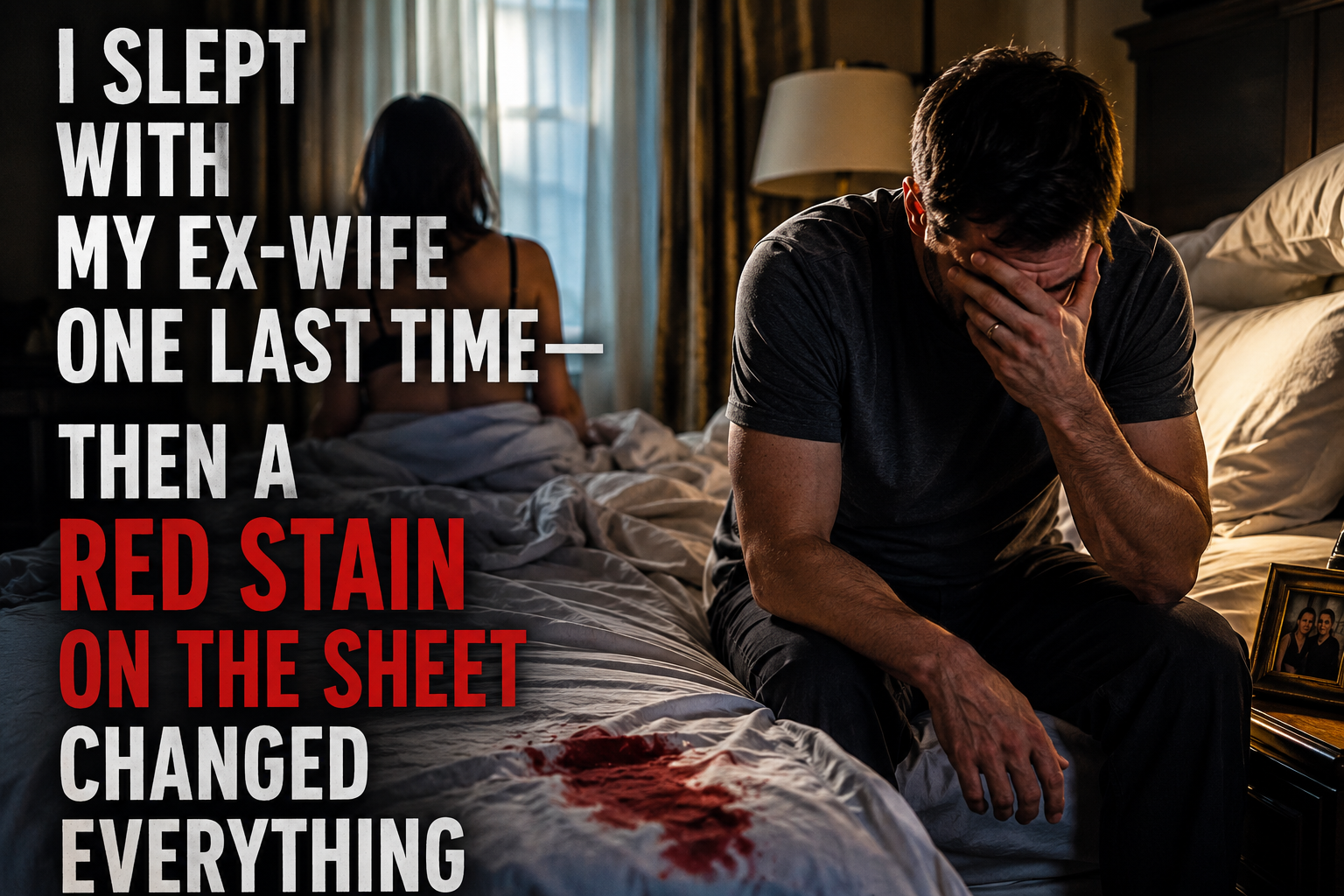
that’s when I noticed the sheet. There was a small red stain near her side of the bed. I froze. “Sarah?” She woke
immediately. Her eyes went to the sheet. The color drained from her face. “Oh no.” “Are you hurt?” “I don’t know.”
She sat up carefully. Her breathing became shallow. I turned on the bedside lamp. There wasn’t much blood, but
enough to frighten both of us. “Should we go to a hospital?” I asked. She shook her head. “Maybe it’s nothing.”
“Sarah.” “Daniel, please.” She pressed a hand against her abdomen. “I’ve been having pain lately.” “What kind of
pain?” She didn’t answer. “How long?” “A few weeks.” I stared at her. “Why didn’t you tell me?” She gave me a tired
smile. “You weren’t exactly in my emergency contact list.” I didn’t laugh. She finally agreed to see a doctor. At the
urgent care clinic, they ran tests. The doctor told us they couldn’t determine the cause immediately but
recommended follow-up with a specialist. Sarah seemed strangely anxious. On the drive back, she stared out the
window. “What aren’t you telling me?” I asked. “Nothing.” “You know I can tell when you’re lying.” “You haven’t
known me in three years.” “I still know you.” She turned toward me. “That’s exactly what scares me.” We spent the
rest of the morning together. She refused to let me cancel my meetings. She insisted it was probably nothing. I
returned to Chicago on Friday. We said goodbye at the airport. She hugged me longer than necessary. “This was a
mistake,” she whispered. My chest tightened. “Do you regret it?” She pulled back. “No.” “Then why call it a
mistake?” “Because I don’t know what it means.” “Neither do I.” She touched my face. “That’s the problem.” Then
she walked away. For the next month, we barely spoke. A few texts. A couple of phone calls. Nothing substantial. I
buried myself in work again. Then, one Thursday morning, my phone rang. The number was from Miami. “Mr.
Carter?” “Yes.” “I’m calling from Jackson Memorial Hospital.” My stomach dropped. “Is this about Sarah?” There
was a pause. “Yes.” I stood up so quickly my chair rolled backward. “What happened?” “She’s been admitted. She
listed you as an emergency contact.” “What’s wrong?” “I think it’s best if you come to the hospital.” I booked the
next flight. During the entire trip, my mind replayed that morning. The red stain. Her fear. The way she’d pressed
her hand against her abdomen. When I arrived at the hospital, a doctor met me. “Are you Daniel Carter?” “Yes.”
“Sarah has been diagnosed with a serious medical condition.” My mouth went dry. “What condition?” He explained
that Sarah had been experiencing internal bleeding connected to a reproductive health problem that required
further evaluation and surgery. There were complications, and they needed to determine whether the condition
was benign or something more serious. I barely heard the rest. “Can I see her?” “She’s resting.” “Please.” When I
entered the room, Sarah looked tiny beneath the white blankets. She smiled when she saw me. “You came.” “Of
course I came.” “I didn’t want to call you.” “Why?” “Because I didn’t want you to feel responsible.” “I don’t.” She
looked away. “There is something else.” My heart started pounding. “What?” She took a breath. “The doctors found
a pregnancy.” I stared at her. “What?” “I’m pregnant.” I couldn’t speak. She continued, “It’s early. Very early.” My
mind immediately returned to that night. “Sarah…” She nodded. “Yes.” “Are you sure?” “The tests are clear.” I sat
beside her. “Is it mine?” She looked almost offended. “Yes.” I lowered my head. “Okay.” She reached for my hand.
“Daniel, there’s more.” I looked up. “The pregnancy is complicated. They think the bleeding may be connected to it.
They don’t know yet whether I can carry it safely.” Suddenly the entire room felt unbearably quiet. “What do you
want?” I asked. Tears filled her eyes. “I don’t know.” “Whatever you decide, I will support you.” “You don’t have to.”
“Yes, I do.” She squeezed my hand. “You don’t understand. This wasn’t supposed to happen.” “Neither was our
divorce.” She laughed through tears. “That’s not funny.” “I know.” For the next several days, I stayed in Miami. Sarah
underwent additional tests. The doctors discovered that the bleeding was caused by a condition that had gone
untreated for too long. Surgery was recommended. But because of the pregnancy, every decision became more
complicated. We sat together in hospital rooms discussing possibilities neither of us had ever imagined. One
evening, Sarah said, “I was going to tell you I was pregnant before the hospital called.” “Why didn’t you?” “Because I
was scared.” “Of me?” “Of what it would mean.” “It means we’re going to have a child.” She started crying. “And if I
lose the pregnancy?” “Then we’ll face that together.” “What if I don’t?” “Then we’ll face that together too.” She
looked at me. “What if we can’t be parents together?” I didn’t have an answer. The truth was, I didn’t know if we
could be married again. I didn’t know if we should. I didn’t even know whether the relationship we had
rediscovered that night was love or nostalgia. But I knew one thing. I wasn’t going to abandon her. The doctors
performed a procedure to control the bleeding and advised strict monitoring. For several weeks, the pregnancy
remained uncertain. Every appointment became a mixture of hope and terror. Then came the ultrasound that
changed everything. The doctor turned the monitor toward us. A tiny flicker appeared on the screen. A heartbeat.
Sarah covered her mouth. I reached for her hand. Neither of us spoke. We cried. That tiny heartbeat didn’t solve
our problems. It didn’t repair our marriage. It didn’t erase the reasons we had divorced. But it gave us something
neither of us had expected: a reason to stop running. We returned to Chicago together temporarily because my
work was there and Sarah could continue medical treatment with specialists. We didn’t move back in together
immediately. Instead, we rented a small apartment near the hospital where she could rest. We became
roommates, co-parents, and eventually something more complicated. There were arguments. Old habits returned.
I still worked too much. Sarah still shut down when she was afraid. We learned quickly that a baby couldn’t
magically fix a broken marriage. If anything, the pregnancy exposed every crack. One night, she screamed, “You
don’t get to decide that we’re a family just because I’m pregnant!” I shouted back, “And you don’t get to decide I’m
only useful when you need me!” We both went silent. Then Sarah began crying. “This is exactly why we failed.” I sat
down. “Maybe.” She wiped her face. “We don’t know how to do this.” “Then we’ll learn.” “What if we can’t?” “Then
we’ll still be good parents.” That conversation became the beginning of our second chance. We started counseling.
Not because we were certain we wanted to reconcile, but because we wanted to learn how to communicate
without destroying each other. The counselor asked us why we had divorced. Sarah said, “We stopped being
partners.” I said, “We stopped seeing each other.” The counselor asked what had brought us back together. Neither
of us answered immediately. Finally, Sarah said, “Fear.” I added, “Love.” She looked at me. “Maybe both.” Our
daughter was born eight months later. Her name was Emma. She arrived early but healthy enough to avoid
intensive complications. When I first held her, I couldn’t stop crying. Sarah was exhausted and smiling. “She’s
beautiful,” I whispered. “She looks like you.” “Poor thing.” We laughed. For the first time in years, we laughed
without sadness underneath it. We didn’t immediately remarry. We wanted to be certain. We spent another year
rebuilding trust. I changed how I worked. I stopped bringing my laptop to dinner. I learned to come home before
our daughter went to bed. Sarah learned to tell me when she was overwhelmed instead of disappearing into
silence. We argued about ordinary things instead of buried resentments. We became friends again. Then one
night, almost two years after the hospital, Sarah and I sat on the balcony of our apartment while Emma slept
inside. “Do you remember the morning of the red stain?” Sarah asked. I nodded. “I thought that night was the
biggest mistake of my life.” “You told me it was.” “I was wrong.” She looked at me. “It wasn’t a mistake.” “No.” “It was
terrifying.” “Yes.” “Complicated.” “Definitely.” She smiled. “But not a mistake.” I took her hand. “Do you want to try
again?” She looked at me for a long time. “Marriage?” “Life.” Her eyes filled with tears. “Yes.” We married again six
months later. We didn’t have a huge ceremony. Just family and a few close friends. We wrote our own vows. Mine
was simple. “I can’t promise I’ll never fail you again. But I can promise I won’t stop trying to see you.” Sarah’s voice
shook when she said hers. “I don’t want the people we were. I want the people we’re becoming.” We kept our
original wedding rings but added a small engraving inside them. “Second chances require first truths.” Years
passed. Emma grew into a curious, stubborn, funny child who loved drawing pictures of our family. Sometimes she
asked why Mom and Dad had two wedding anniversaries. We told her the truth in a way she could understand.
“Sometimes grown-ups make mistakes,” Sarah would say. “But they can learn.” Emma would nod seriously. “Like
when I spilled juice?” “Exactly,” I’d say. “Except our mistakes cost much more than juice.” Sarah would elbow me.
“Daniel.” I’d laugh. Our family wasn’t perfect. No family is. Sarah’s medical condition required monitoring for years.
There were appointments and medications and moments when old fear returned. My company went through
difficult periods. We had financial stress. We disagreed about parenting. But we talked. That was the difference.
We didn’t let silence become the language of our marriage again. Occasionally, I thought about the man I had been
before the divorce. He had believed providing money was the same as providing love. He had believed working
harder was always the answer. He had mistaken responsibility for intimacy. Sarah had her own mistakes. She had
believed shutting down would protect her from disappointment. She had confused independence with strength.
Together, we had learned that love isn’t sustained by grand gestures. It’s sustained by ordinary attention.
Listening. Showing up. Saying you’re sorry. Asking what the other person needs. And refusing to disappear when
things become difficult. Ten years after that business trip, I returned to Miami for a conference. I walked past the
restaurant where Sarah and I had eaten dinner that night. I stopped outside. The same waterfront lights were
reflected in the water. I called her. “Guess where I am?” “Miami?” “How did you know?” “Because you sound
sentimental.” I laughed. “I’m outside the restaurant.” There was a pause. “The one from that trip?” “Yes.” “Are you
remembering?” “Everything.” “Come home.” “I’m coming.” When I returned to Chicago, Sarah was waiting at the
airport with Emma. Emma was holding a sign that said, “Welcome Home, Dad.” Sarah smiled at me. I hugged both
of them. As we walked toward the car, I looked at my wife. “You know something?” “What?” “That trip changed
everything.” She squeezed my hand. “It almost destroyed everything.” “True.” “But it gave us Emma.” “And a second
chance.” She smiled. “Don’t romanticize it too much.” “Why?” “Because our second chance took a lot of work.” I
laughed. “Fair enough.” She kissed my cheek. “Still worth it?” I looked at her, then at our daughter. “Every day.” I
sometimes wonder what would have happened if I hadn’t gone to Miami. If I had stayed in Chicago. If Sarah hadn’t invited me to dinner. If we hadn’t crossed that line. If there hadn’t been that red stain on the sheet. If the hospital
hadn’t called. If the doctors hadn’t found the pregnancy. If the tiny heartbeat hadn’t appeared on that screen. Life
is made of thousands of decisions we don’t realize are decisions until much later. That night could have remained a
regrettable mistake between two divorced people. Instead, it became the doorway to a life neither of us had
planned. But I don’t believe the universe gave us a second chance because we deserved one. I believe we created it through the choices we made afterward. The hospital didn’t save our marriage. The baby didn’t save our marriage.
The fear didn’t save our marriage. We did. We chose honesty when lying would have been easier. We chose
counseling when pride told us we didn’t need it. We chose patience when anger was more familiar. We chose to
become partners instead of simply calling ourselves husband and wife. And that distinction changed everything.
There is one thing I never told Sarah until many years later. On the morning after we first slept together again,
while she was still asleep, I had stood beside the bed staring at that red stain. I had been terrified. I thought it
meant something terrible had happened. I thought it was a warning. I thought the universe was telling me I had
made a mistake. I was wrong. It wasn’t a warning. It was the beginning of a story I couldn’t possibly understand
yet. When I finally told Sarah that years later, she laughed and cried at the same time. “You know,” she said, “I
thought the exact same thing.” “And now?” I asked. She looked toward the living room where Emma was doing
homework. “Now I think some beginnings look like endings because we don’t know what comes next.” I kissed her
forehead. “That’s pretty good.” “I had ten years to think about it.” We sat together in silence. Not the painful
silence from our first marriage. This was different. Comfortable. Safe. The kind of silence shared by two people
who no longer need to fill every empty space with words. I still think about our divorce sometimes. I don’t pretend
it didn’t happen. It mattered. It changed us. Maybe we needed those three years apart to become the people
capable of staying together. Maybe if we had tried to reconcile immediately, we would have repeated the same
mistakes. The distance forced us to grow separately before we could grow together. Sarah once told me that the
strangest thing about our story was that she didn’t believe our second marriage was a continuation of the first.
She believed it was something entirely new. I agree. The first marriage was built on young love, ambition,
expectations, and assumptions. The second was built on knowledge. We knew exactly how badly we could hurt
each other. We also knew exactly what we could lose. That knowledge made us more careful. More grateful. More
honest. Today, when people ask me how long I’ve been married, I usually smile and say, “About twenty years, with a
three-year intermission.” They laugh. Sometimes they ask why we divorced. I tell them the truth. “We stopped
talking.” They usually expect something more dramatic. Infidelity. Money. Betrayal. Something they can
understand. But sometimes the most destructive thing isn’t a single terrible event. Sometimes it’s a thousand
small silences. Sometimes people don’t leave because they stop loving each other. They leave because they forget
how to reach each other. Sarah and I were lucky. We were given a strange, painful, unexpected opportunity to try
again. But second chances aren’t magic. They are work. Every day. Every conversation. Every apology. Every time
you choose to stay present instead of retreating. Every time you look at the person beside you and remember that
they are not your enemy. They are someone trying to figure life out just like you are. Our daughter is now old
enough to know the full story. She once asked me, “Dad, were you scared when Mom got sick?” I said, “More than
I’ve ever been.” “Did you think she would die?” “Yes.” “What did you do?” I looked at Sarah. “I stayed.” Emma
nodded as if that were the most obvious answer in the world. “Good.” Then she went back to her homework. I
watched her for a moment. Children have a way of making complicated truths simple. When someone you love is
hurting, you stay. When you’ve made a mistake, you tell the truth. When something matters, you work for it.
When you’re given another chance, you don’t waste it. That’s what I learned in Miami. Not that sleeping with my
ex-wife was fate. Not that every broken relationship should be repaired. Not that every divorce deserves a
reunion. What I learned was that sometimes life forces you to confront the parts of yourself you’ve spent years
avoiding. That trip forced me to see the man I’d become. The hospital forced me to decide who I wanted to be. And
Sarah forced me to learn that love wasn’t something I could put on a calendar between meetings. It had to be lived.
When I look back now, the red stain on that sheet no longer represents fear. It represents the moment everything
changed. The moment I stopped running from my past and started taking responsibility for my future. I lost three
years with Sarah. I can never get those years back. But I gained something I never expected: a daughter, a second
marriage, and a wife who became my partner again not because we forgot our failures, but because we finally
learned from them. If you had told me on the morning of that business trip that I would return to Chicago with my
entire life changed, I wouldn’t have believed you. If you’d told me I’d become a father again at a time when I
thought that chapter of my life was over, I would have laughed. If you’d told me the woman I had once signed
divorce papers with would someday stand beside me at our second wedding, I would have thought you were crazy.
But life doesn’t ask whether you’re ready. Sometimes it simply opens a door. Sometimes that door leads
heartbreak. Sometimes it leads to healing. And sometimes, if you’re brave enough to walk through it honestly, it
leads somewhere you never imagined. Our story began with a marriage that quietly died. It continued with one
unexpected night. It almost ended with a hospital call. Instead, it became the beginning of a second life. And every
morning now, when I wake up beside Sarah and hear Emma moving around the house, I think about that
frightened man standing beside an unfamiliar bed in Miami, staring at a small red stain and wondering whether
he’d made the biggest mistake of his life. I wish I could go back and tell him one thing. “Don’t be afraid. You don’t
know the ending yet.” Because that night wasn’t the mistake I thought it was. The real mistake would have been
walking away again.