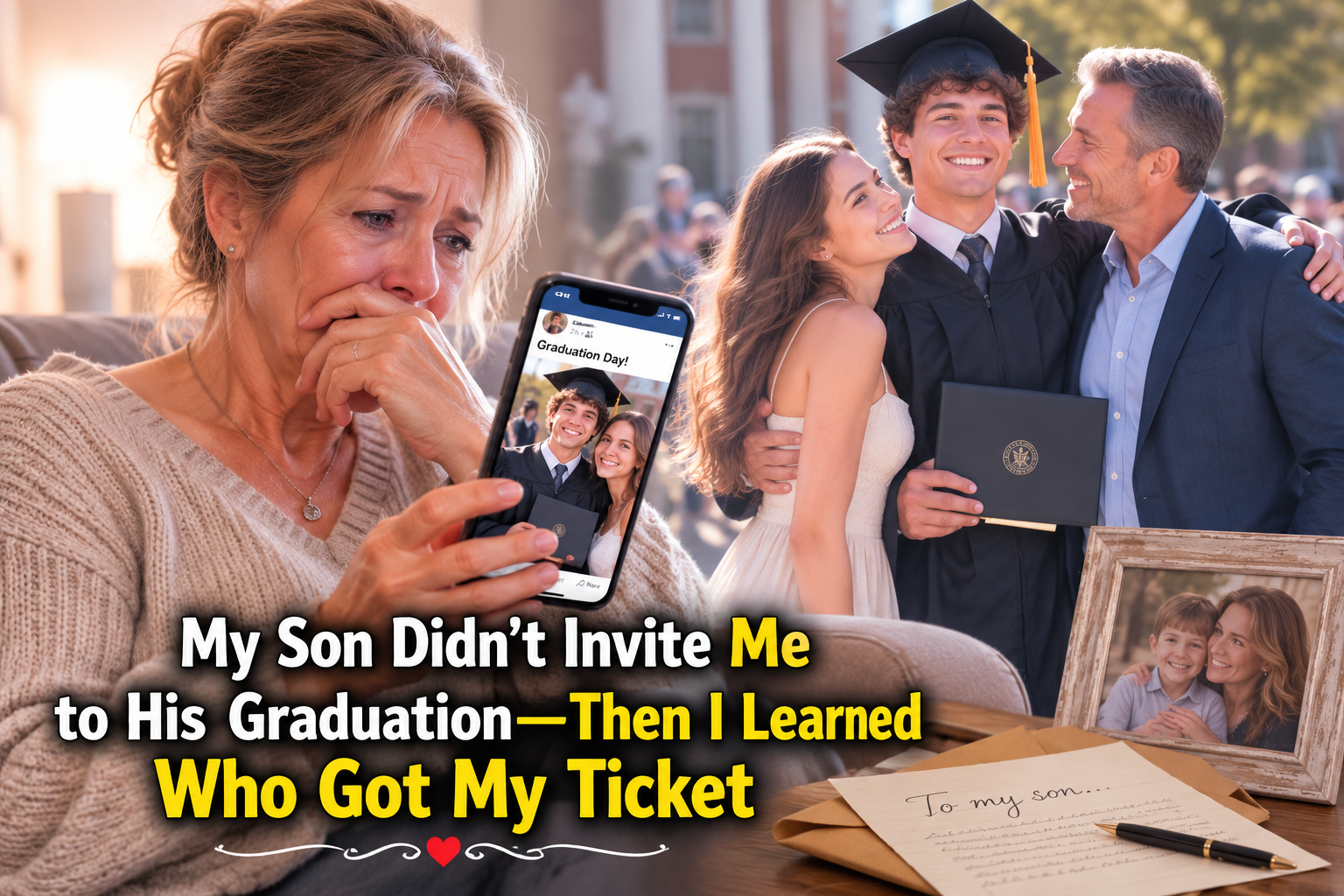
My son didn’t invite me to his college graduation. I found out through Facebook when someone else posted a photograph from the ceremony. There he was in his cap and gown, smiling proudly
beneath the bright afternoon sun, his girlfriend standing beside him with one arm wrapped around his shoulder. Behind them were rows of graduates and families holding flowers, balloons,
cameras, and enormous smiles. I stared at the photograph for nearly a minute before I understood what I was seeing. My son had graduated. My only child had graduated from college. And I wasn’t
there. I hadn’t missed the ceremony because of work. I hadn’t been sick. I hadn’t been told the date and forgotten. I simply hadn’t been invited. I zoomed in on the photograph, almost as though
there might be some explanation hidden in the pixels. Maybe I would see another family member standing behind him. Maybe there was another ceremony. Maybe I had misunderstood the date.
But there was my son, Daniel, twenty-two years old, smiling in his cap and gown, and I was looking at a moment I had spent four years helping him reach from the other side of a computer screen. I
put my phone down. Then I picked it up again. I looked at the photograph one more time. I had paid for four years of tuition. I had driven him to campus when he was a freshman because his car
wasn’t reliable. I had mailed care packages every month. I had worked overtime during holidays. I had skipped vacations. I had taken extra shifts when tuition increased. I had sat at the kitchen table
helping him fill out scholarship applications. I had stayed awake until two in the morning when he called crying because he thought he had failed his chemistry exam. I had celebrated every A, every
internship, every small victory. And now, when the moment finally came, I wasn’t there. My hands began shaking. I called him. He answered after several rings. “Hey, Mom.” His voice sounded
normal. That somehow hurt more. “Daniel,” I said, trying to keep my voice steady. “I saw a picture.” There was a pause. “What picture?” “Your graduation.” Silence. “Oh.” “You graduated today?”
“Yeah.” I swallowed. “Why didn’t you tell me?” Another pause. Then he said the words that would stay with me for years. “There were only two tickets.” Two tickets. I closed my eyes. “Two tickets?”
“Yeah.” “And you couldn’t give one to me?” “Mom…” “Who did you give them to?” He hesitated. “Dad.” I didn’t speak. His father. The man who had left when Daniel was six. The man who hadn’t paid a
dime of child support for most of my son’s childhood. The man who had missed birthdays, parent-teacher conferences, basketball games, broken bones, fevers, Christmas mornings, and countless
nights when Daniel asked me why his father didn’t want him. “Your dad?” I whispered. “Yeah.” “The man who left?” “Mom, please.” “The man who hasn’t paid for your education?” “It’s complicated.” I
laughed, but there was no humor in it. “Is it?” “I’ve been trying to rebuild things with him.” “I know.” “I thought you would understand.” I stared at the wall. “Understand what?” “That I wanted him
there.” I couldn’t breathe properly. “And you didn’t want me there?” “That’s not what I said.” “But that’s what you did.” He went quiet. “Mom, I love you.” “Then why wasn’t I there?” He couldn’t
answer. I waited. Finally, he said, “I didn’t think you’d want to make a big deal about it.” I felt something inside me break. “I would’ve stood outside the stadium just to see you walk across that stage.”
“Mom…” “I would’ve watched through a window if that’s what it took.” “I’m sorry.” “No,” I said softly. “You’re not.” He started to say something, but I hung up. I walked into my bedroom, closed the
door, and cried for an hour. Not the kind of crying that makes you feel better afterward. The kind that leaves you exhausted and hollow. I cried for every birthday cake I had made. Every tuition
payment. Every grocery bill. Every care package. Every night I had waited for him to come home. I cried because I had thought the graduation ceremony belonged to both of us in some strange way.
He had earned the degree, but I had helped carry the weight that made it possible. And suddenly I wondered whether I had imagined that connection. Around midnight, I stopped crying. I washed
my face, made tea, and sat at the kitchen table. My phone was still on the table. The graduation photograph was still open. I looked at my son’s face. He looked happy. That mattered. Even through
my pain, I couldn’t deny it. He looked happy. And if I loved him, I had to care about that too. I opened my laptop. I started writing a letter. I didn’t write what I was thinking at first. I wrote, “Dear
Daniel.” Then I stared at the blank page for almost ten minutes. I deleted the first sentence. Then I tried again. “I am not writing this to make you feel guilty.” I stopped. That was true. I didn’t want
guilt. Guilt would not give me back the ceremony. I continued. “I’m writing because I don’t want this moment between us to become something neither of us can repair.” I told him how I had found
out. I told him how it felt to see the photograph online. I told him that I understood there had only been two tickets. I told him that I understood he wanted his father there. But I also told him that I
wished he had been honest with me. I wrote about the years I had spent supporting him, but I tried not to turn those sacrifices into a bill he owed. “I never paid your tuition so that you would owe
me a seat,” I wrote. “I paid it because I was your mother and I wanted you to have opportunities I didn’t have.” Then I wrote the sentence that took me the longest. “What hurt wasn’t that you chose
your father. What hurt was that you made me feel like I was easy to leave behind.” I read it several times. Then I added, “I hope you had a wonderful graduation. I hope you are proud of yourself. I am
proud of you too, even while I’m hurting.” I signed it simply, “Love, Mom.” I sent it at 1:17 in the morning. I expected nothing. The next day, at 8:06 a.m., my phone rang. It was Daniel. I almost didn’t
answer. Then I did. There was silence. I could hear him breathing. Then he began crying. Not quiet tears. He was sobbing. “Mom.” I closed my eyes. “I’m here.” “I’m so sorry.” I didn’t say anything. “I
didn’t understand what I was doing.” “You wanted your father there.” “Yes.” “That’s okay.” “No, it isn’t.” “Daniel…” “Mom, you don’t understand.” His voice broke. “I gave Dad the other ticket because I
thought it might be my only chance to have him there.” “I know.” “I’ve been trying to rebuild things with him.” “I know.” “I thought if I gave him the ticket, maybe he’d finally feel like my dad.” I
swallowed hard. “I understand that.” “But I didn’t think about what it would mean for you.” I stared at the photograph on my desk. “That’s what hurt.” He cried harder. “He left when I was six. I spent
my whole childhood wondering why. And when he started calling again last year, I thought maybe I could fix it.” “You don’t have to fix what he broke.” “I wanted to.” “I know.” “He said he was proud of
me.” Daniel paused. “I wanted to hear that from him.” That sentence silenced me. Because suddenly I understood that the graduation wasn’t really about me. It wasn’t even entirely about his father.
It was about a little six-year-old boy who had been left behind and had spent sixteen years wondering why his father hadn’t stayed. Daniel had been trying to give that little boy something he never
had. Closure. Recognition. Maybe even love. I couldn’t be angry at him for wanting that. But I could still be hurt by how he handled it. “Did Dad pay for anything?” I asked gently. Daniel was quiet.
“No.” “Did he help you through college?” “No.” “Did he call when you were sick?” “No.” “Then why him?” “Because I wanted him to choose me this time.” I closed my eyes. That was the answer. I
understood it completely. For years, I had thought Daniel didn’t need his father because I had been enough. But children don’t think in terms of replacements. A mother cannot always fill the space
left by a father, just as a father cannot fill every space left by a mother. I had given Daniel everything I knew how to give. But there was still a hole I couldn’t fill. And when his father finally came
back, Daniel had reached into that hole with both hands. I said, “I’m glad you got to have that moment.” “But I wanted you there too.” “I know.” “I should’ve found another way.” “Yes.” He was silent.
Then he said, “Can I come home?” I looked around my quiet kitchen. “This is your home.” He came that evening. When I opened the door, he looked exhausted. He had changed out of his graduation
clothes, but he was still wearing the watch I gave him when he started college. He stepped inside and immediately hugged me. I held him tightly. For several minutes, neither of us spoke. Then he
whispered, “I’m sorry, Mom.” I said, “I know.” We sat at the kitchen table. He told me everything. His father had contacted him during his senior year. At first, Daniel didn’t respond. Then he agreed
to meet for coffee. His father apologized. He said he had been young, selfish, and afraid. He said leaving had been the biggest mistake of his life. Daniel wanted to believe him. They began seeing
each other. His father started calling every week. He sent birthday gifts. He talked about wanting to make up for lost time. Then graduation approached. The university had only issued two guest
tickets because the ceremony was being held in a smaller venue. Daniel had initially planned to give both tickets to me and his girlfriend, Emily. But his father asked if he could attend. Daniel
couldn’t say no. “I thought if I chose Dad,” he said, “maybe he’d understand that I wanted him in my life.” “And Emily?” I asked. “She told me to give her ticket to Dad.” I looked surprised. “She did?”
“She said I had been waiting my whole life for him to show up. She thought I deserved to have him there.” I felt a strange mixture of gratitude and sadness. “She sounds like a good person.” “She is.”
He looked at me. “But I should’ve told you.” “Yes.” “I was afraid you’d say something bad about him.” I shook my head. “I might have.” He smiled weakly. “Exactly.” “I would’ve told you I was worried.” “I
know.” “But I would’ve still wanted you to have your moment.” “I know.” We sat quietly. Then Daniel reached into his backpack and pulled out something. It was his graduation cap. He placed it on
the table. “I brought this for you.” I touched it. “Why?” “Because I wouldn’t have graduated without you.” I smiled through tears. “That’s not true. You did the work.” “But you helped me get there.”
“That’s different.” “Not to me.” He pulled a photograph from his bag. It was a picture of him standing outside the university after the ceremony. His father was beside him. Emily stood on the other
side. But Daniel had apparently asked a friend to take another photograph. It showed him holding his diploma and looking directly at the camera. On the back, he had written something. “For Mom,
who got me here.” I started crying again. He laughed softly. “You’re crying.” “I’m allowed.” “I know.” He hugged me. “I’m sorry.” Over the next few months, our relationship changed. Not dramatically.
Not overnight. We simply became more honest. Daniel started calling me without needing anything. He asked how my day was. He sent photographs from his new apartment. He invited me to his
first job celebration. He introduced me proudly to his coworkers as his mother. His relationship with his father continued, but it wasn’t the perfect reunion he had imagined. His father began
missing calls. He forgot plans. He disappeared for weeks. Eventually, Daniel realized that rebuilding a relationship didn’t mean pretending the past hadn’t happened. One evening, he called me.
“Mom, can I ask you something?” “Of course.” “Do you hate Dad?” I thought for a moment. “No.” “How?” “Because hating him would make me carry something that belongs to him.” “What does that
mean?” “He made his choices. I made mine. I don’t want his choices living inside me.” Daniel was quiet. “Do you think I was wrong to forgive him?” “No.” “Even after everything?” “Forgiveness is yours
to give. I don’t get to decide that for you.” “What if he hurts me again?” “Then you protect yourself.” “Would you forgive him?” I smiled sadly. “That’s not the question.” “Why?” “Because your father
doesn’t need my forgiveness to be your father. He needs to take responsibility for what he did.” Daniel thought about that. “You always make things complicated.” I laughed. “I’m your mother. It’s my
job.” Eventually, Daniel’s father came to me and apologized. It happened at Daniel’s apartment on Thanksgiving. We were all there. The first ten minutes were uncomfortable. Then he approached
me in the kitchen. “I owe you an apology,” he said. I continued stirring gravy. “For what?” “For leaving.” I looked at him. “You should tell Daniel that.” “I have.” “Good.” “But I owe you one too.” “Why?”
“Because you raised him when I didn’t.” I put the spoon down. “Yes, I did.” He swallowed. “I don’t know how you did it.” “Neither did I.” He gave a sad smile. “I was selfish.” “You were.” “I can’t change
that.” “No.” “But I want to be better now.” “Then be better.” He nodded. “That’s what I’m trying to do.” I didn’t forgive him that day. Not completely. But I stopped needing him to suffer for what he
had done. There is a difference between forgiveness and forgetting. I would never forget the nights Daniel cried for his father. I would never forget the bills I paid alone. I would never forget the
first time my son asked me, “Mom, did Dad leave because he didn’t love me?” and I had to tell him, “No, honey. Sometimes adults make choices that have nothing to do with how much their children
are worth.” Those words had been difficult to say because part of me had wanted to tell him the truth: that his father had been selfish. But I knew a six-year-old child shouldn’t have to carry the
weight of an adult’s failure. So I carried it for him. Years later, I realized that perhaps that was what motherhood had been for me all along. Carrying things until my child was strong enough to carry
them himself. After graduation, Daniel moved to another state for his first job. The house became quiet. His bedroom remained mostly unchanged. I occasionally walked past it and smiled. The
graduation photograph stayed on my refrigerator. Not the Facebook photograph. The one Daniel had given me. The photograph where he stood holding his diploma. Every time I looked at it, I
remembered how much had changed between the day I found that first photograph online and the day he placed this one in my hands. I also learned something I wish someone had told me when I
was younger. Sometimes children hurt the people who love them most, not because they don’t love them, but because they are trying to heal wounds that existed long before they understood
them. Daniel wasn’t trying to replace me. He was trying to recover his father. Unfortunately, I became the collateral damage. That doesn’t mean my pain wasn’t real. It simply means his intention
wasn’t to destroy me. And once I understood that, I could begin healing too. Two years after Daniel’s graduation, I received an envelope in the mail. Inside was an invitation. “Please join us for the
opening of Carter & Sons Community Center.” I smiled at the name. Daniel had started a nonprofit with several friends to provide scholarships for students from single-parent families. The first
major scholarship was named after me. The invitation said, “The Maria Carter Scholarship Fund.” I called him immediately. “Daniel.” “Hi, Mom.” “What is this?” “You got the invitation.” “I did.” “Are
you coming?” “Of course I’m coming.” He laughed. “Good.” “Why didn’t you tell me?” “I wanted it to be a surprise.” “You learned nothing from graduation.” He laughed so hard I could hear him
struggling to breathe. “That’s fair.” At the ceremony, there were more people than I expected. Students, parents, teachers, donors. Daniel stood on a small stage and spoke about growing up with
one parent. He didn’t tell the whole story. He didn’t embarrass his father. He simply said, “I was raised by a woman who taught me that love isn’t measured by what you receive in return. She
worked so I could study. She sacrificed so I could dream. She never once made me feel like I owed her for it.” I looked down because I couldn’t stop crying. Daniel continued, “I used to think success
meant proving something to the people who doubted me. Now I think success means using what you have to make someone else’s road easier.” Then he called me onto the stage. I stood beside him.
He hugged me. The audience applauded. But this time, the applause didn’t hurt. It felt different. It felt like recognition. Not recognition for paying tuition. Not recognition for being a perfect mother.
Just recognition for loving my son through every complicated season of his life. Afterward, Daniel and I sat outside. “Mom,” he said, “do you ever think about my graduation?” “Sometimes.” “I’m still
ashamed.” “You don’t need to be.” “I hurt you.” “You did.” He nodded. “But you forgave me.” “I understood you.” “Is that the same thing?” I thought about it. “Not exactly.” “What’s the difference?”
“Forgiveness says, ‘I release you from the punishment I wanted you to carry.’ Understanding says, ‘I see why you did what you did.’ Sometimes you need both. Sometimes you only have one.” He
smiled. “Which one did you give me?” “Both.” He leaned his head against my shoulder, just like he had when he was little. “I love you, Mom.” “I love you too.” “Even when I’m stupid?” “Especially then.”
He laughed. “I deserved that.” We sat there watching the sun disappear. I thought about that Facebook photograph again. The picture that had once felt like proof that I had been forgotten. Now I
understood it differently. It was simply one photograph from one complicated day. It didn’t contain the whole story. It couldn’t show the years before it or the years after it. It couldn’t show the
tuition receipts in my filing cabinet. It couldn’t show the care packages. It couldn’t show the sleepless nights. It couldn’t show the conversations. It couldn’t show the love. A photograph can capture
a moment, but it cannot explain a life. And that was what I had forgotten that day. I had looked at one image and believed it told me what I meant to my son. It didn’t. Daniel had made a painful,
immature choice. He had chosen his father for a moment because he had spent his entire childhood wishing that man would choose him. I had been hurt because I had spent my entire life choosing
Daniel. But love isn’t a competition. There was never supposed to be a winner. Years later, when Daniel got married, he asked me to sit in the front row. There were plenty of seats, so there was no
question of tickets. Before the ceremony, he came into the room where I was waiting. “Mom,” he said. “You ready?” “I’m ready.” He looked nervous. “I have something for you.” He handed me a small
envelope. I opened it. Inside was a photograph from his college graduation. The same one he had given me years before. But this time, underneath his handwritten message, he had added another
sentence. “I finally understand that you were never asking for payment. You were asking to be remembered.” I looked at him. “You remembered.” He smiled. “I always will.” Then he hugged me.
“Come on. They’re waiting for us.” I followed him toward the door. “Daniel?” “Yeah?” “I’m proud of you.” He smiled. “I know.” And for the first time, I believed he really did. I had spent years thinking
motherhood meant giving everything without expecting anything back. And perhaps that was partly true. But I also learned that mothers are human. We have feelings. We can be hurt. We can feel
forgotten. We can need an apology. We can need reassurance. Loving a child doesn’t mean pretending their choices don’t affect us. It means learning how to tell the truth without turning love into a
weapon. That was what I had tried to do with my letter. I hadn’t written it to make Daniel feel guilty. I wrote it because I wanted him to know the truth about my heart. And that letter changed
everything. It opened a conversation we might otherwise have avoided for years. My son had gone to his graduation without me. I had discovered it through a photograph posted by someone else.
For a while, I thought that moment would always be the symbol of what I had lost. Instead, it became the moment that taught both of us how to communicate. Daniel needed to learn that chasing
the parent who left didn’t require abandoning the parent who stayed. I needed to learn that my son’s love wasn’t something I had to earn through sacrifice. And his father needed to learn that
returning to a child’s life doesn’t erase the years you were gone. We all had lessons to learn. None of us learned them perfectly. But we learned them together. And sometimes, when people ask me
whether I regret paying for my son’s college education after what happened, I smile. “No,” I tell them. “I didn’t pay for a seat at his graduation. I paid for his future.” That future belonged to him. He
was allowed to make mistakes in it. He was allowed to love people I didn’t trust. He was allowed to search for answers I couldn’t give him. And I was allowed to feel hurt without becoming bitter.
Those things can all be true at once. The last time I saw the original Facebook photograph, I didn’t cry. I simply looked at my son in his cap and gown and smiled. He looked happy. He looked proud.
And I realized that even though I hadn’t been standing beside him that afternoon, I had been there in every other way that mattered. I was in the late-night phone calls. I was in the care packages. I
was in the tuition payments. I was in the encouragement. I was in every moment he had almost given up but didn’t. I was part of the road, even if I wasn’t in the photograph. And maybe that’s what
being a mother really is. Sometimes you stand in the picture. Sometimes you stand behind the camera. Sometimes you stand miles away, hoping your child is safe. And sometimes, despite
everything you’ve done, your child makes a choice that breaks your heart. You cry. You hurt. You tell the truth. Then you decide whether love is bigger than the wound. For me, it was. My son didn’t
invite me to his college graduation. I thought that meant I wasn’t important. Years later, I realized something much more complicated and much more beautiful. I had never been forgotten. I had
simply been standing outside a photograph, while my son was trying to understand a part of himself. And when he finally turned around, I was still there. I had been there all along.