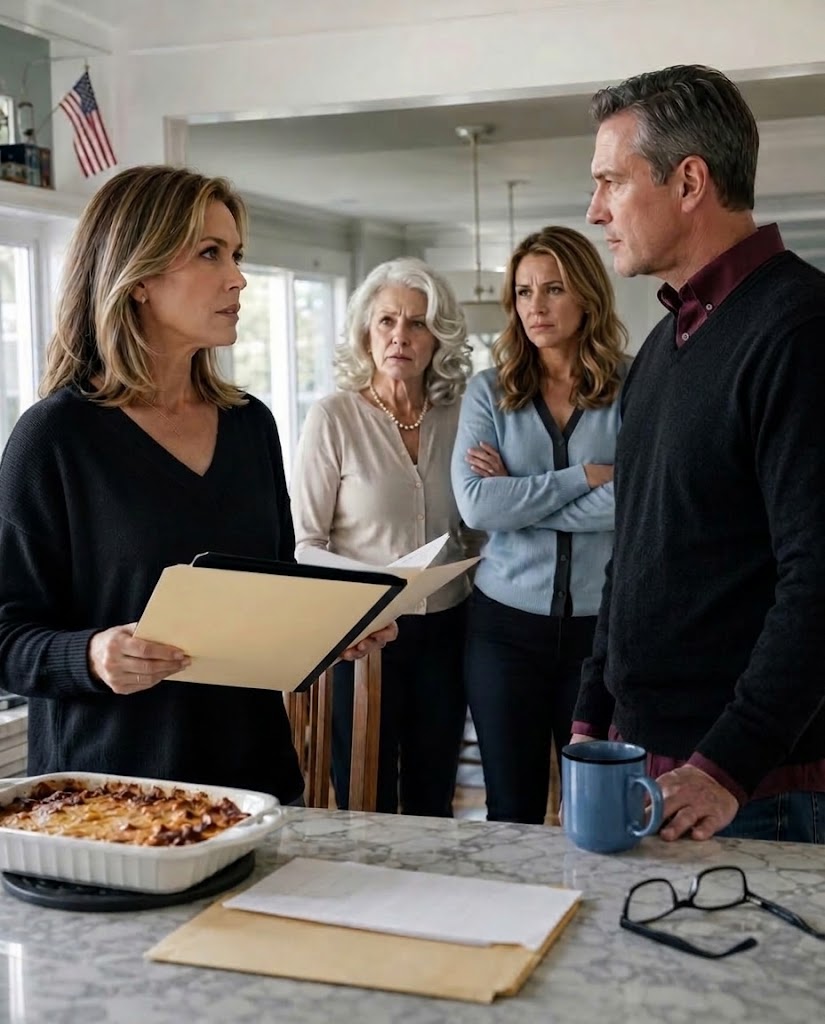
Three days after my father passed away, I walked into the kitchen at ten-thirty on a Wednesday morning and found my husband drinking coffee in his sweatpants.
I stopped in the doorway.
For most of our twenty-two-year marriage, Mark had left for work
before eight, travel mug in one hand and company phone in the other,
usually complaining about some distributor who had decided its problem
could not wait.
Seeing him at the kitchen table in the middle of a weekday felt
immediately wrong.
“Why are you home?”
Mark looked up from his laptop.
“Morning to you, too.”
“It’s Wednesday.”
“I know what day it is.”
For half a second, I assumed he had taken time off because of Dad.
Walter Hail had been gone barely seventy-two hours, and I had spent the
morning arguing with a florist about whether a man who considered
decorative pillows a personal insult would have wanted something called
Heavenly Garden at his funeral.
Then I noticed Mark’s company phone was gone.
“Did something happen at work?”
He closed the laptop.
“I quit.”
I stared at him.
“You what?”
“I resigned.”
“When?”
“Yesterday.”
He took another sip of coffee.
“Clare, don’t make it sound like I joined a cult.”
Normally I might have laughed. Mark had always been good at using
humor to soften uncomfortable conversations.
That morning, I didn’t.
“Why would you quit your job yesterday?”
He leaned back.
“Because I don’t see the point anymore.”
“The paycheck is usually the point.”
“You know what I mean.”
“No, Mark. I really don’t.”
He studied me, then said casually, “Why keep working? Your inheritance
is enough for both of us.”
The kitchen seemed to go silent.
Sympathy cards were stacked beside the toaster. Dad’s obituary was
open on my tablet. His final voicemail was still saved on my phone
because I could not bring myself to delete it.
My husband had apparently looked at all of that and seen retirement.
“What inheritance?”
Mark frowned.
“Come on, Clare.”
“No. Tell me.”
“Your dad sold Hail Mechanical for millions. His house is paid off. He had
investments. He barely spent anything.”
“How much do you think I’m getting?”
“I don’t know exactly.”
“Then how do you know it’s enough for you to stop working?”
He hesitated.
That bothered me more than the answer.
“Well, conservatively, it has to be a few million.”
Conservatively.
He had done the math.
I hadn’t.
I knew Dad had done well when he sold his commercial heating and
cooling company six years earlier. I knew he had investments because he
occasionally complained about his financial adviser using phrases like
“wealth preservation.”
But Dad and I had never discussed what I might inherit.
Mark reached across the table.
“Look, I’ve worked since I was twenty-two. I’m fifty-five. That’s thirty-
three years of quotas, airports, regional meetings, and clients calling on
Sundays because apparently air filters are a national emergency. Maybe
we finally get to enjoy our lives.”
I understood that part.
Mark had been exhausted for years. I had seen him come home from
business trips looking ten years older than when he left.
But understanding why someone wanted something did not make the
way they took it reasonable.
“You quit without talking to me.”
“I knew you’d worry.”
“That isn’t a defense.”
“I was going to tell you.”
“You are telling me. After you quit.”
He rubbed his forehead.
“Can we not do this right now?”
For one strange second, I nearly laughed.
Apparently, three days after my father’s death was an inappropriate time
to question the major financial decision Mark had made because my
father had died.
That evening, Mark’s mother and sister came over.
Diane brought lasagna. Melissa brought wine.
For the first twenty minutes, everything felt almost normal. We
discussed the funeral, the weather, Dad’s old friend flying in from Florida.
Diane even told a story about Dad refusing to replace a toaster because
“new ones have too many settings.”
Then Mark started spending my father’s money.
Diane mentioned another rent increase.
Mark leaned back and said, “Don’t worry about it, Mom. Once everything
clears, I’ll buy you a house.”
My fork stopped halfway to my mouth.
Diane blinked.
“Mark.”
“I’m serious.”
“Oh, honey, I couldn’t let you do that.”
Then almost immediately she added, “There are some nice little ranches
near Westerville.”
Melissa laughed.
“Mom already has a zip code.”
Diane waved her off.
“I’ve looked. That doesn’t mean anything.”
Mark laughed, then turned toward Melissa.
“And we’ll get you straightened out, too.”
Her smile disappeared.
“What does that mean?”
“Your debt. The business stuff. I’ll give you two hundred thousand. Clean
slate.”
Melissa slowly put down her fork.
“Are you serious?”
“Absolutely.”
She stood and hugged him.
I sat there holding my water glass.
Nobody had asked me anything.
Not how I was doing.
Not what Dad’s estate actually contained.
Not what I planned to do with it.
They had gone directly to distribution.
“Mark.”
He looked at me.
“What?”
“Dad hasn’t even been buried.”
The table went quiet.
His smile vanished.
“Clare, that’s not what this is.”
“What is it?”
“I’m talking about taking care of family.”
I looked at Diane, then Melissa.
“Whose family?”
Diane looked down.
Melissa leaned back.
Mark’s jaw tightened.
“That’s unnecessary.”
“So was promising two hundred thousand dollars nobody asked me
about.”
Melissa raised both hands.
“I don’t want to be in the middle of this.”
An interesting statement from someone who had accepted two hundred
thousand dollars less than a minute earlier.
I didn’t say it.
Back then, I was very good at swallowing whatever might make an
uncomfortable moment worse.
After they left, Mark followed me into the kitchen.
“You embarrassed my mother.”
I turned.
“I embarrassed your mother?”
“She already feels uncomfortable accepting help.”
“She recovered remarkably fast.”
“Clare.”
I set down the foil I was using to cover the leftovers.
“You had no right to promise either of them anything.”
“What does that have to do with promising Melissa two hundred
thousand dollars?”
“If your dad left you what I think he did, we’re talking about more money
than we’ll ever need.”
“That still doesn’t answer me.”
He sighed.
“You’re turning this into something it isn’t.”
“What is it, then?”
He gave a tired laugh.
“Clare, there isn’t going to be your money and my money. We’re set.”
I didn’t answer.
Partly because I was exhausted.
Partly because I had spent years deciding which disagreements were
worth the argument they would cause.
Mark had always been generous, sometimes with things that were not
entirely his.
Years earlier, he loaned my SUV to Melissa for four days and told me
afterward. When Diane’s water heater broke, he promised we would pay
for the replacement before mentioning it to me. He volunteered our
house for Thanksgiving so often that one year I found out we were
hosting because Diane called to ask when she should bring the rolls.
None of those things had seemed enormous.
For years, I had told myself not every hill needed a battle.
The next morning, my phone rang while I stood in Dad’s bedroom
deciding which suit he should wear for the funeral.
“Clare? It’s Samuel Green.”
Dad’s attorney.
After the expected condolences, Samuel said, “There are several estate
documents Walter wanted me to review with you. Could you come in
tomorrow?”
“Of course. Mark can come with me.”
There was a brief pause.
“Actually, your father specifically requested that our first meeting be
with you alone.”
I turned toward the doorway.
Through the hall, I could see Mark on the couch with his laptop.
On the screen was a listing for a used boat.
For the first time since Dad died, I wondered what my father had known
that I didn’t.
Samuel Green’s office was on the fourth floor of an old downtown brick
building.
I had been there twice before—once after Mom died and once when Dad
sold Hail Mechanical.
Neither memory made me eager to return.
Samuel met me personally.
“I’m sorry about Walter.”
“Thank you.”
Inside his office, a legal pad, bottled water, and a discreet box of tissues
waited on the table.
I immediately decided I would not need the tissues.
Grief makes you competitive about ridiculous things.
We discussed the house, accounts, documents, and ordinary estate
procedures.
Then Samuel closed the folder.
“Before we get into numbers, there’s something Walter wanted me to
discuss with you.”
“Okay.”
“Did Mark ever tell you that he came to see your father without you?”
That was not remotely what I expected.
“Mark?”
“Yes.”
“When?”
“About eight months ago.”
I shook my head.
“No.”
“He contacted Walter more than once. There was an in-person
conversation, a later phone call, and eventually an email.”
“What were they discussing?”
“Your father’s estate.”
I sat back.
“My husband discussed my father’s estate with him?”
Samuel chose his words carefully.
“Mark didn’t threaten him or do anything legally improper.”
Oddly, that almost made it worse.
“Then what was he doing?”
Samuel opened another folder.
“Planning.”
He slid a handwritten letter toward me.
I recognized Dad’s blocky capital letters instantly.
Samuel said Walter had instructed him to give it to me after his death.
Dad wrote that Mark had visited one afternoon and started talking
about retirement.
Then I reached a paragraph that made me stop.
Dad had recorded part of their conversation almost word for word.
Mark had said, “Once Clare inherits, I can finally stop working.”
Dad had answered:
“Clare inherits.”
According to the letter, Mark laughed.
“Come on, Walter. We’re married.”
I read it twice.
“That bothered him?”
“Yes.”
“Why didn’t Dad tell me?”
“We’ll get to that.”
What disturbed me was how closely Mark’s words matched what he had
said in our kitchen.
There isn’t going to be your money and my money.
That idea hadn’t appeared three days after Dad passed away.
Mark had been thinking about it for months.
Samuel opened another estate folder.
“Your father did very well after selling Hail Mechanical. After charitable
gifts, expenses, and other provisions, the assets primarily intended for
you are currently valued at approximately three-point-eight million
dollars, not including the house.”
I didn’t gasp.
Mostly, I thought Mark’s estimate had been disturbingly accurate.
“The majority is held in a trust Walter established before his death.”
“A trust for me?”
“You’re the beneficiary.”
Samuel explained that the trust could support housing, medical needs,
retirement planning, and my general financial welfare.
Then came the unusual part.
“For the first five years, extraordinary distributions of principal require
approval from an independent corporate trustee.”
“What counts as extraordinary?”
“A large gift to another person could. A major speculative investment.
Putting several hundred thousand dollars into a relative’s business.”
I stared at him.
“So Dad put somebody between me and the money because of Mark.”
“Partly because Walter was concerned about pressure.”
My first reaction was irritation.
“I’m not twelve.”
“No.”
“He could have talked to me.”
“Yes.”
“Instead he built a financial fence around me.”
Samuel leaned back.
“Would you like to know how Walter explained it?”
I nodded.
Dad’s letter acknowledged that Mark had been a good husband in many
ways and that one troubling conversation should not erase twenty-two
years of marriage.
Then came a line that sounded exactly like my father.
I don’t want to leave Clare my opinion of her husband along with my
money.
I stopped reading.
Samuel said quietly, “He didn’t want you spending his last months
defending Mark to him.”
That hurt.
Because Dad knew me.
I probably would have done exactly that.
“He wasn’t trying to decide anything about your marriage,” Samuel
continued. “He wanted to make sure nobody could rush you into deciding
what to do with the money.”
I reached for one of the tissues I had promised myself I would not need.
When I got home, Mark was waiting.
“So?”
I put my purse down.
“So what?”
“What did Green say?”
“There’s a trust.”
His expression sharpened.
“How much?”
I looked at him.
He quickly corrected himself.
“I mean, what are the terms?”
“No. You meant how much.”
He exhaled.
“Fine. How much?”
“I’m not discussing numbers today.”
“Why?”
“Because I buri:ed my father this morning.”
That stopped him.
For about three seconds.
Then he asked, “How long until the trust pays out?”
“It doesn’t work like that.”
I explained enough for him to understand the money would not simply
appear in our joint checking account.
Mark paced across the kitchen.
“So we need approval to use our own money.”
He turned.
“Seriously?”
“That’s what it is.”
“Can we borrow against it?”
“I don’t know.”
“Did you ask?”
“No.”
He exhaled sharply.
“Clare, I already quit.”
There it was.
Not I made a mistake.
Not I should have talked to you.
Not I’m sorry.
I already quit.
As if his decision had created a bill I was now responsible for paying.
That night, I woke after one and went downstairs for water.
Before I reached the bottom step, I heard Mark speaking quietly in the
den.
“No, don’t panic.”
I stopped.
“The money exists. It’s just tied up.”
Melissa.
I knew from his tone.
“I’ll figure it out.”
Then came the sentence I still remember perfectly.
“Clare will come around.”
I stood halfway down the staircase.
Normally, I would have walked in and demanded an explanation.
Instead, I turned around.
For once, I didn’t want Mark to know what I knew.
I wanted to hear what he said when he thought I wasn’t listening.
The next morning, while he spread peanut butter on toast, I asked,
“Besides the house for your mother and the money for Melissa, what
else?”
He froze.
“What?”
“What else have you planned?”
“Clare, it’s seven in the morning.”
“I know.”
He put down the knife.
“Are we really starting this again?”
“I don’t think we ever finished.”
Finally, he pulled out a chair.
“All right. What do you want to know?”
“Everything.”
He had been thinking about buying a place near Buckeye Lake.
Nothing extravagant, he insisted.
He wanted enough invested that we could live comfortably without
using much principal. He imagined helping Diane, paying Melissa’s debts,
spending winters somewhere warm.
The strange thing was that none of those ideas sounded terrible on their
own.
I liked lakes.
I hated Ohio winters.
I wanted Diane secure.
I didn’t enjoy watching Melissa struggle.
The problem was that Mark had designed our entire future without
asking whether I wanted it.
“Anything else?”
“No.”
“You sure?”
“Yes.”
I took a sip of coffee.
“When did you actually quit?”
“I told you. Tuesday.”
“No. When did you resign?”
He looked toward the window.
That was enough.
“Mark.”
“The morning after your dad died.”
I put down my mug carefully.
“Dad died late Sunday night.”
“Yes.”
“So you resigned Monday morning.”
“Yes.”
“We’d already discussed it.”
I caught the word.
“We?”
“My boss and me.”
“You’d already discussed leaving?”
“A few weeks earlier.”
Dad had still been alive.
Mark had been planning his retirement while my father was still alive.
“I was discussing options,” he said.
“Based on what?”
He stood.
“Don’t do this.”
“Do what?”
“Make it ugly.”
I almost couldn’t believe him.
“I’m asking questions.”
“You’re making it sound like I was waiting for Walter to die.”
“Were you?”
“No.”
I believed that answer.
Then he added, “Your dad was seventy-nine. He was sick. We all knew
what was coming.”
The second the words left his mouth, he knew how they sounded.
“That’s not what I meant.”
“Then help me understand.”
He walked to the sink.
“I’ve worked thirty-three years, Clare. I’ve missed birthdays because
somebody in Cleveland couldn’t wait until Monday. I’ve spent half my life
in hotels. I’m tired.”
“I know.”
“Do you? Your father sold his company and retired before sixty. He had
choices.”
There it was.
Something I had heard in Mark’s voice before but never named.
Resentment.
Not exactly toward Dad.
Toward what Dad represented.
“I don’t own a company,” Mark continued. “I don’t have some giant
retirement package. So when it became obvious we would have enough—”
“We?”
He closed his eyes.
“Here we go again.”
“No. When did my father’s estate become your retirement account?”
Mark grabbed his keys.
“I can’t talk to you when you’re like this.”
He was unemployed, but apparently he had somewhere important to
storm off to.
Over the next two days, I discovered just how far his plans had gone.
First, an email appeared in our shared account from a real estate agent
thanking us for our interest in a lake property.
I called.
Mark had placed a refundable five-thousand-dollar deposit from our
joint checking account.
That evening Diane casually mentioned she had already told her landlord
she probably wouldn’t renew her lease in four months.
Then Melissa called.
“Do you have any idea when things might clear?”
“What things?”
A pause.
“The estate.”
“Why?”
Another pause.
“I’ve been talking to one of my creditors. Mark said I shouldn’t agree to a
long repayment plan if I’ll be able to settle everything soon.”
I sat at my desk staring at the wall.
Mark hadn’t merely made promises.
Other people had begun rearranging their lives around them.
When he came home, I confronted him.
“You told Melissa to stop negotiating her debt.”
“I told her not to lock herself into something stupid.”
“And your mother thinks she’s moving.”
“She probably is.”
“You changed other people’s plans using money you don’t control.”
“We do have it.”
I looked at him.
“I have it.”
His face hardened.
“There it is.”
“There what is?”
“Your money.”
“Yes.”
“You’ve never talked like this before.”
“Because you’ve never promised away hundreds of thousands of dollars I
inherited from my father before.”
He shook his head.
“Walter really got what he wanted with that trust.”
Something in me went cold.
“Do not blame my father because you quit your job.”
The next morning, I called Samuel.
“Was the conversation in Dad’s letter the only time Mark discussed the
estate?”
Samuel went quiet.
“No.”
I returned to his office.
This time he placed a thicker folder in front of me.
The first page had a title.
I actually laughed.
My husband had apparently turned my father’s eventual death into
something deserving a business-plan title.
There were investment projections.
A lake property.
Housing assistance for Diane.
A section titled MELISSA BUSINESS DEBT RESOLUTION.
Two hundred to two hundred fifty thousand dollars.
And retirement projections for Mark.
Dad’s estimated estate appeared several times.
So did my name.
Clare’s assets.
Clare’s projected investment income.
Then I saw the date.
Eleven months before Dad died.
Not three days.
Not grief.
Not a rash decision during a terrible week.
Eleven months.
Mark had been designing this life while Dad was still going to the
hardware store and calling me on Sundays to ask whether I had checked
the oil in my car.
I read the pages again.
Then something hit me.
“Samuel.”
“Yes?”
“There’s nothing here about what I wanted.”
He stayed silent.
“No section about whether I wanted to retire. Nothing about Emily.
Nothing about Dad’s scholarship program. Nothing about keeping the
money invested.”
I looked at the pages.
“I’m everywhere in this document.”
Samuel waited.
“And somehow I’m not in it at all.”
“Are you all right?”
“No.”
It was the easiest answer I had given all week.
Before leaving, I gave Samuel one instruction.
“I don’t want any inheritance transferred into our joint accounts. Not
checking, savings, investments, property. Nothing.”
“We can make sure everything is handled carefully.”
“And I’m not requesting large distributions for anything Mark promised.”
That evening, Mark was waiting in the kitchen.
“Did you talk to the trustee?”
“Yes.”
“And?”
“I’m not requesting the money.”
His expression changed.
“Any of it?”
“Not for your mother’s house. Not for Melissa. Not for the lake place.”
For the first time since Dad died, Mark didn’t look irritated or offended.
He looked afraid.
That was when I understood something else.
Until that moment, he had never truly believed I might say no.
The next morning, Mark called his former boss.
“I’m not asking you to pretend I never resigned. I’m asking whether
there’s any way to reverse it.”
After several pauses, he hung up.
“What did he say?” I asked.
“My position has already been offered to Greg.”
Mark had complained about Greg for six years.
“That was fast.”
“Apparently Greg doesn’t need three weeks to make a decision.”
I let it go.
“They may have something else later,” Mark said. “Probably less money.”
“Okay.”
He gave a humorless laugh.
“You don’t have to sound devastated.”
“What do you want me to say?”
“Maybe that we’ll figure this out together.”
“We can figure out what happens next together. We cannot pretend
quitting was a decision we made together.”
That became the argument beneath every other argument for the next
week.
Mark wanted me to request enough from the trust to replace two years
of his salary while he decided what to do next.
I said no.
I wasn’t threatening our mortgage or groceries. I still had income from
my physical therapy office, my own savings, and our normal household
funds.
I simply refused to turn Dad’s estate into severance pay for a resignation
I had never agreed to.
Then Diane and Melissa came over to “talk.”
Melissa started.
“Mark told us you’re not requesting any distributions.”
I looked at him.
“That’s correct.”
“I just wish I’d known before.”
“Before what?”
“Before I changed things with my creditors.”
“I didn’t tell you to change anything.”
“No. Mark did.”
“Then Mark owes you an apology.”
She frowned.
“He’s your husband, Clare.”
“Exactly. My husband. Not my father’s executor.”
Diane stepped in.
“Let’s not make this uglier than it needs to be.”
Apparently, asking people not to spend my inheritance was what kept
making everything ugly.
Diane’s situation was harder for me.
She was seventy-six. Her rent had increased twice in three years. She
worried about what she could afford at eighty.
And despite everything, I loved her.
She had driven me to the hospital when Emily was born because Mark
was away on a sales call. She sat beside me when my mother was sick.
She had been part of my life for decades.
People are inconvenient that way.
They can hurt you without erasing every good thing they have ever done.
After everyone left, I found myself considering whether I might buy
Diane something modest.
Not the house Mark promised.
Maybe a condo.
A few days later, I asked Samuel.
“What if I wanted to buy Diane a place?”
“Do you?”
“I might.”
“That’s different from whether you can.”
We discussed numbers.
A modest condo around two hundred twenty-five to two hundred fifty
thousand dollars might qualify for trustee approval.
Then Samuel asked, “Is this what you want, Clare?”
“I don’t want her worried about housing.”
“That wasn’t my question.”
I sighed.
“I don’t know.”
“Then don’t submit anything today.”
I didn’t.
And I was grateful the following afternoon when Diane arrived at my
house still wearing her coat.
“Mark said you talked to Samuel.”
“He told you that?”
“He said you might be reconsidering.”
“I was considering options.”
Her face brightened.
“A condo would actually be better than a house. Less maintenance.”
I had never mentioned a condo to her.
Mark had.
Again.
“Diane, I haven’t decided anything.”
Her expression changed.
“Clare, I don’t understand what there is to decide.”
“A lot.”
“But your father left you almost four million dollars.”
There was the number.
Mark had shared that, too.
“That is between me and Dad’s estate.”
“I’m not trying to pry. I just think you’re making decisions while you’re
grieving. Walter made sure you’ll never have to worry about money
again.”
Then she said it.
“Walter can’t use it anymore. What exactly are you saving it for?”
I looked at her.
Her voice softened instantly.
“I didn’t mean it that way.”
But there was no other way to mean it.
Until then, I had thought perhaps I could separate my own generosity
from Mark’s entitlement.
Sitting across from Diane, I realized I couldn’t.
Not yet.
She wasn’t waiting to see whether I wanted to give.
She was waiting for me to stop refusing.
“I think you should renew your lease,” I said.
Her face fell.
“Clare—”
“I haven’t submitted anything to the trustee.”
She stared at me, picked up her purse, and left.
Emily called that night.
“Mom, what’s going on?”
“What did Dad tell you?”
“That he made a stupid decision.”
“That narrows it down.”
She didn’t laugh.
“He said he retired too early because Grandpa left enough money that
you two would be okay. He also said you’re talking about separate
accounts and lawyers.”
“I already have a lawyer. He handles Grandpa’s estate.”
“Mom.”
Then came the question I knew someone would eventually ask.
“Dad messed up. I know that. But are you really going to end twenty-two
years over money?”
“No.”
“Then what are you doing?”
I could have sent her Mark’s six-page investment plan.
Instead I said, “I’m not asking you to choose between us.”
“I’m not choosing.”
“Good.”
“But I don’t understand.”
I sat on the edge of my bed.
“I’m trying to figure out when your father started believing that being
married to me meant he didn’t have to ask me anymore.”
Emily went quiet.
That night, Mark came into the bedroom.
“We can’t keep living like this.”
“No. We can’t.”
“If we’re married, we build a future together.”
“I agree.”
“Then you can’t wall off almost four million dollars and act like it has
nothing to do with me.”
I stared at him.
“You quit your job without asking me. You promised your mother a house
without asking me. You promised your sister two hundred thousand
dollars without asking me. You planned your retirement before Dad died
without asking me.”
“Clare—”
“And now I’m supposed to prove I’m committed to this marriage?”
He had no answer.
I picked up my pillow.
“What are you doing?”
“Sleeping in the guest room.”
“For how long?”
I stopped at the door.
“I don’t know.”
For once, I didn’t rush to give Mark an answer simply because he wanted
one.
He eventually moved into the guest room instead.
For several weeks, our marriage became strangely polite.
“Need anything from Kroger?”
“No, thanks.”
“I’m taking the dog out.”
“Okay.”
“I’ll be home late. Interview.”
“Good luck.”
You can live with someone for twenty-two years and become courteous
strangers surprisingly fast.
But Mark began changing things.
He canceled the lake property and recovered the deposit.
He updated his résumé.
He called former clients and colleagues.
Most importantly, he stopped asking about the trust.
At first, I assumed it was strategy.
Then one Saturday morning, I heard him talking to Melissa while I folded
towels.
“No,” Mark said. “You need to work something out with them.”
A pause.
“I know what I told you.”
Another pause.
“No. Clare didn’t change her mind. This isn’t about Clare.”
I stopped folding.
“I shouldn’t have promised you that money.”
I couldn’t hear Melissa’s reply.
Then Mark said, “But it wasn’t mine to promise.”
My hands went still.
That sentence mattered more than I expected.
Not the trustee won’t approve it.
Not Clare won’t release it.
Not Walter tied everything up.
It wasn’t mine.
A few days later, he called Diane.
“Mom, listen to me. Don’t give notice on your place.”
Even from across the kitchen, I could hear her voice rising.
“I know what I said.”
She continued.
“No, Clare didn’t stop me.”
He looked toward me.
Then he turned to the window.
“I promised you something that wasn’t mine.”
There it was again.
“I know you’re disappointed. I’m sorry. But that’s on me.”
After he hung up, I said, “Thank you.”
He looked surprised.
“For what?”
“For not making me the villain.”
He nodded.
“I did that enough already.”
It was the closest thing to tenderness we had shared in weeks.
Which made what I did next harder.
The following Sunday, I asked him to sit at the kitchen table.
The same table where he had promised away my inheritance while Dad’s
funeral flowers were still in our living room.
I placed Samuel’s folder between us.
Mark looked at it.
“What’s that?”
“You tell me.”
I slid the first page toward him.
HAIL-BENNETT FAMILY INVESTMENT PLAN.
His face changed.
He didn’t ask where I had gotten it.
That told me enough.
“You sent this to Dad.”
“It was hypothetical.”
“Eleven months before he died.”
“Yes.”
I opened the folder.
“Here’s your retirement projection. Here’s the lake property. Housing
money for your mother. And two hundred to two hundred fifty thousand
dollars for Melissa.”
“I was planning possibilities.”
“For whose money?”
He rubbed his forehead.
“We’ve done this.”
“No. We haven’t.”
I pushed the pages toward him.
“Show me.”
“Show you what?”
“Where you asked what I wanted.”
He stared at me.
“Clare, it’s six pages.”
“Then it shouldn’t take long.”
He didn’t touch them.
So I did.
“My name is here fourteen times. Clare’s expected inheritance. Clare’s
projected assets. Clare’s investment income.”
I looked up.
“Where am I?”
He frowned.
“Your name is everywhere.”
“Exactly.”
That silenced him.
“My money is everywhere. I’m nowhere.”
For a while, only the refrigerator hummed.
Then Mark said, “I was tired.”
I waited.
“I know that isn’t an excuse.”
“No.”
“I’d been doing the same job forever. Your dad sold his company before
sixty. His house was paid off. He could help Emily with college without
checking his account.”
“Dad never held that over you.”
“I know.”
The answer came instantly.
That somehow made it sadder.
“Walter never had to tell me he was more successful than I was. I knew.”
“Mark—”
“No. Let me finish.”
So I did.
“I wanted to stop worrying about money. I wanted to be the guy who
could tell my mother she’d never worry about rent. I wanted to help
Melissa. I wanted to be the person everybody called because I could fix
things.”
I watched him.
“You wanted to feel like my father.”
He looked away.
After a moment he said, “Maybe.”
I touched the investment plan.
“And you were going to use my father’s money to do it.”
Mark closed his eyes.
He didn’t argue.
That was when something inside me finally settled.
Not because I had won.
I felt no victory.
I finally understood.
Mark hadn’t spent eleven months constructing some elaborate plot
against me.
He had done something much more ordinary.
He had created a story in his own mind where my inheritance solved
every disappointment he had accumulated about his life.
No more travel.
No more quotas.
He became financially secure.
He became the son who rescued his mother and the brother who saved
his sister.
He became the husband who finally had choices.
And somewhere inside that story, he had forgotten I was a person.
I had become an account with a first name.
Emily came by that afternoon.
The folder was still on the table.
“What’s that?”
I looked at Mark.
He nodded.
So I showed her.
Emily read in silence.
Then she looked at her father.
“You wrote this before Grandpa died?”
“Yes.”
“How long before?”
“Eleven months.”
She stared at him.
“Dad.”
There was more disappointment in that one word than an hour of yelling
could have produced.
Mark looked down.
“I know.”
Emily didn’t suddenly become my defender.
She simply understood what she had been asking me to overlook.
After she left, Mark and I remained at the table.
“I’m sorry,” he said.
I believed him.
That was the hardest part.
If he had stayed arrogant, anger would have made everything simpler.
Instead, he was trying.
Maybe genuinely.
But Dad had not created the trust to tell me whether Mark deserved
forgiveness.
He had created time.
And I finally understood what I needed to do with some of it.
“Dad didn’t need to protect me from you with a lawyer,” I said. “He gave
me enough time to see what I would have talked myself out of seeing.”
Mark looked at me.
“What are you saying?”
“I need you to move out.”
His face went still.
“For how long?”
“I don’t know.”
“Are you divorcing me?”
I shook my head.
“I haven’t decided.”
He looked wounded.
I hated that I still cared.
But I did.
Then I said, “And that is the first big decision in this house nobody else
gets to make for me.”
This time, Mark didn’t argue.
He moved out the following Saturday.
There was no dramatic scene.
He rented a one-bedroom apartment fifteen minutes away and made
three trips in his SUV.
On the final trip, he stood in the kitchen holding his keys.
“I’ll leave the garage remote.”
“Okay.”
“You can keep it for now.”
He nodded.
After twenty-two years, neither of us seemed to know how to say
goodbye.
“Call me if anything comes up with the house,” he said.
“I will.”
Then he left.
I locked the door behind him.
And immediately felt guilty for locking it.
That is the strange thing about setting boundaries after years of avoiding
them.
Even when you understand exactly why you’re doing it, part of you still
feels rude.
The following months were not nearly as satisfying as stories like this are
supposed to be.
I missed Mark.
Not constantly.
Some evenings I enjoyed eating exactly what I wanted and watching
television without him asking questions about a show he claimed he
wasn’t watching.
But I missed hearing his key in the door.
I missed his habit of leaving cabinet doors open.
I even missed the way he sneezed loudly enough to offend the dog.
Missing someone does not automatically mean you should go back.
That took me time to understand.
Mark found another sales job after about seven weeks.
It paid less and required more driving.
When he told me, I said, “I’m glad.”
He gave me a crooked smile.
“Not exactly the retirement package I had in mind.”
A few months earlier, that sentence would have started an argument.
This time he added, “I know. Nobody’s fault but mine.”
Diane stayed in her rental and negotiated a smaller increase before
renewing for another year.
Melissa took a full-time position with an established design firm and
started paying down her debts.
Nobody lost a home.
Nobody’s life collapsed.
The catastrophe everyone expected me to prevent turned out to be
ordinary life.
Jobs.
Rent.
Bills.
Budgeting.
The same things everyone had handled before Walter Hail’s estate
appeared on the horizon.
Mark and I began counseling separately.
Eventually, we went together.
I won’t pretend counseling created one perfect conversation where
everything became clear.
Mostly, it was uncomfortable.
One afternoon, the counselor asked Mark why he had been so certain I
would eventually agree to his plans.
He sat quietly for a long time.
Then he said, “Because she always came around.”
I looked at him.
“No.”
He turned toward me.
“I usually gave in.”
Mark started to speak, then stopped.
There wasn’t much to say.
I had spent years calling it compromise.
Sometimes it had been.
Sometimes it hadn’t.
Eventually, Mark learned to apologize without attaching an explanation.
That mattered.
He apologized for turning Dad’s death into a financial event before I had
time to grieve.
For making promises on my behalf.
For assuming my eventual agreement was inevitable.
I believed him.
I also believed he was changing.
But there is something I wish I had understood when I was younger.
Someone becoming better does not require you to return to the version
of yourself who had to be hurt before they changed.
After several months, I asked for a legal separation.
Later, we began divorce proceedings.
It wasn’t vicious.
It wasn’t painless either.
Around that time, Emily and I finally began clearing Dad’s house.
One Saturday morning, we stood in his kitchen surrounded by cardboard
boxes and the ordinary possessions that become strangely sacred once
their owner is gone.
Emily held up four tape measures.
“Four?”
I smiled.
“He didn’t trust the one in the garage.”
“Why?”
“It lied to him once.”
She stared at me.
“What does that mean?”
“I never figured it out.”
We laughed.
It was the first time I had laughed inside Dad’s house since he died.
There was no final secret hidden in a drawer.
No dramatic letter.
Just Dad.
Hardware-store receipts.
Reading glasses.
An old coffee maker I had twice tried to replace.
Measurements scribbled on an envelope for shelves he apparently
intended to build but never did.
Emily was wrapping mugs when she asked, “Do you think Grandpa knew
Dad would do all this?”
I considered it.
“No.”
She looked surprised.
“Really?”
“I think he was worried. There’s a difference.”
I folded another box.
“Dad didn’t know my marriage better than I did. He wasn’t setting a trap
for your father. He noticed something that bothered him and arranged
his estate so I wouldn’t have to make permanent decisions under
pressure.”
Emily nodded.
“That was all?”
“That was all.”
It turned out to be enough.
I did nothing spectacular with the inheritance.
I didn’t buy a red convertible.
I didn’t disappear to Italy.
I didn’t become a different person because the number on an account
changed.
I strengthened my retirement plan.
Samuel and a financial adviser helped me secure my housing after the
divorce.
Most of the money remained invested.
I created an education fund for future grandchildren.
I donated to the community college scholarship program Dad had quietly
supported for years.
Later, I gave Emily money toward a down payment.
But first, we sat together at my kitchen table.
We discussed the amount.
Why I wanted to give it.
Whether any expectations came with it.
There were none.
The conversation lasted maybe twenty minutes.
It was probably the healthiest financial transaction anyone in my family
made that year.
The divorce documents took longer than Mark or I expected.
When we met to sign one of the final sets of papers, we got coffee
afterward.
That might sound strange.
But twenty-two years do not disappear because attorneys put colored
tabs on documents.
Mark stirred his coffee.
“Do you ever wonder what would have happened if I’d just stayed at
work?”
“Sometimes.”
“We’d probably still be married.”
I considered it.
“Maybe.”
He looked at me.
“But the problem would still have been there.”
“What problem?”
I didn’t say it cruelly.
“You thought being my husband gave you ownership of things that
belonged to me.”
Mark looked down.
“The money just made it expensive enough for me to notice.”
He nodded.
“I wish I’d noticed first.”
“So do I.”
We finished our coffee.
In the parking lot, we hugged.
Then we walked toward separate cars.
For a long time, I believed Dad’s final gift to me was three-point-eight
million dollars.
It wasn’t.
The most valuable thing Walter Hail left me was time.
Without that trust, I know what probably would have happened.
Mark would have apologized.
Diane would have cried.
Melissa would have explained how badly she needed help.
I would have looked at the numbers and told myself there was plenty.
Two hundred thousand for Melissa.
A condo for Diane.
A lake place.
A couple of years of Mark’s salary.
One concession at a time.
I would have called it generosity.
I would have called it compromise.
I would have called it marriage.
And eventually, I probably would have given in.
Not because I wanted to.
Because somewhere during twenty-two years of smoothing things over, I
had started confusing keeping everyone happy with being a good wife.
Three days after my father died, my husband quit his job because he
believed my inheritance meant neither of us would ever have to worry
about work again.
He was wrong.
Mark went back to work.
And, strangely enough, so did I.
Except the job I finally quit was one I had been doing for twenty-two
years without realizing it.
Smoothing things over.
Making everybody comfortable.
Turning my own no into a softer maybe until someone else could turn it
into yes.
Pretending peace and respect were the same thing.
They weren’t.
Dad never told me what decision to make about my marriage.
He never tried to choose my future.
He simply made sure I had enough time to choose it for myself.
And in the end, that was worth more than everything else he left behind.