PART 1 — THE ENVELOPE
My father gave my brother the diner I had opened at five every morning for sixteen years.
Then he handed me two thousand dollars.
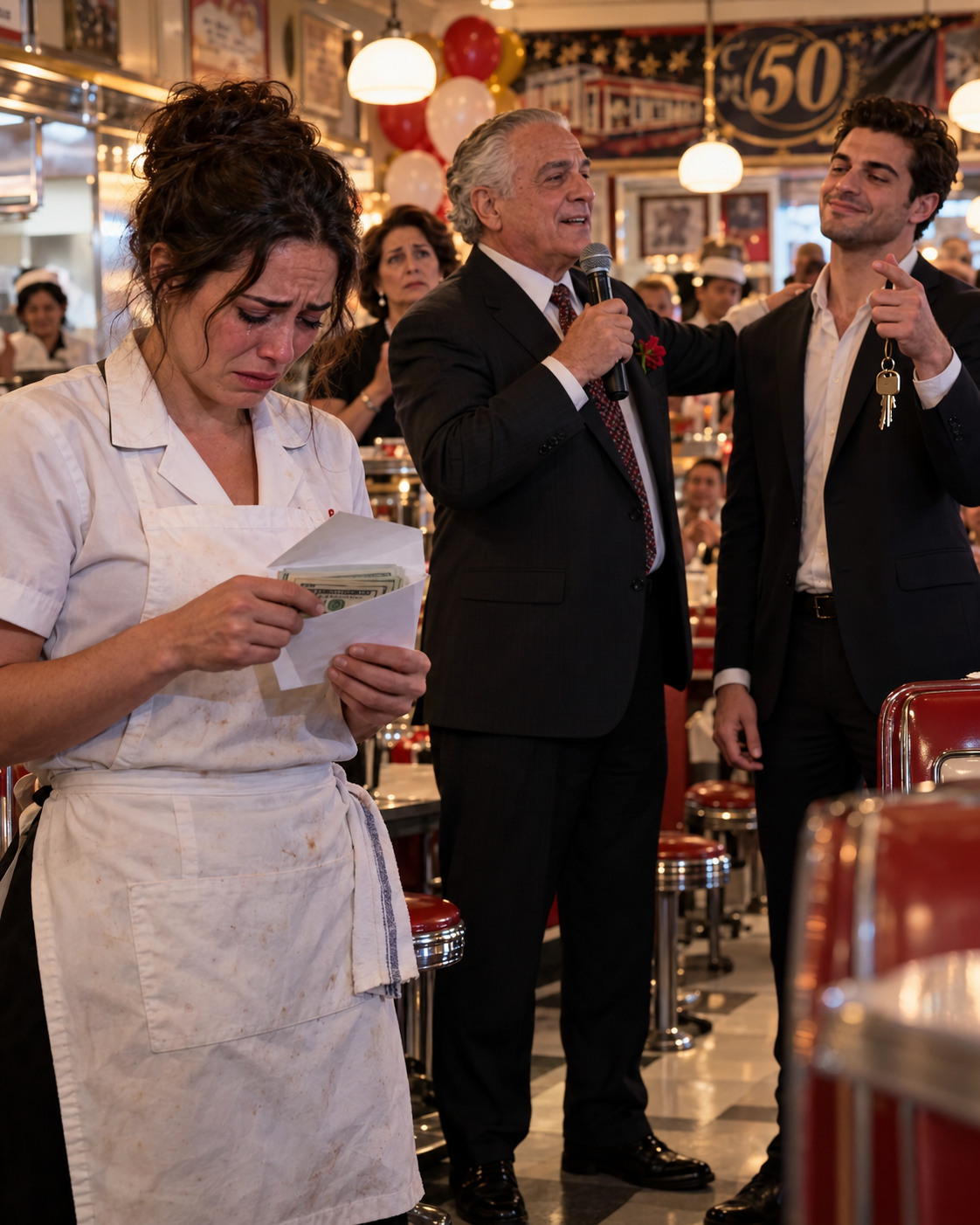
I was still wearing my apron. Eighty people had just eaten a dinner I had ordered, scheduled, and helped cook, and the keys were swinging from my brother’s finger.
“A business like this needs a man’s name behind it,” Dad said. “Marco is my son. This is his inheritance.”
There hadn’t been a funeral. My father was sixty-seven, standing beneath the anniversary banner with a microphone, giving away a future he had promised me since I was twenty-two.
He called the envelope a thank-you.
When I opened it, I counted twenty hundred-dollar bills. I remember noticing that one had a torn corner, because looking at that corner was easier than looking at my mother.
“Thank you for everything, Angie,” Dad said.
I slipped the money back inside.
“Is this supposed to settle something?”
His smile changed. Just a little.
“Don’t make tonight difficult.”
That was when I understood how carefully the evening had been arranged. My brother received the keys in public. I was expected to accept my disappointment quietly.
Three weeks earlier, I had heard my father planning it while I carried milk through the back hallway.
“Come home, son,” he had said into his phone. “It’s time you took over. I’ll handle your sister.”
I stood outside the office until the cardboard edge of the milk case began cutting into my wrist.
Then the grill bell rang, and I went back to work.
My name is Angela DeLuca. I was thirty-eight, and DeLuca’s Diner occupied a brick building in a Knoxville neighborhood where people still gave directions by businesses that had closed twenty years earlier.
Dad opened it in 1994. I was six. My earliest memory of the place was sitting beneath the register with a coloring book while Mom rolled silverware and Dad argued with a refrigerator that would not stay cold.
At twenty-two, I came back to help after his knee surgery.
I had finished a hospitality program and was interviewing for an assistant manager position at a hotel. Dad asked for six weeks. He needed somebody who understood the books and wouldn’t leave when things got hard.
Six weeks became the summer. Then the holidays. Then a year.
“The hotel will pay you to make somebody else rich,” he told me. “Here, you’re building your own future.”
I turned down the second interview.
By twenty-six, I was ordering food, hiring servers, and handling customer complaints. By thirty, I was signing inspection reports and presenting our numbers at the bank. By thirty-four, Dad’s main contribution was arriving around ten, checking the dining room, and telling people business was good.
Mine began at four-thirty.
Earl Watson, our head cook, usually pulled in while I was checking delivery temperatures. He was fifty-nine now, with nineteen years in our kitchen and a left shoulder that predicted rain more accurately than the weather app.
We had eleven employees. I knew which ones needed Tuesdays off, whose mother required dialysis transportation, and which college student could pick up a shift with twenty minutes’ notice.
I handled their payroll every other Friday.
My own name never appeared on it.
Dad gave me two hundred fifty dollars a week from his personal account. He called it spending money. I lived in the apartment above the diner and used the business truck for wholesale runs.
When I asked about wages, he counted those things on his fingers.
“A roof. A vehicle. Food. Most people would be grateful.”
I was grateful. That was part of the problem.
I also believed him when he said the diner would be mine. I heard the promise at twenty-six, thirty, and thirty-four, each time I asked for something written down.
“Someday, Angie. You know that.”
By thirty-eight, I had stopped asking as often. I told myself the place was my retirement plan, my savings account, the reason it made sense to keep postponing everything else.
Then Nora Bell came in for lunch.
Nora had worked as a bookkeeper before retiring early to care for her husband. She watched me correct a payroll entry while taking her order and asked whether I had checked my own Social Security earnings record recently.
I said I hadn’t.
“Look at it,” she said. “Don’t wait until you need it.”
That night, upstairs, I opened my account.
The older years from my teenage grocery-store job had small amounts beside them. The years I had spent working downstairs had zeros where reported earnings should have been.
I refreshed the page twice.
There were reasons a recent year might not appear yet. There was no reasonable explanation for the long blank stretch before it.
I thought about Earl’s shoulder. I thought about what would happen if mine stopped working.
The apartment belonged to the arrangement Dad controlled. The truck belonged to the business. The future I thought I owned depended on a sentence he could stop saying.
I printed the record and folded it into the drawer where I kept spare order pads.
After I overheard the phone call, I took it out again.
I didn’t know yet what I could claim or recover. I knew I needed somebody outside my family to tell me what those papers meant.
The following morning, I called a business lawyer before opening the front door.
For the first time in sixteen years, I made an appointment my father did not know about.
PART 2 — WHAT HE TOLD THE BANK
The first thing I copied was the 2023 loan renewal.
We still owed roughly three hundred ten thousand dollars. The financing had covered equipment, a ventilation overhaul, and older business debt after several difficult years.
I remembered every purchase. I had found the refrigerator supplier, negotiated the installation schedule, and kept breakfast service going while workers opened the ceiling over the kitchen.
Dad remembered signing for the money.
Our company, DeLuca’s Diner LLC, was the borrower. My parents owned it. They had signed personal guarantees. I had signed certain documents as the authorized manager, a position Dad acknowledged whenever an institution required somebody who knew the business.
I had never understood how that title could exist at the bank while disappearing at our dinner table.
Now I wanted to understand.
I copied the records I was authorized to maintain: loan documents, vendor contracts, payroll schedules, inspection reports, and the messages Dad had sent when I asked about ownership.
One from 2018 said, Keep this place healthy and you won’t have to worry when we retire.
Another, from 2022, said, It’s all going to you eventually. Stop upsetting your mother over paperwork.
I put those beside the earnings record.
Then I began writing down dates.
When Marco came home the next weekend, he brought two suits and a cardboard box of framed sales awards from his apartment in Nashville.
He was thirty-one. He sold insurance, and he was good at it. He remembered people’s children’s names, could make a stranger laugh in an elevator, and knew how to follow up without sounding desperate.
He also hadn’t worked a regular diner shift in eight years.
On Saturday, he stood beside me while I counted the register.
“Dad says you’ve got this place running itself.”
I looked up.
“Does he?”
“You know what I mean.”
He smiled, waiting for me to make the conversation comfortable.
I kept counting.
Later, I asked Mom what was happening.
She was peeling apples at the prep table, although the dessert cook had already finished the pies. Mom often found unnecessary work when she wanted a reason to avoid looking at someone.
“Your father has a plan.”
“Is the plan different from the one he promised me?”
Her knife stopped.
“You won’t be left with nothing, Angela.”
It was the first time she had answered me honestly, even if she didn’t mean to.
Dad was less careful.
“Marco needs something permanent,” he said when I confronted him in the office. “You’ve always had a place here.”
“A place doing what?”
“What you’re doing now. You’re good at it.”
“And who will own it?”
He leaned back in the chair I had bought after the old one broke.
“Your brother has to carry the family name forward.”
“My last name is DeLuca.”
“Don’t twist this.”
I waited.
He sighed as if I had created a problem where there wasn’t one.
“Customers expect a man in charge. You handle the kitchen. Marco handles the bigger picture.”
The bigger picture, apparently, did not include paying the person holding most of it together.
On October 9, invitations arrived for the anniversary and succession dinner, scheduled for Saturday, October 17.
Dad had ordered them without asking me how many tables we could seat.
Earl read one while the dishwasher ran.
“You agreed to this?”
“I haven’t been asked to agree to anything.”
He set the invitation down.
“Then I need to decide whether I’m staying.”
I felt a quick, guilty rush of gratitude.
“Don’t quit for me.”
“I’m deciding who I can work for. That’s my business.”
It was a distinction I needed to learn.
My appointment with Tessa Merritt was the following Tuesday. Her office occupied the second floor of a building with a broken elevator, and I arrived carrying a grocery bag because I didn’t own a briefcase.
She read my summary before asking questions.
“Does your father know you’re here?”
“No.”
“Do you want ownership, repayment, or a way out?”
I had prepared explanations for why my parents were good people. I hadn’t prepared an answer to that.
“I want to know what belongs to me.”
She nodded.
“Then we start by separating what was promised from what was signed.”
She explained that my work records mattered, but they did not automatically make me an owner. An employment lawyer and an accountant would need to review the pay arrangement. Recovering old wages and correcting old earnings records involved different rules and different limits.
“Anybody who promises to fix all sixteen years in one afternoon is selling you something,” she said.
Then she opened the loan renewal.
A paragraph identified Angela DeLuca as the designated operating manager. Another required written lender consent for specified ownership transfers and replacement of that manager.
Tessa underlined both.
“These are provisions in this contract. We need to know what the bank has approved.”
I remembered Dad taking Marco to meet Nadine Mercer, our commercial lending officer, the previous Friday.
“He said he was introducing the new owner.”
“An introduction isn’t approval.”
Tessa turned another page.
“And being essential to a loan doesn’t give you ownership. It does mean your decision about continuing to work has consequences they need to address.”
On my way downstairs, my phone rang.
It was Nadine.
“Angela, your father said you’d be sending your continuing-management agreement. Has your attorney finished it?”
I stopped on the landing.
“What continuing-management agreement?”
She went quiet.
Then she said, “I think we need to speak with your father.”
PART 3 — THE THANK-YOU DINNER
Dad called me that afternoon.
“Why are you making the bank nervous?”
I stood behind the building, beside the empty produce crates.
“Nadine asked about an agreement I haven’t seen.”
“It’s transition paperwork. You’ll keep doing what you’re doing.”
“For how long?”
“A few years, until Marco gets established.”
“And what do I get?”
He breathed into the phone.
“Angela, we’re talking about your brother.”
“I know whose name you’re putting on the business. I’m asking about mine.”
He told me we would discuss it after the party. I told him I would not sign anything before my lawyer reviewed it.
For several seconds, I heard only traffic.
“You’ve hired a lawyer?”
“Yes.”
“Against your family?”
“For myself.”
He hung up without saying goodbye.
I should have refused to organize the dinner. Looking back, I know that. But the food had been ordered, my employees had been scheduled, and people I had known since childhood had accepted invitations.
I made one decision I could keep: I would finish the commitments already on the calendar while I planned my departure. I would stop taking on new ones without an agreement.
On Saturday, October 17, I arrived at four-thirty as usual.
Marco appeared at noon with a photographer he had hired for the evening. He asked whether we could move the employee coats because they would look bad in the kitchen pictures.
“They need somewhere to hang them,” I said.
“For one night, Angie.”
Earl looked at him across the grill.
“Find a different camera angle.”
Marco laughed, uncertain whether that was a joke.
By six, we had pushed tables together, covered them with rented linens, and set eighty places. I had found extra folding chairs at a church and sent Marcus Webb to collect them before his kitchen shift.
Dad stood by the entrance, shaking hands.
Mom wore a navy dress I had steamed upstairs between checking the roast and answering a supplier’s question. She kept touching the necklace Dad had given her for their anniversary.
Nobody had asked what I planned to wear.
I changed my stained apron for a clean one and kept working.
The photographer took pictures of Dad and Marco beneath the banner. When I stepped out with the seating list, Dad called me over.
“One with your sister,” he told Marco.
He put a hand on my shoulder and turned me slightly so the embroidered diner name would show.
I understood later why that photograph bothered me so much. Even standing beside the new owner, I had been positioned to advertise the work.
Dinner went well.
Dorothy Ames, eighty-one, sat at her usual table near the window. Her husband had been dead eleven years, but she still ordered his favorite pie on his birthday and asked me to cut it thin.
She caught my wrist as I passed.
“Are you getting a night off after all this?”
“I’m working on it.”
She looked toward Dad.
“Work harder.”
After the main course, Dad took the microphone.
He talked about opening the diner with borrowed money. He talked about his father’s expectations, the DeLuca name, and passing something solid to the next generation.
He thanked Mom for standing beside him.
He thanked Earl for his cooking.
Then he called Marco forward.
The ownership folder he handed my brother contained signed transfer documents that still depended on required approvals. I knew that because Tessa had asked the family’s lawyer for the details.
Dad announced the transfer as if nothing remained to be done.
“This is his inheritance,” he said. “A son should have something to carry forward.”
People clapped. Some slowly. Some because they hadn’t understood there was a choice being made at somebody else’s expense.
Marco looked pleased and nervous.
Then Dad called me up.
He handed me the envelope and said two thousand dollars loudly enough that nobody could mistake the amount.
I asked whether it was supposed to settle something.
He told me not to make tonight difficult.
For a moment, I wanted to give the room everything: the zeros, the promises, the early mornings, the three-year agreement I was expected to sign without being consulted.
But I had spent most of my life explaining myself to people who benefited from misunderstanding me. I didn’t want my future to depend on winning a dinner argument.
“I’ll finish the service tonight,” I said. “We can discuss the rest with our lawyers.”
Dad lowered the microphone.
The silence was worse than shouting would have been.
Mom stared at the tablecloth. Marco stopped turning the keys.
I went into the kitchen and asked Earl whether the pies were ready.
He looked at me for a long moment.
“They are.”
“Then let’s get them out.”
I didn’t cry until I carried the last coffee urn into the back room. Even then, I made very little noise. I was embarrassed by how much of me still wanted Dad to follow me and say there had been a mistake.
He didn’t come.
At nine-thirty, Earl folded his apron and put it on the counter.
Dad, Mom, and Marco were counting leftover wine bottles.
“Monday, I’m giving notice,” Earl said. “If you want me here after that, Angela’s position needs to be real.”
“You’re choosing sides?” Dad asked.
“I’m choosing management.”
Earl left through the back door.
Dad turned to me.
“You put him up to that.”
“No.”
He held out another folder.
“We need this signed so the bank can finish.”
Inside was a draft requiring me to remain the general manager for three years. The compensation section said: existing family arrangement to continue.
I looked up at him.
He had given my brother a future and prepared a contract to keep me supplying it.
PART 4 — MY LAST DAY IN WRITING
On Monday morning, I put the three-year draft on Tessa’s desk.
The envelope lay beside it.
“I haven’t spent the money,” I said.
“Good. We need to be clear about what accepting it does and doesn’t mean.”
She read the draft twice, then called the family’s lawyer while I sat beside her.
He said the compensation language was a placeholder. He had expected the parties to discuss it before signing.
“My client was handed it after a public announcement,” Tessa said. “She will not be signing it.”
She listened for a moment.
“Then your client needs to understand that continuing employment is not something he can transfer with the keys.”
We prepared a notice stating that I would finish my existing work through November 1 unless we reached a written interim agreement. It went to my parents and their lawyer.
With my authorization, we also notified Nadine that I had not agreed to the proposed three-year arrangement. I was still handling operations, but the bank needed accurate information about what would happen afterward.
I signed my own notice before Tessa sent it.
For sixteen years, I had signed papers to protect the business. This one protected my decision to leave it.
When I returned, four employees were waiting outside the office.
Earl held a sheet with his signature and three others: Patty Nguyen, Denise Cole, and Marcus Webb.
Their notices provided two weeks. Each had written that they would reconsider if the diner established a credible management arrangement with me.
They hadn’t written that I should inherit anything. They hadn’t asked my permission to resign.
Patty had a mortgage. Denise cared for her mother. Marcus had two children and could not afford weeks of disorganized shifts.
“We need to know who makes the schedule,” Denise said. “And whether the person making it understands we have lives.”
I nodded.
“You should make whatever decision is right for you.”
Dad read their letter and mine in the same sitting.
Then he came into the kitchen.
“You’d close this place to prove a point?”
My hands were in the sink. I dried them before answering.
“I’ve given you a date and time to make another arrangement.”
“This is your home.”
“That’s why my lawyer also asked about the apartment.”
His face tightened.
He had never threatened to put me out before. I realized that I had still organized my entire life around making sure he wouldn’t need to.
That afternoon, I called the building’s owner about a separate rental reference and asked Nora whether she knew of any temporary rooms.
Nora said her spare bedroom had a door that locked.
I wrote the address down.
The photograph from the party appeared on the diner’s Facebook page that evening. Marco had posted it with a caption about honoring our father’s legacy.
The first comment came from Dorothy.
Angela, will you still be there?
Other customers asked the same question. A few mentioned the envelope. Somebody wrote that parents could give their property to anyone they wanted.
Another person said I had lived rent-free and should stop complaining.
I wanted to answer all of them. Instead, I asked Marco not to post about my employment until we had an agreement.
“People are making me look terrible,” he said.
“People are asking what happened.”
“They don’t know the whole situation.”
“Neither did I.”
Two holiday catering customers called. They wanted to know whether their deposits would still cover the menus and staffing I had discussed with them.
I confirmed their contracts and told them the diner would contact them about any management change. I didn’t invite them to follow me anywhere.
There was nowhere to follow me yet.
On Tuesday, I called Celeste Harlan, who operated three family restaurants around Chattanooga. Earl had given me her number; he had worked with one of her kitchen managers years earlier.
She remembered a local newspaper article about our fundraiser breakfasts.
“Send me your resume,” she said. “We’re hiring for a new location.”
I didn’t have a resume that reflected the work I actually did.
That night, I made one.
I listed staff supervision, scheduling, vendor negotiations, food safety, payroll administration, and annual budgets. I looked up the numbers instead of guessing. I asked Earl whether I had forgotten anything.
He read the pages at the prep table.
“You might mention that you can fix the register printer while somebody’s yelling about toast.”
I laughed for the first time since the party.
Celeste scheduled an interview for Friday. She wanted a sample staffing plan and references from people who weren’t relatives.
I spent Thursday evening preparing them.
Friday, I drove to Chattanooga in Nora’s car. Celeste showed me the new dining room and asked what I would do if breakfast sales fell while food costs rose.
We talked for ninety minutes.
When she asked my current salary, I told her the truth.
She didn’t pity me. She asked what compensation I would require to take the position.
I answered with a number Tessa and I had discussed.
Driving home, I realized something had changed even before an offer existed.
I had described my work to someone who expected to pay for it.
At the diner, Mom was waiting beside the dark register.
“The bank called your father,” she said. “They want documents he doesn’t have.”
The story continues—click the Next button below to read the next part.
