Part 1 of 3
On our wedding night, I was unbuttoning his pants when I noticed a scar on his hip. I froze. “When did you get that?” I whispered. His answer came far too quickly. I didn’t argue. I locked myself in the bathroom, staring at my reflection as one terrifying thought took hold. Maybe the man I had spent three years mourning… wasn’t the man I thought he was.
Part 1

“If you are marrying me because I have my dead brother’s face, stop this wedding right now.”
Those were the last words Sebastian Morales said to me before he became my husband.
My name is Mariana Lopez. I am thirty-five years old and I teach high school English in Austin, Texas. In November 2022, I was on the verge of doing something I had sworn for three years I would never do: get married again. And not just to any man, but to the identical twin brother of Santiago, my first husband, who died in a fiery crash.
Sebastian and Santiago were identical. Same height, same voice, same dark eyes. But to me, they had never been the same. Santiago was a jokester, loud, capable of making friends with anyone in seconds. Sebastian was reserved, patient, and quiet. During my marriage to Santiago, Sebastian never crossed a line.
When Santiago died in 2019, Sebastian survived. The car caught fire on the highway, and my husband’s body was burned beyond recognition. They identified him through his personal belongings, his wedding band, and the survivor’s testimony.
Afterward, Sebastian stayed close without pushing. He helped with my daughter, Camila, fixed leaks, changed light bulbs, or brought over meals sent by his mother. Little by little, Camila grew to love him. It took me much longer.
When he first confessed he had feelings for me, I rejected him.
“Every time I look at you, I’m terrified I’m just searching for Santiago.”
“Then don’t marry me,” he replied gently. “I refuse to be a shadow.”
We stayed apart for months. And in that distance, I realized I missed the man I believed Sebastian was.
The wedding was small: family, close friends, Texas barbecue, and too many curious glances. My mother-in-law, Teresa, held my hands before the ceremony.
“Let people talk, Mariana. You don’t live your life to shut other people’s mouths.”
That night, Camila stayed with her grandparents. The house was dead quiet. Sebastian closed the bedroom door, and for the first time, we were no longer a widow and a brother-in-law.
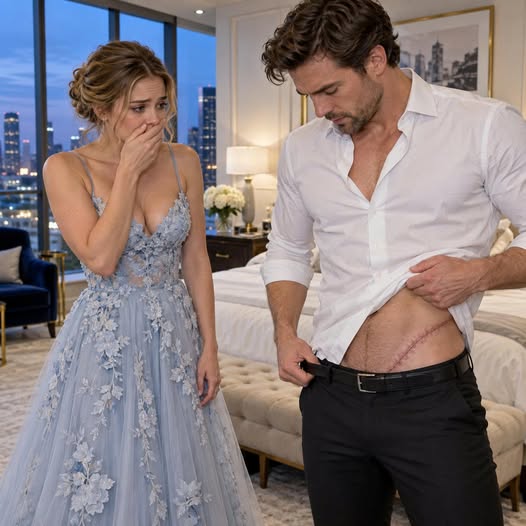
He took off his suit jacket and unbuttoned his shirt. I set my earrings on the nightstand, and when I looked up, the air left my lungs.
On the lower part of his left hip was a curved scar, shaped like a fishhook.
I knew that mark.
In 2017, our glass shower door shattered, and Santiago threw himself in front of me to push me out of the way. A shard sliced open that exact spot. I cleaned that wound myself and changed his bandages for weeks.
Sebastian had never had an injury there. His only major scar was a plate in his left wrist from a high school football injury.
“What is that?” I whispered.
He looked down at the scar and hesitated for a fraction of a second.
“A motorcycle spill. Years ago.”
That single second ran cold through my veins.
Sebastian had never owned a motorcycle.
I locked myself in the bathroom. Sitting on the edge of the tub, my mind began to piece together fragments: over three winters, this man had never once complained about his wrist aching in the cold; he called Camila “my ladybug”—the exact nickname Santiago used; he knew tiny layout quirks about our old house that I had dismissed as twin intuition.
When I stepped back into the bedroom, I feigned a sudden migraine. We slept back-to-back.
As the sun came up, only one thought consumed my mind: if the man who just married me bears Santiago’s scar… who was buried three years ago under my husband’s name?
Part 2
I didn’t confront him right away. If I was wrong, I would destroy a family over grief-induced paranoia. But if I was right, I had been living next to a monstrous lie for three years.
Two days later, I set a trap.
“Do you remember that B&B in Fredericksburg Santiago and I stayed at? Room 204, right?”
Sebastian answered without thinking. “It was 207. 204 faced the parking lot, and you wanted the courtyard view.”
He froze instantly.
“Santiago told me about it,” he added, his voice dropping a pitch.
We had never told a soul about that room.
Later, I brought up a restaurant and deliberately misremembered Santiago’s favorite dish. He corrected me automatically. Another afternoon, Camila pulled an old toy watch from the top shelf of a closet—a hiding spot her father used years ago.
“Daddy Sebastian found it for me,” my daughter said innocently.
I tracked down Courtney, an ex-girlfriend of Sebastian’s from college. I asked her to meet him under the pretense of bumping into him at a coffee shop while I watched from across the street.
“With this cold front coming in, I bet that wrist you broke in high school is acting up,” Courtney remarked casually.
He smiled. “Now and then.”
Courtney walked out to my car pale.
“Mariana, we weren’t even dating when he broke his wrist,” she told me, her hands shaking. “Santiago was the one who drove him to the ER. That man knows the fact, but he doesn’t remember the life around it. And when he laughs… that’s Santiago’s laugh.”
I went straight to the Travis County Sheriff’s Office. Detective Lucia Hernandez sat quietly as I laid it all out: the scar, the hotel room, the watch, the wrist.
“Memories aren’t enough to secure an arrest warrant, Mrs. Morales,” Detective Hernandez warned. “Do not confront him. Let us run a background check.”
He noticed my coldness before I could manage to mask it.
One evening, I returned home from work to find my parents, my in-laws, and Sebastian sitting in the living room. Spread across the coffee table were copies of my old therapy notes from 2020—records of my severe insomnia and complicated grief.
“I’m worried about Mariana,” he told the room, his eyes brimming with performative concern. “Three years ago, she kept saying she heard Santiago, that she saw him in me. Now she thinks he’s alive again.”
I saw his strategy instantly: he was trying to frame my investigation as a psychiatric relapse.
“I’m not confused,” I said, standing tall in the entryway. “Santiago’s scar is on your hip.”
He went dead gray.
I turned to Teresa. “Mom, I spoke to Courtney. I have reason to believe Santiago is alive.”
My mother-in-law stood up slowly, her hands trembling against her sweater. “Then… who did we put in the ground?”
I packed a bag and left for my parents’ house. The next morning, my former therapist confirmed to investigators that my sessions were strictly for bereavement, with zero history of delusions.
Meanwhile, the detective uncovered the missing piece of the puzzle.
Before the accident, Santiago had been embezzling money from the commercial electrical supply firm where he worked. He had falsified invoices and receipts to cover disastrous stock trading losses. The deficit was over two hundred thousand dollars.
Sebastian had discovered the fraud. Days before the crash, Sebastian emailed copies of the financial records to his best friend, Diego, with a note: “Hold onto these. If everything gets sorted next week, I’ll tell you to delete them.”
The afternoon of the accident, both brothers got into the car together because Santiago was supposedly driving to turn himself in.
Three days later, Detective Hernandez called me into her office.
“We managed to pull archived fingerprint records from before the crash,” she said. “Identical twins may share nearly identical DNA profiles on standard tests, but their fingerprints are distinct.”
My throat locked up. “And the man living as Sebastian?”
Hernandez slid a Manila folder toward me. “His prints belong to Santiago Morales.”
I sat frozen in total silence.
She opened a second file. “Now, Mrs. Morales, we have to tell you who was actually in that burning car.”
Part 3
The truth didn’t hit like a lightning bolt; it collapsed like a home falling room by room while you’re still trapped inside.
The police investigation painstakingly pieced together November 20, 2019.
Santiago had been spiraling for months. He lost his own savings first, then began dipping into company accounts, convincing himself he would pay it back before anyone noticed. When he couldn’t, he forged signatures and cooked the books.
Sebastian, working in the firm’s technical department, spotted the discrepancies on a routine audit. He confronted Santiago in a small storage unit behind their parents’ house.
“Tell me the truth,” Sebastian had demanded.
Santiago tried to brush it off. “You don’t understand how corporate sales work.”
Sebastian laid the forged receipts on the table. “I understand fraud.”
Santiago broke down, begging for a month to fix it. Sebastian gave him one week to confess to the board, backing himself up by sending the evidence to Diego.
Two days before the deadline, Santiago called Sebastian. “Drive with me tomorrow. I’ll confess.”
Sebastian believed him.
On the afternoon of November 20, Santiago dropped off Camila at daycare and blew me a kiss outside the school where I taught. “Drive safe,” I had told him.
“Always do, teacher,” he smiled.
An hour later, Sebastian arrived at Santiago’s house with the folder. They got into Santiago’s sedan—Santiago driving, Sebastian in the passenger seat.
Investigators concluded they never made it to the corporate office. An argument broke out on a lonely stretch of State Highway 71. The car veered off the road, plowed through a guardrail, and flipped down an embankment.
Santiago scrambled out, bruised and disoriented.
Sebastian was knocked unconscious, pinned behind a crushed dashboard.
Up to that moment, it was an accident. What happened next was cold, calculated horror.
Santiago was carrying his wallet, his watch, and his wedding ring. He knew Sebastian’s jacket contained his own ID. Seeing his brother unconscious as smoke began pouring from the engine bay, Santiago saw an escape hatch from his ruin.
He swapped wallets and rings.
He left his identity on his dying brother, pocketed Sebastian’s life, and crawled away. When paramedics arrived at the flaming wreckage, Santiago claimed to be the survivor: Sebastian.
No one will ever know if Sebastian could have been pulled free before the flames consumed the cab.
That was what broke Teresa completely. She hadn’t just lost a son—her surviving child had forced her to weep over the wrong coffin for three years.
Part 4
When the arrest warrant was issued, Detective Hernandez permitted us to assemble at my in-laws’ home so Santiago could be taken in without a public scene. My aunt took Camila into a back room with headphones.
Santiago walked into the house attempting to maintain his casual, measured demeanor.
“What’s going on?” he asked, looking around at our pale faces.
Teresa sat on the sofa, her hands clamped over her knees. “Tell me your name.”
He gave a dry, nervous laugh. “Mom, come on.”
My father-in-law, Joaquin, slammed the police printout onto the dining table. “The sheriff’s department ran your prints against old records.”
Santiago went dead still. The soft, gentle expression he had worn as ‘Sebastian’ vanished, replaced by the hollow mask of a stranger.
“Say your name,” I demanded.
“Mariana…”
“Say your name!”
Teresa stood up, her voice tearing from her chest. “Where is Sebastian?”
Santiago dropped his head. “It was an accident.”
“I know it was an accident!” she screamed. “Where is my son? Where is your brother?!”
“I tried to pull him out—”
“Liar!” I yelled. “You swapped your rings! You left your wedding band on his hand! You let him burn so you could kill your debt!”
Joaquin stepped into his face. “Over money? You stole your brother’s life over money?!”
“I was going to pay it back!” Santiago sobbed, sinking to his knees. “Everything spun out of control!”
Teresa looked down at him with a dead, hollow despair. “The crash was an accident, Santiago. But living for three years under your brother’s name was a choice.”
The sheer cruelty of it settled over the room like lead.
For three years, he had watched his daughter cry for her father. He had walked beside his mother as she laid flowers on a grave. He had watched me grieve, attend therapy, and struggle to piece my life back together.
And then he had seduced me using his brother’s identity.
“How could you watch me mourn you?” I whispered, tears burning my eyes. “How could you let me suffer while Sebastian was buried under your crimes?”
“I loved you,” he wept, reaching for my hand. “I was terrified of losing you.”
“I lost you the moment you chose your cowardice,” I said, stepping back. “If you had come back three years ago and faced the fraud, I might have hated you, we might have divorced—but at least you would have been a man. You stole your brother’s legacy and my right to know who was in my bed.”
Santiago looked up, desperate. “Think of Camila!”
“Don’t you dare use your daughter to hide behind!” I threw back at him.
It was the exact phrase Sebastian had typed to him in an email three years prior.
Then, a small voice broke from the hallway.
“Daddy?”
Camila stood by the frame, having pulled off her headphones. She looked at the man kneeling on the floor, then at me.
“Are you… Daddy Santiago?”
Nobody could shelter her from the truth anymore.
Santiago collapsed into his hands, sobbing uncontrollably. Camila didn’t run to him. She backed away, pressing her small frame tightly against my side.
“Then… is Uncle Sebastian dead?” she whispered.
Teresa buried her face in her hands and wept. I pulled my daughter tight against my hip, feeling the full, crushing weight of the truth settle on all of us at once.
The officers stepped inside and handcuffed him without resistance.
The legal proceedings dragged on for months. Santiago was charged with grand larceny, fraud, identity theft, and obstruction of justice, alongside civil suits from the company he robbed. Because forensic experts could not definitively prove whether Sebastian died from the impact or the fire, homicide charges could not be filed, but the judge showed zero leniency during sentencing.
Santiago was sentenced to twenty-two years in state prison.
When the verdict was read, there was no relief—only exhaustion. Sebastian was still gone. Camila had to digest that her father was alive, yet had willingly abandoned her to play a ghost.
The hardest day came six months later: exhuming the grave to correct the tombstone.
It was a crisp spring morning at the cemetery in Austin. Teresa brought white roses. Joaquin walked with a heavy cane. I held Camila’s hand.
When the stone mason replaced the marker with the correct name, Teresa traced the fresh carving with her fingers:
SEBASTIAN MORALES
She bowed her head and wept. “For three years I called you by your brother’s name. Forgive me, sweet boy.”
I remembered how Sebastian had kept a respectful distance from me when I was Santiago’s wife. I remembered how he refused to let his brother sweep crime under the rug. I remembered him getting into that car with a folder, believing until the end that his brother might do the right thing.
We had spent years assuming the survivor had been changed by trauma.
Now we knew Sebastian had never changed at all. Santiago had simply attempted to play his part.
In the aftermath, our marriage was legally annulled. I resumed teaching. Camila spent time in child therapy, slowly working through the betrayal. Teresa and Joaquin remained a vital part of her life; I never made them pay for their son’s unspeakable choice.
One afternoon, driving home from the cemetery, Camila looked at me in the rearview mirror.
“Mom? Was Daddy a bad person?”
I waited before answering.
“Your father did good things once. He loved you when you were a baby. But he made terrible, selfish choices.”
“Why didn’t he stop?”
“Because every time he had a chance to tell the truth, he picked a fresh lie to cover the old one. He could have confessed the money issues. He could have owned up after the crash. He could have stopped before he married me again. He chose the lie every single time.”
Camila stared out at the passing trees. “And Uncle Sebastian?”
“Uncle Sebastian was afraid too, sweetie. But he tried to do what was right, even when it was hard.”
People often say the truth tears families apart.
It wasn’t the truth that broke us. It was living inside a lie for three years. The truth simply turned the lights on. And while that light exposed an ugly reality, it also freed us from confusing love with fear, and family with obligation.
I still leave flowers on Sebastian’s grave.
Not because he was my husband—he never was. I bring them because he stood up for what was right when his twin wouldn’t, and because for three long years, his memory was held hostage by the person who betrayed him most.
I don’t spend my days hating Santiago. Hatred is exhausting. But I don’t soften what he did to make myself feel better, either.
The last time we visited the plot, Camila placed a single white rose over the stone and said quietly, “He had my dad’s face, but he made better choices.”
I hugged her close.
Two men were born with the exact same face. But only one understood that losing your money, your reputation, or your freedom will never be as terrible as losing your soul.