My Wife Wanted Our Stories Straight Before Anyone Asked Questions

The nurse had barely finished helping my five-year-old daughter settle after her stitches when my phone vibrated again.
I expected another explanation from my wife.
Instead, the message said: COME HOME. WE NEED TO GET OUR STORIES STRAIGHT BEFORE ANYONE STARTS ASKING QUESTIONS.
I read it twice.
My daughter was sitting beside my sister, wrapped in a paper blanket, one eye swollen around the fresh bandage. She was exhausted, frightened, and trying very hard not to cry again. The words on my screen suddenly made the room feel much smaller.
My wife wasn’t asking whether our daughter was okay.
She wasn’t asking how many stitches the doctor had used.
She wasn’t asking whether the bleeding had stopped.
She was asking me to get our stories straight.
And I had just watched the video that explained why.
A few minutes earlier, the neighbor whose security camera faced the side of our yard had sent me a clip. He had saved it before I even got home because he had heard my daughter screaming.
I watched it standing in the hallway outside the exam room.
The first time, I kept the sound low. I wanted to see the sequence without letting my anger fill in anything the camera hadn’t actually shown.
The second time, I used headphones.
There was no ambiguity about the part that mattered.
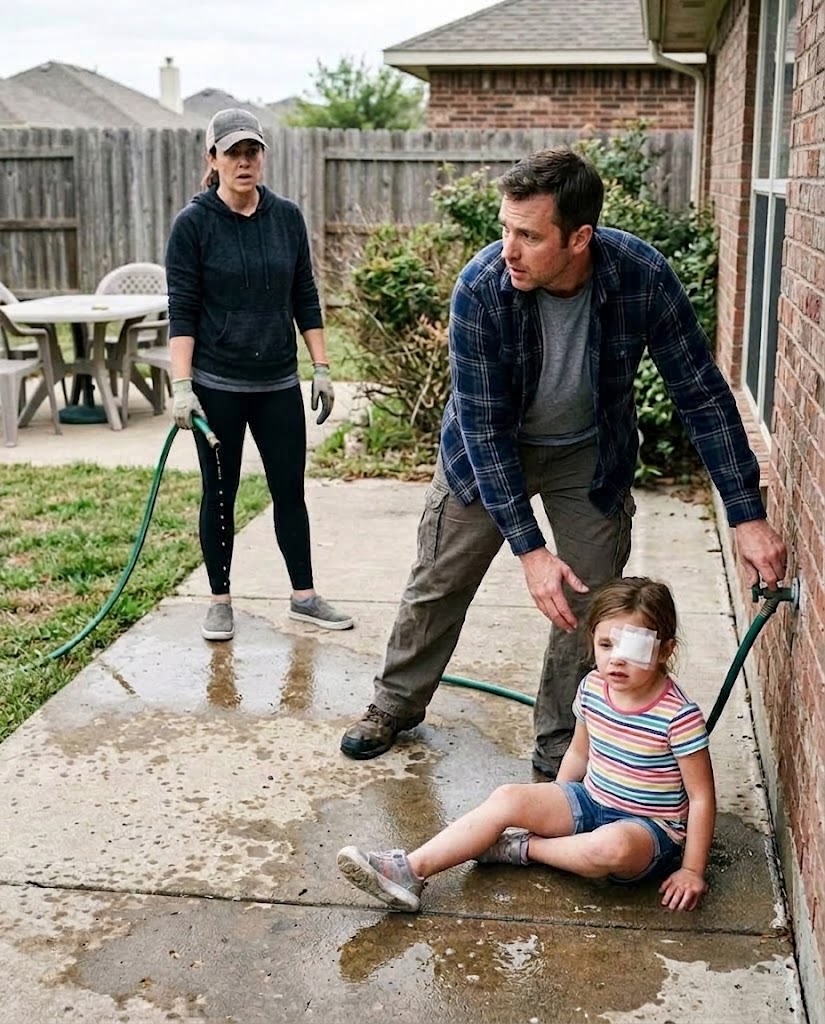
My daughter had been near the flower bed when my wife came through the patio door carrying the garden hose. The camera didn’t show what had happened inside the house before that. It didn’t show every word spoken between them. But it showed what happened after my wife turned the water on.
My daughter backed away.
The stream followed her.
She raised both arms over her face.
My wife kept the hose pointed toward her.
Then my daughter slipped.
Her head struck the edge of a low planter.
The hose didn’t stop immediately. It stopped after she was already on the ground.
For several seconds, my wife stood over her.
Then she went inside.
She came back carrying the gauze I had seen when I first stepped onto the patio.
I had spent the entire drive to urgent care trying to hold two thoughts at once: maybe there was an explanation I hadn’t heard, and my daughter was too frightened for me to ignore what she was saying.
Now I had something neither of those thoughts could explain away.
The video didn’t answer everything.
It did something more important.
It established a sequence.
My daughter had told me that the water made her move backward. The camera showed her moving backward while the stream followed her. She had told me the hose was pointed at her. The footage showed it. She had told me she fell after the spraying began. The footage showed that too.
But there was another detail.
Just before my wife went inside for the bandage, she lifted her phone and aimed it toward the patio.
My daughter had told me earlier that her stepmother took a picture before the fall.
I had almost dismissed that detail as something a frightened child might remember incorrectly.
I didn’t dismiss it anymore.
I saved the video in two places.
Then I forwarded a copy to my sister.
When I went back into the exam room, my daughter looked up at me.
“Daddy?”
“I’m here.”
“Are we going home?”
“Not tonight.”
She looked toward the door.
“Is she coming here?”
“No.”
My sister sat beside her and gently adjusted the paper blanket around her shoulders.
My daughter looked at me again.
“Don’t tell her I told you.”
That sentence had stayed with me since urgent care.
Not because a child had told me something difficult.
Because she was already thinking about protecting herself from the consequences of telling the truth.
I crouched beside the exam table.
“You’re not in trouble,” I told her. “You did the right thing by telling me.”
She nodded, but she still looked nervous.
The doctor had already documented what she said about the fall. He had documented the cut beside her eyebrow, the stitches, and the scrapes on her elbow and knees. He had also recorded the answer she gave when he asked how the injury happened.
“The water made me move backward.”
That sentence was no longer standing by itself.
The video gave it context.
And my wife’s messages were beginning to give the whole afternoon a different shape.
Before we left home, my wife had given me one explanation.
Our daughter had gotten dirty after she fell.
At urgent care, she said our daughter had been throwing dirt.
Then she said she had only rinsed mud from the child’s legs.
Then she said the hose had accidentally swung upward when our daughter stumbled.
Three explanations in less than an hour.
At first, I had treated each one as a possible attempt to describe the same confusing accident.
Now I was looking at them differently.
The problem wasn’t simply that the explanations were different.
The problem was that each one appeared only after another piece of information had become inconvenient.
When the injury was visible, the fall was accidental.
When my daughter described the water, the hose had supposedly been used to clean mud.
When I asked the doctor to document her account, the hose had supposedly swung upward by accident.
And now, after the neighbor’s footage existed, my wife wanted me home so we could get our stories straight.
I didn’t answer her.
Instead, I asked my sister to stay with my daughter while I stepped into the hallway.
I called the neighbor.
“I need to know something else,” I said.
“What?”
“Does your camera keep the audio?”
There was a pause.
“Not clearly,” he said. “It picks up some outdoor sound, but the wind and traffic make most of it hard to understand.”
“Can you send me the original file?”
“I sent you the clip.”
“I know. I need the original if you still have it.”
“I do.”
“Please don’t edit it.”
“I won’t.”
Another pause followed.
Then he said, “There’s something else you should know.”
My hand tightened around the phone.
“What?”
“The camera starts a little earlier than the clip I sent.”
“How much earlier?”
“About twelve minutes.”
I looked through the small window in the exam-room door.
My daughter was watching my sister fold the edge of the paper blanket into a neat line.
“Can you send me that too?”
“Yes.”
“Everything. Don’t leave anything out.”
“I already made a copy.”
“Why?”
“Because I heard her screaming.”
I closed my eyes for a moment.
The neighbor had heard what I hadn’t.
My daughter had been outside without me.
And someone nearby had heard enough to know something was wrong.
When the longer file arrived, I didn’t watch it in the hallway. I took my sister’s phone, stepped into an empty consultation room, and opened it there.
The first few minutes showed an ordinary afternoon.
My daughter moved around the flower bed. She crouched near the plants. She stood up. She appeared to be doing what a five-year-old might do when left outside for a few minutes.
Then my wife appeared.
She didn’t come outside carrying a towel.
She came carrying the hose.
The footage showed her stop several feet from my daughter.
My daughter turned toward her.
Then the water started.
The camera couldn’t tell me what had been said.
But it didn’t need to.
My daughter stepped backward.
My wife moved the hose with her.
My daughter raised her arms.
She stumbled.
Then came the fall.
I paused the video.
There was one frame that I couldn’t stop looking at.
My daughter was already on the ground.
My wife was standing over her.
The hose was still in her hand.
I didn’t need another dramatic moment.
That frame was enough to tell me what I needed to know about the sequence of events.
But the earlier portion of the video gave me something else.
It showed my wife taking out her phone before the fall.
My daughter had not invented that.
She had noticed it.
She had remembered it.
And she had been trying to tell me that the picture existed.
I called my sister back into the room.
“Watch this,” I said.
She stood beside me.
We watched the section together.
Neither of us spoke for several seconds afterward.
My sister finally said, “You need to keep that somewhere safe.”
“I already made two copies.”
“Make another.”
“I will.”
Then her expression changed.
“What about the phone?”
“My wife’s?”
She nodded.
“If she took a picture, it may still be there.”
That was the first thing I hadn’t considered.
The photograph could have been taken before the fall.
If it was still on my wife’s phone, its metadata could potentially establish when it was taken. More importantly, the photograph itself might show my daughter’s condition before she hit the planter.
I didn’t want to guess what it contained.
I wanted to know whether it existed.
But I wasn’t going to call my wife and ask her to show me.
Not after she had just asked me to get our stories straight.
My phone vibrated again.
Another message.
I opened it.
This time she wrote: YOU’RE MAKING A SIMPLE ACCIDENT LOOK LIKE SOMETHING ELSE.
I stared at the sentence.
Then another message arrived.
SHE’S FIVE. SHE DOESN’T UNDERSTAND WHAT HAPPENED.
I looked through the doorway at my daughter.
She was five.
She didn’t understand every adult decision happening around her.
But she understood that water was being aimed at her.
She understood that she fell.
She understood that she was hurt.
And she understood enough to be afraid of what would happen if she told me.
I put the phone away.
My sister asked, “Are you going to answer?”
“No.”
“What are you going to do?”
“I’m going to keep everything.”
The doctor came by again and reminded us that my daughter needed to keep the stitches dry and that someone should watch for any changes around the injury. My sister listened carefully while I wrote everything down.
For the first time that afternoon, I felt like I was doing something concrete instead of simply reacting.
My daughter needed medical care.
She had received it.
She needed somewhere safe to sleep.
She had that too.
And now the account of what happened needed to be preserved before anyone had a chance to change it.
I asked my sister to take my daughter to the waiting area while I made another call.
This time I called a local professional who could tell me how to preserve the video and photographs properly. I wasn’t looking for a dramatic confrontation. I wasn’t looking for revenge.
I needed the original files intact.
I needed the doctor’s documentation intact.
I needed my daughter’s words preserved exactly as she had spoken them.
And I needed to stop treating my wife’s changing explanations as if they were harmless confusion.
When I returned to the room, my daughter was half asleep.
She opened her good eye when she heard me.
“Daddy?”
“Yeah?”
“Are you mad at me?”
The question nearly broke me.
“No.”
“Promise?”
“I promise.”
She closed her eye again.
I sat beside her until her breathing slowed.
My phone stayed face down on the chair.
For the first time since I had found her on the patio, I wasn’t waiting for my wife to explain what I had seen.
I was looking at what could be established.
The footage showed the water.
It showed my daughter backing away.
It showed the fall.
It showed my wife retrieving the bandage afterward.
It showed the phone coming out before she went inside.
The doctor had documented the injuries.
My daughter had described the sequence before she knew I had seen any footage.
And my wife’s own messages had introduced a new problem of their own.
She wasn’t asking what happened anymore.
She was asking me to agree with her version.
I still didn’t know why she had taken the picture.
I didn’t know what was on her phone.
I didn’t know what had happened inside the house before she came onto the patio.
Those questions mattered.
But I had learned something that afternoon that mattered even more.
When a child’s account, medical findings, recorded footage, and a person’s changing explanations begin pointing to the same sequence, the next step isn’t to invent an answer.
It’s to preserve the evidence and let the facts speak in the order they actually happened.
My daughter had fallen.
She had been injured.
And before anyone could rewrite that afternoon, I intended to make sure the original record remained exactly where it belonged.