The voice from the life I had abandoned made it clear my family was not entirely unfamiliar to them, and in that instant, Jake’s beating stopped feeling like one terrible event with a clean beginning and end.
I still didn’t know what they knew.
I only knew enough to understand that the night had changed shape.
A few hours earlier, my biggest concern had been whether my eight-year-old son would make it to soccer practice on time.
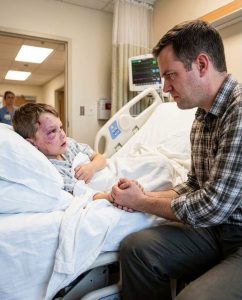
Now he was in a hospital bed with a serious concussion, his face swollen and bruised, while I tried to understand how three grown men from his own family could hold him down for his grandfather.
The hospital lights were the first thing that stayed with me.
Not the footsteps in the hall, not the rolling carts, not the voices behind curtains, but the fluorescent bulbs buzzing overhead while everything I knew about my family seemed to come apart underneath them.
My phone kept vibrating in my pocket.
Christine had called eight times.
I knew because I had looked at the screen each time without answering.
My wife was not sitting beside me.
She had not followed the ambulance.
She had not shown up in the waiting room asking which doctor had seen our son or whether the scans were back.
She was still at her father’s house, the place Jake had somehow managed to escape after being hurt.
That fact kept returning no matter how hard I tried to focus on the doctors.
A neighbor had found Jake alone on the sidewalk, struggling to stay upright with one sneaker missing and blood near his ear.
The same kid who normally filled our living room floor with Lego pieces and ran from room to room like he had unlimited energy had barely been able to stand.
I kept imagining the missing sneaker.
It was such a small thing compared with the concussion, the bruises, and the fear, but maybe that was why it got to me.
Kids lose shoes when they are playing too hard, racing through sprinklers, or piling into the back seat after practice.
Jake had lost his while trying to get away from people he should never have needed to fear.
The doctor told me he had a serious concussion and needed more scans because they were watching for swelling.
I listened.
I nodded when I was supposed to nod.
I asked the questions I could manage.
But there was a strange distance between hearing medical words and accepting that they belonged to your child.
That morning, Jake had been a kid with a soccer schedule.
That night, he was a patient.
When the doctor finally told me he was awake and asking for me, I had to make a decision before I entered the room.
I could carry my anger through that door, or I could leave it in the hallway long enough to be the father Jake needed.
So I pushed it down.
Not because it was gone.
Because my son had already spent enough time around angry adults.
His face looked worse up close.
One side was swollen, purple bruising spread across his skin, small cuts marked his cheek, and dried blood sat near his hairline.
Then he looked at me and said, “Dad…”
That one word nearly took my legs out from under me.
I sat beside the bed and took his hand carefully.
“I’m here, buddy. I’ve got you.”
His fingers closed around mine harder than I expected.
“I tried to run,” he whispered.
I wanted to tell him he never should have needed to.
I wanted to tell him none of those men deserved to breathe the same air as him.
Instead, I asked what happened.
Jake told me his grandfather had gotten angry.
“He said you think you’re better than everybody.”
I kept my voice level.
“What happened next?”
Jake swallowed before answering.
“Uncle Brian grabbed my arms…and Uncle Scott held my legs.”
There are moments when a room seems to physically change around you even though nothing has moved.
The bed was still there.
The monitor was still there.
The hallway was still beyond the door.
But after Jake said those words, I could no longer think of Brian and Scott as difficult relatives, loud family members, or men I had disagreed with before.
They were grown men who had used their strength to keep an eight-year-old child from getting away.
Then Jake told me what his grandfather had done.
“Grandpa slammed my head on the driveway.”
For a second, the only thing I could feel clearly was Jake’s hand inside mine.
I held on to that.
I needed something physical to remind me where I was and what mattered most.
Jake wasn’t telling me the story because he wanted revenge.
He was telling me because he needed his dad to understand what had happened when his dad wasn’t there.
Then he repeated what his grandfather had said to him.
“Your daddy isn’t here to protect you.”
That line did something to me that the description of the attack hadn’t.
The violence was horrible enough, but those words told me the humiliation had been deliberate.
Jake had not only been hurt.
He had been made to believe that the person he depended on most had abandoned him.
I leaned down and kissed the side of his forehead that wasn’t injured.
“I’ll always come for you.”
His eyes shifted before he spoke again.
“Mom didn’t stop them.”
I wish I could say I had an answer ready.
I didn’t.
There was nothing a father could say in that moment that would erase the fact that Jake believed his mother had watched and failed to stop what was happening.
I did not know what Christine would eventually say about that night.
I did not know what explanation she believed she had.
All I had was my son’s account, my wife’s absence from the hospital, and eight missed calls glowing on my phone.
Those were facts.
And facts were suddenly the only things I trusted.
I stepped into the hallway for a moment, but I kept looking back through the glass.
Jake was watching the doorway.
He was checking whether I was still there.
That hurt almost as much as anything he had told me.
Before that night, I would have thought a father proved himself through the big things: earning enough, showing up to games, fixing whatever broke around the house, keeping promises that sounded important when you made them.
In that hospital, fatherhood had become much simpler.
Stay where your son can see you.
My phone was still in my hand.
Christine’s name was there.
So was her father’s number.
I called neither of them.
Arguing with people who already knew a child had been hurt would not make Jake safer, and rage would not tell me what I needed to know.
Instead, I opened an encrypted app I had not touched in years.
The contact I found inside did not have a name attached to it.
It didn’t need one.
I knew who was on the other end before I pressed the button.
That contact belonged to a part of my life I had deliberately walked away from.
I had made myself a promise that I would never go back to it.
Christine knew me as the man who came home, worried about schedules, handled ordinary problems, and tried to build an ordinary life around his family.
Her relatives had apparently decided that ordinary meant weak.
They had seen a suburban father and assumed there was nothing underneath that life except whatever they could see from the outside.
They were wrong about one thing that mattered.
The past I had buried had not taught me how to explode when I was angry.
It had taught me how dangerous anger could become when it replaced thinking.
It had taught me to pay attention to the part of a story people rushed past, to separate what somebody claimed from what could actually be established, and to stop wasting energy on threats when the truth itself could change what happened next.
That was why I made the call.
The connection opened almost immediately.
A familiar voice answered.
“I was wondering if I’d ever hear from you again.”
I looked through the glass at Jake.
He had pulled the blanket closer around himself.
“I need your help,” I said.
There was a pause before the voice asked the question I had known was coming in one form or another.
“Who are we dealing with?”
I answered with the only list that mattered.
My father-in-law.
His sons.
And Christine.
I expected the person on the other end to ask what the men had done, whether I was sure, or what I wanted done about it.
Instead, the first real question was about Jake.