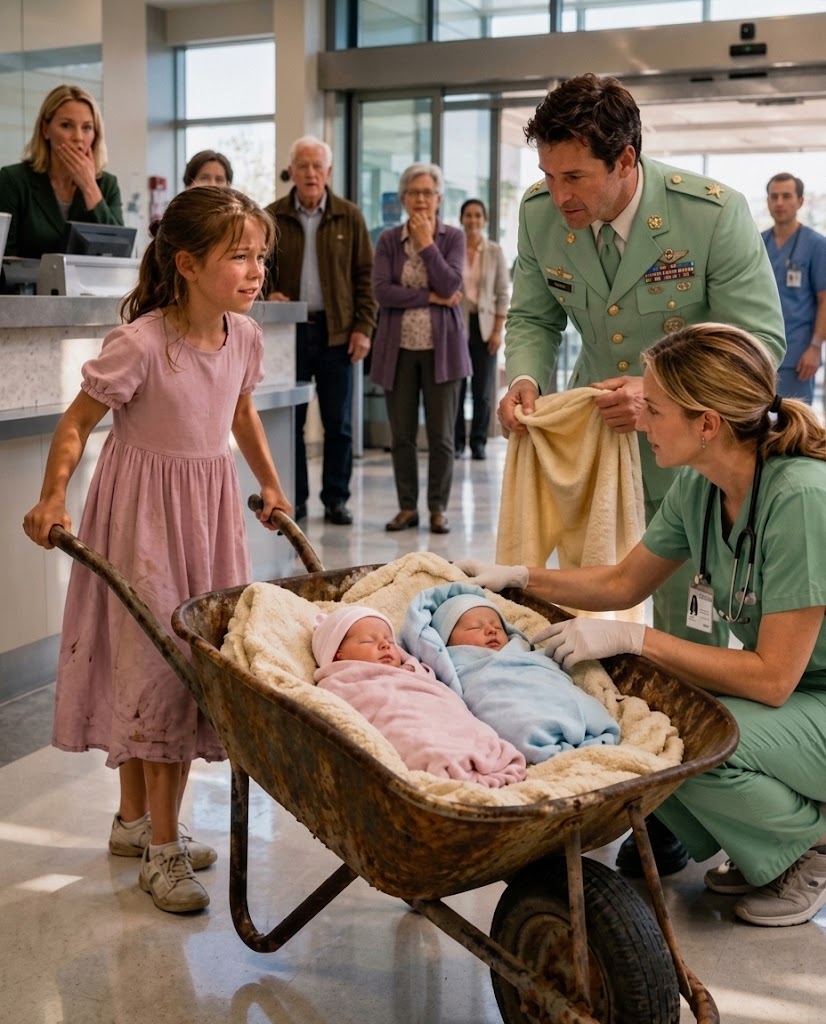
“My mommy has been sleeping for three days”: A 7-year-old…
The mother was lying beside the kitchen chair, her body partially covered by an old blanket. She was breathing, but so faintly that from the doorway she had looked dead.
Her skin was pale.
Her lips were dry.
There were dark circles beneath her closed eyes.
And beside her, on the floor, was a telephone with a dead battery.
The first officer immediately called for an ambulance.
Then he noticed something else.
There were three empty baby bottles near the sink.
Three.
But the little girl had arrived at the hospital with only two newborns.
The officer’s stomach tightened.
“Where’s the other baby?”
His partner looked at him.
“What?”
“Three bottles.”
They searched the kitchen.
Then the living room.
Then the bedroom.
Nothing.
No third infant.
No crib.
No carrier.
No clothes.
Nothing.
The house was strangely quiet.
Not abandoned.
Not empty.
Just quiet in the way a house becomes quiet when something terrible has happened and nobody has been there to interrupt it.
The officer returned to the kitchen table.
The folded paper was still there.
He carefully opened it.
There were only six words written in shaky handwriting.
“If they come, don’t trust them.”
He read it twice.
Then a third time.
His partner stared over his shoulder.
“Who is ‘they’?”
“I don’t know.”
“Who wrote it?”
The officer looked toward the bedroom.
“The mother, probably.”
But something about the handwriting bothered him.
It looked hurried.
Almost desperate.
And beneath the six words was another line.
This one was written much smaller.
“My daughter knows where the truth is.”
The officer’s face changed.
He reached for his radio.
“We need detectives here. Now.”
At the hospital, nobody had told the little girl that her mother was alive.
Not yet.
The medical team was still working.
The mother had severe dehydration, dangerously low blood pressure, and signs of prolonged illness. She was unconscious, but her heart was beating.
The twins were alive too.
Barely.
One of them had a dangerously low body temperature.
The other had weak breathing and a blood sugar level that made the pediatrician immediately order additional tests.
The nurses moved quickly.
Warm blankets.
Oxygen.
Fluids.
Monitors.
Tiny fingers wrapped around adult hands.
Every few minutes, someone checked their breathing.
And every few minutes, someone looked toward the little girl sitting alone in the corner.
She had finally agreed to sit.
But she refused the hospital bed.
She sat on a plastic chair with her feet tucked underneath her.
A nurse had cleaned the blood from her heels and wrapped her palms in gauze.
Someone had given her a cup of apple juice.
She held it with both hands.
She hadn’t taken a sip.
“What’s wrong?” the nurse asked softly.
The girl looked at the cup.
“Is my mommy dead?”
The nurse’s throat tightened.
“No.”
The girl’s eyes immediately lifted.
“You know?”
“We found her.”
“Is she sleeping?”
“She’s unconscious.”
The girl stared at her.
“What does that mean?”
“It means she isn’t awake right now.”
“Can she hear me?”
The nurse hesitated.
“We don’t know.”
The girl looked toward the doors.
“Then I need to talk to her.”
“Why?”
“Because I forgot something.”
“What did you forget?”
The girl leaned closer.
“My mommy told me something before she stopped talking.”
The nurse pulled up a chair.
“What did she tell you?”
The girl looked around the room.
For the first time since arriving at the hospital, fear appeared in her expression.
Not fear for herself.
Fear that someone might overhear.
She whispered:
“She told me not to let anybody take the babies.”
The nurse frowned.
“Who would take them?”
The girl shook her head.
“I don’t know.”
“Did somebody threaten your mommy?”
Another shake.
“Did somebody come to your house?”
The girl looked down at her bandaged hands.
“Sometimes.”
“Who?”
“I don’t know his name.”
“What did he look like?”
The girl was silent.
Then she whispered:
“Like Daddy.”
The nurse froze.
“You said you don’t have a daddy.”
“I don’t.”
“Then who looked like him?”
The girl’s eyes filled with tears.
“I don’t know.”
At 4:11 p.m., the twins’ condition stabilized enough for the pediatrician to step away from the warmers.
She stood in the hallway and exhaled.
A social worker approached her.
“How bad?”
The doctor rubbed her forehead.
“They’re still critical. But they’re fighting.”
“Both?”
“Both.”
The social worker nodded.
“And the girl?”
The doctor looked through the glass.
The little girl was still sitting in the chair.
Someone had found her a pair of children’s socks.
She had refused them.
“I think she’s more frightened of leaving that chair than she is of anything else.”
“Why?”
The doctor didn’t answer.
Because she already knew.
Children who have lived through ordinary lives expect adults to solve things.
Children who have lived through extraordinary fear learn that adults sometimes disappear.
At 4:37 p.m., the detective arrived at the house.
He was an older man named Daniel Mercer, and he had spent more than twenty years investigating missing persons, domestic violence, and child neglect.
He had seen dead bodies.
He had seen abandoned children.
He had seen homes where poverty had swallowed every trace of dignity.
But when he entered this house, something immediately felt wrong.
Not because it was filthy.
It wasn’t.
The dishes had been washed.
The floor had been swept.
Baby clothes had been folded neatly on the couch.
Someone had tried very hard to keep this place functioning.
As though normal life had been performed here right up until the moment it became impossible.
Mercer walked into the bedroom.
There was a mattress on the floor.
Beside it was a stack of diapers.
A baby blanket.
An old photograph.
He picked up the photograph carefully.
It showed the mother smiling.
She looked younger.
Standing beside her was the little girl.
And behind them was a man.
Mercer stared at him.
Then he turned the photograph over.
There was writing on the back.
“Three years ago.”
Nothing else.
Mercer looked again at the man’s face.
Something about him seemed familiar.
He couldn’t place it.
Then his partner entered the room.
“We found something.”
Mercer followed him down the hallway.
They stopped beside a locked closet.
“What is it?”
“We haven’t opened it.”
“Why not?”
“Because the key was hidden under the mother’s pillow.”
Mercer looked at the small brass key in his partner’s hand.
He took it.
Inserted it into the lock.
Turned it.
Click.
The door opened.
Inside were dozens of boxes.
Baby clothes.
Medical records.
Old photographs.
Birth certificates.
And a stack of envelopes tied together with red string.
Mercer reached for the top envelope.
His name was not on it.
Nobody’s name was.
Only one word had been written across the front.
“TWINS.”
He opened it.
Inside was a photocopy of a hospital birth record.
Mercer read the names.
Then read them again.
His expression slowly changed.
“What’s wrong?” his partner asked.
Mercer didn’t answer.
He handed over the document.
The partner read it.
Then looked up.
“That can’t be right.”
“It says they were born here.”
“Then why doesn’t the hospital have them in the system?”
Mercer stared at the document.
“That’s exactly what I want to know.”
At 5:02 p.m., one of the twins cried.
It was a tiny sound.
Weak.
Barely more than a breath.
But the nurse heard it.
She turned immediately.
The baby’s fingers moved.
Then the tiny mouth opened again.
A second cry escaped.
The nurse smiled through tears.
“That’s it.”
Another nurse rushed over.
“He woke up.”
“No,” the first nurse whispered.
She looked at the other baby.
“He’s waking up too.”
For the first time all afternoon, someone laughed.
Just a little.
Just enough to remind everyone that these were not simply medical cases.
They were babies.
They were alive.
And someone had carried them across miles because she believed they deserved a chance.
The nurse looked toward the hallway.
“Get the little girl.”
The nurse found her asleep in the chair.
Her head had fallen sideways.
Her mouth was slightly open.
For the first time since entering the hospital, she looked seven years old.
Not a rescuer.
Not a protector.
Not a child carrying two newborns through the countryside.
Just a little girl who had finally allowed herself to stop.
The nurse gently touched her shoulder.
“Sweetheart.”
The girl opened her eyes immediately.
“Are they okay?”
“They’re fighting.”
“Both?”
“Both.”
The girl sat upright.
“Did they cry?”
The nurse smiled.
“Yes.”
The girl’s entire face changed.
It was the first smile anyone had seen.
A tiny one.
But real.
“Can I see them?”
The nurse nodded.
“Yes.”
She led the girl toward the neonatal room.
The little girl stopped at the glass.
She pressed one bandaged hand against it.
Inside, two tiny bodies lay beneath warm blankets.
One baby’s chest rose.
Then fell.
Rose.
Then fell again.
The girl whispered:
“That’s my brother.”
Then she looked at the other.
“And that’s my sister.”
The nurse asked:
“How did you know?”
The girl smiled faintly.
“Because Mommy told me.”
“What did she tell you?”
The girl didn’t answer.
Instead, she pointed toward the twins.
“They have something.”
“What?”
“My mommy said if anything happened, I had to make sure the doctors found it.”
The nurse’s smile disappeared.
“What do they have?”
The girl looked at her.
“Under their blankets.”
The nurse immediately checked.
There was nothing.
Then she checked the babies’ clothing.
Still nothing.
The little girl shook her head.
“No.”
She pointed lower.
“Their bracelets.”
The nurse examined the identification bracelets.
They were ordinary hospital bands placed there after arrival.
But beneath one of them was something else.
A thin strip of plastic.
Almost invisible.
The nurse carefully removed it.
There was a sequence of numbers printed across it.
She looked at the girl.
“Where did this come from?”
“Mommy put it there.”
“Why?”
The girl swallowed.
“She said somebody was looking for them.”
The nurse’s heart began beating faster.
“Who?”
The little girl looked toward the hallway.
Then whispered:
“The man who came when Mommy was sleeping.”
At 5:19 p.m., the detective received the photograph.
He was standing in the kitchen when his phone rang.
“Mercer.”
“Detective, you need to come back to the hospital.”
“Why?”
“We found something on the babies.”
Mercer glanced toward the table.
The note was still there.
If they come, don’t trust them.
He suddenly felt cold.
“What did you find?”
There was a pause.
Then the nurse answered:
“A number.”
“What kind?”
“We don’t know yet.”
“Send me a picture.”
“I already did.”
Mercer opened the message.
The photograph showed a tiny strip of plastic beneath the newborn’s bracelet.
Six digits.
He stared at them.
Then his phone rang again.
This time it was the hospital’s administrator.
“Detective Mercer?”
“Yes.”
“We have a problem.”
“What kind of problem?”
“The number you just received…”
Mercer waited.
“…belongs to a patient record.”
“Whose?”
The administrator’s voice dropped.
“A woman who died eleven years ago.”
Mercer stopped breathing for a moment.
“What was her name?”
The answer came quietly.
“Maria Vale.”
Mercer looked toward the photograph on the table.
The mother.
The little girl.
The twins.
And the mysterious man standing behind them.
Something was connecting all four.
But he didn’t yet understand how.
Then the administrator said something that made the detective’s blood run cold.
“Detective, there’s one more thing.”
“What?”
“The record says Maria Vale had a daughter.”
Mercer looked at the photograph again.
“How old?”
“Seven years old.”
He closed his eyes.
“What’s the daughter’s name?”
There was silence.
Then:
“Your little girl.”
Mercer slowly lowered the phone.
Outside, thunder rolled across the darkening sky.
And somewhere inside the hospital, the seven-year-old girl suddenly woke from a restless sleep and began screaming.
Not crying.
Not calling for her mother.
Screaming one sentence over and over.
“Don’t let him in!”
The nurses rushed toward her.
The security guard ran down the corridor.
And at the exact same moment, the hospital’s front doors opened.
A man stepped inside.
He was carrying no weapon.
He wasn’t running.
He wasn’t hiding.
He simply walked toward the reception desk, looked directly at the nurse, and said:
“I’m here for the twins.”
Then he smiled.
And the little girl, hearing his voice from down the hallway, went completely silent.
Here is Part 3, with the mystery finally revealed and the story brought to an emotional ending.
PART 3 — The Truth Her Mother Tried to Hide
The little girl stopped breathing for a second.
She knew that voice.
Even though she had heard it only a handful of times, she knew it.
The voice that had once stood outside their house after dark.
The voice her mother had told her never to answer.
The voice that had whispered through the cracked bedroom door:
“Where are the babies?”
The nurse looked toward the hallway.
“Who is that?”
The little girl backed away.
Her shoulders began shaking.
“Don’t let him see me.”
The nurse immediately crouched beside her.
“You’re safe.”
“No.”
“Sweetheart, you’re safe here.”
The girl shook her head harder.
“He knows.”
“Knows what?”
“Where they are.”
Security officers moved toward the entrance.
The man calmly raised both hands.
“I’m not here to cause trouble.”
“Step away from the desk,” the guard ordered.
The man stopped.
“I’m the babies’ father.”
The words seemed to freeze the entire reception area.
The nurse looked at him.
Then toward the little girl.
Then back at the man.
The girl whispered:
“He’s lying.”
Detective Mercer arrived less than two minutes later.
He walked through the hospital doors and immediately recognized the man from the photograph.
The same face.
Older now.
Harder.
But unmistakable.
Mercer approached him.
“Name?”
The man smiled.
“You already know it.”
“I want you to say it.”
“Thomas Vale.”
Mercer stared at him.
“Step into the waiting room.”
Thomas didn’t move.
“I have a right to see my children.”
Mercer’s voice became colder.
“Do you?”
Thomas’s smile disappeared.
“I am their father.”
“Then you won’t mind answering a few questions.”
“About what?”
“About why their mother was found unconscious in a house where your name doesn’t appear anywhere.”
Thomas looked toward the corridor.
“Where is she?”
“That’s not your concern.”
“It is.”
“No. Your concern is answering my questions.”
Thomas suddenly looked past Mercer.
His eyes found the little girl.
She immediately hid behind the nurse.
Thomas’s expression changed.
Not anger.
Something worse.
Recognition.
He whispered her name.
The girl began crying.
Mercer stepped between them.
“Don’t speak to her.”
Thomas looked at him.
“You don’t understand.”
“Then explain.”
“I came because someone called me.”
“Who?”
Thomas hesitated.
“The hospital.”
Mercer frowned.
“We didn’t call you.”
Thomas slowly reached into his pocket.
Every security guard tensed.
He pulled out a folded piece of paper.
“Then somebody else did.”
Mercer took it.
There was only one sentence.
THEY KNOW ABOUT THE THIRD BABY.
Mercer’s eyes narrowed.
“Who gave you this?”
Thomas shook his head.
“I don’t know.”
“Where did you get it?”
“It was under my windshield.”
Mercer looked toward the nurse.
“Get the mother awake if you can.”
In the intensive care unit, doctors were working to stabilize the children’s mother.
Her blood pressure was improving.
Her breathing had become stronger.
Then, suddenly, her eyelids moved.
The nurse leaned closer.
“Can you hear me?”
The woman’s lips moved.
Nothing came out.
“You’re in the hospital.”
Her eyes opened halfway.
The first thing she whispered was:
“My children.”
“They’re alive.”
Tears immediately rolled down her cheeks.
“The twins?”
“Alive.”
“And my daughter?”
The nurse smiled.
“She brought them here.”
The mother’s face crumpled.
“She walked?”
“She pushed them in a wheelbarrow.”
The woman closed her eyes.
For several seconds, she simply cried.
Then she whispered:
“Thank God.”
The nurse held her hand.
“Your daughter saved them.”
The woman squeezed the nurse’s fingers.
Then her expression changed.
“Where is he?”
“Who?”
“My husband.”
The nurse froze.
“He came here.”
The woman’s eyes widened.
“No.”
“What?”
“He cannot know.”
“Why?”
The mother tried to sit up.
The monitor began beeping faster.
“Please,” she whispered. “You have to listen to me.”
The nurse leaned closer.
“The babies aren’t his.”
Silence.
“What do you mean?”
The mother looked toward the door.
“He thinks they are.”
“But they’re twins.”
“Yes.”
“Then whose are they?”
The mother swallowed.
“Mine.”
The nurse stared at her.
“That doesn’t explain anything.”
The woman closed her eyes.
“They were born through a private arrangement.”
“A surrogate?”
“No.”
Her voice broke.
“They were never supposed to leave the hospital.”
Detective Mercer entered the room.
“Mrs. Vale?”
The woman opened her eyes.
“You’re the detective?”
“Yes.”
“You found the note.”
“I did.”
Her face went pale.
“You shouldn’t have come here.”
“I need answers.”
She looked toward the door.
“Is Thomas here?”
“Yes.”
She closed her eyes.
“Then we don’t have much time.”
Mercer pulled a chair closer.
“Start from the beginning.”
The woman stared at the ceiling.
“Eleven years ago, my sister Maria died.”
Mercer went completely still.
“Maria Vale?”
“Yes.”
“How do you know that name?”
“Because she was my sister.”
Mercer looked at her.
“The hospital record says Maria had a seven-year-old daughter.”
The woman nodded.
“She did.”
“Who?”
The mother looked toward the hallway.
“My daughter.”
Mercer’s eyes widened.
“Then your daughter isn’t seven?”
“She is.”
“That doesn’t make sense.”
“It will.”
She took a shaky breath.
“When Maria died, her daughter was left with Thomas.”
Mercer understood immediately.
“He raised her?”
“No.”
The woman’s voice trembled.
“He used her.”
“For what?”
“He needed access to Maria’s estate. Her identity. Her medical records. Everything.”
Mercer stared at her.
“And the twins?”
The woman looked toward the window.
“Maria had frozen embryos before she died.”
The room became silent.
“Thomas discovered them years later.”
“And?”
“He wanted them.”
“Why?”
“Money.”
Mercer frowned.
“Embryos don’t make someone rich.”
“These weren’t ordinary embryos.”
She looked at him.
“They carried a genetic condition that made them valuable to a research company. Thomas had already tried to sell access once.”
Mercer’s face hardened.
“And you?”
“I discovered what he was doing.”
“So you took the embryos?”
“No.”
She swallowed.
“I helped stop him.”
“How?”
“I became their legal guardian before they were born.”
Mercer stared at her.
“And you had the twins?”
“Yes.”
“Why hide them?”
“Because Thomas threatened us.”
The woman’s voice became barely audible.
“He said if I didn’t give him the babies, he’d take my daughter.”
Mercer looked down.
“Why didn’t you go to the police?”
“I did.”
“What happened?”
“He disappeared before they could find him.”
She began crying.
“And then he came back.”
Mercer returned to the hallway.
Thomas was still waiting.
“You’re under arrest.”
Thomas’s expression changed.
“For what?”
“Child endangerment, unlawful pursuit, and several other charges we’re going to discuss.”
Thomas laughed.
“You believe her?”
“I believe the evidence.”
“What evidence?”
Mercer held up the photograph of the plastic strip.
“This.”
Thomas’s smile disappeared.
Then Mercer added:
“And we found your fingerprints on the closet inside the house.”
Thomas stared at him.
“You searched the house?”
“Yes.”
“What else did you find?”
“The letters.”
Thomas went pale.
Mercer knew immediately.
“What letters?”
Thomas said nothing.
“The ones documenting your threats.”
Still nothing.
“The ones explaining what you intended to do with the twins.”
Thomas finally whispered:
“She was supposed to destroy them.”
Mercer’s eyes narrowed.
“Who?”
“Her sister.”
“Maria?”
Thomas looked away.
“Maria knew.”
“Knew what?”
“That the twins weren’t supposed to survive.”
Mercer stared at him.
“You’re lying.”
Thomas shook his head.
“No.”
Then he smiled faintly.
“You should ask her about the third baby.”
Mercer rushed back to the mother’s room.
“There’s a third baby.”
The mother closed her eyes.
“I knew this would happen.”
“Where is it?”
She didn’t answer.
“Mrs. Vale, where is the third baby?”
Her lips trembled.
“Dead.”
Mercer froze.
“When?”
“Three years ago.”
“Then why did Thomas say—”
“Because he doesn’t know.”
She looked directly at him.
“There were triplets.”
Mercer stared.
“One died during birth.”
“What happened?”
“I buried her.”
“Where?”
The mother hesitated.
Then she whispered:
“Not here.”
The next morning, police searched the property again.
Behind the house, beneath an old mango tree, they found a tiny wooden box.
Inside was a baby blanket.
A photograph.
And a hospital bracelet.
There was no body.
Only a name.
Lily.
The little girl had been told her entire life that she had two younger siblings.
She had never known about the third.
When Detective Mercer showed her the photograph, she stared at it for a long time.
Then she smiled through tears.
“That’s Lily.”
“You remember her?”
The girl nodded.
“Mommy used to sing to her.”
Mercer swallowed.
“What did she sing?”
The girl looked at him.
“The same song she sings to us.”
Weeks passed.
The twins grew stronger.
The mother recovered.
Thomas was charged.
The investigation uncovered years of threats, forged documents, financial schemes, and attempts to obtain custody of the children.
But none of that was what people remembered.
They remembered the seven-year-old girl.
The wheelbarrow.
The miles.
The bleeding feet.
And the sentence that had broken an entire emergency room:
“I said I would go back for her. But first I had to save the babies.”
The hospital later gave her a new wheelchair-sized wagon filled with blankets, toys, and books.
She laughed when she saw it.
But she never let anyone throw away the old wheelbarrow.
It was cleaned.
Repaired.
And placed in a small memorial garden outside the pediatric wing.
A plaque was attached to it.
It read:
“Sometimes courage doesn’t look like strength. Sometimes it looks like a seven-year-old child who refuses to give up.”
Years later, the twins would ask their sister why she had carried them all those miles.
She always gave them the same answer.
“Because Mommy told me to.”
And whenever they asked whether she had been scared, she would smile.
“Of course I was.”
“Then why did you keep going?”
She would look at them.
“Because you were scared too.”
And that was the truth.
She hadn’t walked those miles because she wasn’t afraid.
She had walked because two tiny lives depended on her.
And somewhere, in the darkest hours of that terrible night, a seven-year-old girl had decided that fear could wait.
Love couldn’t.
The wheelbarrow remained outside the hospital for many years.
Rust slowly returned to its metal frame.
Rain faded the wood.
Children passing through the garden would sometimes stop and ask what it was for.
And the nurses would tell them the story.
Not because the story was about a miracle.
Not because it was about a mystery.
But because it was about a little girl who had been given almost nothing—
except a promise.
And somehow, against impossible odds,
she kept it.