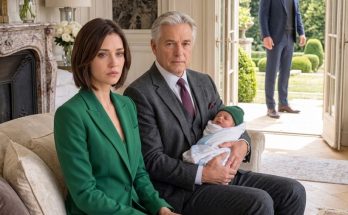
My father leaned toward my mother at my college graduation, looked straight at my wrinkled gown, and whispered, “We’re
finally done wasting money on this failure.”
He thought I would cross the stage, take a cheap diploma, and disappear.
Then the dean lifted a crystal award into the lights, and the woman from Harvard Medical School stood up with the crimson
folder I had hidden from my family for six months.
I was twenty-two, wearing heels that pinched and a smile I had practiced in bathroom mirrors for years.
Around us, other families carried roses, balloons, and pride.
Mine carried impatience.
My mother checked her watch before the ceremony even started.
“Let’s keep this quick,” she muttered. “We have dinner reservations.”
No one asked whether I was coming.
My older brother Marcus arrived late in sunglasses, indoors, with the expensive camera Dad bought him after his first
semester at Harvard Law.
He used it to photograph himself in the lobby mirror before he aimed it anywhere near the stage.
Marcus was the family masterpiece.
He got the steakhouse birthdays, the BMW, the applause, the rescue money, and the endless second chances.
At twenty-eight, he was still living in my parents’ pool house, still “finding himself,” and somehow still treated like the future.
I was the daughter with a studio apartment, a coffee-stained apron, and a degree they called “that science thing.”
They never asked what molecular biology meant.
They never asked why I came home smelling like espresso at dawn and lab chemicals after midnight.
They never asked how I covered tuition after they quietly stopped helping.
They only called when they needed somebody blamed.
So I learned to keep important things silent.
Like the late-night calls from Boston.
Like the interviews I took in the stairwell outside my apartment so my neighbors wouldn’t hear me shaking.
Like the email with the crimson crest that I opened six months earlier and read three times before I believed it was real.
I told no one in my family.
Not because I didn’t want to celebrate.
Because every time I handed them a fragile piece of joy, they squeezed until it cracked.
Inside the auditorium, parents waved from every row. Bracelets flashed. Flowers rustled. A father in front of us wiped his eyes before the ceremony even began.
My father flipped through the program like he was waiting for a bill.
My younger sister Emma scrolled through her phone and said, “Can we be done before four? Jessica’s meeting me at the mall.”
I smiled because that was what survival looked like in my family.
Smile.
Sit still.
Swallow it.
Graduate.
Dean Morrison stepped to the podium and began the usual speech about sacrifice, discipline, and the future.
I barely heard him.
I was staring at my hands in my lap, telling myself that once I had my diploma, I could leave the building, go back to my
studio, and pack for a life none of them knew existed.
Then his voice changed.
“Before we confer degrees,” he said, “we are recognizing one student whose work has already reached far beyond this
campus.”
A murmur moved through the room.
He spoke about long nights in the research laboratory.
About protein folding.
About a paper accepted for publication.
About work with potential implications for neurodegenerative disease.
Every sentence tightened around my ribs.
Behind me, someone whispered, “That sounds huge.”
Dean Morrison looked down at the card in his hand.
“Sarah Elizabeth Thompson, please join me onstage.”
For one second, the whole auditorium went silent.
I stood because my body moved before my mind did.
When I turned toward my family, my father’s mouth was open.
My mother had stopped checking her watch.
Marcus lowered his sunglasses.
I walked to the stage hearing every click of my heels against the floor.
Dean Morrison placed a crystal award in my hands. It caught the light like ice.
“Outstanding Undergraduate Research Award,” he said into the microphone. “For exceptional scholarship, discipline, and
work with extraordinary medical promise.”
The applause hit me like heat.
Real applause.
Not pity.
Not politeness.
I looked into the crowd and found my family frozen in the same row where they had been so eager to be anywhere else.
For the first time in my life, they were looking at me the way they had always looked at Marcus.
Like I was suddenly worth seeing.
I should have felt vindicated.
Instead, I felt calm.
Because the award was not the secret.
The award was only the door opening.
Dean Morrison turned back to the microphone.
“There is one more announcement regarding Miss Thompson.”
My pulse slammed once, hard.
In the front row beside Professor Liang, the mentor who had watched me live on vending-machine dinners and
stubbornness, a woman rose to her feet.
Navy suit.
Harvard pin.
Crimson folder in her hand.
Dr. Elaine Porter.
I had seen her face on a screen in my apartment six months earlier when she said the words I had been too afraid to repeat
out loud in case the universe heard me and changed its mind.
My mother went pale before Dr. Porter even reached the stage.
Marcus straightened so fast his sunglasses slipped down his nose.
My father stopped pretending he was bored.
Dr. Porter stepped beside me, shook my hand, and placed the crimson folder next to the crystal award.
Then she looked past me, directly into the row where my family was sitting.
“Before Sarah leaves for Boston,” she said evenly, “there is one detail about her future her family has not heard yet.”
The room went dead quiet.
Dean Morrison moved aside.
Dr. Porter opened the folder to the page with my name on it.
And Marcus’s camera slid from his hand and struck the auditorium floor.
“Sarah Thompson has been admitted to Harvard Medical School,” Dr. Porter announced, “with a full scholarship covering
tuition, housing, and research support.”
The sound that followed seemed to lift the ceiling.
Students cheered.
Professors stood.
Professor Liang pressed both hands to her mouth.
Somebody behind my family shouted, “That’s incredible!”
Dr. Porter explained that I had been chosen not only for my academic record, but for the resilience I had shown while
working and living independently.
Professor Liang looked at me, and I knew what she was remembering.
The night she found me asleep on the laboratory floor with my backpack under my head.
The morning I fainted during a presentation because I had lived on coffee and half a bagel for two days.
The semester I nearly withdrew after my father canceled the tuition payment he had promised to make.
He called it teaching me responsibility.
Professor Liang called it an emergency.
She helped me appeal for aid, found me a paid research assistant position, and quietly began leaving containers of food in
the faculty refrigerator with my name written on them.
My parents knew none of that.
They had not wanted to know.
When Dr. Porter handed me the folder, I saw my father rise from his seat.
“Sarah,” he called.
His voice carried farther than he intended.
Heads turned.
Dean Morrison looked at me, silently asking whether I wanted him to intervene.
For most of my life, I would have rushed to my father before he could become angry.
That day, I did not move.
Dr. Porter leaned toward me.
“You don’t owe anyone an immediate response,” she whispered.
It was such a simple sentence.
But no adult had ever said it to me before.
I turned toward the microphone.
“I wasn’t planning to speak,” I said.
The room quieted again.
My father remained standing.
My mother gripped his sleeve.
“I know graduation speeches are supposed to be about gratitude,” I continued. “And I am grateful. I’m grateful to Professor
Liang, who noticed when I was struggling before I knew how to ask for help. I’m grateful to the financial-aid office, the café
manager who scheduled me around lab hours, and the classmates who shared notes and meals when I was too tired to
admit I needed either.”
Professor Liang’s eyes filled.
I swallowed.
“My family believes they paid for this degree.”
My father’s face changed.
I saw the warning in his eyes.
Stop.
Do not embarrass us.
Protect the family.
It was the command under every command I had ever obeyed.
I looked at him and kept going.
“They stopped helping halfway through my second year. I worked mornings at a café, evenings in the library, and weekends
in a grocery store. I took loans. I won grants. I cleaned laboratory equipment for additional hours. The people who made
today possible are the people who helped me stand when I was already standing alone.”
A silence settled over the auditorium.
It was not uncomfortable.
It was attentive.
My father’s cheeks darkened.
“This isn’t the place,” he said.
His voice was lower now, but everyone near him heard.
I met his eyes.
“You’re right.”
For one hopeful second, he thought I was surrendering.
“The place was every dinner where you called me a failure. Every birthday when you compared me to Marcus. Every phone
call when you told me my work was useless. But you chose public contempt today, so the truth became public too.”
Someone began clapping.
Then another person joined.
Soon the applause spread again, slower this time, less celebratory and more deliberate.
My father sat down.
I thanked Dean Morrison, hugged Professor Liang, and walked off the stage carrying the crystal award and the crimson
folder against my chest.
My mother reached for my hand when I returned to the aisle.
I moved past her.
For the remainder of the ceremony, my family sat in rigid silence.
Marcus did not take a single photograph.
When my name was called for my degree, my classmates cheered loudly enough to make me laugh.
Professor Liang stood again.
My family remained seated until they realized people were looking at them.
Then my mother sprang up and clapped with a bright, frantic smile, as though she could rewrite the previous four years by
applauding for seven seconds.
After the ceremony, the courtyard filled with graduates and families.
Flowers changed hands.
Parents cried.
Cameras flashed beneath the afternoon sun.
I stood with Professor Liang and Dr. Porter near the science building while Dean Morrison took our photograph.
Professor Liang adjusted my hood and whispered, “I always knew.”
Those four words nearly broke me.
Not because I had never heard praise.
Because she said it as if believing in me had required no effort at all.
My father pushed through the crowd before the photograph was finished.
“Sarah, we need to talk.”
Dr. Porter glanced at me.
“I’m fine,” I said.
She nodded but did not leave. Neither did Professor Liang.
My mother, Marcus, and Emma followed several steps behind.
My mother’s expression had transformed from boredom into wounded concern.
“Why didn’t you tell us?” she asked.
Not congratulations.
Not we’re proud of you.
Why didn’t you tell us?
I looked at the roses in other graduates’ arms.
“You never asked.”
“That is not fair,” she said immediately. “We’re your parents.”
“Exactly.”
My father lowered his voice.
“You made us look like monsters in there.”
“I repeated what happened.”
“You humiliated your mother.”
My mother touched his arm, accepting the role he offered her.
I almost admired the efficiency of it.
In less than ten minutes, they had turned my achievement into their injury.
Marcus stepped forward.
“So you’re really going to Harvard?”
His tone held disbelief and something sharper.
Possession.
As if Harvard belonged to him because he had attended law school there for one semester before withdrawing.
“Yes.”
“What program?”
“Medicine.”
“I heard that part,” he snapped. “I mean what specialty?”
“I won’t choose a specialty for years.”
He frowned as if my answer proved I was unprepared.
Dad glanced toward Dr. Porter.
He was calculating.
My mother did it next.
Her posture softened. Her voice became sweet.
“Boston is expensive. You’ll need help moving. Your father has contacts there. Marcus knows the area.”
Marcus had spent nine months in Cambridge and most of them avoiding class.
“I have arrangements,” I said.
“Family matters, Sarah. Whatever disagreements we’ve had, we should present a united front.”
“A united front to whom?”
His jaw tightened.
“The community. Our friends. People are going to hear about this.”
There it was.
Not my future.
His reputation.
My mother took my arm gently.
“We only pushed you because we knew you were capable of more.”
I removed her hand.
“You called my degree pointless.”
“We didn’t understand it.”
“You could have asked.”
“You were always so secretive.”
“I became secretive because you punished anything that wasn’t Marcus.”
Marcus laughed once, without humor.
“Oh, please. You’ve always been jealous of me.”
The old accusation landed between us.
For years, it had worked.
Whenever I objected to the BMW, the private tutors, the rent-free pool house, or the money Dad used to cover Marcus’s
gambling debts, I was jealous.
Whenever Marcus forgot my birthday or mocked my job, I was sensitive.
Whenever he failed, he was under pressure.
Whenever I succeeded, I was showing off.
I looked at him standing in the graduation courtyard wearing a Harvard Law sweatshirt from a school he had left six years
earlier.
“No,” I said. “I wanted what you had.”
His smile returned.
Then I finished.
“Parents.”
The word struck harder than shouting would have.
Marcus looked at Dad.
Dad looked at me.
My mother’s face folded as though I had slapped her.
Professor Liang placed a hand against my back.
Dad pointed toward the parking lot.
“We are not doing this in public.”
“I’m not going anywhere with you.”
“We have dinner reservations.”
“You said you wanted this to be quick.”
“Sarah,” my mother hissed.
I shifted the award in my hands.
“I’m having dinner with Professor Liang, Dr. Porter, and the research team.”
Dad stared at Professor Liang as if she had stolen me.
“We are her family.”
Professor Liang’s reply was quiet.
“Then today would have been an excellent day to act like it.”
My father’s face turned purple.
Dr. Porter stepped between us with professional calm.
“Sarah has a reception to attend. I suggest allowing her to enjoy the remainder of her graduation.”
Dad looked at me again.
“This conversation is not over.”
“For you, maybe.”
Then I turned and walked away.
My knees shook the entire distance to the science building.
That evening, I returned to my apartment and found eleven missed calls.
The family group chat, usually silent unless someone needed something, had exploded. Mom had posted a photograph from
the auditorium.
In it, I stood onstage beside Dr. Porter.
The caption read: Our brilliant Sarah! Harvard Medical School! We always knew she would do something extraordinary.
I stared at the screen until I laughed.
Then I left the group.
My father called again immediately.
This time, I answered.
“What?” he demanded. “You’re too good for your family chat now?”
“I’m too tired for rewriting history.”
“Your mother is devastated.”
“My mother was worried graduation would interfere with dinner.”
“You are twisting everything.”
“No. I’m remembering it.”
He exhaled hard.
“Fine. We made mistakes. Is that what you want to hear?”
An apology shaped like an accusation.
I sat on the edge of my bed.
“What was the last class I took?”
Silence.
“What was my research about?”
Nothing.
“What café did I work at for three years?”
He cleared his throat.
“That’s not the point.”
“What is my apartment number?”
“Sarah.”
“What day am I moving?”
“You haven’t told us.”
“I sent Mom the date three months ago. She replied with a thumbs-up.”
His voice hardened.
“You’ve been building a case against us.”
“No. I’ve been building a life without you. The evidence collected itself.”
He called me ungrateful.
That word no longer controlled me.
“I’m hanging up,” I said.
“If you do, don’t expect us to help when Harvard gets difficult.”
I looked around my studio apartment at the secondhand desk, the stack of medical textbooks, and the two suitcases waiting
by the wall.
“You haven’t helped when anything was difficult.”
I ended the call.
The next morning, Marcus came to my apartment with two coffees and no sunglasses.
It was the first time he had ever visited.
He looked at the peeling paint, the narrow bed, and the boxes stacked against the wall.
“You really lived here alone?”
“For two years.”
He lowered his eyes.
At first, he tried to defend Dad. Then I asked why he had watched them cut off my tuition and said nothing.
Marcus sat at my tiny kitchen table for a long time.
“Because if you were the failure,” he finally said, “I didn’t have to be.”
He admitted that he had left Harvard Law after severe panic attacks. Dad had hidden the truth and kept presenting him as
the family success story. Marcus had treated me cruelly because my determination exposed everything he was afraid to
face.
It did not excuse him.
But it was the first honest thing he had given me.
Before leaving, he handed me the memory card from his camera.
“There’s a picture of you onstage,” he said. “You looked like you belonged there.”
“I did belong there.”
He nodded.
“I know.”
Three days later, Mom arrived with roses.
She had searched her email and found every tuition notice, every unanswered request, and every message she had
dismissed with a thumbs-up.
“I failed you,” she whispered.
For once, I did not rush to comfort her.
“Then tell the truth,” I said. “Tell people you did not pay for my degree. Stop claiming you always believed in me. And when
Dad calls me ungrateful, do not stand beside him.”
She cried, but she agreed.
I still did not let her help me move.
Professor Liang and my classmates loaded the van instead.
Marcus appeared carrying an envelope. Inside was every dollar he had borrowed from me.
He had sold the expensive camera.
“My life needs to stop being funded by everyone else,” he said.
My father never came.
He sent one message telling me I was making a mistake by turning my back on family.
I blocked his number before the van left.
Boston was difficult.
I failed my first anatomy quiz and cried in a library bathroom. I spent months convinced Harvard had admitted the wrong
Sarah Thompson.
Whenever that fear returned, I remembered Dr. Porter saying, “We’ve been waiting for you.”
I remembered Professor Liang saying, “A difficult day is not evidence of a mistaken life.”
Slowly, I stopped hearing my father’s voice whenever I struggled.
Marcus began therapy, moved out of the pool house, and took an entry-level job at a legal clinic.
Emma enrolled in community college and chose nursing without asking Dad’s permission.
Mom left my father, rented a small apartment, and began sending letters that contained no excuses. She learned the title of
my research paper. She remembered my exams. She asked questions and listened to the answers.
Dad remained silent for almost four years.
Then, on the night before my medical school graduation, an email arrived.
I heard you are graduating. I would like to attend. I will understand if the answer is no.
I allowed him to come under one condition: he would sit wherever there was space and would not approach me unless I
approached him.
He agreed.
The next morning, Mom fastened my graduation hood. Marcus held a new, inexpensive camera he had bought with his own
money. Emma arrived in scrubs from her nursing shift. Professor Liang and Dr. Porter stood with them.
Dad sat alone near the back.
When my name was called, the people who had carried me stood.
I crossed the stage and heard the dean say, “Doctor Sarah Thompson.”
Afterward, I found Dad beside a stone wall.
“I was wrong about you,” he said.
“You were wrong to treat me that way,” I answered. “That matters more.”
He lowered his head.
“You’re right.”
No excuse followed.
He handed me the program from my college graduation. My name was circled beneath the research award.
On the back he had written: I finally saw you when everyone else did, and I will regret that for the rest of my life.
“I’m not ready to forgive you,” I said.
“I know.”
“I may never be the daughter you expect.”
“I know.”
“But you can respect the relationship I am willing to offer.”
He nodded and stepped back.
I returned to the people waiting for me.
Marcus raised the camera.
Just before the flash, I thought about the girl in the wrinkled gown who believed success meant proving her father wrong.
She had been mistaken.
Success was no longer needing his judgment at all.
The camera clicked.
And for the first time, the family photograph did not capture the role I had been assigned.
It captured the life I had chosen.
THE END! THANK YOU FOR READING!