My stepson was twenty-one when my husband died after a long illness, leaving me with a three-hundred-and-ninety-thousand-dollar house, more than sixty-eight thousand dollars in unpaid bills,
and a grief so heavy that some mornings I could barely get out of bed. I had helped raise that boy for nearly fifteen years. I had packed his lunches, sat through parent-teacher conferences, stayed
awake when he had fevers, driven him to soccer practice, helped him study for exams, and stood in the front row when he graduated high school. I had never called myself his mother because he
had a mother of his own, but there were years when I had quietly done almost everything a mother would do. So when my husband, Robert, died, I believed the two of us would lean on each other. I
was wrong. Three weeks after the funeral, I sat at the kitchen table with a stack of bills and a calculator. The mortgage was manageable, but the medical debt was frightening. There were hospital
charges, specialist bills, credit-card balances, property taxes, and a line of credit Robert had taken out during his final year of treatment. I added everything twice. Sixty-eight thousand, four
hundred and twelve dollars. I stared at the number until it blurred. Across from me, my stepson, Tyler, was eating cereal and scrolling through his phone. “Tyler,” I said carefully, “we need to talk
about expenses.” He didn’t look up. “About what?” “The house. The bills. Everything your dad left behind.” He sighed. “I know he’s gone, Linda.” “I know.” I swallowed. “I’m not asking you to pay his
debts. But you’re twenty-one now, you’re working, and you’re living here. I need you to contribute six hundred and fifty dollars a month toward rent and household expenses.” He slowly lowered
his phone. Then he laughed. Not a nervous laugh. Not a surprised laugh. He actually laughed in my face. “You’re serious?” “Yes.” “You want rent from me?” “I want help keeping the house.” He leaned
back in his chair. “This is Dad’s house.” “It is my house too.” “Not really.” That sentence hurt more than I expected. “What do you mean?” “Dad left it to you because you’re his wife. That doesn’t mean
you own the whole family.” “I’m not trying to own anything.” “Then why are you charging me rent?” I looked at him. “Because the electricity isn’t free. The taxes aren’t free. The insurance isn’t free.
And neither are the bills your father left.” Tyler shrugged. “Those aren’t my problem.” “I’m not saying they’re your problem.” “Then what do you want?” “A reasonable contribution.” He stared at me
for a moment, then smiled in a way I had never seen before. “You don’t have children of your own.” I felt something tighten inside my chest. “What does that have to do with anything?” He leaned
forward. “I’m your retirement plan.” I couldn’t believe what I was hearing. “Excuse me?” “You heard me.” “Tyler, that’s not how this works.” “Why not? Dad is gone. I’m all you’ve got.” “That’s not true.”
“Who else is going to take care of you when you’re old?” “I can take care of myself.” He laughed again. “Sure you can.” I stared at him. In that moment, something inside me finally broke. Not loudly.
Not dramatically. It simply stopped trying. I stood up. “Pack your things.” His smile disappeared. “What?” “You’re leaving.” “You’re kicking me out?” “Yes.” “This is my home.” “No. It was your father’s
home. You have been living here because I allowed it.” “You can’t do that.” “I just did.” He threatened to call a lawyer. I told him he was welcome to do so. He threatened to call his mother. I told him
she could help him find somewhere to live. He told me Dad would be ashamed of me. That one almost broke me. Almost. But I had spent fifteen years making excuses for Tyler because Robert
always said, “Give him time.” So I simply said, “Your father isn’t here to make excuses for you anymore.” The next morning, I changed the locks. Tyler packed two suitcases, several boxes, and a
gaming console. Before he left, he stood on the porch and said, “You’ll regret this.” I watched him walk down the driveway. “Maybe,” I whispered. “But I don’t think so.” For three days, the house was
silent. It was the first silence I had experienced since Robert died that didn’t feel like grief. It felt like space. I started cleaning Tyler’s bedroom because I wanted to turn it into a small office. His
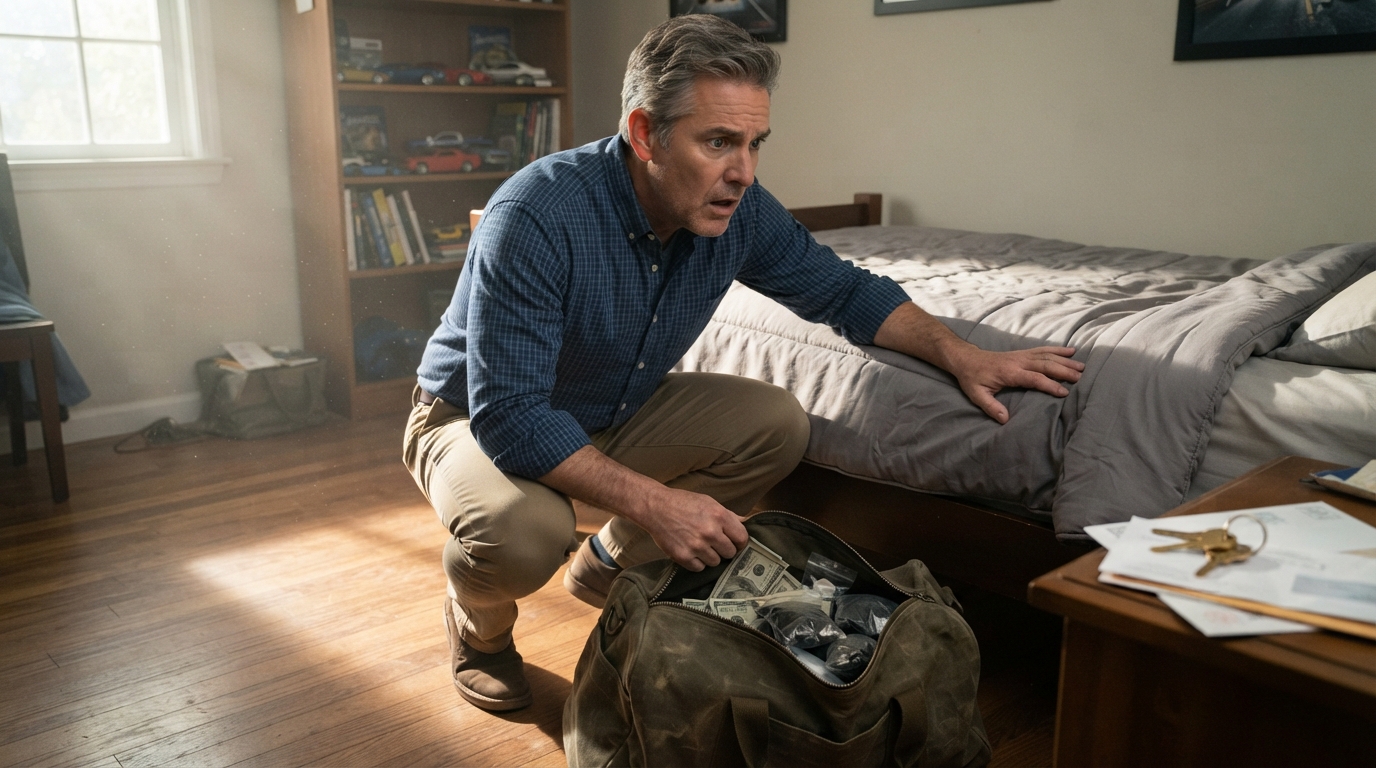
room had been untouched for months. Posters covered the walls. Clothes were stuffed into drawers. Empty soda cans sat beneath the desk. I opened the closet and began sorting. Then I noticed
something beneath the bed. A black duffel bag. I assumed it contained old clothes. I pulled it out. My name was written across the top in faded white marker. LINDA. My hands stopped. I stared at
the letters. Why would Tyler have a bag with my name on it? I opened it. The first thing I saw was a photograph. It was old. Very old. It showed Robert standing beside a young woman I didn’t
recognize. They were standing outside a courthouse. Robert looked maybe twenty-five. The woman was holding a baby. I turned the photograph over. On the back, someone had written, “Before
Linda.” My heart started beating faster. Beneath the photograph were legal documents. Birth records. Bank statements. Property records. A copy of an old life insurance policy. Then I found
something that made my hands shake so badly I nearly dropped it. It was a hospital bracelet. Robert’s name was printed on it. But the date was eighteen years before I met him. I sat on the floor. I
couldn’t breathe. Why had Tyler kept these things? Why was my name on the bag? I continued searching. There was an envelope labeled “For Linda—if he dies before I tell her.” The handwriting was
Robert’s. I knew it instantly. I held the envelope for several minutes before opening it. Inside was a letter. “Linda, if you’re reading this, then I didn’t get the courage to tell you myself.” I stopped
reading. My vision blurred. Robert had written that he had been carrying a secret since before our marriage. A secret involving Tyler’s birth. I read every word. Tyler wasn’t his biological son.
Robert had known. But that wasn’t even the worst part. Tyler’s biological father was a man named Daniel Mercer, Robert’s closest friend. Daniel had died in an accident when Tyler was two. Robert
had taken responsibility for the child because Daniel’s family couldn’t care for him. But there was another layer. Daniel hadn’t simply died in an accident. The accident had happened after Daniel
discovered that someone had been stealing money from the construction company he and Robert owned together. According to Robert’s letter, Daniel believed Robert was involved. They had
argued the night before Daniel’s death. Robert said he wasn’t stealing anything, but he had been terrified that the truth would destroy his reputation and his marriage. After Daniel died, Robert
raised Tyler as his own. But Robert had never told Tyler that he wasn’t his biological father. He hadn’t told me either. I read further. “Linda, I wanted to tell you many times. But every time I tried, I
imagined losing you. I convinced myself silence was protection. It wasn’t. It was cowardice.” I pressed the letter against my chest. “Why, Robert?” I whispered. Then I found another document. A
bank record showing payments from an account belonging to Robert into an account belonging to someone named Margaret Mercer. Daniel’s widow. The payments were made for years. There
were dozens of them. I searched the documents again and found a legal settlement. Daniel’s family had received a substantial amount of money after his death. But the settlement had been funded
partly by Robert. Why? I needed answers. The next morning, I called the number on the oldest document. A woman answered. “Mercer residence.” “Is this Margaret?” There was silence. “Who is
this?” “My name is Linda Reynolds. I was married to Robert Reynolds.” Margaret went completely quiet. “Robert is dead?” “Yes.” “When?” “Three weeks ago.” I heard her breathe in sharply. “I’m
sorry.” “I found something in his belongings.” “What did you find?” “Documents about Daniel.” Another silence. Then she said, “I knew this day would come.” “What does that mean?” “You need to
come see me.” I drove two hours the next day. Margaret lived in a modest house outside the city. She was older than I expected, with silver hair and tired eyes. When she opened the door, she stared
at me for several seconds. “You look exactly like he described.” “Who?” “Robert.” She invited me inside. We sat at her dining table. I placed the black bag between us. She looked at it and closed her
eyes. “He kept it?” “Tyler did.” “Of course he did.” “You knew?” “Tyler has known for years.” My stomach dropped. “He knew?” “He discovered the truth when he was sixteen.” “Why didn’t he tell me?”
Margaret shook her head. “Because he was angry.” “At Robert?” “At everyone.” She told me Tyler had found an old letter in Robert’s desk. He confronted Robert, who finally confessed that Daniel
was his biological father. Tyler had been devastated. He had spent his entire childhood believing Robert was his father. Then he learned that the man he called Dad had hidden the truth. Worse, he
discovered that Daniel had suspected Robert of financial wrongdoing before his death. Tyler became obsessed with finding out what had really happened. “Did Robert steal from Daniel?” I asked.
Margaret looked at me. “No.” “Then why did Daniel think he did?” “Because someone did.” She opened a drawer and pulled out a folder. “Daniel had been keeping copies of company financial
records. He found irregular transfers. He thought Robert was responsible because Robert was the only other person with full access.” “Was he?” “No.” “Who was?” Margaret looked down. “Robert’s
business partner.” She told me the partner’s name was Gerald Price. Gerald had been handling payroll and vendor payments. He had been diverting money through fake invoices. Daniel discovered
it and confronted him. Gerald panicked. The night of Daniel’s death, Gerald followed him. The accident had been caused by Gerald tampering with Daniel’s vehicle. Robert discovered the truth
afterward but was afraid to expose Gerald because Gerald threatened to frame Robert for the theft and claim Robert had been involved in Daniel’s death. “Why didn’t Robert go to the police?” I
asked. “He tried.” Margaret reached into the folder. “But before he could, Gerald disappeared.” “Disappeared?” “He left the country.” Robert spent years trying to locate him. He also secretly
supported me and Tyler financially because he believed Daniel’s family deserved protection.” I stared at the documents. “Why didn’t he tell me?” Margaret gave me a sad smile. “Because he thought
protecting you meant keeping you ignorant.” “And Tyler?” “Robert wanted to tell him when he was older.” “He did.” “Then why did Tyler act like that?” Margaret sighed. “Because knowing the truth
didn’t make him feel loved. It made him feel betrayed.” That sentence stayed with me. On the drive home, I thought about Tyler’s words. “I’m your retirement plan.” Maybe his cruelty hadn’t
appeared from nowhere. Maybe beneath it was a young man terrified that he wasn’t anyone’s first choice. But understanding his pain didn’t excuse his behavior. I still had to protect myself. When I
returned home, I found three missed calls from Tyler. I didn’t call back. An hour later, he showed up. He stood outside the new locked door. “We need to talk.” “You should have called first.” “I know
about the bag.” “I figured.” “Did you read everything?” “Yes.” His face changed. “Then you know.” “I know about Daniel.” “And Dad?” “I know he wasn’t my biological father.” Tyler looked away. “I found
out when I was sixteen.” “Why didn’t you tell me?” “Because Dad made me promise.” “Robert made you promise?” “He said he wanted to tell you himself.” “He never did.” “He was scared.” I nodded
slowly. “So you kept the truth from me for years.” “I didn’t know what to do.” “And then you told me I was your retirement plan.” He flinched. “I was angry.” “At me?” “At everyone.” “I wasn’t
responsible for what your father hid.” “I know.” “Then why punish me?” He had no answer. I stepped aside. “Come in.” He entered. We sat at the kitchen table where our argument had started. He
looked at the chair where his father used to sit. “I miss him,” he whispered. “So do I.” “I hated him for lying.” “I did too.” “Then I hated myself for hating him.” I reached across the table but stopped
before touching him. “Tyler, your father loved you.” “I know.” “He made mistakes.” “I know.” “But you don’t get to turn those mistakes into permission to hurt everyone around you.” Tears filled his
eyes. “I know.” He pulled a folded document from his jacket. “There’s something else.” I opened it. It was an old insurance policy. Tyler pointed to a clause. “Dad changed this before he died.” I read
the beneficiary information. The policy was worth $250,000. I was the beneficiary. Tyler had been listed as a secondary beneficiary, but only if I died first. “Why didn’t I know about this?” “Dad
didn’t want you worrying.” “Where is the policy now?” “I found it in the black bag.” He looked at me. “I wasn’t hiding it to steal it.” “Then why?” “Because I wanted to know whether he really saw me
as his son.” I understood then. Tyler hadn’t been looking for money. He had been looking for proof that he belonged. The cruel statement about being my retirement plan had been armor. Beneath it
was fear. But I still couldn’t simply invite him back as if nothing had happened. “Tyler,” I said, “I love you.” His eyes filled with tears. “But I can’t let you live here without responsibility.” He nodded. “I
understand.” “If you want to rebuild this relationship, we can. But it won’t be because you’re my retirement plan.” He gave a weak smile. “I know.” “And if you live here again someday, you’ll
contribute. Not because I need your money, but because adults share responsibility.” He nodded. “Okay.” “For now, you need your own place.” “Okay.” He stood. At the door, he turned. “Linda?”
“Yes?” “Can I still call you Mom?” I felt tears rise in my eyes. “You can call me whatever you want.” He nodded and left. Six months passed. Tyler rented a small apartment and found a better-paying
job. He paid his own bills. He visited me every Sunday. Sometimes we talked about Robert. Sometimes we didn’t. We slowly learned how to have a relationship without pretending the past hadn’t
happened. Meanwhile, I used Robert’s documents to help clear Daniel’s name officially. Gerald was eventually located overseas. The evidence was old, but there was enough documentation for
authorities to reopen parts of the investigation. I didn’t seek revenge. I wanted the truth. Eventually, Gerald admitted to the financial theft and confessed that he had tampered with Daniel’s
vehicle. He had believed Robert would take the blame. Robert had spent decades carrying a secret he should have revealed much sooner. When I received the final report, I sat on the porch and
cried. Not because everything had been fixed. It hadn’t. No report could bring Daniel back. No confession could give Tyler his childhood truth at the right age. No explanation could erase the years
Robert and I had spent living around a secret. But the truth finally belonged to everyone instead of one dead man. A year after Robert died, Tyler and I stood at his grave together. He brought
flowers. I brought the letter. “I used to think Dad ruined everything by lying,” Tyler said. “Maybe he did.” “But he also gave me a life.” “He loved you.” Tyler nodded. “I know now.” We stood silently.
Then Tyler said, “I was horrible to you.” “You were hurting.” “That’s not an excuse.” “No.” “I’m sorry.” I looked at him. “I forgive you.” He cried. I hugged him. It was the first time we’d embraced since
the funeral. For a long time, neither of us moved. Eventually he whispered, “Thank you for not giving up on me.” I pulled back. “I almost did.” “I know.” “But you were worth another chance.” He
smiled. “So were you.” I laughed through my tears. Over the next few years, our relationship changed completely. Tyler became independent. He bought a small house. He got married. He and his
wife eventually had a daughter. When that little girl was born, Tyler called me from the hospital. “Mom,” he said, his voice shaking, “you have a granddaughter.” I cried so hard I couldn’t answer.
When I finally visited them, Tyler handed me the baby. I looked at her tiny face and thought about how complicated families could be. Sometimes people shared blood but not love. Sometimes
people shared no blood at all but became family through years of showing up. Robert had been Tyler’s father even though they weren’t biologically related. I had been a mother figure even though I
hadn’t given birth. And Tyler, despite everything, had become my son in a way that no legal document could fully explain. The house remained mine. I eventually paid off most of the medical debt
using part of the insurance money. I kept the black bag and its contents in a locked cabinet. Not because I was afraid of them, but because they reminded me that every family has stories beneath
the stories we tell. The greatest lesson I learned wasn’t about money or inheritance. It was about assumptions. I had assumed Tyler was simply entitled. He had assumed I would eventually need
him. Robert had assumed silence was protection. We were all wrong in different ways. One evening, years later, Tyler came over with his daughter. She ran through the living room laughing. Tyler
stood beside me in the kitchen. “Do you ever regret kicking me out?” he asked. I smiled. “No.” He laughed. “That was fast.” “I regret that we needed it.” He nodded. “Fair.” “You needed to learn how to
stand on your own.” “And you needed to learn that you didn’t have to carry me.” I looked at him. “Your father would have been proud of you.” Tyler’s smile faded. “I hope so.” “He would.” He looked
toward the living room where his daughter was playing. “You know what I remember most about Dad?” “What?” “When I was little, he used to tell me that family isn’t the people who are perfect.
It’s the people who stay when things get difficult.” I smiled. “He should have listened to himself.” Tyler laughed. “Yeah. He should have.” We stood there together, listening to his daughter giggle. I
thought about the day he had laughed in my face and told me I was his retirement plan. I thought about how angry I had been when I changed those locks. At the time, I believed I was ending a
relationship. Instead, I was forcing both of us to grow up enough to build a healthier one. Sometimes love needs boundaries. Sometimes forgiveness requires distance. Sometimes the kindest thing
you can do for someone is refuse to rescue them from the consequences of their choices. And sometimes the family you thought you lost is waiting on the other side of a hard truth. Tyler eventually
asked me to be his daughter’s legal guardian in his estate plan. I laughed when he told me. “Are you sure?” “Absolutely.” “What if I live to ninety?” “Then I’ll be eighty-nine and still complaining about
you.” He grinned. “Deal.” I looked at him and realized how far we’d come. The boy I had once helped with homework had become a man. The angry young adult who thought I owed him a future had
learned to build his own. And I had learned that being childless didn’t mean I was without family. I had spent years thinking motherhood was defined by biology. It isn’t. It’s defined by presence. By
sacrifice. By showing up. By loving someone enough to tell them when they’re wrong. By setting a boundary and still leaving the door open for them to become better. Robert left me a house, a
mountain of bills, and a secret that nearly tore our family apart. But beneath all of that, he also left me a lesson. Love without honesty becomes a burden. Love without boundaries becomes
resentment. And love without courage can hurt the very people it is trying to protect. I wish Robert had told me the truth while he was alive. I wish Tyler had trusted me enough to tell me what he
knew. I wish none of us had needed a black bag hidden beneath a bed to force the truth into the light. But I cannot change those things. What I can do is decide what happens next. The last time I
visited Robert’s grave, I placed the old hospital bracelet beside his headstone for a moment before putting it back in my purse. I whispered, “You made mistakes, Robert. But you loved him.” Then I
looked toward Tyler, who was waiting beside the car with his daughter asleep against his shoulder. “And somehow, despite everything, we found our way back.” I walked toward them. Tyler opened
the car door for me. “Ready, Mom?” I smiled. “Always.” And as we drove home together, I realized something I hadn’t understood on the day I changed the locks. I hadn’t thrown my stepson out
because I stopped loving him. I threw him out because I finally understood that love does not mean allowing someone to make you responsible for their future. Sometimes the greatest gift you can
give someone is the chance to become responsible for themselves. Tyler didn’t need me to be his retirement plan. He needed me to believe he could build a life of his own. And once I stopped
carrying him, he finally learned how to walk beside me.