Part 2 — “The Name on His Wrist”
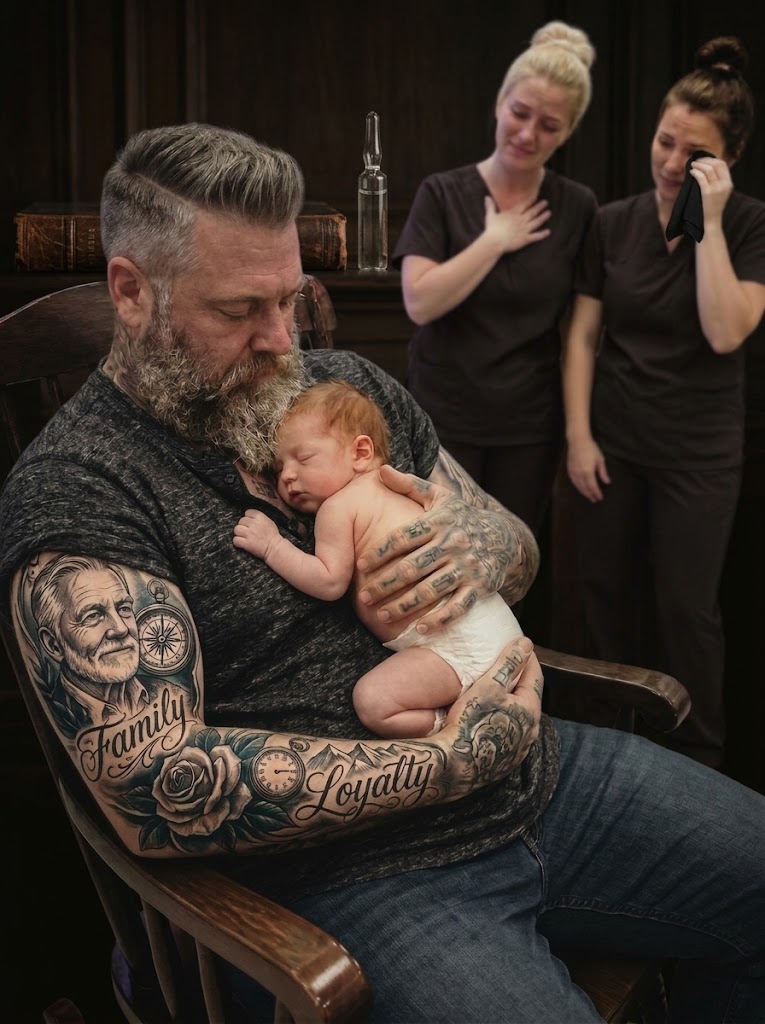
Wade didn’t explain the tattoo that night.
He didn’t need to. I had been a nurse long enough to recognize the
language of a body carrying something it couldn’t set down. The way his
hand stayed flat against the baby’s back — not protective in the urgent
sense, but deliberate, as though he were memorizing the rhythm of a
heartbeat he had once lost track of and was determined never to lose
again.
I didn’t ask. I adjusted the monitors. I noted the baby’s vitals — stable,
settled, the calmest he’d been since admission. I brought Wade a cup of
water without being requested.
“Thank you,” he said. His voice was low and careful, the way a man speaks
when he’s aware that the volume of his natural register could wake a child
he’s spent twelve hours keeping asleep.
“You should rest,” I said.
“I’m fine.”
“The program allows you to leave and come back tomorrow.”
He looked down at Baby Boy Miller. The baby’s mouth was slightly open.
His hand had shifted during sleep and now rested against the side of
Wade’s neck, fingers spread like a tiny starfish pressed against bark.
“I know,” Wade said. “But he’ll wake up if I move. And I don’t want him to
wake up alone.”
I didn’t argue.
I went about my shift. I checked the other babies — fourteen of them that
night, each in a different stage of the fragile, uncertain business of being
born too early or too small or too sick. Parents were asleep in fold-out
chairs beside some of the incubators. The father of the twins in beds four
and five was snoring softly with a receiving blanket over his shoulder and
formula stains on his shirt.
Every bed had someone.
Except bed nine.
Bed nine had Wade.
At 4:30 AM, I stepped into the break room to pour coffee. When I came
back, another nurse — Janelle, who had worked the NICU longer than
anyone — was standing near Wade’s chair, watching him.
She turned to me.
“How long has he been here?”
“Since yesterday morning.”
“Sixteen hours?”
“Give or take.”
Janelle studied him for a moment. Then she looked at me.
“Did you see the tattoo?”
“I saw it.”
“Do you know the story?”
“No.”
Janelle leaned against the nursing station and crossed her arms.
“His wife told me. She called the volunteer office before he started the
program. She wanted us to understand why he was doing this.”
I waited.
“Eli was their son,” Janelle said. “Born three years ago at a hospital in
Tulsa. Full-term. Healthy pregnancy. Everything looked fine.”
She paused.
“Cord compression during delivery. By the time they got him out, he had
gone too long without oxygen. He lived for six hours.”
I set my coffee down.
“Wade held him for every one of those hours. The nurses told his wife
they’d never seen anyone hold a baby that still for that long. He didn’t eat.
He didn’t drink water. He didn’t speak. He just held Eli and breathed with
him until Eli stopped.”
The NICU hummed around us. The monitors. The ventilators. The soft,
mechanical soundtrack of children being kept alive by machines and
medicine and the stubborn insistence of people who refused to give up on
them.
“After Eli died, Wade shut down,” Janelle continued. “His wife said he
didn’t talk for three weeks. He stopped working. He stopped riding. He sat
in their garage and stared at the wall.”
“And then?”
“And then she found him in the nursery — the room they’d set up for Eli
before the birth. He was sitting in the rocking chair with a blanket they’d
bought, just holding it. And she heard him whispering.”
“What was he saying?”
Janelle looked toward the rocking chair where Wade sat motionless, the
baby still asleep against his chest, his scarred hand still rising and falling
with each breath.
“He was saying, ‘I’m right here.’”
The same words he’d whispered to Baby Boy Miller when I placed the
child against his chest.
Easy now, little bear. I’m right here.
He hadn’t been talking to this baby.
He’d been talking to every baby. Every child who arrived without
someone. Every newborn who cried into a room where no one answered.
Every Eli.
Because Wade had answered his son’s cry for six hours, and then it
stopped, and the silence that followed had been so enormous that the
only way he knew to fill it was to find another cry and answer that one
too.
I picked up my coffee. It was cold.
I drank it anyway.
Part 3 — “The Man Who Came Back Every Morning”
Wade returned the next day.
And the day after that.
And every day for the next three weeks.
He arrived at 7 AM, before the morning shift change. He washed his
hands at the station — slowly, methodically, the way the training had
taught him — and he put on the disposable gown that looked absurd on his
frame and walked to bed nine as though it were the only place in the
building that mattered.
Baby Boy Miller — who the nurses had started calling “Bear,” because
Wade called him “little bear” and the name migrated the way names do in
hospitals, through repetition and affection — was improving.
His weight was climbing. His lungs were strengthening. The feeding tube
had been replaced by a bottle, and he was taking it well — slowly,
stubbornly, with the particular determination of an infant who had
decided, without consulting anyone, that he was going to be fine.
Wade fed him. He held him. He changed him when the nurses showed him
how, his enormous hands handling the tiny diaper with a precision that
was almost comical — like watching a crane operator thread a needle.
He talked to Bear constantly. Not baby talk. Conversation. As though the
child were a person who deserved to be spoken to directly.
“Weather’s clearing up out there,” he’d say, looking toward the window.
“Your first spring’s going to be a good one.”
Or: “The Harley’s running rough again. Carburetor, probably. I’ll show you
how to clean one someday, if you’re interested.”
Or, at the end of a long afternoon, when the light was low and the unit was
quiet: “You’re getting stronger, little bear. I can feel it.”
The other parents noticed.
At first, there were glances — the kind that happened when a man who
looked like Wade was seen holding a baby in a NICU. Curiosity. Wariness.
The unconscious, unfair calculus that people perform when someone
doesn’t match the picture they expect.
But after a few days, the glances became nods. After a week, they became
conversations. The mother of the twins brought Wade a granola bar one
afternoon. The father of a baby girl in bed twelve asked him what branch
he’d served in — an assumption, based on Wade’s bearing, that happened
to be correct.
“Marines. Seventy-nine to eighty-seven.”
“Thank you for your service.”
Wade nodded. He didn’t elaborate. Marines rarely do.
I learned his story in pieces over those three weeks — not from Wade
himself, but from Janelle, from his wife Carol, who called the unit once a
week to check on “the baby Wade’s been holding,” and from the small,
accumulating details that emerged the way details always do when
someone is present long enough for the walls to come down.
Wade and Carol had tried for a child for fourteen years. IVF twice. A
miscarriage at nineteen weeks that Wade still couldn’t talk about without
leaving the room. And then Eli — a miracle, Carol called him, because after
everything, he was the one who held.
Until he didn’t.
After Eli’s death, Wade spent nine months in a silence so deep that Carol
told Janelle she sometimes checked whether he was still breathing. He
stopped working at the shop. He stopped riding with the club. He stopped
answering the phone.
Then one evening, Carol found a printout on the kitchen table. The Pine
Valley Children’s Hospital infant comfort volunteer program. Wade had
circled the enrollment section in pencil.
“I need to be useful,” he told Carol. “I can’t just sit here.”
She drove him to the orientation. She signed the forms with him. She
watched her husband — a man who could rebuild a transmission
blindfolded — learn how to hold a four-pound baby without applying
pressure to the fontanel.
He passed every evaluation. He completed every training module. He
showed up on his first day in his leather vest and work boots and was
politely asked to leave both at the door.
He never complained about that. He never complained about anything.
He showed up, he washed his hands, and he sat in the rocking chair with
whoever needed holding.
Bear wasn’t his first baby. He’d held seven others before — short-term
volunteers, a few hours each, filling the gap between parental visits.
But Bear was different.
Bear was the one nobody came for.
And Wade, who understood what it meant to arrive in the world and leave
it with only one person holding you, could not let this child be that person
alone.
Part 4 — “The Morning Someone Came”
On day twenty-two, the social worker brought news.
Bear’s mother — Kayla Miller, nineteen years old — had been located
through the county’s family reunification program. She was living with a
cousin in a town forty minutes south. She had not abandoned Bear. She
had left the hospital in a state of postpartum crisis, without support,
without transportation back, and without the language or the resources
to navigate the system that was holding her child.
She wanted to come back.
The social worker, a woman named Diane Ostrowski who had the steady,
unshakeable calm of someone who had seen the system fail and succeed
in equal measure, sat with me at the nursing station.
“She’s scared,” Diane said. “She’s nineteen. She has no car. She has no
money. She thinks we’ve taken her baby and she’ll never see him again.”
“He’s been here for three weeks.”
“I know. And every day she’s been away is a day she believes makes it
harder to come back.”
“It doesn’t.”
“I know that. She doesn’t.”
Diane arranged transportation. Kayla arrived at Pine Valley the following
morning at 10:15 AM.
She was small, thin, with dark circles under her eyes and hands that shook
when she signed the visitor forms. She wore a sweatshirt two sizes too
large and sneakers with the laces untied, and she looked at the NICU
entrance the way people look at doors they’re not sure they deserve to
walk through.
I met her in the hallway.
“Kayla. I’m Nurse Henley. I’ve been caring for your son.”
She pressed her lips together.
“Is he okay?”
“He’s doing very well. He’s gaining weight. He’s feeding on his own. He’s a
strong little boy.”
Her chin trembled.
“I didn’t leave because I didn’t want him.”
“I know.”
“I didn’t know how to come back.”
“You’re here now. That’s what matters.”
I walked her to the NICU. She stopped when she saw the row of
incubators, the monitors, the soft lights. The scale of it — the machinery,
the sounds, the implications — froze her in the doorway.
Then she saw Wade.
He was in the rocking chair beside bed nine, holding Bear against his
chest, whispering something I couldn’t hear. The baby was awake, eyes
open, one hand wrapped around Wade’s index finger — a finger wider
than Bear’s entire wrist.
Kayla stared.
“Who is that?”
“That’s Wade. He’s a volunteer. He’s been with your son every day since
you left.”
“Every day?”
“Every single day.”
Kayla walked slowly toward the chair. Wade looked up. He saw a
nineteen-year-old girl standing in front of him with tears streaming down
her face and her arms hanging at her sides as though she didn’t know
what to do with them.
He understood immediately.
Without a word, Wade stood. He cradled the baby carefully, walked to
Kayla, and placed Bear in her arms.
“He’s been waiting for you,” Wade said.
Kayla looked down at her son. The baby looked up at his mother. Their
eyes met — and something passed between them that had nothing to do
with medicine or charts or the twenty-two days they had been apart.
Kayla’s entire body changed. Her shoulders dropped. Her hands steadied.
She pulled Bear against her chest, and a sound came out of her that I had
heard a thousand times in thirteen years of NICU nursing — the sound of
a mother meeting the child she thought she’d lost.
Wade stepped back.
He stood three feet away, hands at his sides, watching a mother hold her
baby for what was, in every meaningful sense, the first time.
I looked at his face.
He was smiling. Not broadly. Not dramatically. The quiet, steady smile of a
man who understood what was happening and why it mattered and who
had spent three weeks keeping a seat warm for the person who was
always supposed to be sitting in it.
Then I saw his hand move.
He touched his wrist. His thumb pressed briefly against the tattoo — the
name, the date, the single day that had held everything and nothing.
Eli.
He pressed it the way a person touches a wound that has healed but
hasn’t stopped being tender.
Then he turned and walked toward the door.
“Wade,” I called.
He stopped.
“Where are you going?”
He looked back at Kayla and Bear — mother and son, together, whole —
and then at me.
“Home,” he said. “He doesn’t need me anymore.”
“He needed you for twenty-two days.”
Wade nodded.
“That was enough.”
He walked out of the NICU. He collected his leather vest from the hook by
the entrance. He pulled on his boots. And he walked down the corridor of
Pine Valley Children’s Hospital with the measured, unhurried stride of a
man who had done what he came to do.
I watched him through the glass doors.
He stopped in the parking lot, beside a black Harley-Davidson that looked
as old and weathered as he did. He didn’t get on it right away. He stood
beside it with one hand on the seat and his head bowed.
I think he was talking to Eli.
I think he was saying, I held another one for you. He’s going to be all right.
After a minute, he climbed on the bike, started the engine, and pulled out
of the lot.
The sound of the Harley faded down the road. The NICU hummed on.
And in bed nine, a baby boy who had arrived in the world with nothing but
a hospital bracelet and a temporary name was lying against his mother’s
chest, warm and fed and held, because a man who had lost everything had
decided to come back and hold the door open until someone arrived to
walk through it.
Part 5 — “The Bear Who Got a Name”
Kayla stayed.
Not immediately — the logistics took time. Diane Ostrowski coordinated
housing through a county family support program. A transitional
apartment, furnished, twenty minutes from the hospital. Close enough for
daily visits while Bear finished his NICU stay. Close enough for the
feeding schedule, the weight checks, the slow and careful process of
teaching a premature body to do what full-term babies do without
thinking.
Kayla was there every morning by eight. She held Bear. She fed him. She
learned to read the monitors without panicking when a number shifted.
She asked questions — good ones, specific ones, the kind that told me she
was paying attention and intended to keep paying attention long after the
hospital discharged them.
On day thirty-one, Bear’s pediatric team cleared him for release.
Seven pounds, two ounces. Lungs clear. Feeding independently. A strong,
steady heartbeat that the cardiologist described as “textbook.”
Kayla signed the discharge paperwork. She had a car seat — donated by
the hospital’s social services office. She had formula, diapers, a starter
pack of onesies in three sizes. She had Diane’s phone number
programmed into her phone with the instruction, “Call anytime. I mean it.”
And she had a name.
She told me on discharge day, while I was unclipping the last monitor lead
from Bear’s chest.
“I named him.”
“What did you choose?”
She looked at me.
“Eli.”
I set the monitor lead down.
“His middle name,” she said quickly. “His first name is Marcus — after my
grandfather. But I wanted him to carry the name of the man who held him
when I couldn’t.”
“Does Wade know?”
“Not yet. I was hoping you could tell him.”
I nodded.
“I’ll tell him.”
Kayla buckled Marcus Eli Miller into the car seat. She checked the straps
twice. She adjusted the angle. She tucked a small knitted blanket around
his legs — a blanket one of the NICU nurses had made during the night
shift, because that’s what NICU nurses do when a baby doesn’t have
anyone to knit for him.
She carried him out the front door of Pine Valley Children’s Hospital on a
Tuesday morning in April, and the sunlight hit his face for the first time in
his life, and he didn’t cry.
He just blinked. Slowly, curiously, the way newborns do when the world
opens up and they haven’t yet learned to be afraid of it.
Kayla put the car seat in the back of Diane’s car. Diane was driving them
to the apartment.
Before she got in, Kayla turned to me.
“Will you thank him? Wade. For all of it.”
“I will.”
“Tell him Marcus is going to know. When he’s old enough. I’m going to tell
him about the man who held him every day and called him little bear.”
“I’ll tell him.”
She got in the car. They drove away.
I stood on the sidewalk and watched until they turned the corner.
Wade came back two weeks later.
Not for Bear. Bear was home. Wade came back because there was
another baby in bed nine — a different child, a different story, but the
same silence, the same absence, the same empty chair beside an
incubator in a room full of families.
He washed his hands. He put on the gown. He lowered himself into the
rocking chair with the same impossible caution, as though his weight and
his strength were things that needed to be handled delicately in a room
full of people who weighed less than his forearm.
Before I placed the new baby against his chest, I told him.
“Wade.”
He looked up.
“Kayla named her son. Marcus Eli Miller.”
Wade went very still.
His hand moved to his wrist. His thumb found the tattoo. He pressed it —
not hard, not dramatically, just the steady, familiar pressure of a man
touching a name he had carried for three years.
His eyes filled.
He didn’t wipe them. He didn’t turn away. He sat in that rocking chair in a
disposable blue gown with tears running into his white beard, and he let
them fall, because some things are too important to hide and too sacred
to explain.
“Eli,” he said.
“She wanted him to carry the name.”
Wade nodded.
“He was a good little bear.”
“He was.”
Wade took a breath. Then another. Then he opened his arms.
“All right,” he said. “Let’s meet this one.”
I placed the new baby against his chest. The child squirmed. Then settled.
Then pressed a tiny hand against Wade’s neck — the same spot Bear had
found, the same landing place, as though some part of every baby
understood that this was where you rested when the world was too loud
and too new and someone safe was holding you.
Wade whispered.
“Easy now, little bear. I’m right here.”
The NICU hummed. The monitors beeped. Parents slept in fold-out chairs
beside their children, and nurses walked softly between the beds, and
outside the window, the spring sun moved across the parking lot where a
black Harley sat waiting for a man who was in no hurry to leave.
I went back to my station. I wrote my notes. I checked the charts.
And every time I looked up, Wade was still there — still holding, still
whispering, still pressing his thumb against a name on his wrist that meant
everything and explained nothing and connected a man who had lost his
son to every child who needed a father to sit beside them and say the only
words that ever mattered.
I’m right here.
He was.
Every morning, without fail, in a rocking chair beside bed nine, in a
disposable gown that was never quite big enough, with hands that had
built engines and buried a son and learned, in the aftermath of the worst
day of his life, that the only thing they were truly made for was holding on.
Wade held on.
For Eli. For Bear. For every baby who arrived without someone to
welcome them.
He held on because that was the promise he’d made in a nursery three
years ago, whispering to a son who could no longer hear him — a promise
that the holding wouldn’t stop just because the arms were empty.
The arms weren’t empty anymore.
They never would be again.