She isn’t one of those children who invents shadows to
make a story sound bigger. She doesn’t lie for attention. She
doesn’t even raise her voice when she gets excited. She is
quiet, sweet, and still believes the moon follows our car
because it likes her.
That is why, when she said it so calmly that morning,
something inside me cracked.
— Dad… every night a man enters your room after you’ve
already fallen asleep.
My hands slipped on the steering wheel.
— What did you just say?
She kept staring out the window on the way to school,
watching shops and traffic slide by as if she were talking
about the weather.
— He walks very slowly, she said. — Like he doesn’t want
the floor to make noise. Mom closes her eyes, but she
doesn’t say anything.
There was no fear in her voice.
No confusion.
Only certainty.
That certainty was what turned my blood cold.
— Maya… where did you get that from?
She shrugged.
— I see him.
The rest of the drive felt wrong. The air inside the car
seemed too thick to breathe. I kept looking at her in the
mirror, waiting for a smile, a laugh, some sign that this was a
child’s strange invention. Nothing came. She just adjusted
the straps of her pink backpack and hummed softly to
herself, like she hadn’t just opened a hole beneath my feet.
Maybe she had a dream.
Maybe she had seen something online.
Maybe there was a shape in the hallway and her
imagination had given it a face.
Maybe.
But sometimes a sentence lands in your chest and your
body knows before your mind does.
I dropped her off at school. She kissed my cheek, climbed
out, and ran toward the gate with her pink backpack
bouncing behind her. I watched her disappear into the
crowd of children, and I swear the whole world tilted for a
second.
Then I drove straight back home.
My wife was in the kitchen, exactly where she always was
at that hour. Morning light spilled through the window.
Coffee steamed beside the toaster. Her hair was tied back.
She looked up and smiled like nothing in this world had
moved an inch.
— You’re back already?
And for the first time since the day I married her, I didn’t
know how to look at her.
I wanted to laugh at myself.
I wanted to tell her what Maya had said and let her explain
it away in ten seconds.
I wanted to believe my daughter had mistaken a dream for
a memory and my marriage was still the safe place I
thought it was.
Instead, I stood there holding my keys too tightly and
noticed things I had never let myself notice before.
The dark circles beneath her eyes.
The way her sleeves stayed long even though the day was
warm.
The little flinch when I stepped closer, as if she had been
somewhere far away and needed a second to return.
She asked if everything was okay. I said yes.
That entire day, I moved through the house like a stranger
renting my own life. Every sound sharpened. Every silence
grew teeth. When her phone buzzed on the counter, she
grabbed it too quickly. When she stepped into the laundry
room to answer a call, I heard only one sentence before she
lowered her voice.
— Tonight then… after he’s asleep.
My stomach dropped so fast I had to put a hand on the wall.
She came back out a moment later carrying towels, calm as
ever, and asked if I wanted chicken or pasta for dinner.
I said I didn’t care.
She looked at me for a second too long, as if she sensed
something had shifted, but neither of us said anything. Not
over dinner. Not while Maya told us about spelling practice.
Not while we cleaned the dishes. Not while the house
slowly surrendered to night.
Before bed, I stopped at Maya’s doorway.
— Have you really seen him every night?
She nodded against her pillow.
— He always comes when it’s very dark. He carries
something. Mom never screams. She just looks sad.
Sad.
That word should have slowed me down.
It didn’t.
My wife came to bed around eleven. She smelled like soap
and something sterile I couldn’t place. She asked if I had
taken my sleeping pill. I said yes and let her hear the
bathroom tap running, but I spat the tablet into the sink
and tucked it into my pocket instead.
Then I lay beside her in the dark and waited.
I made my breathing heavy.
Regular.
Convincing.
Beside me, her breathing was wrong too. Too careful. Too
awake.
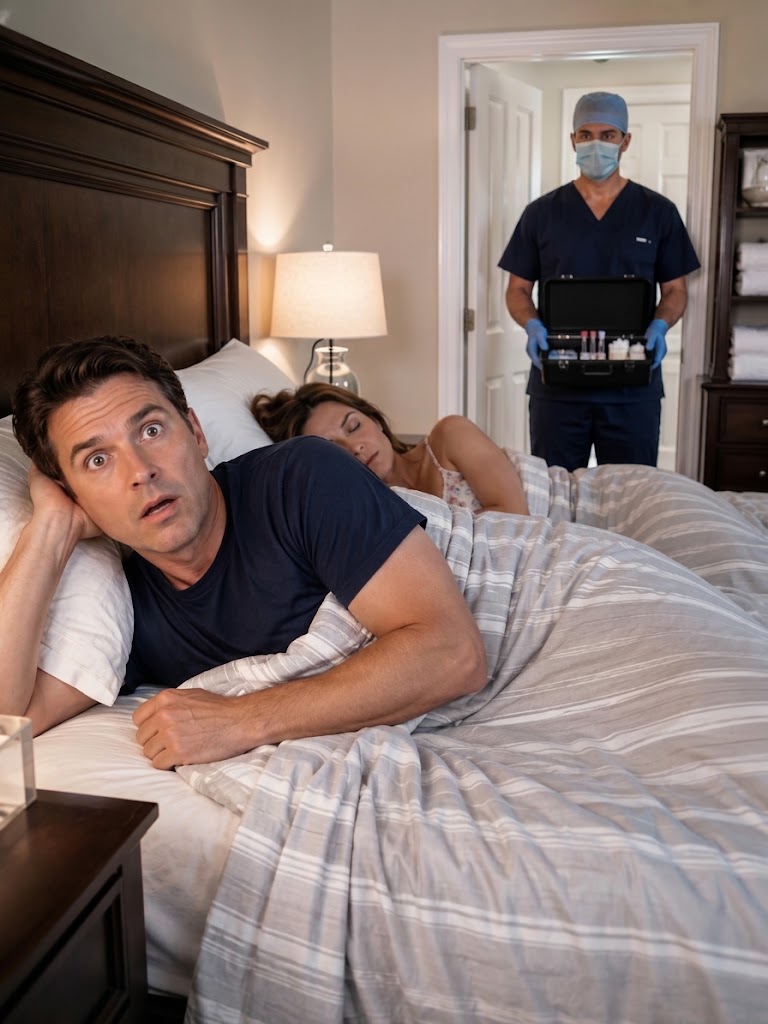
At 1:13, the bedroom door moved.
Not all at once.
Slowly.
Like someone who had done it before.
A thin line of hallway light slid across the floorboards.
Then a figure stepped inside.
A man.
Tall. Careful. Silent.
He closed the door without letting the latch click. In one
hand he carried a narrow black case. He didn’t turn on the
light. He knew exactly where he was going.
To her side of the bed.
My entire body locked.
My wife didn’t move, but I saw her eyes close tighter, not
like someone sleeping, but like someone preparing.
The man stopped beside her. For a moment nobody spoke.
Then he bent slightly, and in a voice so low it made my
stomach twist, he whispered:
— It’ll only take a minute.
My wife gave the smallest nod.
I felt something primal rise inside me. Rage. Humiliation.
The hot, dizzying kind that erases reason. I could already
see myself lunging across the mattress.
Then I heard another sound.
The soft snap of rubber.
Latex.
A faint sterile smell drifted through the dark. Alcohol.
Plastic. Something clean and cold.
The black case opened with a quiet metallic click.
My wife lifted one trembling hand to the collar of her
nightshirt.
And when the stranger leaned over her, reached into the
dark, and pulled something thin and silver into the sliver of
light by our bed, I realized that whatever was about to
happen next was going to either expose a betrayal… or tear
open a truth I had been too blind to see, because my hand
was already moving toward the lamp when—
I clicked the switch.
Yellow light flooded the bedroom, cutting through the
shadows and blinding all three of us.
The man spun around, shielding his eyes with a gloved
forearm. I surged upright, the mattress springs groaning
under my sudden weight. My chest heaved, hands balled
into fists, every nerve primed for violence.
“Get the hell away from her!” I roared.
My wife gasped, sitting up abruptly and clutching the neck
of her nightshirt. “David, stop! Wait!”
The stranger took a cautious step back, raising two rubber-
gloved hands in a placating gesture. He was wearing a dark,
unbranded tracksuit, a surgical mask tucked under his chin,
and a lanyard around his neck bearing a small ID badge.
“Sir, please calm down,” the man said, his voice flat,
exhausted, and entirely unbothered by my aggression. “I’m
not here to hurt anyone.”
My gaze darted between him and my wife. The narrow
black case sat open on the nightstand. Inside rested neat
compartments of sterile medical supplies: vials, alcohol
wipes, disposable syringes, and a sleek, handheld
mechanical pump attached to a thin silver needle—an IV
port applicator.
My eyes snapped to my wife. She wasn’t wearing a full
nightshirt; the collar was pulled down on her left side,
revealing a square patch of medical tape covering a semi-
permanent port embedded beneath her collarbone. Her
skin surrounding it was bruised, a sickly mosaic of deep
purple and yellow.
The rage in my chest evaporated, replaced instantly by an
icy, suffocating confusion.
“What… what is this?” I breathed, my voice cracking. “Sarah,
what is this?”
Sarah couldn’t look at me. She buried her face in her hands,
her shoulders trembling silently.
“I’m sorry,” the man murmured softly, reaching down to
close the black case. “I should let you two talk. Mrs. Vance,
we didn’t complete the infusion, but I set the line. I’ll step
outside for ten minutes.”
“Infusion?” I repeated, the word tasting like ash in my
mouth. “What infusion? Who are you?”
“I’m Marcus,” he said, pulling off his latex gloves with a crisp
snap. “I’m a private home-care nurse. I’ve been coming here
at night for the past three weeks to administer your wife’s
late-stage trial treatment.”
He picked up his case and walked out of the room, closing
the door softly behind him.
The silence that followed was heavier than the darkness
had been. I sat on the edge of the mattress, staring at my
wife. The bright lamplight exposed everything I had failed
to notice over the last six months: the sunken hollows of
her cheeks, the stark fragility of her collarbones, the
extreme pallor of her skin.
“Sarah…” My voice was barely a whisper. “Talk to me.
Please.”
She pulled her knees to her chest, wrapping her arms
around them. When she finally looked up, her eyes were
wet with tears.
“It started eight months ago,” she said quietly, her voice
trembling. “Persistent fatigue. Joint pain. I thought I was
just getting older, or stressed from managing the house
while you worked those eighty-hour weeks at the firm. I
went for a routine blood test.”
She paused, swallowing hard before forcing the next words
out.
“It’s aggressive, David. A rare strain of non-Hodgkin’s
lymphoma. By the time they caught it, it was already
advanced.”
The room seemed to spin. The walls leaned in. I tried to
speak, but no sound came out.
“Why didn’t you tell me?” I finally choked out, my eyes
burning. “How could you keep something like this from me?
I’m your husband!”
“Because you were already drowning!” she cried, the raw
emotion finally spilling over. “Your father had just passed
away, you were trying to make partner, and you were
having panic attacks in the car every morning! If I told you,
you would have broken. You would have given up your
career, your sanity, everything, to watch me deteriorate.”
“So you just… handled it alone?” I asked, tears finally
slipping down my cheeks. “Every night?”
“I couldn’t do standard chemo during the day without you
noticing the hair loss and the sickness,” she explained,
wiping her eyes with the back of her hand. “My doctor
managed to get me into an experimental targeted-
immunotherapy trial. But the medication has a strict 24-
hour cycle and causes extreme nausea and drop in blood
pressure right after administration. The trial sponsor
agreed to send a midnight mobile nurse so I could receive
the infusion while you slept, take the anti-emetics, and
recover by morning before Maya woke up.”
She looked down at her hands.
“Every night, I gave you a mild herbal sleep aid in your
evening tea so you wouldn’t wake up to the sound of the
door opening or me being sick in the bathroom. I was trying
to protect you. Both of you.”
I buried my face in my hands, a dry sob tearing through my
throat. The horror of my own assumptions crushed me. I
had suspected her of the ultimate betrayal, spent an entire
day suspecting her of stepping out on our family, while she
was quietly fighting for her life in the bed right beside me.
“And Maya…” I whispered, looking toward the door. “She
saw him.”
“Marcus is always quiet,” Sarah said softly. “But our
floorboards squeak outside her room. She must have
woken up, peeked through the door crack, and seen him
coming in. I never knew she saw.”
I stood up, walked around the bed, and sat right next to her.
I pulled her frail frame into my arms, holding her so tightly I
was afraid she might break, burying my face in the crook of
her neck.
“No more secrets,” I sobbed into her hair. “No more pills in
my tea. No more hiding in the dark. I don’t care about the
firm. I don’t care about making partner. I am here. We fight
this together.”
She held me back, weeping softly, the crushing weight of
her secret finally lifted off her chest.
The next morning, the house was quiet.
I sat at the kitchen counter, two cups of coffee cooling
between my hands. Sarah was resting upstairs; after
Marcus finished the infusion, the medication had taken its
toll, leaving her weak and nauseous. I had called out of
work indefinitely—no explanations, no apologies to my
boss. Nothing mattered except the two people living under
my roof.
I heard small, hesitant footsteps on the stairs.
Maya appeared at the kitchen doorway, her pink backpack
slung over one shoulder, her big brown eyes searching my
face. She looked uncertain, sensing the shift in the house’s
atmosphere.
“Dad?” she asked softly. “Is Mom sick?”
I set my mug down and walked over to her, kneeling so I
was at eye level. I reached out and gently smoothed back
her hair.
“She is, sweetie,” I said, keeping my voice calm and gentle.
“She’s been sick for a little while, but she was trying really
hard not to worry us.”
Maya lowered her gaze, biting her lip. “Was that man… a
doctor?”
“He’s a nurse,” I explained, smiling softly to reassure her.
“His name is Marcus. He comes at night to give Mom
special medicine that helps her body fight the sickness. He’s
a good guy, Maya. He’s helping her get better.”
Maya was silent for a moment, processing my words. Then,
she looked up, her expression surprisingly serious for an
eight-year-old.
“Is Mom going to be okay?”
“We’re going to do everything we can to make sure she is,” I
promised, pulling her into a warm hug. “And you helped us,
Maya. Because you told me what you saw, I found out the
truth. You were a brave little girl.”
She wrapped her small arms around my neck, resting her
head on my shoulder. “I don’t want Mom to look sad
anymore.”
“She won’t have to face it alone anymore,” I whispered.
“Neither will we.”
The months that followed were the hardest of our lives, but
we were no longer moving through the dark.
I took a leave of absence from the firm. I handled the
cooking, the cleaning, driving Maya to school, and
managing Sarah’s endless appointments. Marcus continued
his nightly visits for three more months until the
experimental trial concluded, but now, I was the one who
met him at the door, brought him water, and sat by Sarah’s
side, holding her hand through every single infusion.
There were days when the treatment made her so weak
she couldn’t leave the bed. Days when fear crept back into
the house, thick and paralyzing. But we didn’t hide from it.
We talked, we cried, and we held each other through the
worst of it.
By the time winter rolled around, the cold air brought a
new kind of quiet to our home—not the heavy, secretive
silence of before, but a peaceful one.
It was a Tuesday afternoon in December when the
oncologist called.
Sarah sat on the living room sofa, wrapped in a thick wool
blanket, with Maya reading a book beside her. I stood near
the window, holding the phone to my ear, my heart
hammering against my ribs.
“David?” the doctor’s voice came through the speaker. “I
have the results from Sarah’s latest PET scan.”
I gripped the phone tightly. “Go ahead, Doctor.”
“The targeted trial was a complete success,” she said, her
tone light and full of warmth. “The tumors have shrunk
completely. There is no evidence of active disease. Sarah is
officially in full remission.”
I dropped my head, tears of pure relief spilling down my
face. I couldn’t even speak. I just walked over to the sofa,
sank to my knees before my wife, and rested my forehead
against her lap.
“David?” Sarah asked, her hand instantly finding my hair.
“What did she say?”
“It’s gone,” I choked out, looking up at her with a tearful
smile. “It’s all gone, Sarah. You’re in remission.”
Sarah gasped, her hands flying to her mouth as tears
overflowed her eyes. Maya dropped her book and threw
her arms around both of us, squealing with joy even if she
didn’t fully understand the medical jargon—she just knew
the dark days were over.
That night, for the first time in nearly a year, the house felt
entirely safe.
There were no midnight footsteps in the hallway. No silent
shadows opening the bedroom door. No secret burdens
carried in the dark.
I lay in bed beside Sarah, listening to the steady, peaceful
rhythm of her breathing. She looked restored, the color
returning to her cheeks, the heavy shadows beneath her
eyes finally faded away.
I reached over and turned off the nightstand lamp, letting
the room settle into comfortable darkness. Outside the
window, a light snow was beginning to fall, dusting the
trees in quiet white.
From down the hall, I heard the faint sound of Maya’s door
opening. A moment later, tiny feet padded across the
floorboards.
Maya peeked her head into our bedroom, clutching her
stuffed bear.
“Dad?” she whispered into the dark.
“Yeah, sweetie?” I replied, raising my voice slightly so as not
to startle her.
“Can I sleep with you guys tonight?” she asked. “Just for a
little bit?”
Sarah stirred, smiling in the dark, and lifted the edge of the
duvet. “Come here, Maya.”
Maya ran over, climbed into the middle of the large
mattress, and wiggled beneath the covers between us.
Sarah wrapped an arm around her, and I reached over,
resting my hand over both of theirs.
“Dad?” Maya whispered, looking up at the ceiling.
“Yes, Maya?”
“The moon really does follow our car, right?”
I smiled into the dark, pulling my family close.
“It sure does, kiddo,” I said softy. “It follows us everywhere
we go.”