When I was sixteen, my dad crumpled my art school acceptance letter in his fist, pointed at the front door, and said, “Get
out, and don’t come crawling back when you fail.” My mother sat at the kitchen table with both hands wrapped around a
mug of coffee, staring down into it as if the steam rising from the cup were more interesting than the destruction of her
daughter’s future. I remember everything about that afternoon. The yellow light above the kitchen sink. The ticking clock on
the wall. The smell of toast burning in the toaster because nobody had bothered to turn it off. Most of all, I remember the
sound of my acceptance letter being crushed. It was the sound of twelve years of dreaming being squeezed into a ball in my
father’s hand. “Dad, please,” I said. “It’s a scholarship.” “It’s a waste,” he answered. “You think people make careers drawing
pictures?” “It’s an accredited program.” “It’s an excuse to avoid getting a real job.” I looked at my mother. “Mom?” She finally
lifted her eyes. I waited for her to say something. Anything. She didn’t. My father threw the crumpled letter onto the table.
“You’re going to college locally. Business, accounting, nursing, something practical. You’re not running off to some art school
because you think you’re special.” “But this is what I’m good at.” “Being good at something doesn’t mean you can make a
living from it.” I picked up the letter and carefully flattened it with my palms. “What if I can?” My father laughed. It wasn’t a
warm laugh. It was the kind that made you feel foolish for speaking. “Then prove it.” “I will.” His face hardened. “No. You
won’t. You’re sixteen. You don’t know anything.” “I know I want this.” “Then go want it somewhere else.” I stared at him.
“What?” He pointed toward the door. “If you’re determined to throw your life away, you’re old enough to do it without living
under my roof.” My mother finally whispered, “Your father doesn’t mean—” “Yes, I do,” he interrupted. “If she thinks she’s an
adult, let her act like one.” I looked at my mother again. “You’re really going to let him do this?” She lowered her eyes. That
was when something inside me broke. Not loudly. Not dramatically. It simply became very still. I went upstairs and packed a
suitcase. I took three sketchbooks, two pairs of jeans, a few shirts, my watercolor set, my grandfather’s fountain pen, and
the small wooden box where I kept my savings. I counted the money twice. $1,186. That was everything I had. Money from
grocery-store shifts, weekend portrait commissions, babysitting, and selling small paintings at local fairs. Before I left, I went
back downstairs. My father was still sitting at the table. My mother had disappeared into the living room. “You told me to
leave,” I said. He didn’t look up. “Then leave.” I put the flattened acceptance letter beneath my jacket. “I won’t ask you for
money.” He smiled bitterly. “Good. Because you won’t get any.” I nodded. “And I won’t come crawling back.” Then I walked
out. The front door closed behind me, and I stood on the sidewalk with one suitcase in my hand and $1,186 in my pocket. I
was terrified. I was sixteen years old, alone, and had no idea how I was going to survive. But I also felt something I had never
felt inside that house. I felt like the next decision belonged to me. I spent the first week sleeping on the couch of a woman
who had once bought one of my paintings. She knew my situation and offered me a place temporarily. I found a small part-
time job at a coffee shop and contacted the art school. The scholarship was still valid, but there were expenses it didn’t
cover. Transportation. Supplies. Food. Housing. I worked every hour I could. During the day, I attended classes. In the
evenings, I worked. On weekends, I painted portraits and restored old furniture for extra money. My classmates complained
about deadlines. I complained about nothing because I was terrified someone would take the opportunity away from me. I
learned quickly that talent wasn’t enough. I had to learn how to sell, negotiate, budget, network, and survive rejection. My
first semester was brutal. I once lived for three weeks on almost nothing but rice, eggs, and canned soup. I slept in a room so
cold that I painted wearing gloves with the fingertips cut off. But I never called my parents. Not once. I didn’t want them to
hear desperation in my voice. I didn’t want my father to say, “I told you so.” More importantly, I had made a promise to
myself. I would succeed or fail on my own terms. During my second year, something unexpected happened. One of my
professors noticed that my paintings had an unusual quality. I loved old things. Antique frames. Faded portraits. Furniture
with scratches. Objects that showed their age instead of hiding it. My professor suggested that I visit estate auctions. I
began going on weekends. At first, I couldn’t afford much. I’d buy damaged frames for five dollars, old lamps for ten,
paintings with torn canvases for twenty. I learned how to repair them. I learned how to identify artists, periods, materials,
and craftsmanship. Then I discovered something that changed everything. People were willing to pay far more for restored
pieces than I had paid for them. My first serious profit came from an ugly little landscape I bought for $35. The frame was
damaged, the canvas was filthy, and everyone at the auction ignored it. I spent three days cleaning and repairing it. A
collector bought it for $700. I couldn’t believe it. I reinvested every dollar. I began buying more. Soon, collectors started
asking me to find pieces for them. I realized that I wasn’t just an artist. I was becoming a curator, a restorer, a buyer, and
eventually a businesswoman. After graduation, I rented a tiny storefront. The sign above the door said simply, “Harlow
House Antiques.” I had almost no money left after paying for the lease and renovations. The shop was small enough that I
could stand in the middle and touch both walls. But I loved it. I painted the walls myself. I repaired every display case. I found
old brass lamps and polished them until they shone. I filled the windows with restored paintings and furniture. On opening
day, three people came in. One bought a small mirror. One asked for directions to a bakery. The third bought nothing. I went
home exhausted and proud. Six months later, I couldn’t keep up with demand. I opened a second location. Then a third. I
hired two employees. Then ten. I learned that running a business was different from making art. Every mistake cost money.
Every employee depended on my decisions. Every bad acquisition could destroy a month’s profit. I made mistakes. I bought
pieces that turned out to be worthless. I trusted people who betrayed me. I signed contracts I shouldn’t have signed. But I
learned. By twenty-five, I owned four antique galleries. By twenty-seven, I had expanded into restoration and private
collections. By twenty-eight, I bought an old commercial building in Seattle that everyone told me was too expensive. The
building had been neglected for years. The roof leaked. The elevators barely worked. The upper floors were empty. I saw
something nobody else seemed to see. Potential. I bought it, renovated it, and turned it into a tower that housed my
headquarters, galleries, private exhibition rooms, artist studios, and offices. The project nearly destroyed me financially.
There were nights when I sat alone in the unfinished lobby wondering whether I had made the biggest mistake of my life.
But eighteen months later, the Seattle tower opened. The newspapers called it an unexpected success story. I didn’t tell
them about the sixteen-year-old girl standing on a sidewalk with $1,186. I didn’t tell them about the crumpled letter
beneath my jacket. I didn’t tell them about my father. I didn’t want my success to become a story about proving him wrong. I
wanted it to belong to me. I also kept my personal life private. My company grew through acquisitions, partnerships, and
careful investments. One of those investments involved purchasing a portfolio of distressed mortgages through one of my
financial subsidiaries. I didn’t personally examine every loan. There were hundreds of them. I trusted my financial team. I
had no idea that one of those mortgages belonged to my parents. Twelve years passed. During those years, my relationship
with my family became almost nonexistent. My sister, Emily, was the only one who occasionally contacted me. She was
never cruel to me. She had been seventeen when I left and had been too young to challenge our father. At first, she called
every few months. Eventually, those calls became emails. She told me about ordinary things: her job, her children,
neighborhood gossip. I replied politely. We never discussed our parents in detail. I didn’t want to put her in the middle. Then,
one Tuesday morning, an email arrived with the subject line: “I don’t know what to do.” I opened it. “Dad lost his job. Mom is
drowning in bills. The mortgage is behind. They don’t know where to turn. They still think you’re barely surviving. I don’t
know if I should tell them how well you’re doing.” I stared at the screen. Twelve years earlier, my father had told me I would
fail. Now his daughter was writing to tell me he was struggling financially. I didn’t feel happy. I didn’t feel victorious. I felt
something closer to sadness. My sister sent another email. “Dad refuses to ask you for help because he’s too proud. Mom
says you’re probably still angry. They may lose the house.” I leaned back in my chair. My office overlooked Seattle. Rain was
sliding down the glass. On the wall behind me hung a painting I had bought for $40 and restored myself. It was worth several
thousand dollars now. I thought about my father. I thought about my mother sitting silently at that kitchen table. I thought
about the letter. Then I remembered the promise I had made: I would never come crawling back. I had kept that promise. I
had never asked them for money. I had never begged for approval. But I had never promised that I would refuse to help if
they truly needed it. I called my chief financial officer. “Pull the mortgage records for my parents’ address.” He paused.
“Their address?” I gave it to him. “Give me a minute.” A few minutes later, he called back. “Interesting. That mortgage is part
of the portfolio we acquired two years ago.” My stomach tightened. “What company holds it?” He gave me the subsidiary’s
name. It was mine. I stared at the wall. “How much is outstanding?” He gave me the amount. It was serious, but not
catastrophic. “Are there foreclosure proceedings?” “Not yet. They’re delinquent, but we’re still within the restructuring
window.” I thanked him and ended the call. I sat there for a long time. My father didn’t know I owned the company holding
his mortgage. He didn’t know I owned the Seattle tower. He didn’t know I owned a chain of antique galleries. As far as he
knew, I was probably still some stubborn teenager who had run away to draw pictures. I could have quietly paid the
mortgage. I could have erased the debt. But I knew that would only create another secret. Instead, I asked my assistant to
schedule a meeting. “Put them down for an eleven o’clock appointment tomorrow.” “Who?” she asked. I gave her their
names. She looked at me. “Your parents?” “Yes.” “Do they know they’re meeting you?” “No.” She nodded slowly. “What should
I tell them?” “Tell them the CEO is reviewing distressed accounts personally.” That night, I barely slept. I kept thinking about
what I would say. I didn’t want revenge. I didn’t want to humiliate them. But I also wasn’t going to pretend nothing had
happened. The next morning, I arrived at the tower early. My assistant had arranged the conference room. I changed my
mind and decided to meet them in my office. At 10:57, I looked out the window. Seattle was covered in gray clouds. At
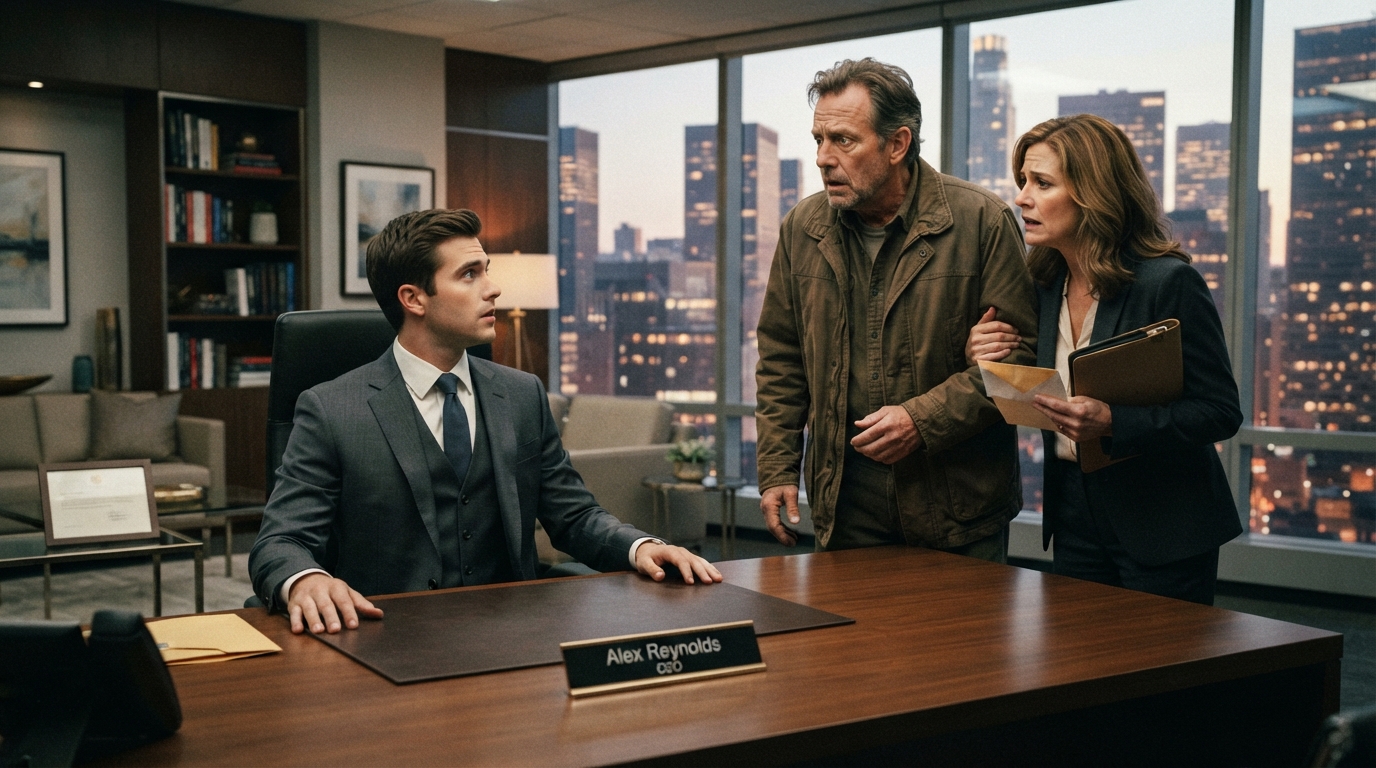
10:59, my assistant called. “They’re here.” I took a breath. “Send them in.” The door opened. My father walked in first. He
looked older than I remembered. His hair had turned mostly gray. His shoulders seemed narrower. My mother followed him,
carrying a folder against her chest. She looked tired. They both glanced around the office. My father seemed impressed
despite himself. “We’re here about the mortgage,” he said. “Yes,” I replied. He looked toward my assistant. “We’re supposed
to meet someone from the bank.” “You are.” He sat down. My mother remained standing. “We were told there might be a
restructuring option.” “There is.” My father opened the folder. “I lost my job eight months ago. We’ve been trying to keep up.
We weren’t expecting this.” I looked at the documents. “Why didn’t you contact the lender earlier?” “Pride,” my mother
whispered. My father glanced at her. “We thought we’d recover.” I nodded. “And now?” “Now we need help.” The words hung
in the air. Twelve years earlier, my father had told me I would come crawling back. Now he was sitting in my office asking a
stranger for mercy. I looked at him carefully. He still didn’t recognize me. My assistant had used my professional name, and I
had changed my appearance over the years. I had cut my hair differently, stopped wearing glasses, and carried myself
differently. He had no reason to suspect that the executive across from him was his daughter. My mother looked around the
room again. Her eyes stopped on a photograph of me receiving an award. She frowned. “Isn’t that—” She stopped. My father
turned. “What?” “Nothing.” I almost smiled. The photograph was from a business magazine. My face had been on the cover
months earlier. They hadn’t recognized me. My assistant stepped in with another file. “Would you like me to stay?” I shook
my head. “No. We’re fine.” She left. My father opened his folder again. “We don’t want charity.” “Good,” I said. “I don’t give
charity.” He looked relieved. “Then what are our options?” I slid a document toward him. “A three-year restructuring plan.
Lower monthly payments. Late fees reduced. No immediate foreclosure.” He stared at the paper. “That’s generous.” “It’s
practical.” My mother whispered, “Who owns the mortgage?” I looked at her. “My company.” My father’s head lifted. “Your
company?” I nodded. “Which company?” I gave him the name. His eyes narrowed. “That’s owned by…” He stopped. He
looked at me. Then he looked at the wall. Then back at me. His face changed. He stood slowly. “No.” I said nothing. He stared
at me as if seeing me for the first time. “You?” My mother turned toward me. “Oh my God.” I stood. “Hello, Dad.” His mouth
opened, but no sound came out. He finally whispered, “How did you even—?” I smiled sadly. “You told me I would fail.” He sat
down hard. My mother began crying. “You’re the owner?” “I’m the owner.” My father looked around the office again. “The
galleries?” “Mine.” “The tower?” “Mine.” He swallowed. “The company holding our mortgage?” “Mine.” Silence. My mother
covered her face. “Why didn’t you tell us?” “Would you have believed me?” She looked at the floor. My father finally spoke.
“Your sister said you were barely surviving.” “I never told Emily to lie.” “She didn’t know everything,” he said. “She knew you
were successful.” I nodded. “She knew enough.” My father rubbed his forehead. “I thought you were still angry.” “I was.” “Are
you?” I looked at him. “Sometimes.” He looked at the acceptance letter I had placed on my desk. I had brought it that
morning. It was still flattened, though the crease remained. His eyes widened. “You kept that?” “For twelve years.” He stared
at it. “Why?” “Because it was the first thing I chose for myself.” My mother began crying again. “I should have stopped him.” I
looked at her. “Yes.” She nodded. “I know.” My father looked down at his hands. “I was wrong.” I waited. Those words had
lived in my imagination for twelve years. I had pictured them many times. I had imagined him apologizing. I had imagined
feeling triumphant. Instead, I felt tired. “You were,” I said. He looked at me. “I thought art was a dead end.” “It wasn’t.” “I
thought you were being rebellious.” “I was sixteen.” “I thought you would come back.” “I told you I wouldn’t.” He nodded. “You
did.” He took a shaky breath. “I’m sorry.” My mother stood and walked toward me. “Can I hug you?” I hesitated. I had
imagined this moment too. I had imagined throwing my arms around her. Instead, I simply nodded. She hugged me, and I felt
how much she had aged. For a moment, I was sixteen again, waiting for her to defend me. This time, she whispered, “I should
have protected you.” I closed my eyes. “Yes.” She pulled away. “I’m sorry.” My father stood. “I don’t deserve your help.”
“Maybe not.” He looked surprised. “But I’m not going to use your financial situation to punish you.” I handed him the
restructuring documents. “You will have a chance to keep the house. But you’ll need to make the payments.” He nodded. “Of
course.” “And if you can’t, we’ll discuss the next step professionally.” He almost smiled. “You’re really running this like a
business.” “It is a business.” He nodded. “You always were stubborn.” “I prefer determined.” For the first time, he laughed. It
was small, but real. “Fair enough.” Before they left, my father turned around. “Can I ask you something?” “Sure.” “Are you
happy?” The question caught me off guard. I looked at the city outside the window. “Yes.” “Even after everything?”
“Especially after everything.” He nodded. “Good.” They left. I remained behind my desk. My assistant came in a few minutes
later. “Are you okay?” “I think so.” She looked at the acceptance letter. “Was that the letter?” “Yes.” “You kept it all these
years?” I nodded. “It reminds me of where I started.” She smiled. “I’d say you’ve come a long way.” I looked around the office.
The paintings. The skyline. The tower. The company. The life I had built. Then I thought about the sixteen-year-old girl
standing outside her parents’ house with $1,186 and a suitcase. She had been terrified. She had cried that first night. She
had wondered whether she had made a terrible mistake. She hadn’t. The next three years were hard, but they made her
stronger. The rejection made her persistent. The loneliness made her independent. The silence from her mother taught her
not to wait for someone else’s permission to become who she wanted to be. And my father’s words taught me something I
didn’t understand until much later: sometimes people tell you that you will fail because they are afraid of what will happen if
you succeed. My father had wanted a predictable daughter. I became an unpredictable woman. I didn’t build my galleries to
prove him wrong. I built them because I loved art. I didn’t buy the Seattle tower to impress my parents. I bought it because I
saw potential where others saw a broken building. I didn’t acquire their mortgage because I wanted revenge. I didn’t even
know it was theirs when the investment was made. But when I discovered it, I had a choice. I could use my power to punish
them, or I could use it to become someone different from the person who had once thrown me out. I chose differently. Over
the following months, my parents kept the house. They followed the restructuring plan. My father found consulting work.
My mother started a small craft business from home. Emily visited them more often, and eventually she visited me too. One
afternoon, she came to my gallery and stood in the middle of the main room, staring at the paintings. “I still can’t believe this
is yours.” I laughed. “Neither can I sometimes.” She hugged me. “I’m sorry I didn’t stand up for you.” “You were seventeen.”
“Still.” “You were a kid too.” She smiled through tears. “Dad keeps telling everyone you’re the most stubborn person he’s ever
met.” “He’s probably right.” She laughed. “He also tells everyone you’re the best businesswoman he knows.” I smiled. “That’s
progress.” Months later, my father visited the Seattle tower again. This time, he came without paperwork. He walked
through the gallery slowly, stopping in front of every painting. Finally, he stood before a large portrait I had painted years
earlier. It showed a teenage girl standing at the edge of a long road with a suitcase beside her. Behind her was a house with
one light glowing in the window. Ahead was a sunrise. My father stared at it. “Is that you?” he asked. “Yes.” “When did you
paint it?” “The year after I left.” He looked at the girl. “You look scared.” “I was.” “But you kept walking.” “I did.” He was quiet
for a long time. Then he said, “I’m proud of you.” I looked at him. “Thank you.” He swallowed. “I wish I’d said it sooner.” “Me
too.” He nodded. “I can’t change that.” “No.” “But I can say it now.” I smiled. “Then say it.” He laughed softly. “I’m proud of you.”
I believed him. Not because I needed his approval anymore, but because I could finally hear those words without feeling like
they determined my worth. We stood together in silence. Then he pointed toward another painting. “How much is that
one?” I laughed. “Dad, you’re not buying a painting just because you’re my father.” “Why not?” “Because you don’t even like
modern art.” “Maybe I’ve changed.” I smiled. “Maybe you have.” He eventually bought a small painting. He paid full price. I
didn’t give him a discount. When he left, I watched him walk toward the elevator carrying the wrapped painting under his
arm. I felt something settle inside me. Not victory. Not revenge. Closure. The next year, my mother attended one of my
gallery openings. She stood beside me while dozens of collectors walked through the exhibition. “Your grandfather would
have loved this,” she said. I nodded. “He would.” She touched my arm. “I’m sorry I was silent.” “I know.” “I was afraid of your
father.” I looked at her. “I know.” “I should have been brave.” “Yes.” She took a breath. “Can you forgive me?” I thought about it.
“I’m trying.” She smiled. “That’s enough.” And somehow, it was. I never moved back into that house. I never needed to. I had
built my own home in Seattle, filled with books, paintings, plants, old furniture, and windows overlooking the city. I kept my
grandfather’s fountain pen in a glass case. I kept my original $1,186 savings record in a drawer. And I kept the acceptance
letter. Not because I was still trying to prove my father wrong. I kept it because it reminded me of the girl who chose herself
before she knew what choosing herself would cost. Years later, when young artists came to my galleries looking for advice, I
often told them the same thing: “Don’t let someone else’s fear become your future.” Sometimes they asked whether my
parents supported me. I smiled and said, “Not at first.” Sometimes they asked how I became successful. I told them success
wasn’t one moment. It was thousands of small decisions made when nobody was watching. Getting up after rejection.
Working when tired. Saving when I wanted to spend. Learning from mistakes. Asking questions. Taking risks carefully. And
refusing to let one person’s opinion become the definition of my life. My father had once crumpled my acceptance letter and
told me to get out. Twelve years later, he walked into my office carrying a folder and asking a mystery CEO for mercy. When
he discovered that the CEO was the daughter he believed would fail, he froze. I could have smiled and said, “I told you so.” I
could have denied him help. I could have let the bank take the house. Instead, I gave him a fair chance to save it. Not because
he deserved a reward. Not because I had forgotten what happened. I did it because I had finally understood something that
sixteen-year-old me couldn’t have known. Success isn’t about making the people who hurt you suffer. Success is about
reaching a place where their cruelty no longer controls what kind of person you become. My father had tried to make me
feel small. He failed. My mother had remained silent. She eventually found her voice. My sister had believed I was barely
surviving. She eventually discovered I had built an empire. And I had once walked out of that house with $1,186, three
sketchbooks, and a crumpled letter hidden beneath my jacket. I thought I was leaving with almost nothing. I didn’t realize I
was carrying the most valuable thing I owned: the belief that my life was mine to create. The girl who left that night never
came crawling back. She kept walking. She stumbled. She failed sometimes. She cried. She worked. She learned. She built.
And twelve years later, when the people who had doubted her walked into her office, she didn’t need to prove them wrong.
Her life had already answered for her.
THE END! THANKS FOR READING!