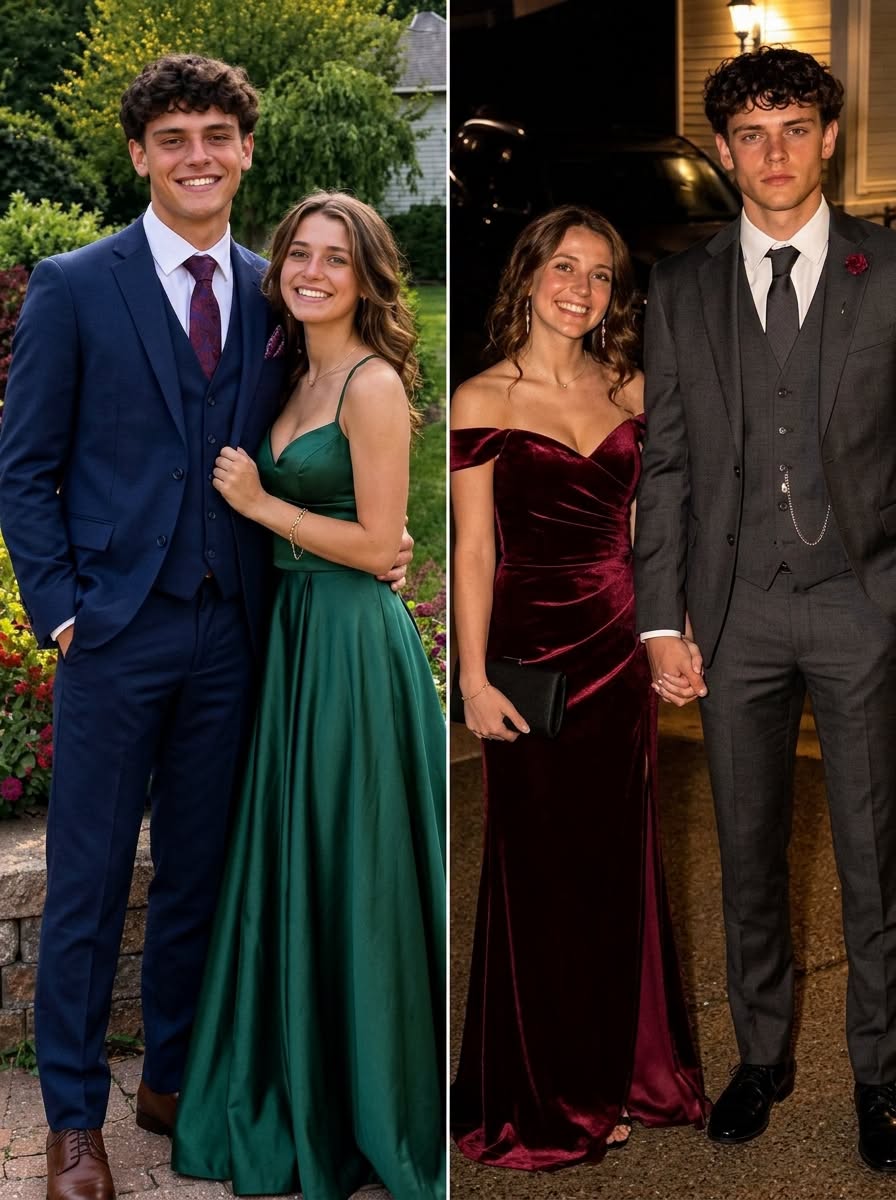
Iris had been counting down the days to prom since January.
She had a calendar taped above her desk.
Every morning, she crossed off another square.
I pretended her excitement was contagious.
Most of the time, it was.
My daughter was seventeen, bright, funny, and careful about whom she trusted.
She had grown up without her father.
I had told her he left before she was born.
That was true, but it was not the whole truth.
For years, I had convinced myself those were the same thing.
Then Ryan asked her to prom.
Ryan Mercer was captain of the football team.
He had excellent grades and a scholarship interview scheduled for the following week.
At school, he was the boy everyone seemed to know.
Iris told me he had first noticed her in chemistry class.
He had stayed after school to help her rebuild a broken model for a science competition.
“Mom, he listened when I was talking,” she said.
“As opposed to what?”
“As opposed to waiting for me to stop.”
I laughed.
I liked that answer.
I liked how peaceful she looked around him.
I had watched her become guarded during the last few years.
Her friends sometimes compared fathers’ careers or vacation plans.
When conversation turned toward her own father, she usually made a joke.
She said she didn’t care.
I wanted to believe her.
But I had found her once at the kitchen table with a blank family-tree worksheet.
The box beside the word Father had been left empty.
She folded the paper before I could ask about it.
I knew I should have told her more.
I kept finding reasons to wait.
The right age.
The right moment.
The right way to explain something that had never seemed right to me.
When Ryan arrived on prom night, he carried pale pink flowers.
He wore a dark blue suit, and his tie matched the narrow ribbon around Iris’s bouquet.
I took photographs on the porch.
I made them stand beside the flowering dogwood.
Ryan kept making terrible jokes until Iris laughed naturally.
For a moment, I could almost forget the envelope hidden at the back of my bedroom closet.
It held letters addressed to my daughter.
Letters she had never seen.
Ryan asked if they could stay out until midnight.
I said eleven thirty.
Iris groaned.
He grinned.
“Eleven forty-five?”
“Eleven thirty.”
“Fair enough.”
They drove away under a sky just beginning to turn purple.
I stood on the porch longer than necessary.
Inside, the house seemed unusually quiet.
I washed two coffee mugs.
I folded a blanket from the couch.
Then I checked my phone.
I was not usually an anxious parent.
I knew the school had supervisors at the dance.
I knew Ryan’s parents.
Or rather, I thought I knew them.
His mother, Evelyn Mercer, had waved to me at football games.
His father rarely attended school events.
I knew him only from photographs.
I had never tried to learn more.
That omission would eventually matter.
Around ten, Iris sent a message.
MOM. YOU ARE NEVER GOING TO BELIEVE WHAT JUST HAPPENED.
I smiled.
I asked whether she’d won something.
She replied that she would explain when she got home.
Then the messages stopped.
At eleven thirty, I looked through the front curtains.
At eleven forty, I sent a question mark.
At midnight, a car finally turned into our driveway.
Iris came through the door almost running.
Her cheeks were pink from the cold.
She still had her corsage on.
“Mom, something happened tonight.”
She looked at Ryan.
“Actually, I’ll get us some water.”
She disappeared into the kitchen.
Ryan’s smile vanished.
He stood near the front door with his hands tightly clasped.
“You have five minutes,” he said.
I thought I had misunderstood.
“Five minutes for what?”
“To tell Iris the truth. Or I will.”
I felt a deep, terrible familiarity.
“Ryan, what are you talking about?”
He reached into his jacket.
He held up a photograph.
It was faded at the corners.
In it, a younger version of me stood beside a dark-haired man outside a hospital.
I knew that photograph.
I had believed every copy had been destroyed.
“Where did you get that?”
Ryan glanced toward the kitchen.
“My mother has a box of old pictures.”
He swallowed.
“We found this one tonight.”
It had been eighteen years since I’d seen the man in that picture.
I remembered his quiet voice.
His wedding band.
The promise he had made when he told me he would leave his marriage.
I remembered learning that the promise had been another lie.
Ryan watched my expression.
“I think you know who he is.”
I put a hand against the wall.
A decade ago, I would have been afraid of scandal.
Now I was afraid of my daughter standing ten feet away.
“Ryan, please don’t spring this on her.”
“Then you tell her.”
His voice shook.
“He was at the dance tonight. My dad.”
I stared at him.
“Your father was there?”
“He helped chaperone the alumni reception next door.”
I heard Iris moving glasses in the kitchen.
Ryan spoke quickly.
“My dad recognized her last name on the welcome board. He asked me who her mother was.”
I had given Iris my surname.
A name her biological father knew very well.
“Then what?”
“Then he asked how old she was.”
Ryan looked as sick as I felt.
“He went outside and wouldn’t talk to me.”
I could hear the refrigerator humming.
“He told me later that he knew you before I was born.”
I closed my eyes.
“How old are you, Ryan?”
“Seventeen. Almost eighteen.”
My knees weakened.
He showed me another photograph.
A family gathering.
His father stood behind a little boy.
Beside them was Evelyn, looking much younger.
I knew his father before I’d seen the caption.
His name was Thomas Mercer.
When I was twenty-four, he had called himself Tom.
He had told me his marriage had ended.
It hadn’t.
When I discovered I was pregnant, he said he wanted to do the right thing.
Two weeks later, he was gone.
What I’d never known was that his wife had also been pregnant around that time.
The door to the kitchen opened.
Iris entered with three glasses of water.
She stopped when she saw us.
“What’s wrong?”
I looked at her prom dress.
The small rhinestone clasp on her shoulder.
The curls she had spent all afternoon arranging.
Her face was still full of hope.
I understood that I could not make her past disappear by refusing to speak about it.
I could only decide whether I would tell the truth myself.
“Sit down, sweetheart,” I said.
She looked at Ryan.
“Did something happen to you?”
He shook his head.
“It’s about our families.”
A silence passed between us.
Then I took the photograph from his hand.
“Iris, there’s something I’ve kept from you about your father.”
Her eyes moved to the picture.
She recognized me immediately.
“Who’s that man?”
I had practiced dozens of answers over the years.
Every one of them vanished.
“His name is Thomas Mercer.”
Ryan pulled out a chair.
Iris didn’t move.
“Mercer?” she repeated.
And I knew the next sentence would change all three of our lives.
PART 2 – The Letters I Hid for Seventeen Years Revealed a Lie That Had Hurt Two Families
“Thomas Mercer is your father,” I said.
Iris stared at me.
For several seconds, she seemed not to understand the words.
Then her gaze moved toward Ryan.
“Mercer is your name.”
He nodded.
“It’s my father’s name too.”
She took a step backward.
I reached for her arm.
She moved away.
“Don’t,” she whispered.
Ryan pushed his chair farther from the table.
“We don’t know everything yet,” he said.
Iris looked at him.
“You knew?”
“Only tonight.”
“Did you know when you asked me to prom?”
“No.”
She pressed her palms against her cheeks.
Then she hurried upstairs.
Her bedroom door closed with a sharp click.
Ryan stood in the living room.
He looked young and frightened.
“I never should have brought you that ultimatum,” he said.
“You were frightened too.”
“She’s going to hate me.”
“She’s hurt. Don’t make her comfort you about that.”
He nodded and picked up his car keys.
Before he left, he told me that his mother had been looking for the photograph because Thomas had kept a box in the garage.
“Mom found it after he started acting strange tonight.”
“Does she know?”
“She knows he had an affair. She didn’t know there was a child.”
After he left, I sat on the bottom stair.
I could hear Iris moving around in her room.
A drawer opened.
A hanger struck the closet door.
Then everything went quiet.
I wanted to knock.
I wanted to explain that I had been afraid.
But my fear was no longer the most important thing in the house.
I went into my bedroom instead.
At the back of the closet was a cardboard box holding winter scarves and old photographs.
Below the scarves sat a blue envelope.
I had kept it for seventeen years.
Inside were three letters from Thomas.
One had arrived shortly before Iris was born.
One came six months after.
The last arrived when she turned three.
He had written that he was sorry.
He had written that he wanted to explain things someday.
He had asked me not to contact his wife.
There was no offer to help with diapers or rent.
No plan to see his daughter.
Only apologies and requests for secrecy.
I kept the letters because I thought Iris might need them when she was older.
Then I kept them because I was ashamed.
Each year, telling her seemed harder than the year before.
My sister, Helen, had told me to stop waiting.
“She’ll find out somehow,” Helen said once.
“She has a right to know what happened.”
I had promised to talk to Iris after her sixteenth birthday.
That birthday came and went.
I told myself we were happy.
It was a convenient excuse.
At one in the morning, Iris opened her bedroom door.
She wore pajamas now.
Her makeup had been washed away.
“Did you know he had another family?” she asked.
“Yes.”
“Did you know about Ryan?”
“No. I didn’t know Thomas had a son.”
“Are you sure?”
I held out the letters.
“Read these if you want. You don’t have to tonight.”
She took them without speaking.
Then she sat on the couch and read.
I stayed in the armchair across from her.
When she reached the last letter, she folded it carefully.
“So he knew I existed.”
“Yes.”
“And he chose not to come.”
“Yes.”
Her chin trembled.
“Did you ever try to find him?”
“I sent one letter to an address I had. It came back.”
“Did you try again?”
“No.”
“Why?”
I took a long breath.
“Because I was humiliated. And angry. And frightened of what his wife might say.”
Iris looked down.
“You cared more about being embarrassed than about me knowing my father?”
It was a painful question.
I answered it without defending myself.
“I let my shame make decisions that should have belonged to you.”
She wiped her eyes.
“That’s not fair.”
“No.”
“Nothing about this is fair.”
We sat together until almost three.
I told her the details I could remember.
Thomas and I had met through a volunteer committee.
He traveled frequently for work.
He said he and Evelyn were separated.
When I saw a wedding photograph on a colleague’s desk, I confronted him.
He admitted he was still married.
I ended the relationship.
Weeks later, I learned I was pregnant.
I told him.
He promised support but withdrew instead.
Iris listened without saying much.
Finally she asked the question I had feared most.
“What does that make Ryan?”
“Possibly your half brother.”
She flinched at the words.
“Possibly?”
“Your biological father would need to be confirmed. We shouldn’t treat the photographs as proof.”
“Did you ever do a paternity test?”
“No.”
Iris stood.
“I need to be alone.”
I let her go.
The following morning, she stayed home from school.
I called the attendance office and said she had a family emergency.
I didn’t describe it.
She had slept only a few hours.
So had I.
At nine, my phone rang.
The caller was Evelyn Mercer.
Her voice was controlled but exhausted.
“I’m calling because Ryan told me what happened.”
“I know this is difficult.”
“I want to hear what you know, not what Thomas told me.”
I explained the relationship and the letters.
Evelyn listened.
Then she asked for copies of the correspondence.
I said I would provide them after speaking with Iris.
“This concerns her life,” I said.
“I understand.”
Evelyn paused.
“Thomas has been telling us that you left town.”
“I never left.”
“He said you wanted nothing from him.”
“That isn’t what happened.”
For a long time neither of us spoke.
Then she said she was going to ask him to leave their home while they sorted things out.
I didn’t offer advice about her marriage.
I had no right to make those decisions for her.
That afternoon, Ryan texted Iris.
He apologized for the way he handled the situation.
He told her he understood if she never wanted to speak with him again.
Iris showed me the message.
She hadn’t replied.
“Do I have to be nice to him?”
“No.”
“It’s not his fault.”
“That doesn’t mean you’re ready to talk.”
She sat across from me at the kitchen table.
“Everyone’s going to find out.”
“Some people may. You get to choose whom you tell.”
“What about school?”
“We can talk to the counselor about privacy.”
She nodded slowly.
On Monday, I took her to see Ms. Alvarez, the school counselor.
We told her enough to explain why Iris needed support and why certain conversations at school could be painful.
Ms. Alvarez did not ask for gossip.
She gave Iris space to speak.
She suggested we find an outside therapist if Iris wanted ongoing help.
Iris asked whether Ryan could be moved from one of their shared classes temporarily.
The school arranged an alternative study period for the next few weeks.
That was when I saw how much damage I’d done by delaying the truth.
I had worried about one difficult conversation.
My daughter now faced dozens of them.
A week later, Thomas contacted me.
He wanted to meet Iris.
He wrote that he had always hoped to explain.
I showed her the message.
She read it twice.
Then she asked me to reply that she was not ready.
I did.
Thomas answered immediately.
He said it wasn’t fair to deny him a relationship.
I could hardly believe his choice of words.
I typed a reply and then deleted it.
Instead, I let the message sit.
After seventeen years of silence, he could wait while his daughter decided what she wanted.
Iris began asking about the past in small pieces.
What had I wanted to name her before I chose Iris?
Did Thomas ever hold her?
Had I loved him?
I answered each question as carefully as I could.
Sometimes I said I didn’t remember.
Sometimes I said the truth was painful.
I never told her she should be grateful for the childhood I’d given her.
She had never asked to be protected through deception.
One evening, she found the prom photographs on my phone.
She stared at one picture for a long time.
Ryan was standing beside her under the dogwood.
They both looked happy.
“Can you delete that one?” she asked.
“Of course.”
I moved it to a private folder instead, after asking whether she wanted it gone permanently.
She said she might want to see it someday.
We sat on the couch.
A rainstorm tapped at the living room windows.
Iris rested her head against the cushion.
“I think I want to know for sure,” she said.
“About Thomas?”
“About whether Ryan and I are related.”
I knew the answer mattered.
Not only for the relationship she’d thought she was beginning, but for her own medical history and sense of identity.
“I’ll help you find out,” I promised.
And this time, I intended to keep my promise without finding another reason to wait.
PART 3 – A Test Confirmed Our Family Connection, but Iris Chose the Boundaries That Came Next
Confirming paternity took longer than Iris expected.
She wanted an answer the next morning.
I explained that a reliable test required consent, proper collection, and time for laboratory processing.
Our attorney, a family-law practitioner named Andrea Bell, advised us how to obtain a documented test without allowing Thomas to control the process.
Iris was still a minor.
We made the arrangements with her knowledge and agreement.
Thomas consented after several calls.
He insisted that we meet before the test.
Iris declined.
So we attended the appointment separately.
A technician explained the collection procedure.
The cheek swab took seconds.
The waiting afterward felt much longer.
During those days, Iris went back to school.
She finished her science project.
She studied for exams.
She also met with Ms. Alvarez every Thursday.
Sometimes she came home angry.
Sometimes she seemed almost normal.
I learned not to measure her recovery by whether she laughed at dinner.
She could enjoy a joke and still be grieving what had happened.
Ryan kept his distance.
He told the counselor he would not pressure Iris to answer his messages.
I appreciated that, though I didn’t say so to him.
Evelyn and I exchanged brief updates.
She had begun counseling herself.
Thomas had moved into a rented apartment.
She told me that she was reviewing their finances and considering what she wanted from the marriage.
I didn’t ask for details.
Her decisions belonged to her.
When the test report finally arrived, we opened it at our kitchen table.
The findings confirmed Thomas as Iris’s biological father.
Ryan was his son.
They were half siblings.
Iris read the page silently.
Then she turned it over.
“I knew it,” she said.
“I know.”
“But now I actually know.”
I reached across the table.
She allowed me to hold her hand.
After a while she asked whether she could call Ryan.
I said she could decide when she was ready.
She called him that evening.
I stayed in the kitchen while they spoke on the porch.
The conversation lasted twenty minutes.
When Iris came inside, she had been crying.
“He said he’s sorry.”
“I heard.”
“He was crying too.”
I handed her a tissue.
“We said goodbye to dating.”
She folded the tissue in her hands.
“We don’t know how to be brother and sister.”
“You don’t have to know immediately.”
She nodded.
“We might never be close.”
“That can be your decision.”
Ryan transferred to a different elective the following term.
They were polite when they passed at school.
Friends noticed the change.
Some asked questions.
Iris decided on a simple explanation.
“We found out our families are related, so we’re not dating.”
She did not owe anyone the details.
Most classmates lost interest quickly.
A few continued whispering.
The school addressed one particularly cruel rumor after Iris reported it.
I was proud of how she asked for help.
It wasn’t easy for her.
Two months later, Iris requested a meeting with Thomas.
She asked me to come, along with Andrea.
We chose a quiet conference room rather than anyone’s home.
Thomas arrived early.
He wore a gray jacket and carried a folder.
When Iris walked in, he stood.
“Hello,” he said.
She remained near the door.
“Hello.”
He looked at her face with a tenderness I had once hoped to see when she was a baby.
But tenderness after seventeen years was not the same as parenting.
“I’ve wanted to meet you,” he said.
Iris looked down at her notes.
“Then why didn’t you?”
Thomas breathed out slowly.
“I made mistakes.”
“That’s not an answer.”
He tried to explain that he had been afraid of losing his marriage.
That he had believed staying away would prevent further damage.
Iris listened.
Then she asked why he had told Evelyn I left town.
His expression changed.
“I thought it would make things easier.”
“For you?”
He nodded.
“Yes.”
Iris was quiet for a moment.
Then she said the sentence she had rehearsed at home.
“You didn’t protect me. You protected yourself.”
Thomas did not argue.
He apologized specifically for failing to support her and for lying about what happened.
Andrea explained that questions about past financial obligations could be handled separately from Iris’s decision about contact.
Thomas agreed to provide records needed for that review.
We did not pretend one meeting settled years of legal and emotional consequences.
At the end, he asked whether Iris wanted another appointment.
She said she would think about it.
That was all.
Outside, she leaned against my car.
“Did I sound mean?”
“No.”
“I wasn’t trying to hurt him.”
“You were asking for an explanation.”
She looked at the cloudy sky.
“I don’t feel better.”
“You may not, yet.”
We drove home in silence.
Later that month, Evelyn invited Iris to a meeting without Thomas present.
Iris accepted.
They talked at a café with me seated nearby.
Evelyn brought a photograph of Ryan as a baby.
She also brought a photo album showing the family through the years.
She did not try to turn Iris into a replacement daughter.
She simply said she was sorry for the pain caused by the adults’ decisions.
Iris asked whether Evelyn hated her.
Evelyn shook her head.
“None of this was your doing.”
Iris cried.
Evelyn offered a tissue and did not touch her without asking.
That kindness mattered.
The months went by.
Iris completed her final exams.
She applied to three colleges and was accepted by two.
She started volunteering at a community art program over the summer.
She made friends who knew nothing about prom night.
Our relationship changed too.
She asked me hard questions.
I did my best to answer them.
When I didn’t know, I said so.
Sometimes she was angry that I had kept the letters.
Sometimes she asked me to read them with her again.
I stopped asking when she would forgive me.
I went to a counselor as well.
I needed to understand why shame had felt more manageable than honesty.
I needed to make sure I didn’t repeat that mistake in another part of our lives.
At graduation, I sat near the back of the auditorium.
Iris walked across the stage in a blue gown.
She looked toward me afterward and smiled.
A few rows away, Ryan sat with Evelyn.
He had come to support classmates.
He clapped when Iris’s name was called.
They exchanged a brief wave afterward.
No dramatic reunion.
No promise of instant closeness.
Only two young people trying to make room for a truth neither had chosen.
Thomas did not attend.
Iris had asked him not to.
He respected that request.
In August, the week before she left for college, Iris brought out the old family-tree worksheet.
She had found it in a drawer.
The box beside Father was still empty.
She set it between us.
“I used to think this meant something was missing from me,” she said.
I listened.
“Now I know it means somebody failed to show up.”
She picked up a pen.
“But I’m still here.”
She wrote Thomas’s name in the box.
Beside it, in smaller letters, she added: biological father; no current relationship.
Then she placed the worksheet inside her folder.
That evening, we packed her books and winter clothes.
She insisted on bringing the ridiculous lamp she’d had since middle school.
I said it would take up too much space.
She said she liked its light.
We argued gently over where it should go.
When the suitcase was closed, she hugged me.
“I still love you, Mom.”
“I love you too.”
“But I need you to tell me things, even when they’re hard.”
“I will.”
I had no way to erase the years I’d spent keeping silent.
I did have a choice about the years ahead.
I watched Iris carry her suitcase toward the front door.
She was nervous about college.
Excited too.
Her future was bigger than the secret I’d kept.
And for once, I wasn’t trying to decide what she could bear to know.
THE END
