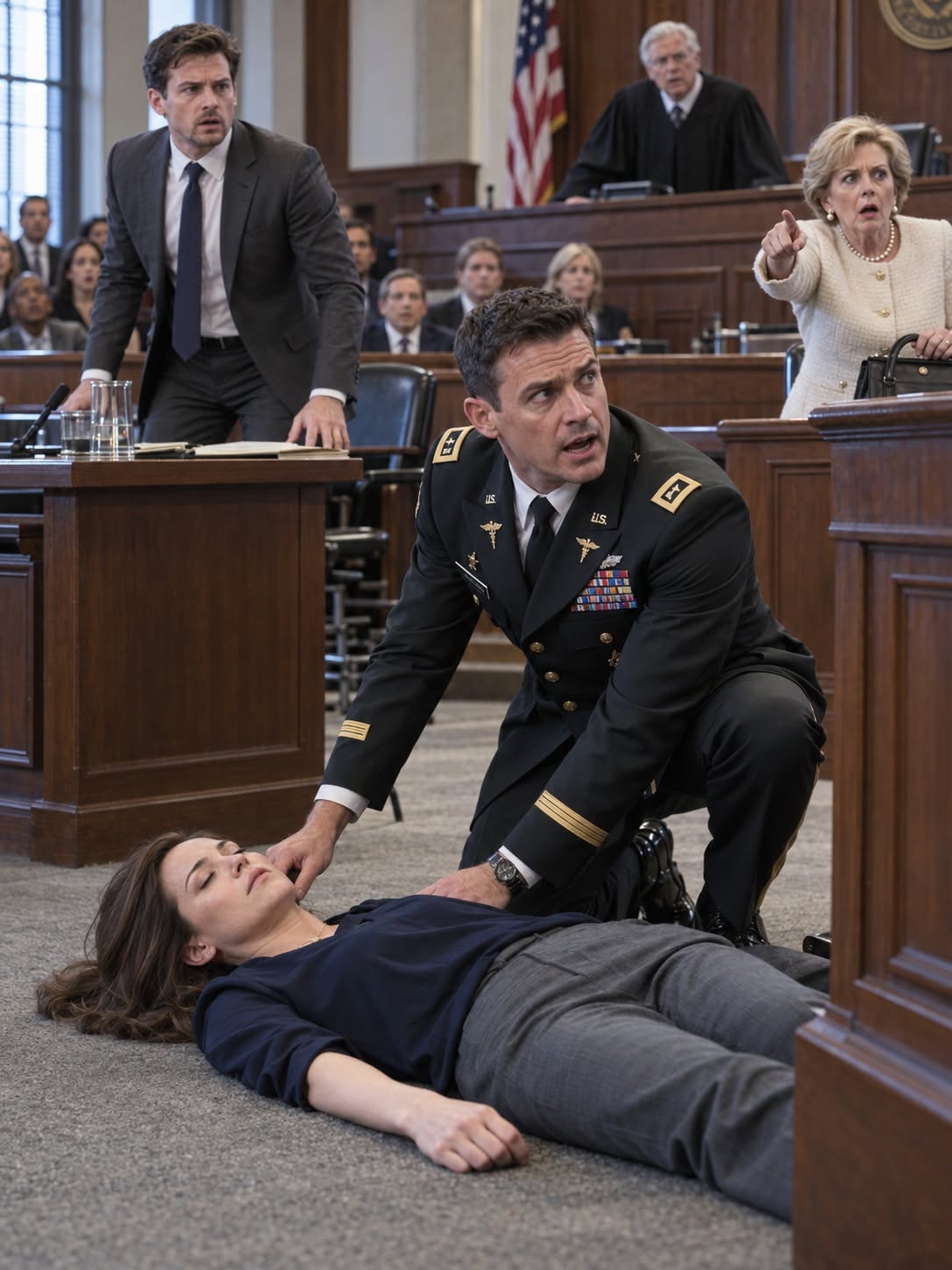
My mother-in-law pointed at me in court and said, “She’s faking it.” My husband smirked, telling the judge I did this every time.
Everyone seemed ready to believe them,
until my legs suddenly gave out and a military doctor rushed forward, shouting for someone to call 911.
My mother-in-law pointed at me from the front row of the courtroom.
“She’s faking it.”
Her voice cut through the silence like a snapped wire.
My husband, Daniel Whitaker, leaned back in his chair beside his attorney and smirked. “She pulls this every time she doesn’t get her way.”
I was standing near the witness box, one hand gripping the rail so hard my knuckles had gone white.
The room was too bright. The fluorescent lights buzzed above me.
Every sound seemed stretched and sharp: papers sliding, a pen clicking, someone whispering behind me.
Judge Richard Hanley looked over his glasses. “Mrs. Whitaker, are you able to continue?”
I tried to answer.
Nothing came out.
The custody hearing had already been going badly.
Daniel’s lawyer had painted me as unstable, emotional, manipulative. My medical records had been waved around like evidence of weakness. My dizziness, blackouts, and hospital visits were described as excuses.
Daniel claimed I used illness to avoid responsibility. His mother, Patricia, backed him up with a calm smile and a purse full of tissues she never used.
I had come alone, because my lawyer had withdrawn two weeks earlier after Daniel emptied our joint account and delayed payments.
I had spent the morning trying to explain why our seven-year-old daughter, Lily, cried every Sunday night before going to his house.
But nobody seemed to hear that.
Now the floor tilted beneath me.
“Your Honor,” I whispered, “I need a minute.”
Daniel laughed softly. “See?”
Patricia shook her head. “Drama.”
Judge Hanley’s jaw tightened. “Mrs. Whitaker, this court has been very patient.”
That was when my legs gave out.
I remember the railing slipping from my hand. I remember the hard crack of my shoulder hitting the floor.
Then voices rose around me, distorted and far away.
Someone rushed forward from the back benches.
A tall man in a dark green uniform knelt beside me. I recognized him vaguely.
He had been sitting quietly near the aisle all morning, waiting for another case. His name tag read: CARTER.
He pressed two fingers to my neck, then looked at my face. “Ma’am, can you hear me?”
My lips moved, but my tongue felt heavy.
Daniel stood, annoyed rather than frightened. “She’s fine. She does this.”
The uniformed man looked up sharply. “I’m Colonel Aaron Carter, U.S. Army Medical Corps. Your Honor, she needs help.”
Patricia scoffed. “You don’t know her.”
Colonel Carter ignored her. He lifted my eyelid, checked my pulse again, then his expression changed.
“Call 911,” he said.
No one moved fast enough.
His voice thundered across the courtroom.
“CALL 911!”
Everyone froze.
Until Judge Hanley stood up.
His chair scraped backward so violently that the sound seemed to split the room in two.
“Bailiff,” he ordered. “Call emergency services now. Clear the aisle.”
The courtroom changed instantly.
The same people who had been staring at me with suspicion were suddenly moving chairs, gathering bags, stepping backward.
Colonel Carter loosened the scarf at my neck and lowered his face closer to mine.
“Stay with me.”
I could hear him, but only barely.
His voice seemed to come through water.
“What’s your name?”
“Emily.”
“Good. Emily, look at me.”
I tried.
The ceiling lights floated above him like white moons.
“What medications are you taking?”
I swallowed.
“I don’t…”
My mouth was dry.
“Daniel handles…”
Colonel Carter’s eyes sharpened.
“What?”
Daniel stepped around the counsel table.
“She manages her own medication.”
I saw Carter turn his head.
It was only a small movement.
But something about the silence afterward made Daniel stop walking.
“I asked her,” Carter said.
Daniel’s face hardened.
“She’s confused.”
Patricia rose from the bench. “This is ridiculous. She wants everybody looking at her.”
Judge Hanley slammed one palm against his desk.
“Mrs. Whitaker, sit down.”
Patricia stared at him.
For the first time all morning, the confidence left her face.
Sirens began wailing somewhere outside.
Colonel Carter kept one hand beneath my wrist.
“Emily, when did you last eat?”
“Breakfast.”
“Any new medication?”
I tried to remember.
There had been a white tablet in my organizer that morning.
Daniel had filled those organizers for years.
Even after we separated, he insisted on doing it because, as he liked to say,
I was “too scattered to keep track.”
I had finally told him to stop three weeks earlier.
Then he had shown up with Lily’s backpack two Sundays ago and asked to use the bathroom.
I remembered the medicine cabinet door standing open afterward.
The memory came and went before I could hold onto it.
“My pills…”
My breath caught.
“Something’s wrong with my pills.”
Daniel laughed again.
But this time no one joined him.
Colonel Carter looked toward the judge.
“Your Honor, make sure that statement is preserved.”
Judge Hanley looked at the court reporter.
“Everything is on the record.”
The paramedics arrived less than three minutes later.
They surrounded me with equipment, clipped something onto my finger, wrapped a cuff around my arm,
and began asking questions.
One of them read the blood pressure aloud.
Colonel Carter’s face went still.
“That’s not anxiety,” he said.
Daniel looked toward his attorney.
His attorney did not look back.
As they lifted me onto the stretcher, I saw Patricia step toward the doors.
The bailiff blocked her.
“Ma’am, the judge has not dismissed anyone.”
Her mouth fell open.
“I need air.”
“You need to remain in the courtroom.”
Daniel stood quickly.
“I’m going with my wife.”
“No.”
Judge Hanley’s voice stopped him.
Daniel turned.
The judge’s expression had changed completely.
Not sympathy.
Not yet.
Something colder.
“Mr. Whitaker, you will remain here until I determine what happens next.”
Daniel’s jaw tightened.
“I have a right—”
“You spent the last twenty minutes telling this court your wife’s physical condition was an act.
A physician has now told me she is experiencing a medical emergency. You will sit down.”
The stretcher rolled through the doors.
The last thing I saw before they closed was Daniel lowering himself into his chair.
He was no longer smiling.
I woke beneath softer lights.
A monitor beeped beside my head.
My left hand felt heavy from an IV.
For several seconds I had no idea where I was.
Then the courtroom returned in fragments.
Patricia pointing.
Daniel laughing.
The floor.
Colonel Carter shouting.
I tried to sit up.
A nurse appeared almost immediately.
“Easy.”
“Lily.”
My voice cracked.
“Where’s my daughter?”
“She’s safe.”
“Where?”
The nurse glanced toward the doorway.
A woman in a gray blazer stepped inside.
She was maybe fifty, with tired eyes and a leather folder held against her chest.
“My name is Marlene Vega. I’m a court-appointed child advocate.”
Every muscle in my body tightened.
“Why are you here?”
“Judge Hanley issued an emergency order while you were being transported.
Lily was removed from the scheduled exchange pending investigation.”
I stared at her.
“Removed from Daniel?”
“For tonight, yes.”
My eyes filled before I could stop them.
“Where is she?”
“With your sister, according to the emergency contact listed at her school.”
I closed my eyes.
My sister Claire lived twenty minutes away.
Daniel hated her.
Which was probably why I had listed her.
“Can I see Lily?”
“As soon as your doctors clear it.”
Marlene pulled a chair closer but did not sit immediately.
“There’s something else.”
The room seemed to shrink.
“What?”
“Your blood work.”
A physician entered behind her.
Dr. Salazar.
She introduced herself, checked the monitor, then stood at the side of my bed.
“We found a sedating medication in your system.”
I blinked.
“I don’t take sedatives.”
“That is what concerns us.”
My fingers curled into the blanket.
Dr. Salazar continued carefully.
“The concentration is inconsistent with accidental trace exposure.\
We’re running confirmation testing, but it may explain the dizziness, confusion, weakness, and episodes of collapse you’ve been experiencing.”
I stared at the IV line.
“No.”
“We also reviewed your prior emergency visits.”
She placed several pages on the table.
“At least three of them documented symptoms consistent with the same type of exposure, though no toxicology screen was performed at the time.”
My breathing changed.
Daniel sitting beside my hospital bed six months earlier.
Daniel telling the doctor I was under stress.
Daniel answering questions before I could.
Daniel taking me home.
Patricia making tea because I “needed to settle down.”
“No.”
This time the word came out differently.
Not disbelief.
Recognition.
Marlene finally sat.
“Emily, I need to ask you something difficult.”
I looked at her.
“Does Daniel still have access to your home?”
I thought of the bathroom two Sundays earlier.
The open medicine cabinet.
“He had a key.”
“Had?”
“I changed the locks.”
“When?”
“Last week.”
Marlene exchanged a look with Dr. Salazar.
“Has Lily ever said anything about your medication?”
My heart started beating harder.
“I don’t know.”
“Think carefully.”
Sunday nights.
Lily crying.
Her arms around my waist.
Her refusal to explain.
She never said she hated visiting Daniel.
She never said he hurt her.
She always asked one question.
Mommy, are you going to be okay while I’m gone?
I had thought she was worried because I was sick.
My stomach turned.
“Oh God.”
Marlene leaned forward.
“What?”
“She wasn’t crying because she was afraid to go.”
My voice broke.
“She was afraid to leave me.”
Silence settled over the room.
Marlene’s pen stopped moving.
“Why?”
“I don’t know.”
But suddenly I did.
Or part of me did.
A child-sized answer had been sitting in front of me for months.
I pressed both palms against my face.
“She kept asking if I would drink anything Grandma brought me.”
Marlene became very still.
“What exactly did she say?”
“She asked me once if grown-ups could get sick from vitamins.”
My hands started trembling.
“I thought she was talking about gummy vitamins. I told her not if you take them properly.”
“Emily.”
Marlene’s voice was soft now.
“Did she ever mention Patricia?”
I looked at her.
“She said Grandma knew which medicine made people sleep.”
The monitor beside me began beeping faster.
Dr. Salazar touched my shoulder.
“Slow your breathing.”
I couldn’t.
Because I remembered another thing.
Three months earlier, I had woken on my kitchen floor.
Daniel had been standing above me.
He said he had come by because Lily forgot her sweater.
I never remembered hearing the door.
He told everyone afterward that I had fainted dramatically because we had argued about custody.
His lawyer used that incident against me that morning.
Marlene rose.
“I need to contact the court.”
“Wait.”
She stopped.
“If Lily knows something, don’t make her tell it in front of him.”
Marlene’s expression softened.
“I won’t.”
“I mean it.”
“I understand.”
“No.”
I reached for her sleeve.
“I have spent months having adults decide what is true before I finish speaking. Please don’t do that to her.”
Marlene looked down at my hand.
Then back at me.
“I promise.”
She left.
That evening, Colonel Carter came to my room.
He stood just inside the doorway without his cap, looking less imposing than he had in court.
“You look better.”
“I feel like I was hit by a truck.”
“That’s an improvement.”
A laugh escaped me before I expected it.
It hurt.
But it was the first sound I had made all day that didn’t feel frightened.
“Thank you,” I said.
He nodded once.
“You don’t owe me anything.”
“You were the only person in that room who believed something was wrong.”
Carter’s expression shifted.
“I didn’t believe you.”
The words startled me.
He moved closer.
“I observed you.”
I stared at him.
“Your skin color was wrong. Your speech was slowing. You were losing postural control.
Your pulse didn’t match the behavior people were accusing you of performing.”
He paused.
“Belief shouldn’t have been necessary.”
Something in me cracked open.
I looked away because crying in front of him felt unbearable.
He pretended not to notice.
“Judge Hanley asked me to provide a statement.”
“Will you?”
“Yes.”
“Daniel will say you interfered.”
“He can say whatever he wants.”
Carter looked toward the window.
Outside, rain had begun tapping against the glass.
“I’ve testified in military hearings where everyone in the room had already decided who the difficult person was.”
He looked back at me.
“Sometimes the most dangerous lie isn’t the one somebody tells.”
“What is it?”
“The one everybody finds convenient.”
He left ten minutes later.
I remembered that sentence for the rest of my life.
The emergency hearing took place forty-eight hours later.
I attended remotely from the hospital.
Daniel appeared in court wearing a dark suit and an expression carefully arranged somewhere between concern and exhaustion.
Patricia sat behind him.
She had changed tactics.
No smirk.
No scoffing.
She looked like a worried grandmother.
Daniel’s attorney began by describing my collapse as a “regrettable medical event” unrelated to parenting.
Judge Hanley stopped him.
“Counsel, your client testified under oath that Mrs. Whitaker routinely fabricated medical symptoms.”
A pause.
“Yes, Your Honor, based on his experience—”
“And we now have laboratory evidence showing an unprescribed substance in her system.”
Daniel leaned toward his attorney.
The attorney’s shoulders tightened.
“We do not know how it entered her system.”
“Correct.”
Judge Hanley folded his hands.
“That is why there is an investigation.”
Then Marlene entered with Lily.
My daughter looked tiny beneath the courtroom lights.
Her brown hair was braided.
She was wearing the yellow cardigan I had bought her for picture day.
The sight of her almost destroyed me.
“Mommy?”
My screen was positioned on a rolling monitor near the judge.
“I’m here, sweetheart.”
Her mouth trembled.
“I want to go home.”
“I know.”
Marlene knelt beside her.
Judge Hanley’s voice changed when he spoke.
“Lily, nobody here is angry with you. You don’t have to answer anything you don’t want to answer.”
Daniel leaned forward.
“Baby, Daddy’s right here.”
Lily recoiled.
It was small.
Barely a movement.
But everyone saw it.
Daniel froze.
“Lily?”
She stepped behind Marlene.
Patricia whispered something.
Lily looked at her grandmother.
Then she started crying.
Not loudly.
That made it worse.
Tears simply slid down her cheeks while she stood completely still.
Marlene turned toward the judge.
“Your Honor, I believe we should proceed without the parents questioning her directly.”
“Agreed.”
She led Lily into the judge’s chambers with a court reporter and a child specialist.
Daniel objected.
Judge Hanley overruled him.
We waited.
Twenty-three minutes.
I watched the second hand of the wall clock travel in circles.
Daniel tapped one finger against the table.
Patricia never moved.
Finally the chamber door opened.
Marlene came out alone.
She was holding a small purple tablet.
Daniel’s face changed.
I noticed it immediately.
“What is that?” his attorney asked.
Marlene did not answer him.
She approached the bench.
“Your Honor, Lily brought this from her backpack.”
Daniel stood.
“That’s mine.”
The room went silent.
Marlene looked at him.
“You just said it was yours?”
Daniel’s attorney grabbed his arm.
“Sit down.”
Daniel realized what he had done.
“I mean I purchased it.”
Marlene’s voice remained calm.
“Lily says she uses it to record songs and play school games.”
“Yes.”
Daniel swallowed.
“It belongs to the family.”
Marlene turned toward Judge Hanley.
“There is an audio recording on this device. Lily says she started recording because her teacher told the class they could make an audio diary for a family-history project.”
My pulse began pounding in my ears.
“She forgot the recorder was running one night at her father’s house.”
Patricia’s face lost all color.
Daniel whispered, “Mom.”
One word.
That was all.
His attorney closed his eyes.
Judge Hanley looked toward the bailiff.
“Secure the courtroom.”
Daniel shot to his feet.
“This is absurd.”
“Sit down.”
“You cannot hold us here over a child’s recording.”
Judge Hanley’s voice dropped.
“Sit down, Mr. Whitaker.”
Daniel remained standing.
The bailiff moved closer.
Daniel sat.
Marlene connected the tablet.
At first there was only the sound of a child humming.
Lily’s voice.
A drawer opening.
Footsteps.
Then Patricia.
Clear enough that nobody could mistake her.
“She changed the locks.”
Daniel answered.
“Then we use the court exchange. She still lets me inside if Lily forgets something.”
My hand flew to my mouth.
A chair creaked in the courtroom.
Patricia whispered, “Turn it off.”
No one moved.
The recording continued.
Patricia said, “You’re pushing this too far.”
Daniel laughed.
Not the courtroom laugh.
A private laugh.
Harder.
“She looks unstable. That’s the point.”
A long pause.
Then Patricia again.
“And if something happens?”
“She’s been to the emergency room four times. Nobody found anything.”
My vision blurred.
Marlene lowered her eyes.
The recording played on.
“You said half.”
“I said enough that she can’t stand straight. Hanley sees her lose it in court, I get temporary custody. Once Lily’s with me, Emily takes whatever settlement I give her.”
Patricia’s voice became quieter.
“And the girl?”
“She doesn’t know anything.”
A small sound came through the speaker.
A child breathing.
Lily.
Daniel’s recorded voice continued.
“Just keep the pills where she won’t see them.”
Then the audio stopped.
Nobody spoke.
Judge Hanley stared straight ahead.
Daniel’s attorney slowly moved his chair several inches away from his client.
Patricia was crying now.
Real tears.
“I never wanted this.”
Daniel turned on her.
“Shut up.”
She stared at him.
“You told me it was harmless.”
“Mom.”
“You said she’d get sleepy.”
“STOP TALKING.”
The bailiff moved immediately.
“Mr. Whitaker.”
Daniel shoved his chair backward.
“This entire thing is being twisted.”
I had never seen him frightened before.
Angry, yes.
Cruel.
Cold.
Smug.
But never frightened.
He pointed at the monitor displaying my face.
“She drove me to this.”
My breath stopped.
Daniel’s attorney whispered, “Do not say another word.”
But Daniel was no longer listening.
“She was going to take Lily. She was going to destroy my life.”
Judge Hanley stared at him.
“So you drugged your wife?”
“No.”
“You just said—”
“I said she pushed me.”
The silence afterward was enormous.
Daniel looked around the courtroom.
His mother would not look at him.
His lawyer was gathering papers.
Colonel Carter, seated near the back as a witness, watched without expression.
Daniel finally understood.
Nobody was rescuing him.
His attorney stood.
“Your Honor, I must request an immediate recess to address an ethical issue concerning representations previously made to this court.”
Judge Hanley nodded.
“Granted.”
Then he looked at the bailiff.
“Mr. Whitaker and Mrs. Patricia Whitaker are not to leave the courthouse.”
Patricia made a broken sound.
Daniel stared at the doors.
Two deputies were already standing there.
The criminal investigation moved quickly after that.
The recording gave detectives enough to obtain warrants.
They found medication that had not been prescribed to me among items in Patricia’s home.
They recovered messages between her and Daniel discussing my court dates, my symptoms, and whether I seemed “foggy enough.”
They found photographs Daniel had taken of my medication organizer.
They found searches about how long certain substances remained detectable.
They also found financial records showing that emptying our joint account had not been an act of panic during divorce.
It had been planned.
He had transferred money weeks before my attorney withdrew.
He knew that without representation, exhausted and sick, I would be easier to defeat.
Every piece of his strategy depended on the same assumption.
That if I appeared weak enough, no one would ask why.
Daniel was arrested.
Patricia was charged as well.
The custody case did not survive the evidence.
Daniel’s visitation was suspended.
A protective order barred both of them from contacting Lily or me outside approved legal channels.
His attorney withdrew.
The judge referred Daniel’s earlier sworn statements for review.
Nothing remained of the confident man who had sat across the courtroom smirking while I begged for one minute to breathe.
But justice did not feel the way I had imagined it would.
There was no music.
No moment when the world suddenly became bright.
The first night I came home from the hospital, I stood in my kitchen for almost ten minutes staring at the kettle.
Claire was unpacking groceries behind me.
“Emily?”
I couldn’t touch it.
Patricia had made tea in that kettle.
Daniel had stood at that counter.
My medication was in the cabinet above it.
“I can throw it away,” Claire said.
I shook my head.
“It’s a kettle.”
“I know.”
“I’m scared of a kettle.”
Claire put down the grocery bag.
She didn’t tell me I was safe.
She didn’t tell me to be reasonable.
She simply came over, unplugged it, and placed it inside a cupboard.
“We’ll buy another one when you want one.”
That was when I cried.
Not in court.
Not when the doctor told me I had been drugged.
Not when I heard Daniel’s voice on Lily’s tablet.
I cried because my sister moved a kettle without making me explain why.
Lily came home three days later.
She walked through the front door and stopped.
I knelt.
For a second neither of us moved.
Then she ran into me so hard I almost fell backward.
Her arms locked around my neck.
“I’m sorry.”
The words came muffled against my shoulder.
I pulled away.
“For what?”
“I knew.”
My heart broke.
“No.”
“I saw Grandma put something in your pill box.”
Her lower lip trembled.
“I should have told you.”
“You tried.”
“I didn’t say it right.”
“You were seven.”
She looked down.
“I thought Daddy would be mad.”
I held her face between my hands.
“You were never supposed to protect me from grown-ups.”
“But you got sick.”
“That was not because you didn’t tell me.”
“I recorded them.”
“I know.”
“I left it recording because I wanted proof.”
I stared at her.
My seven-year-old daughter had understood something I had spent years being taught to doubt.
Evidence mattered because adults might not believe you.
I hated that she had learned that lesson so young.
So I gave her another one.
I pulled her back against me.
“Listen to me. You never have to collect proof before you tell me you’re scared. You never need the perfect words. You can just say, ‘Mom, something feels wrong.’ And I will listen.”
She nodded against my shoulder.
“Even if I’m wrong?”
“Especially then.”
She was quiet.
Then she whispered, “I wasn’t scared to go to Daddy’s.”
I felt her grip tighten.
“I know.”
“I was scared to leave you.”
There it was.
The truth behind every Sunday night.
Every tear.
Every stomachache.
Every time she stood by the front door asking whether I would be alone.
I closed my eyes.
She had not been pleading for herself.
She had been trying to guard me from six miles away.
That knowledge stayed painful for a long time.
But slowly, our house changed.
Claire helped me repaint the kitchen.
We moved the medicine to a locked drawer that only I controlled.
Lily picked the color for the walls.
Soft yellow.
“Like morning,” she said.
Colonel Carter visited once, several weeks later.
He brought no flowers.
Instead, he brought a small wooden whistle on a cord.
“For Lily.”
She turned it over in her hands.
“What does it do?”
“It makes noise.”
She looked unimpressed.
He smiled.
“That’s the point.”
I laughed.
He crouched until they were eye level.
“When something is wrong, making noise is a good skill.”
Lily looked at me.
Then back at him.
“I already did.”
“Yes,” Carter said quietly. “You did.”
Judge Hanley asked to speak with me after the final custody order.
I almost refused.
Then I went.
The courtroom was empty this time.
No Daniel.
No Patricia.
No spectators.
Just sunlight crossing the wooden benches.
Hanley removed his glasses.
“I owe you an apology.”
I said nothing.
He continued.
“I allowed confidence to sound more credible than distress.”
His fingers rested on the file.
“I mistook composure for truth and illness for unreliability.”
I looked toward the place where I had fallen.
“You weren’t the only one.”
“No.”
He met my eyes.
“But I was the one in the chair.”
That mattered.
Not because it erased anything.
It didn’t.
But accountability without excuses was something Daniel had never given me.
So I nodded.
“Thank you.”
Months passed.
Then a year.
Daniel eventually pleaded guilty rather than face the recording and digital evidence before a jury.
Patricia entered a separate plea agreement and testified regarding Daniel’s planning.
Their relationship collapsed long before sentencing.
Each blamed the other.
That seemed fitting somehow.
They had spent years reinforcing each other’s cruelty.
In the end, the same loyalty that had protected their lies vanished the moment truth carried consequences.
I did not attend sentencing.
For months I thought I would.
I imagined sitting in the front row so Daniel would have to look at me.
Then the morning came.
I stood in my bedroom dressed in a navy blouse, holding my car keys.
Lily was eating cereal downstairs.
Sunlight stretched across the carpet.
And suddenly I understood.
Daniel had already taken enough mornings from me.
I put the keys down.
I changed into jeans.
Then I went downstairs and asked Lily if she wanted pancakes.
She stared at me.
“On a school day?”
“Reckless, I know.”
She grinned.
We made too many.
Some were burned.
One landed on the floor.
For the first time in years, disaster in my kitchen meant nothing more than flour on the counter.
Near the second anniversary of the courtroom collapse, Claire arrived carrying a cardboard box.
“I found this in the storage closet.”
Inside were old school papers, photographs, broken crayons, birthday cards.
At the bottom was a folded sheet of paper covered in Lily’s handwriting.
She was nine now.
Tall enough that her head reached my shoulder.
She saw the paper and groaned.
“Oh no.”
“What?”
“That’s embarrassing.”
I unfolded it.
It was dated months before the custody hearing.
A family-history assignment.
At the top, Lily had written a question in purple marker.
WHO IS THE BRAVEST PERSON YOU KNOW?
Below it was her answer.
My mom.
I looked at her.
She covered her face.
“I was seven.”
“Why did you write me?”
She shrugged.
Then she lowered her hands.
“Because you kept getting sick and you were still trying to make breakfast.”
My throat tightened.
“That’s your reason?”
“No.”
She took the paper from me.
On the back was another paragraph.
I had never seen it.
She read it silently first.
Then handed it back.
The handwriting was uneven.
Some words were erased and rewritten.
My mom thinks brave means not being scared. I think brave means being scared and still listening when somebody needs you. Sometimes she forgets to listen to herself. I hope she learns.
I sat down.
Claire turned away toward the window.
Lily suddenly looked worried.
“Mom?”
I laughed through tears.
“You knew before I did.”
“Knew what?”
“That I wasn’t weak.”
She frowned like the idea had never made sense.
“You were sick.”
Three words.
That simple.
That devastating.
You were sick.
Not dramatic.
Not manipulative.
Not unstable.
Not difficult.
Sick.
A child had understood what a courtroom full of adults had failed to see.
I framed the paper.
Not the side that called me brave.
The back.
I hung it in the yellow kitchen.
Years later, people sometimes asked me how I survived Daniel.
I never knew what answer they wanted.
They expected something about strength.
Justice.
Evidence.
The heroic doctor.
The recording.
The courtroom reversal.
Those things mattered.
But surviving was quieter than that.
It was learning to drink tea again.
It was letting Lily leave for a sleepover without checking the locks six times.
It was going to a doctor and answering my own questions before anyone else could.
It was keeping my bank account in my name.
It was hearing someone say, “You’re overreacting,” and no longer feeling the reflexive need to prove I wasn’t.
It was trusting discomfort.
It was understanding that confusion can be a warning.
It was learning that love does not require you to surrender your version of reality.
On Lily’s tenth birthday, we returned to the courthouse.
Not for a hearing.
Colonel Carter had arranged to meet us outside because he was retiring from active service and moving out of state.
The afternoon was warm.
Trees along the courthouse steps were turning gold.
Carter stood near the same entrance where the ambulance had carried me out years earlier.
He looked older without the uniform.
Lily ran to hug him.
He pretended the impact nearly knocked him over.
“You got stronger.”
“So did you,” she said.
He laughed.
I handed him a small box.
Inside was a framed photograph.
Lily and me in our yellow kitchen, covered in pancake flour.
On the back I had written only one sentence.
Thank you for noticing.
Carter read it.
He stared at the words longer than I expected.
Then he looked at me.
“You noticed too.”
“What?”
“Eventually.”
He nodded toward Lily.
“And she noticed first.”
Lily smiled.
We stood there in the late-afternoon sunlight, three people connected by one terrible morning none of us had planned.
Then Carter said goodbye.
Lily and I walked back toward the parking lot.
Halfway there, she reached for my hand.
She didn’t need to anymore.
She was ten.
Independent.
Embarrassed by hugs in front of friends.
Too grown-up, according to her.
But she held my hand anyway.
At the car, she stopped.
“Mom?”
“Yeah?”
“Do you still get scared in courtrooms?”
I looked back at the building.
The tall windows reflected a sky so blue it almost looked painted.
“A little.”
“Then why did you come?”
I squeezed her fingers.
“Because being afraid of a place doesn’t mean it gets to own you.”
She considered that.
Then nodded.
We got into the car.
I started the engine.
The radio came on too loudly, and Lily complained dramatically until I turned it down.
We drove home with the windows cracked open.
That evening, rain arrived without warning.
Soft at first.
Then steady.
Lily sat at the kitchen table doing homework while I stood at the counter.
The yellow walls glowed beneath the warm lights.
Her framed assignment hung above the small shelf near the refrigerator.
I filled the kettle.
Not the old one.
A blue one Lily had chosen months earlier because she said it looked cheerful.
I set it on the stove.
Water began to warm.
For a moment I simply listened.
Rain against the windows.
Pencil moving across paper.
The faint hiss of the kettle.
Ordinary sounds.
Beautiful sounds.
Lily looked up.
“Tea?”
“Tea.”
She narrowed her eyes playfully.
“You sure?”
I smiled.
Then I opened the cabinet.
I took down two mugs.
One for me.
One for her cocoa.
“I’m sure.”
The kettle began to whistle.
Once, a loud voice in a courtroom had called me a liar.
Once, a man I loved had watched me collapse and smiled because he believed my weakness would become his victory.
Once, I had needed a stranger to shout for help because my own voice had disappeared.
But that was not where my life ended.
It was where the lie ended.
I poured the water.
Steam curled upward between us.
Lily came around the table and leaned against my side.
Outside, the rain washed the windows clean.
Inside, no one was shouting.
No one was watching me for signs of weakness.
No one controlled the locks, the medicine, the money, the truth, or the story.
My daughter was safe.
I was safe.
And for the first time in longer than I could remember, safety did not feel temporary.
I handed Lily her mug.
She lifted it carefully.
“To pancakes on school days,” she said.
I laughed.
“To making noise.”
She grinned.
We tapped our mugs together.
A small sound.
Almost nothing.
But in the quiet kitchen, it rang clear.
And this time, no one told us we imagined it.
