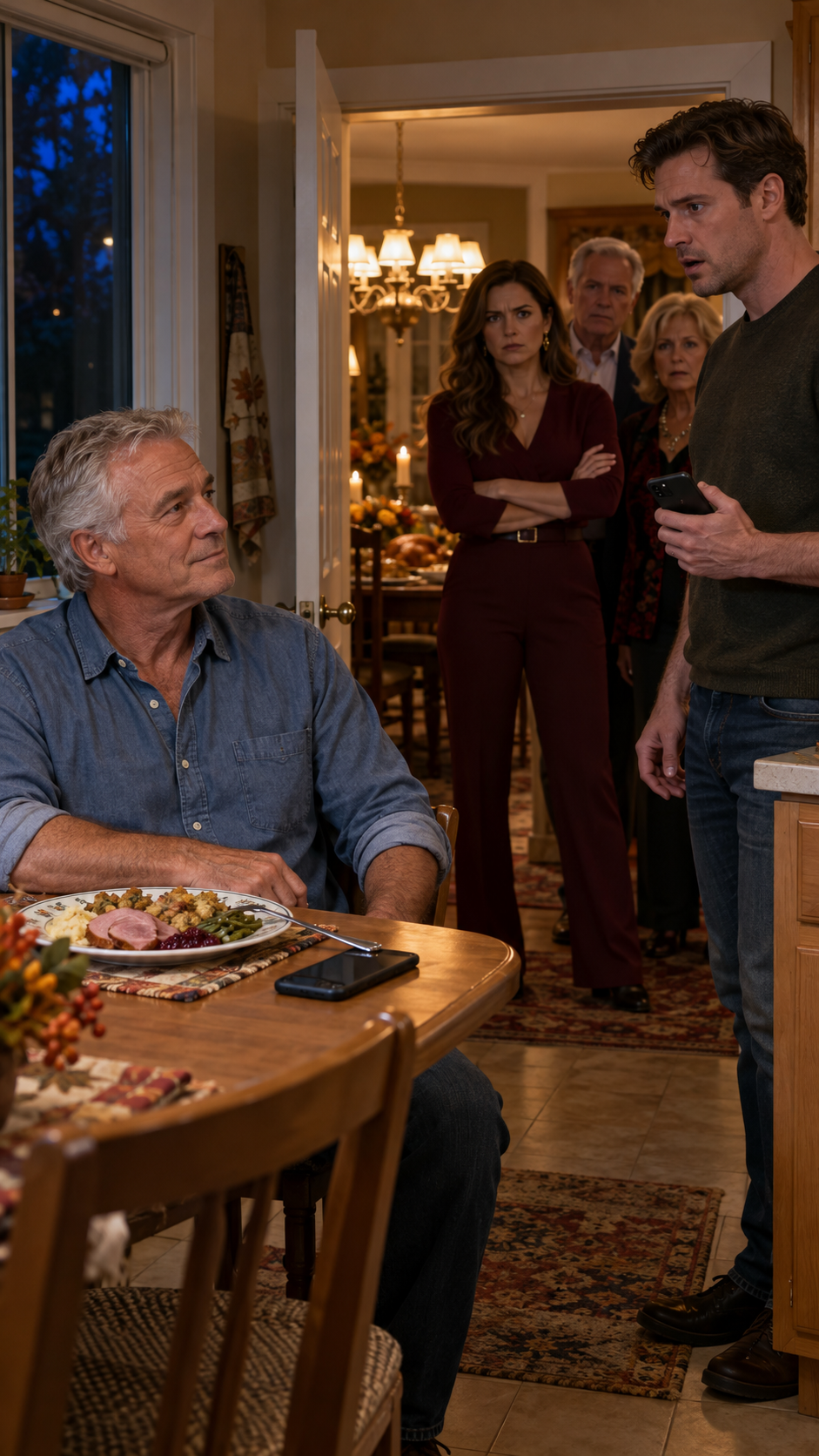
I spent 6 hours cooking Thanksgiving dinner.
At 7 pm, my son arrived
with 6 guests from my daughter-in-law’s family.
They sat down
like they owned my home.
My DIL said, “Would you mind
eating in the kitchen, Dad?”
I just smiled and walked
into the kitchen… what I did next
had everyone screaming.
“Would you mind eating
in the kitchen tonight?”
Candace smiled when she said it,
like she was asking me
to pass the salt.
I was standing beside the chair
I had used at every Thanksgiving dinner
for fifteen years.
My plate was in my hand.
Ten chairs surrounded the table.
There were eight guests.
Her father, Stuart, was already sitting
at the head of my table.
My son Trey stared at his plate.
He didn’t say a word.
I had been awake
since 4:30 that morning.
The ham went into the oven
at 5:08.
I made the dressing
from my mother’s 1974 recipe,
green bean casserole, sweet potatoes,
macaroni and cheese,
and cranberry sauce from scratch.
My kitchen.
My food.
My house.
And my daughter-in-law was asking me
to eat alone in the kitchen
because her family needed “elbow room.”
I looked at Trey one more time.
His jaw was tight.
His hand lay flat beside his fork.
He knew exactly what was happening.
Still, he wouldn’t look at me.
So I smiled.
“Of course,” I said.
“Enjoy your dinner.”
Then I picked up my plate
and walked through the swinging kitchen door.
What nobody at that table understood
was that I had been waiting
eleven months for this night.
I’m sixty-three.
I bought those four acres
outside Knoxville in 1992
and rebuilt much of the house myself.
I framed the back deck,
laid the kitchen tile,
replaced the roof,
paid for the HVAC,
and signed every check.
I also built Finch Outdoor Services
from a used mower
and a half-ton pickup
with 190,000 miles on it.
For thirty-two years, I scheduled crews,
bid jobs, handled bad weather,
kept clients, and made payroll.
Trey grew up riding beside me
in that truck.
When he joined the company full-time,
I thought I was watching
the next generation step in.
I gave him room.
Too much room.
Candace arrived a couple of years later.
At first, the changes were small.
Her family visited one Sunday,
and suddenly I was asked to eat
at the kitchen counter
even though there were empty chairs.
She reorganized my pantry without asking.
Then she had my twenty-two-year-old armchair
reupholstered in fabric I never chose.
Each thing was small enough to ignore.
That was the trick.
Then I started noticing the numbers.
A $14,000 discrepancy appeared
in the operating accounts.
I called Ben,
my accountant of sixteen years,
and asked him to review
eight months of records.
Four days later, he called back.
Nine unexplained transactions.
$61,000 total.
One matched a withdrawal
from an online betting account
registered in Trey’s name.
I said nothing.
Instead, I bought a composition notebook.
Every date.
Every transaction.
Every unexplained transfer.
For eleven months, I documented everything.
Then, six weeks before Thanksgiving,
my sister Nell sent me a screenshot
from a family group chat.
Candace had sent a message
to the wrong people.
“Tell your dad Stuart is taking
the head chair this year.”
Then came the line
that changed everything.
“A few more months and we don’t
need to keep doing all this.
Finch signs over by spring.”
I read it twice.
Then I went back to making cornbread.
By Thanksgiving, I wasn’t angry anymore.
I was ready.
So when Candace sent me
into my own kitchen,
I sat at the little table
by the window and listened
to her family laughing
in the dining room.
Then I took out my phone.
First, I called Vic Ostrander.
Vic had worked beside me
for twenty-nine years.
“It’s time,” I said.
“Already at the yard,” he answered.
“Thirty minutes.”
“We’ll be there.”
Then I called Ben.
“The business accounts.
Trey’s signatory access.
Pull it now.”
“Running it as we speak.”
Next came the bank.
I removed Trey
as an authorized user
on the primary operating account.
Then I suspended the personal guarantee
I had maintained on a separate
credit line he opened
fourteen months earlier.
He had told me that money
was for equipment.
It wasn’t.
The representative confirmed the changes.
I thanked her.
Then I ate a bite of ham.
From the dining room,
I could hear serving spoons
clinking against dishes.
They thought everything was going
exactly as planned.
I sent one more message.
Clark Donovan controlled
the largest property-management portfolio
in the county.
His contract represented nearly one-third
of Finch Outdoor Services’ annual revenue.
He had been my client
for seventeen years.
A month earlier,
he had warned me that Trey
was quietly meeting with a competitor.
I had asked Clark
to delay the renewal
until I gave him the word.
Now I sent it.
“Operational authority is with Vic Ostrander.
My word stands behind every crew
and every contract.”
Four minutes later, Clark replied.
“Done. Call Monday.”
That was when the phones started buzzing
in the dining room.
Once.
Twice.
Three times.
Then Candace’s voice cut through the wall.
“What do you mean it’s declined?
Try the other one.”
Silence.
Then, sharper:
“Trey, why is every card
doing the same thing?”
I cut another piece of ham.
The kitchen door slammed open.
Trey stood there holding his phone.
His face had gone gray.
“Dad.”
I looked up.
His voice cracked.
“What did you do?”
I set down my fork.
“I took back what was mine.”
His hand tightened around the phone.
“The operating account is locked.
The credit line is frozen.
Do you understand what Monday looks like
without that account?”
I stayed seated.
“The payroll will run.
Vic has the authorization codes.
Your crews will be paid on time.”
Trey stared at me.
Then the door opened again.
Candace stepped in.
Her smile was gone.
Behind her stood Stuart and Connie,
suddenly much quieter
than they had been at my table.
Candace folded her arms.
“I don’t know what this is,
but this is not the time
or the place.”
Before I could answer,
the front doorbell rang.
Everyone stopped.
I wiped my mouth with the napkin.
Then I stood.
Because I knew exactly who was
on the other side of that door.
Vic stood beneath the porch light,
holding a flat cardboard box.
Nell was beside him.
Behind them stood Miriam Cole,
the attorney who had spent six weeks
asking me questions
I had avoided for eleven months.
Nobody carried handcuffs.
Nobody had come
to drag my son away.
Somehow that made the moment harder.
There would be no spectacle
to hide inside.
Just people.
Paper.
And what we had done.
“Still want us here?” Vic asked.
I opened the door wider.
“Yes.”
Nell touched my arm
as she passed.
Her fingers were cold.
I realized she had been afraid
I would change my mind.
Miriam took off her coat.
“Where would you like to sit?”
I looked toward the dining room.
“At my table.”
Stuart had followed me into the hallway.
He let out a short laugh.
“Oh, for heaven’s sake.
You brought a lawyer
to Thanksgiving?”
“No,” I said.
“I invited witnesses
into my house.”
Candace appeared behind him.
“Witnesses to what?”
Miriam set her bag down.
“That depends on what everyone
chooses to say.”
We went into the dining room.
Connie stood beside the sideboard.
Candace’s brother, Evan,
held a spoon suspended
above the macaroni and cheese.
His wife, Beth,
was staring at her lap.
Candace’s aunt Darlene
had stopped chewing.
Six guests from her family.
My son.
His wife.
Eight people,
with two empty chairs.
I looked at those chairs
long enough for everyone
to notice them.
Then I faced Stuart.
“You’re in my seat.”
His expression hardened.
“This is childish.”
“Get up.”
Nobody moved.
The refrigerator hummed beyond the wall.
At last, Stuart pushed back
so hard the chair legs scraped.
He stood.
I pulled the chair out myself
and sat down.
My plate was still
on the kitchen table.
Nell went to get it
without asking.
That small kindness nearly undid me.
Miriam remained standing.
“Before this goes further,
Mr. Finch has asked
that company property be returned tonight.”
Trey looked at Vic’s box.
“What is that?”
“Somewhere for the keys,” Vic said.
“And the fuel card.
Tablet.
Gate remote.”
“You’re firing me?”
I had imagined that question
a hundred times.
In my imagination,
my answer always came easily.
At my table,
with my son standing there,
it felt like swallowing gravel.
“Yes.”
Candace laughed once,
high and sharp.
“You can’t fire him.
He runs that company.”
“He has held management duties,”
Miriam said.
“Ownership remains with his father.”
“He was promised the business.”
“Nothing has been transferred.”
“We have plans,” Candace snapped.
Stuart raised his voice.
“Your boy gave you years!”
“And I paid him
for every one,” I said.
“With raises.
With bonuses.
With a salary
that never missed a Friday.”
Trey stared at me.
“You were going to retire.”
“I was.”
That past tense landed
harder than I expected.
Miriam opened her folder.
“Your father has also directed
that further business communication
go through my office.”
Candace stepped toward the table.
“No.
We are not doing this.”
She reached for the folder.
Miriam put her hand over it.
“You may have copies
of material addressed to you.
You may not take
my client’s file.”
Then Stuart saw
the first page beneath her hand.
His own name
was visible in the heading.
His face changed.
“What’s my name doing there?”
I watched him carefully.
“Consulting invoices.”
Evan lowered the serving spoon.
“What consulting invoices?”
“Don’t start,” Stuart told him.
“Three payments,” I said.
“Six thousand dollars each.”
Candace’s voice rose.
“That was approved.”
“By whom?”
“Trey had authority.”
“To buy supplies.
Pay subcontractors.
Schedule jobs.”
I looked at my son.
“What did Stuart consult on?”
Trey said nothing.
Stuart threw up his hands.
“I advised him on growth.”
“Show me the work.”
“You don’t put a price
on experience.”
“You put eighteen thousand dollars
on yours.”
That was when everyone
started talking at once.
Stuart shouted that I was humiliating him.
Candace screamed that Trey
needed to say something.
Connie demanded to know
why nobody had told her.
Evan stood so quickly
his water glass tipped.
Beth caught it
before it struck the floor.
Their voices filled the room
where I had once listened
to my wife hum
while she set out plates.
For one moment,
the noise seemed to move away.
I saw the yellow curtains
she had chosen.
The little nick
in the sideboard.
Trey at eleven,
carrying a pie with both hands.
Then Nell spoke.
“Enough.”
She had taught third grade
for thirty-seven years.
The room obeyed.
She set my plate
in front of me.
“Your food is getting cold.”
I almost laughed.
Instead,
I picked up my napkin.
Miriam waited until everyone
had become quiet.
“The accounting review is ongoing.
No one is being asked
to settle every disputed fact tonight.
But access to company funds
has ended.
Relevant records must be preserved.”
Trey finally looked at the folder.
“How much do you think
I took?”
The question hurt
because of the word think.
“Sixty-one thousand we identified first,” I said.
“Ben is still reconciling
the rest.”
Candace turned toward him.
“You said fourteen.”
His eyes closed.
There it was.
The first crack
that had nothing to do
with me.
“You knew?” I asked her.
She pulled her shoulders back.
“He said it was temporary.”
“That wasn’t my question.”
“I knew he borrowed
against his future.”
I looked at Trey.
“Was that what you called it?”
He rubbed both hands
over his face.
“Yes.”
Something in my chest
went strangely still.
For months I had wanted
a complicated explanation.
An accounting mistake.
A supplier refund.
A reason my son
could remain the boy
I remembered.
Borrowed against his future.
He had found six words
that turned theft
into impatience.
“You weren’t borrowing
against your future,” I said.
“You were spending mine.
And Vic’s.
And the wages
of twenty-three people
who trusted me.”
“I was going to replace it.”
“When?”
He couldn’t answer.
Candace pointed at his phone.
“Why were you checking cards
during dinner?” Nell asked.
Candace looked furious
that anyone had noticed.
“We had a reservation deposit.”
“For what?”
“A rental.”
Trey spoke
before she could stop him.
“A cabin.
For Christmas.”
I waited.
“For her family.”
“On a company card?”
His silence answered.
Stuart reached for his coat.
“I don’t have to listen
to this.”
“No,” I said.
“You don’t.”
Candace turned on him.
“Dad, stay.”
But he was already
moving toward the hall.
Connie didn’t follow.
She looked at him
as if his face
had become unfamiliar.
“You told me those payments
were for work.”
“They were.”
“What work, Stuart?”
He pointed at me.
“This is what he wants.
All of us fighting.”
I shook my head.
“What I wanted
was dinner.”
Nobody had an answer
for that.
Miriam slid a short letter
toward Trey.
It confirmed his dismissal,
requested company property,
and gave him a time
to collect personal belongings
with Vic present.
There were no threats
printed in red.
No flourish.
Just his name,
the date,
and the end
of what I had hoped
would become his life’s work.
He read it twice.
Then he reached into his pocket
and set his keys
inside the box.
The metal made
a small, ordinary sound.
That was when
I nearly changed my mind.
I saw his first work boots.
The red marks
they left on his ankles.
How proud he had been
to buy them himself.
Then I remembered
the payroll account.
I kept my hands
flat on the table.
“The truck?” Vic asked.
“At our place.”
“I’ll arrange pickup tomorrow.”
Trey nodded.
Candace was crying now,
but anger kept pushing
through the tears.
“You’re destroying our marriage.”
I looked at her.
“You brought your marriage here.
I’m dealing with my business.”
“You could have spoken privately.”
“I should have,” I said.
“Months ago.”
The admission surprised her.
It surprised me, too.
“I should have acted
when Ben found the first transfers.
Instead, I watched.
I kept hoping
there would be an explanation
I could live with.”
Miriam glanced at me,
but I continued.
“I left controls in place
that weren’t strong enough.
I told myself
I was protecting my son.
I was protecting myself
from knowing him.”
Trey flinched.
“I’m here,” he said quietly.
“I know.”
For the first time that evening,
my voice shook.
“That’s what makes this hard.”
Candace wiped her face
with the heel of her hand.
“So now what?
You throw us out?”
“You have your own house.”
“You helped with the down payment.”
“As a gift.”
“And you’ll take that back, too?”
“No.”
She seemed almost disappointed
to lose that accusation.
“I’m not taking back gifts.
I’m ending access.
There’s a difference.”
Nell stood near my shoulder,
solid as a fence post.
I looked around the room.
“Dinner is over
for anyone who thinks
I owe them my chair.”
Darlene put down her napkin.
“I’m sorry, Arthur.”
My name sounded strange
after so much Dad
and him
and your father.
“I should have said something
when she asked you
to leave the table.”
Candace turned toward her.
“Aunt Darlene—”
“I heard you.”
Darlene picked up her purse.
“And I sat there.”
Evan helped Beth
with her coat.
At the door,
he looked back at me.
“I didn’t know about the money.”
“I believe you.”
“I knew about the chair.”
That answer mattered more.
Connie remained
until everyone else
had reached the hallway.
“I’m sorry,” she said.
I nodded.
I didn’t know yet
what else to give her.
Stuart waited on the porch,
his car keys clenched
in his fist.
Candace went past me
without a word.
Trey was last.
He stood in the doorway
with his coat half on.
“Can I call you?”
“About the company,
call Miriam.”
“And about us?”
I looked at my son,
at the little scar
above his eyebrow
from falling off a bicycle
I had let go of
too soon.
“Not tonight.”
He nodded.
Then he left.
I closed the door
without slamming it.
The house seemed enormous.
I could hear
somebody’s car starting.
Then another.
Behind me,
Miriam gathered her papers.
“I’ll call tomorrow afternoon.”
Vic carried the box
into the kitchen.
Nell started stacking plates.
I stood in the hallway
with one hand
still on the doorknob.
For eleven months,
I had imagined relief.
Instead,
I felt a terrible exhaustion.
The kind that comes
when you finally set down
something heavy
and discover what carrying it
has done to your back.
“Arthur?”
Nell’s voice came softly.
I turned.
“Sit down.”
“I ought to clean up.”
“You ought to sit down.”
I made it
to the kitchen chair.
Then I put my face
in my hands
and cried so hard
I couldn’t draw breath
between the first few sobs.
Nell knelt beside me.
She didn’t tell me
I had done the right thing.
She didn’t tell me
it would get better.
She held my wrist
until I could breathe again.
“I wanted him to stop,”
I finally said.
“I know.”
“I wanted him
to look at me
and stop.”
Her eyes filled.
“I know, honey.”
Vic stood at the sink
with his back to us.
He ran the water
longer than necessary.
After a while,
I wiped my face.
“There’s enough food
for an army.”
Vic turned.
“Well,” he said,
“I haven’t eaten.”
Nell rose slowly,
one hand on her knee.
“Neither have I.”
We carried the dishes
back into the dining room.
Miriam stayed
for a slice of ham
after all.
Nobody made a toast.
Nobody called it victory.
We ate warm dressing
and cold cranberry sauce,
and Nell told us
about a former student
who had become a firefighter
and still spelled her name wrong
on Christmas cards.
I laughed once.
It hurt.
Then it helped.
When everyone had gone,
I found a serving spoon
under Stuart’s abandoned napkin.
I washed it,
dried it,
and put it away.
The house was quiet
when I went upstairs.
For the first time
in a long while,
I checked the front lock
because I wanted to,
not because I feared
someone might come in
and rearrange my life
while I slept.
Friday brought rain.
Ben arrived at nine
with coffee,
a scanner,
and a face
that told me
there would be more.
We worked at the kitchen table.
The composition notebook lay
between us.
He compared my entries
with statements,
payroll records,
and invoices I had printed.
By noon,
he closed the notebook.
“Arthur, I need to say something.”
I looked up.
“We found the first problem
eleven months ago.”
“I know.”
“You kept asking me
to keep watching.
I should have pushed harder
for a formal review.”
“I asked you to wait.”
“And I let your wishes
replace my judgment.”
Rain tapped the window.
Neither of us reached
for an excuse.
Finally, I said,
“Then let’s stop doing that.”
He nodded.
We hired an outside examiner.
Ben helped assemble the records,
then stepped back
from reviewing his own work.
It cost more.
I paid it.
Some lessons arrive
with invoices
you have earned.
That afternoon,
the bank clarified
what my Thanksgiving calls
had actually accomplished.
My shorthand about suspending
the guarantee
had been too simple.
The personal guarantee
had not vanished.
Existing debt remained
subject to the documents
I had signed.
What stopped that night
was new borrowing
under the arrangement
already prepared with the lender.
I sat very still
while the representative explained it.
The number still outstanding
made my stomach turn.
When she finished,
I thanked her.
Then I wrote it down.
I had spent thirty-two years
teaching young men
to read a site plan
before digging.
Somewhere along the way,
I had stopped reading
what love asked me
to sign.
On Monday,
I went to the yard
before sunrise.
Twenty-three employees
stood among parked trucks,
coffee steaming
in their hands.
News had traveled.
Of course it had.
I gathered them
inside the equipment shed.
“Trey no longer works here.”
Nobody spoke.
“Payroll is funded.
Your benefits are in place.
Vic has operational authority.
If any of you
receive instructions from Trey,
send them to Vic.”
Luis,
our irrigation foreman,
shifted his weight.
“Are we in trouble?”
The question stripped away
every speech I had prepared.
“No,” I said.
“But the business had a problem,
and I waited too long
to handle it.
That part is mine.”
Vic stood beside me,
arms folded.
I explained the new controls.
Two approvals
for unusual transfers.
Independent review
of monthly statements.
No company cards
for family expenses.
Nobody applauded.
They asked sensible questions
about fuel accounts
and supplier deliveries.
Then they went to work.
Their ordinary trust
felt heavier
than any accusation.
Clark called at ten.
He wanted a meeting,
proof of financial stability,
and a clear transition plan.
Seventeen years
earned me a conversation.
It did not entitle me
to his business.
Vic and I went together.
For forty minutes,
Clark asked hard questions.
Vic answered most of them.
I sat beside him
and discovered
that the company could survive
without my voice
filling every silence.
On the drive back,
I said,
“You should have had
this authority years ago.”
Vic watched the road.
“Probably.”
“I’m sorry.”
“Use it for something,” he said.
“The apology.”
So we did.
Trey came to the yard
that afternoon.
I watched from my office window
as he carried
two cardboard boxes
out of the building.
A framed photograph
stuck up from one.
He and I
beside the first commercial mower
we had bought new.
He paused near the truck
that was no longer his.
Vic said something.
Trey nodded,
then walked toward
an old compact car
I didn’t recognize.
I almost opened the window.
I didn’t.
That evening,
his first message arrived.
I’m sorry about Thanksgiving.
I read it
until the screen dimmed.
Then I replied.
Thanksgiving wasn’t the first day.
Three dots appeared.
Disappeared.
No answer came.
The outside review
took weeks.
The total climbed,
then settled.
Eighty-seven thousand four hundred dollars
in unauthorized payments
and personal spending.
The betting losses
were part of it.
So were Stuart’s invoices,
a resort deposit,
household purchases,
and transfers Trey
had described as advances
without telling anyone
they existed.
There was also a draft agreement
on his work laptop.
It proposed moving
several major accounts
to a competing operator.
Trey would join them
with a management title
and a possible ownership stake.
He had no signed commitment.
Only a plan,
some meetings,
and a spreadsheet
containing clients
who had trusted me
since before he could drive.
Miriam showed me
the email attached to it.
Once the old man signs,
we can bring the book.
I stared at those words
for a long time.
Not because of old man.
Because of we.
Candace had been copied.
So had Stuart.
I put the paper down.
The anger I had thought
was gone
had merely been waiting
for a different door.
“Do you want a minute?”
Miriam asked.
“No.”
I took a breath.
“I want to stop learning
new ways
they thought I was finished.”
She waited.
Then she asked
the question
I had been avoiding.
“What do you want
to happen next?”
I thought about
Trey’s eleven-year-old hands
around a pie plate.
Then I thought about Luis
asking whether his family’s paycheck
was safe.
“Submit the records,” I said.
“All of them.”
Miriam explained
what that meant,
what remained uncertain,
and what decisions
would belong to other people.
I listened.
Then I signed.
I did not call Trey
to warn him.
I did not call
to tell him
I loved him, either.
Both would have been attempts
to soften something
I could no longer
control for him.
He came to the house
three nights later.
Nell was there.
I had asked her
to stay for dinner
because the evenings
had become difficult.
Trey stood on the porch
with rain on his shoulders.
“Please,” he said.
“Just ten minutes.”
I let him
into the kitchen.
He looked at Nell.
“She stays,” I said.
He nodded.
For a while,
he studied the table.
Then he took out his phone
and placed it
face down.
“I kept losing.”
His voice was flat.
“At first
it was a few hundred.
Then I won enough
to think I understood it.”
I said nothing.
“When I lost again,
I thought I could recover it.
I took money
I thought nobody would miss
for a week.”
Nell’s hands
tightened around her mug.
“I know what that sounds like,”
he said.
“Keep going,” I told him.
He swallowed.
“Then I needed another week.
Then I couldn’t tell you
without telling you everything.”
“So you made it bigger.”
“Yes.”
“And the competitor?”
He rubbed a thumb
against the table edge.
“I thought a signing payment
could fill the hole.”
“You were going to sell
what you didn’t own
to replace
what you had already taken.”
He nodded.
Tears ran down his face.
He didn’t wipe them away.
“Did Candace know all of it?”
“No.
She knew enough.
I let her believe
you had approved more
than you had.”
“And Stuart?”
“He said everybody
paid family through a business.
He said you’d done it
with me for years.”
I leaned back.
“Did he make you
send the money?”
“No.”
“Did Candace make you gamble?”
“No.”
“Did either one
keep you quiet
at that table?”
His mouth trembled.
“No.”
At last,
a word
with no place
to hide behind it.
“I saw what she did,”
he said.
“I knew you were hurt.
I thought if I objected,
she’d ask why
I was suddenly defending you.”
I looked at him.
“So you let me leave.”
“Yes.”
The refrigerator clicked off.
Without its hum,
the kitchen seemed
painfully quiet.
“I could survive
you owing me money,” I said.
“I didn’t know how
to survive sitting there
and realizing
you were relieved
I was out of the room.”
He bowed his head.
“I was.”
Nell closed her eyes.
Trey cried then,
without trying
to make it look dignified.
I wanted to touch
the back of his neck
the way I had
when he was small.
I kept my hands
around my cup.
“You need help,” I said.
“I called someone.”
“Keep calling.”
“Will you come with me?”
That question found
the old reflex immediately.
Fix it.
Drive him.
Pay for it.
Stand between him
and whatever hurt.
“I’ll attend a session
when your counselor
thinks it would help.”
His face fell.
“I won’t run
your recovery, Trey.”
He sat with that.
Then he asked,
“Can you stop the investigation?”
“No.”
“I could pay it back.”
“You should.”
“If I do,
will you ask them—”
“No.”
He went very still.
I made myself
finish the sentence.
“I will tell the truth
about any repayment.
I won’t trade the truth
for one.”
He looked toward Nell,
then back at me.
For a moment,
I saw anger.
Real anger.
The kind people feel
when the door
that has always opened
finally stays shut.
“You’re my dad,” he whispered.
“Yes.”
The word hurt us both.
“That’s why
I’m still sitting here.”
He stayed another twenty minutes.
We did not solve anything.
Before leaving,
he carried his untouched tea
to the sink
and washed the cup.
I watched him dry it.
A small act.
Too small
to bear the weight
I wanted to put on it.
So I let it
remain small.
December arrived
with frost on the deck.
I changed the locks
and gave Nell a key.
I met with a counselor
because I had begun
hearing my son’s voice
in every silent room.
At the first appointment,
I talked about the company.
At the second,
I talked about Thanksgiving.
At the third,
I said my wife’s name
and had to stop.
June had been gone
seven years.
For seven years,
I had poured
everything left of me
into being useful.
Useful to Trey.
Useful to the company.
Useful to anybody
who might otherwise
leave me alone
with an empty house.
The counselor asked,
“What happened when you said no?”
I thought about
Sunday dinners,
the pantry,
my chair.
“I usually didn’t.”
“Then what did you expect
people to learn?”
I disliked her
for nearly a minute.
Then I went home
and canceled a favor
I had already resented agreeing to.
The world continued.
It was a revelation
small enough
to be embarrassing.
Christmas was quiet.
Nell came.
Vic brought his wife, Alma,
who arrived with rolls
and instructions
that nobody was allowed
to call them biscuits.
We ate early.
Trey spent the day
with a recovery group
and a coworker
from the warehouse job
he had found.
He sent me a photograph
of a paper plate
and a crooked Christmas tree.
I replied,
Merry Christmas, son.
It was true.
So was the distance.
In January,
Connie asked to meet me
at a coffee shop.
She looked smaller
without Stuart beside her.
“I’m not asking you
to forgive anybody,” she said.
“Good.”
She accepted that.
Then she set
an envelope on the table.
Inside were copies
of messages and invoices.
“Stuart told me
he had a consulting business.
I helped organize his receipts.”
Her eyes filled.
“When I saw your papers,
I knew some dates
didn’t make sense.”
“Have you given these
to anyone else?”
“My attorney.
She told me
how to preserve the originals.”
I nodded.
Connie twisted
her wedding ring.
“I kept telling myself
he exaggerated.
That was all.
That if I contradicted him,
he’d feel small.”
“Did he?”
“Other people did.”
We sat quietly.
She had moved
into her sister’s spare room.
She did not know yet
whether her marriage
would survive.
I did not offer advice.
Before she left,
she said,
“You shouldn’t have had
to ask for your chair.”
“No,” I said.
“I shouldn’t.”
Some apologies
cannot repair anything.
They can still
put a fact
back where it belongs.
By spring,
Trey and Candace
were living apart.
He told me
in Miriam’s conference room,
after a meeting
about restitution.
I asked whether
he had somewhere safe
to stay.
“A room over a garage.
It’s clean.”
“Good.”
He looked as if
he had expected more.
I had expected more
from myself.
But concern did not require
a new down payment.
Candace sent me
a long email
around the same time.
The first half
explained what Trey
had concealed from her.
The second half
described my coldness.
Near the end,
one sentence stopped me.
I honestly thought
once you retired,
the house would become
our family’s gathering place.
I read it
three times.
Then I answered.
It already was.
I live here.
She did not respond
for six weeks.
When she did,
the message was shorter.
You’re right about that.
It wasn’t reconciliation.
It was the first
honest thing
she had written me
without asking for something.
At the company,
Vic discovered that authority
meant more paperwork
than he had bargained for.
He complained every Tuesday.
I bought him
a better office chair.
He called me extravagant.
Then he stopped complaining
about his back.
We began planning
a gradual employee ownership arrangement,
with outside advice
and numbers
everyone could understand.
It would take time.
There were risks,
tax questions,
and details
that did not fit
inside an inspiring speech.
That made me
trust it more.
Vic would earn his stake.
So would the others
who chose to participate.
Nobody would receive
a company
because I was afraid
of disappointing them.
One afternoon,
Luis brought his daughter
to the yard
after a school appointment.
She sat in my office
drawing a yellow truck.
On the side
she wrote FINCH
in uneven letters.
“Is that yours?” she asked,
pointing through the window.
“For now.”
“Who gets it after?”
I looked at Vic
walking across the gravel,
then at the crews
loading equipment.
“We’re figuring that out together.”
She nodded,
satisfied,
and made the tires purple.
I pinned the picture
beside my desk.
The investigation moved slowly.
There were interviews,
records requests,
meetings I dreaded,
and stretches of silence
long enough
to make me wonder
whether anything was happening.
Trey kept his appointments.
Sometimes he missed
a repayment deadline
and called beforehand.
The first time,
he explained the shortfall,
gave me a date,
and did not ask
for the balance
to disappear.
Afterward,
I sat in my truck
for ten minutes.
Accountability had sounded
so grand
when other people
talked about it.
In practice,
it sometimes looked like
a young man admitting
he was eighty dollars short
before someone caught him.
That summer,
I found myself
in the attic
looking for a fan.
Behind a suitcase
was a cedar box
June had used
for letters and recipes.
I almost put it aside.
Then I saw
Trey’s name
on a small envelope.
Inside was a receipt
from a repair shop,
a photograph,
and a folded note
in my wife’s handwriting.
The photograph showed
our old pickup
with a crushed front fender.
I remembered the accident.
Trey had been seventeen.
He had backed
into a concrete post,
then told us
someone hit it
in a parking lot.
I remembered paying
for the repair.
I had not remembered
the argument afterward,
or June taking him
for a long drive.
The note was brief.
Arthur,
He told me today.
He hit the post.
He’s afraid disappointing you
means you’ll stop seeing
anything good in him.
I told him
the truth gives us
somewhere to start.
Please let him
make this one right.
Beneath it,
in younger handwriting,
were amounts and dates.
Twenty dollars.
Thirty-five.
Forty.
The full repair cost,
paid back
through summer work.
I sat on the attic floor.
I had forgotten
my son had once known
how to come back
from a lie.
I had also forgotten
how often June
had made room
for difficult truths
before I arrived
with my answers.
There was no message
from beyond the grave.
No instruction
telling me what to do.
Just evidence
that our family
had once practiced something
we had stopped practicing.
I brought the envelope downstairs.
The following Sunday,
I invited Trey for coffee.
He arrived
with grocery-store muffins
and asked
whether he should
take off his shoes.
“Only if they’re muddy.”
They weren’t.
We sat
at the kitchen table.
I slid the photograph
toward him.
He stared.
Then he covered his eyes.
“I forgot she kept that.”
“I forgot
you paid it back.”
“Mom made me
write down every payment.”
“She was good
at that.”
He nodded.
His mouth worked
before he could speak.
“She said you loved me
more than your truck.”
“I did.”
He looked at me.
“I do.”
His face crumpled.
This time,
when I reached
across the table,
I put my hand
over his.
“I can love you
and let the consequences happen.”
He held on
without arguing.
We sat that way
until the coffee cooled.
Then he said,
“I have to tell you something.”
My body tightened.
He noticed.
“I know.
I know why
you look like that.”
“Tell me.”
“The night of Thanksgiving.
Before dinner.
I was in the hallway
when Candace told Stuart
to take your chair.”
I waited.
“She asked if
you would make trouble.
I said no.”
He swallowed hard.
“I told her
you’d do anything
to keep the peace.”
The words
seemed to settle
onto every surface
in the kitchen.
I let go
of his hand.
He did not try
to take it back.
“That’s the part
I hadn’t said,” he whispered.
“I wasn’t just silent.
I helped her know
she could do it.”
I stood
and went to the window.
Outside,
a cardinal landed
on the deck rail.
For a long time,
neither of us spoke.
Then I said,
“Thank you for telling me.”
It did not sound
like forgiveness.
It sounded like effort.
When I turned back,
he was crying quietly.
“I don’t want
to be that man.”
“Then keep doing
the things he wouldn’t.”
He nodded.
Before he left,
we made another plan
for coffee.
Nothing more.
That was enough
for one day.
By autumn,
the financial case
had reached a resolution.
Trey entered a guilty plea
to the charge
his attorney explained to him.
I attended the hearing.
He wore a plain suit
that hung loosely
at the shoulders.
When given the chance
to speak,
he did not mention
Candace first.
He did not mention
Stuart first.
He said,
“I took money
I was trusted to manage.
Then I lied
to keep taking it.”
I watched his hands
shake against the lectern.
The sentence included supervision,
restitution,
community service,
and continued treatment requirements.
The judge made clear
what would happen
if he ignored them.
It was not
the harshest possible outcome.
It was not
a clean slate.
Outside the courthouse,
Trey stopped beside me.
“Are you disappointed?”
“Yes.”
He looked down.
“And I’m glad
you told the truth.”
He nodded slowly,
holding both things
without asking me
to choose one.
Stuart’s part
did not disappear
with Trey’s plea.
The records Connie preserved
became part
of the separate case
against him.
His repayment came
through a negotiated resolution,
with penalties
and obligations
he could not talk
his way around.
He sold the boat
he had once described
as a smart investment.
I felt no pleasure
when I heard.
I deposited the money
into the company account
and sent the receipt
to Miriam.
Justice was less dramatic
than I had imagined.
Mostly,
it involved forms,
dates,
and people finally
being required
to finish what they started.
Candace and Trey
completed their divorce
that fall.
There were no children
caught between them,
a mercy
I felt more deeply
than I could explain.
He told me
they had both apologized
for different things.
He also told me
an apology
had not made them
good for each other.
I said,
“That sounds painful.”
“It is.”
We walked
another stretch of the park
without trying
to improve the answer.
A week before Thanksgiving,
Candace came by
to collect a serving dish
she had left
the year before.
I placed it
on the porch table.
She stood at the steps
wearing a coat
I hadn’t seen before.
For a moment,
we looked like strangers
with an errand.
Then she said,
“I knew there were
empty chairs.”
The wind moved
through the dry leaves
beside the house.
“I know.”
“I’ve tried to explain
why I said it.
To myself.”
She pressed her lips together.
“Most of the explanations
make me sound better
than I was.”
I waited.
“I wanted my family
to feel important.
And I thought
making you move
would prove
the house was becoming ours.”
There it was.
Without elbow room.
Without misunderstanding.
Without the holiday
to blame.
“It wasn’t becoming yours,” I said.
“No.”
Her eyes shone.
“I’m sorry, Arthur.”
I nodded.
“I appreciate
you saying it.”
“Do you think
you’ll ever forgive me?”
“I don’t know yet.”
She took a breath
and accepted that.
Then she picked up
her dish.
At the car,
she turned.
“Your dressing
was always good.”
I almost smiled.
“So was your lemon cake.”
It was a strange,
small place
to leave things.
It was honest.
The morning
of the next Thanksgiving,
I woke at six.
Not four-thirty.
Six.
I lay still
and watched pale light
reach the bedroom wall.
Then I got up,
made coffee,
and opened my mother’s recipe.
There were fewer dishes
on the menu.
Nell was bringing
sweet potatoes.
Alma had claimed
the rolls again.
Vic was responsible
for nothing
except arriving hungry.
Trey had asked
what he could bring.
“Cranberry sauce,” I told him.
“From a can?”
“If that’s what
you can manage.”
“I can learn.”
“Then learn.”
At eleven,
he arrived carrying
a glass bowl
with both hands.
The sauce was
a little too tart.
He knew it
before I tasted it.
“I might have
misread the sugar.”
“Your grandmother did that once.”
“Really?”
“No.”
He laughed.
So did I.
The sound surprised us
into looking
at each other.
Then I handed him
a bag of potatoes.
“Peeler’s in the drawer.”
He found it
without rearranging anything.
We worked
side by side.
For a while,
we talked about
his warehouse job.
He had been offered
a training position
with steady hours
and a modest raise.
He sounded proud
and slightly embarrassed
by how proud
he sounded.
“That’s good work,” I said.
“Yeah.”
He peeled another potato.
“I keep thinking
you’ll ask
when I’m coming back.”
I set down
the knife.
“Are you waiting
for me to?”
He considered that.
“Less than I was.”
I nodded.
“The company has
a different plan now.”
“I know.”
“You need one
that belongs to you.”
He looked at
the potato in his hand.
“I think
I’m starting to.”
We did not hug.
We finished the potatoes.
Later,
Nell arrived
with a casserole
and complaints
about parking.
There were four acres.
She complained anyway.
Alma brought flowers
along with the rolls.
Vic carried
an extra folding chair
from his truck.
“Just in case.”
I looked at it,
then at him.
He shrugged.
“Habit.”
We put it
against the wall.
Nobody needed it.
Before dinner,
I went into the den.
My old armchair
stood beside the window.
I had finally
had it covered again,
this time
in dark green fabric
I chose myself.
The upholsterer had found
a little toy car
wedged inside the frame.
Blue.
One wheel missing.
Trey’s.
I kept it
on the side table,
beside June’s photograph.
For months,
I had thought
taking back my life
would mean
removing every trace
of the people
who had hurt me.
Instead,
it had meant
learning which things
I could keep
without surrendering myself.
The little car
could stay.
So could love.
Neither one
needed access
to my bank account.
“Dad?”
Trey stood
in the doorway.
“Everything’s ready.”
I looked up.
He glanced
at the toy car,
then at the photograph.
His eyes softened.
“I remember that.”
“I figured you might.”
“I looked everywhere.”
“So did I.”
He smiled faintly.
Then he said,
“I didn’t set places.”
I waited.
“I thought
you should decide.”
We went back
to the dining room.
Six chairs
surrounded the table.
Six people
would eat there.
I placed June’s flowers
where everyone
could see them.
Nell lowered herself
into a chair
with a satisfied sigh.
Alma corrected Vic
for stealing a roll.
Trey stood
beside my usual place.
For one second,
the year before
returned so sharply
I could hear
Stuart’s chair scrape.
Then my son
pulled the chair out.
He didn’t make
a speech.
He didn’t call
anyone’s attention
to the gesture.
He simply waited
until I sat down.
Then he took
the place beside me.
We passed the food.
The ham was tender.
The dressing held
exactly enough sage.
Alma’s rolls vanished
at an unreasonable speed.
Nobody mentioned
elbow room.
Halfway through dinner,
Vic began telling
the story
of the first mower
I had bought.
He got
the purchase price wrong.
I corrected him.
He ignored me.
Nell laughed
with her head tipped back.
Trey reached
for the cranberry sauce,
tasted his own work,
and winced.
“It’s pretty tart.”
“It’s improving,” I said.
“It’s the same bowl.”
“Then maybe I am.”
He looked at me.
I let him see
that I meant it.
After dinner,
he started clearing plates.
I caught his wrist
gently.
“Sit a minute.”
“The dishes—”
“Will keep.”
So he sat.
The late afternoon light
lay across the table,
showing scratches
I had stopped noticing
years before.
There were marks
from homework pencils,
a hot pan,
a small boy’s experiment
with a pocketknife.
A table could survive
a great deal
and still be
worth gathering around.
That did not mean
letting anyone
cut into it again.
Trey followed my gaze.
“I did that one.”
“I know.”
“You were mad.”
“I was.”
“Mom said
it gave the table character.”
“Your mother
was protecting you.”
He smiled,
then looked down.
“She did that.”
“Yes.”
For a moment,
grief sat with us.
Nobody tried
to send it
into another room.
“I miss her,”
he said.
“So do I.”
“I wish
she could see—”
He stopped.
I waited.
“Not the court.
Not all of it.
I wish
she could see
I’m trying.”
I looked at
his work-worn hands.
The careful way
he had placed
his phone away.
The face
that no longer
searched mine
for an escape.
“I can see it,”
I said.
His eyes filled.
This time,
he let the words
be enough.
At dusk,
everyone helped clean.
Nell wrapped leftovers.
Vic dried dishes
with a towel
slung over his shoulder.
Alma took charge
of the refrigerator
only after asking
where things belonged.
Trey washed
the roasting pan
until the water
went gray.
I made coffee.
Nobody sent me
anywhere.
After they left,
my son remained
on the porch.
He held
his leftover container
against his coat.
“Same time Sunday?”
“Three,” I said.
“Call if work changes.”
“I will.”
He looked toward
the bare trees,
then back at me.
“I love you, Dad.”
“I love you, too.”
He stepped forward
slowly enough
to let me choose.
I put
my arms around him.
He was taller
than I remembered
every time
I held him.
For a moment,
I felt the child,
the grown man,
and the difficult distance
between them.
Then I let
my son
be the man
standing there.
When he drove away,
I stayed outside
until his taillights
passed the bend.
The air smelled
of leaves
and somebody’s woodstove.
Inside,
the house was warm.
I checked the lock,
turned off
the dining room light,
and carried
a small plate
of leftover pie
into the kitchen.
The little table
by the window
waited in lamplight.
I sat there
because I liked
watching the trees
move against the dark.
For a while,
I ate slowly
and listened
to the quiet.
Then I rinsed
my plate,
set the coffeemaker
for morning,
and went upstairs
in my own time.
