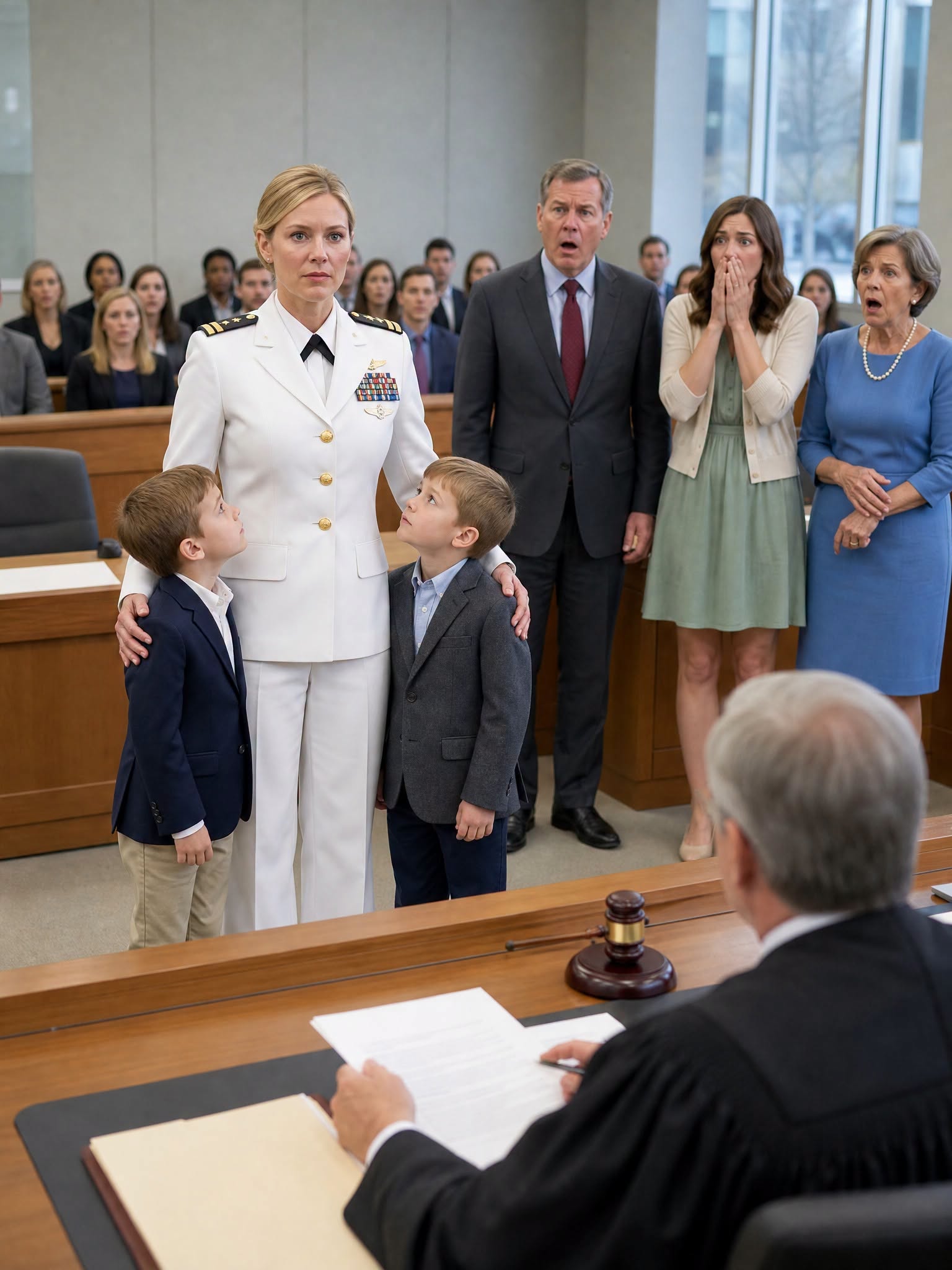
The rain had been falling over Fairfax County since dawn when I arrived at the courthouse for the hearing that was supposed to end my marriage. By the time I reached Courtroom Four, reporters had already filled the back row, local business leaders occupied several seats in the gallery, and my husband Adrian’s three attorneys were arranged beside him as though they were preparing for a corporate takeover instead of a divorce.
Adrian Hollis looked exactly as he always did when he believed everything was under control. He checked his watch, adjusted his cuff, and occasionally leaned toward Paige Ellison, the glamorous woman who had replaced me in his private life long before our marriage officially collapsed.
Paige sat beside him as though the seat had always belonged to her. She whispered something into Adrian’s ear that made him smile, and neither of them seemed particularly concerned that the woman they intended to defeat hadn’t yet entered the courtroom.
I understood their confidence.
Adrian was the celebrated CEO of Hollis Transit Systems, one of the most successful transportation companies in Northern Virginia. He had an ironclad prenuptial agreement, a team of expensive attorneys, and twelve years of carefully constructed assumptions about the woman he married.
According to the story Adrian had spent years telling everyone, I was Evelyn Lane, the quiet wife who had abandoned any meaningful ambition after marriage. I had no visible career, no impressive public income, and no professional identity that appeared beside Adrian’s in magazine profiles or photographs from business events.
He never asked why.
He never wondered why I avoided photographers whenever local magazines interviewed him. He never questioned the unexplained trips I occasionally took, the phone calls I answered behind closed doors, or the leather handbag I carried almost everywhere.
That bag contained things Adrian had never bothered to look for.
He didn’t investigate because he didn’t think I was interesting enough to have secrets.
Judge Henry Calder entered the courtroom shortly after nine.
Everyone stood.
When the room settled again, his eyes moved toward the empty chair at my table.
“Where is Mrs. Lane?”
Adrian leaned back slightly.
“My wife has never respected anyone else’s time.”
A few people in the gallery laughed.
Then the courtroom doors opened.
I walked inside holding the hands of my eight-year-old sons, Samuel and Owen.
The laughter stopped.
Both boys wore their best clothes, but I could feel how frightened they were from the way their fingers tightened around mine. I hadn’t originally wanted them anywhere near a divorce hearing, yet Adrian had already involved them so deeply in our conflict that keeping them away from the courtroom would no longer protect them from what he had been saying.
Paige looked toward us.
“She actually brought the children?”
Judge Calder immediately turned toward her.
“One more interruption, Ms. Ellison, and you’ll be removed from my courtroom.”
Paige went silent.
I faced the judge.
“I apologize, Your Honor.”
His expression softened only slightly.
“The boys shouldn’t be here.”
“I agree.”
I looked down at Samuel and Owen.
“But their father has already told them that I abandoned them, that I have no job, and that they’ll soon be living permanently with him and Ms. Ellison.”
Adrian shifted in his seat.
I continued.
“They deserve to hear the truth instead of another version created for them.”
The judge studied me for several seconds before instructing us to proceed.
Adrian’s attorneys wasted no time.
They began presenting the financial picture their client had spent years preparing.
Bank accounts carrying Adrian’s name.
Property deeds controlled through his companies.
Investment statements showing assets he claimed as separate property.
Then came the prenuptial agreement.
It was thick, detailed, and drafted by attorneys who had anticipated almost every ordinary way a spouse might challenge Adrian’s wealth.
His lead attorney placed it before the judge with obvious confidence.
“Mrs. Lane entered this marriage with no meaningful career or independent income comparable to Mr. Hollis’s current financial position.”
I listened quietly.
“She has not participated publicly in the management of Hollis Transit Systems and has no documented executive position within the company.”
Also true.
“Under the terms of the prenuptial agreement, she waived any claim to the substantial business assets accumulated by Mr. Hollis during the marriage.”
That was where the argument became interesting.
Adrian looked at me.
His expression said he was waiting for panic.
I gave him none.
His attorneys continued building the portrait they believed would destroy me.
I was financially dependent.
Professionally insignificant.
A woman who had enjoyed the lifestyle created by a successful husband and now wanted a share of something she hadn’t built.
Eventually, Judge Calder turned toward me.
“Mrs. Lane, who is representing you today?”
“I am, Your Honor.”
Adrian smiled.
One of his attorneys actually looked surprised.
Judge Calder studied me.
“You understand that Mr. Hollis is represented by three attorneys experienced in family and corporate law?”
“Yes.”
“And you still intend to represent yourself?”
“Yes, Your Honor.”
Adrian leaned toward Paige.
She smiled.
They thought the decision proved exactly what they had always believed about me.
I was outmatched.
Unprepared.
And too naive to understand what was about to happen.
I placed my leather handbag on the table.
For eleven years, Adrian had seen that bag sitting in our kitchen, our bedroom, our cars, restaurants, airports, school events, and family vacations. He had never once asked why I guarded it so carefully.
I opened it.
My fingers found the sealed envelope inside.
There were no stacks of legal binders.
No team of attorneys waiting outside.
Just one envelope.
I placed it on the table.
“Your Honor, I’d like to submit an original document.”
Judge Calder looked toward Adrian’s attorneys.
They objected immediately.
The judge examined the envelope first and then allowed the document to be presented subject to authentication.
He broke the seal.
Adrian’s smile remained in place.
For approximately ten seconds.
Judge Calder unfolded the papers.
His eyes moved down the first page.
Then the second.
He returned to the first.
The room became increasingly quiet.
Finally, he looked toward Adrian.
“Mr. Hollis.”
Adrian straightened.
“Yes, Your Honor?”
Judge Calder held up the document.
“Can you explain why these original incorporation records identify someone other than you as the founding owner of Hollis Transit Systems?”
Adrian stopped moving.
One of his attorneys immediately reached for another file.
The second attorney whispered something to the first.
Paige looked between them.
“What does that mean?”
Nobody answered her.
Adrian finally spoke.
“There must be some mistake.”
I looked at him.
There wasn’t.
The papers in Judge Calder’s hands were the original incorporation records for the company Adrian had spent years presenting to the world as his empire.
Hollis Transit Systems existed because of money that didn’t come from Adrian.
The original capital came from the Lane Family Trust.
My grandfather’s estate.
My inheritance.
And my authorization.
Adrian had built the public image.
I had built the foundation beneath it.
Judge Calder examined the ownership information again.
Then he looked toward me.
“Mrs. Lane, is there anything else this court should know before we continue?”
“Yes, Your Honor.”
Adrian stared at me.
His attorneys were no longer smiling.
Neither was Paige.
I reached into my handbag again.
This time, my fingers found a slim black portfolio concealed inside a false flap in the lining.
That portfolio had traveled with me through school pickups, grocery runs, birthday parties, dinners, vacations, and eleven years of marriage.
Adrian had never found it.
More importantly, he had never thought to look.
I placed it on the table.
“I believe it’s finally time everyone learns who I really am.”
The judge motioned for the bailiff to bring the portfolio forward.
When Judge Calder opened it, the first item he removed wasn’t another business document.
It was an identification card.
He studied it.
His expression changed.
Then he read it again.
I stood.
“Colonel Evelyn Margaret Lane.”
A murmur spread through the gallery.
“United States Army.”
Paige’s mouth fell open.
Adrian laughed.
It was a short, disbelieving sound.
“You’re not in the Army.”
I turned toward him.
“I’ve been in the Army for twenty years, Adrian.”
His laugh disappeared.
“Longer than I’ve known you.”
Judge Calder examined the accompanying verification letter.
It confirmed my active service status and rank, and according to the records I submitted, my assignments had involved sensitive operations that required significant protection of my professional identity.
The judge looked toward me.
“How long has your service status been concealed from your husband?”
“Eleven years, Your Honor.”
“Since before the marriage?”
“Yes.”
“Did Mr. Hollis know about the nature of your assignment or your rank?”
“No.”
The judge turned toward Adrian.
“Mr. Hollis, your filings repeatedly describe your wife as unemployed and financially dependent. Did you know she was a military officer?”
Adrian’s jaw tightened.
“I knew she had a past.”
“A past?”
“I knew there were things she didn’t discuss.”
“But you didn’t know she was serving?”
“No.”
Judge Calder looked back toward me.
I could feel every person in the courtroom watching.
For years, Adrian had mistaken secrecy for emptiness.
Because I didn’t advertise my work, he assumed I had none.
Because I didn’t compete with his public success, he assumed I couldn’t.
And because I allowed him to occupy the spotlight, he eventually convinced himself he had created everything around us alone.
His lead attorney recovered first.
“Your Honor, while Colonel Lane’s service record is certainly unexpected, it doesn’t change the central issue before the court.”
He stood.
“The prenuptial agreement remains valid.”
I didn’t disagree.
In fact, I had been waiting for him to say exactly that.
“The agreement governs the division of marital assets,” he continued. “Colonel Lane willingly executed that agreement before the marriage.”
Judge Calder turned toward me.
“How do you respond?”
I opened the black portfolio again.
“The prenup governs marital assets.”
I removed another set of documents.
“But it cannot give Mr. Hollis ownership of something that was never his.”
I placed the papers before the court.
“These records establish that Hollis Transit Systems was originally capitalized through the Lane Family Trust, which I controlled before I ever met Adrian.”
His attorney began reading.
The confidence disappeared from his expression.
“These appear authentic.”
“They are.”
I looked toward Adrian.
“Every signature was notarized, and the relevant filings were submitted through the proper corporate channels.”
Adrian finally stood.
“I built that company.”
His voice carried through the courtroom.
“I worked eighteen-hour days to build Hollis Transit from nothing.”
“You did work hard.”
I didn’t need to deny that.
“But you didn’t start from nothing.”
His eyes locked onto mine.
“You started with my money.”
The room became silent.
“My contracts.”
I took another document from the portfolio.
“My connections.”
Adrian shook his head.
“You inherited money. That doesn’t mean you built my company.”
“Ten years ago, when Hollis Transit couldn’t pay its first major insurance premium, who wrote the check?”
He said nothing.
“When the operating license stalled, who made the call that got the application reviewed?”
Still nothing.
“When the bank threatened to repossess the first fleet, who provided the guarantee that stopped it?”
Adrian’s jaw tightened.
“You told me those were investors.”
“They were.”
I paused.
“Me.”
Paige stared at him.
“You told me the company was yours.”
“It is.”
His answer came too quickly.
I turned toward Judge Calder.
“I have a certified ownership agreement identifying the Lane Family Trust as the controlling shareholder of Hollis Transit Systems.”
Adrian’s lead attorney closed his eyes briefly.
He understood what his client hadn’t yet accepted.
The prenup might protect Adrian’s legitimate separate assets.
But it couldn’t transform my preexisting ownership interest into his property simply because he had spent years behaving as though the company belonged exclusively to him.
I placed the certified agreement beside the incorporation documents.
“Mr. Hollis has no unilateral authority to sell, transfer, or encumber company assets without trustee approval.”
Adrian slammed his palm against the table.
“You can’t do this.”
Judge Calder immediately warned him to control himself.
I looked at the man I had married.
Twenty years earlier, my grandfather had taught me something I eventually forgot during my marriage.
Never let someone else convince you that what you brought to the table disappeared simply because they became louder than you.
For years, I had allowed Adrian to stand in front of the company.
He attended the interviews.
He appeared in the photographs.
He accepted the awards.
And slowly, the public story became his private belief.
He stopped seeing himself as the man I had helped build something with.
He began seeing himself as the man who built everything while his useless wife watched.
Paige leaned toward him.
“Adrian.”
He ignored her.
“Adrian, is what she’s saying true?”
“The company is mine.”
“According to those papers, it isn’t.”
He turned on her.
“Shut your mouth.”
Paige flinched.
For the first time that morning, she looked genuinely frightened by him.
I recognized the expression.
I had worn versions of it myself.
Judge Calder called the courtroom back to order.
“Given the significant dispute concerning corporate ownership, this court will not permit either party to alter the status of these assets until the records can be independently reviewed.”
Adrian’s attorneys said nothing.
“I am ordering a full audit of Hollis Transit Systems.”
The judge looked directly at Adrian.
“Until that audit is complete, Mr. Hollis is prohibited from selling, transferring, pledging, or otherwise encumbering company assets.”
Adrian sat down.
His face had gone pale.
But I wasn’t finished.
The company mattered.
The money mattered.
The lies mattered.
None of them mattered as much as Samuel and Owen.
“Your Honor.”
Judge Calder looked toward me.
“I need the court to address temporary custody.”
His expression became more serious.
“Do you have evidence relevant to the children’s welfare?”
“Yes.”
I reached into my handbag again.
This time, I removed my phone.
Three weeks earlier, Owen had received a tablet for his birthday. He loved recording everything—songs, jokes, conversations, and random noises he thought were funny.
The previous week, he had accidentally left it recording in our living room.
What it captured wasn’t funny.
I pressed play.
Adrian’s voice filled the courtroom.
He was telling Owen that he needed to tell the judge he wanted to live with his father.
Then came Owen’s small voice.
“But Mom said—”
Adrian interrupted him.
“Mom’s leaving, Owen. She’s going to move far away, and you’re going to live with me and Paige.”
I watched Adrian.
He no longer looked angry.
He looked alarmed.
Samuel’s voice came through the recording next.
“Is Mom leaving because of us?”
Then Adrian answered.
“No. Mom’s leaving because she has secrets. She doesn’t love us the way we deserve.”
I heard one of my sons begin crying.
Then Adrian told him to stop being a baby.
I stopped the recording.
Nobody moved.
Judge Calder stared at my husband.
“Mr. Hollis, do you have anything to say?”
Adrian straightened his tie.
“Every parent says things they regret during a divorce.”
The judge’s expression hardened.
I looked toward Adrian.
“You weren’t preparing them for a divorce.”
His eyes met mine.
“You were preparing them to choose you.”
“You’re using our children against me.”
“No.”
I held up the phone.
“I’m using your own words to protect them from being manipulated.”
Adrian looked toward the back of the courtroom.
It was a tiny movement.
Most people probably wouldn’t have noticed.
I did.
A man in a gray suit sat near the door.
He wasn’t watching me.
He was watching Adrian.
Their eyes met.
Something passed between them.
Recognition.
Fear.
Maybe both.
The stranger stood.
The bailiff immediately moved toward him.
“Sir, remain seated.”
The man ignored the instruction and reached inside his jacket.
Several people gasped.
The bailiff accelerated toward him.
But the stranger didn’t pull out a weapon.
He pulled out a folder.
He threw it onto the courtroom floor and walked through the doors.
The bailiff went after him.
Judge Calder called for order while people in the gallery whispered and reporters scrambled to understand what had just happened.
Eventually, the folder was retrieved and brought to the bench.
Judge Calder opened it.
He read the first page.
Then he looked directly at Adrian.
The expression on his face changed so completely that even Adrian seemed to understand something far worse than our divorce had just entered the room.
“Mr. Hollis.”
Adrian swallowed.
“You have forty-eight hours to produce all records related to your accounts at Meridian Offshore Bank in the Cayman Islands.”
Adrian’s face drained of color.
Paige turned toward him.
“What is he talking about?”
Judge Calder held up the document.
“Based on the information provided here, approximately fourteen million dollars in company assets may have been systematically transferred into offshore accounts over a period of nine years.”
Paige stared at Adrian.
“Fourteen million?”
He didn’t answer.
I felt my own pulse accelerate.
I knew the offshore accounts existed.
I had traced pieces of them through records I kept on a laptop hidden at home.
What I had never been able to prove was who actually controlled them.
Now someone had walked into a courtroom and dropped that missing evidence at the judge’s feet.
The divorce had already exposed more than Adrian ever expected.
But as I looked toward the empty doorway where the stranger had disappeared, I understood something else.
The fourteen million dollars weren’t the end of the secret.
They were the beginning of a much larger one.
And whoever had just handed us the evidence clearly wanted Adrian—and me—to know that he was watching.
Part 2 – Forty-Eight Hours After I Won Temporary Custody, Someone Sent Me a Photograph of My Sons at School
Judge Calder looked down at the documents the stranger had thrown into the courtroom, then announced that the court would reconvene for a full asset hearing in thirty days. Until then, Adrian would be required to produce every record connected to the fourteen million dollars held through Meridian Offshore Bank in the Cayman Islands.
Then the judge turned to the matter I cared about most.
“Pending review of these records, I am granting temporary sole custody of Samuel and Owen Hollis to Colonel Lane, with supervised visitation for their father.”
Adrian immediately stood.
“Your Honor—”
Judge Calder stopped him.
“Until I have reviewed those offshore accounts, you are to have no unsupervised contact with your children. That is my final order.”
The gavel came down.
Reporters surged toward the front while Adrian’s attorneys surrounded him, speaking urgently enough that even he seemed to understand the situation had moved beyond an ordinary divorce. Paige remained beside the table staring at him as though the man she intended to build a future with had suddenly become a stranger.
I gathered my documents.
My hands were shaking.
I had taken only a few steps when Adrian called my name.
“Evelyn.”
I stopped but didn’t immediately turn.
“You think you’ve won something.”
His voice was low.
“You’ve destroyed everything I built.”
I looked back at him.
“What I built.”
His expression tightened.
“And I would have shared it with you, Adrian, if you had ever loved me the way you claimed.”
“I did love you.”
I studied him.
“Whatever you felt wasn’t love.”
I tightened my grip on the portfolio.
“You can’t love someone you spend twelve years lying to.”
Outside the courtroom, Samuel and Owen were waiting with my sister.
The moment they saw me, both boys ran toward me.
“Mom, what happened?”
I knelt and wrapped my arms around them.
“The judge said you’re coming home with me.”
Owen pulled back.
“Forever?”
The question hurt because I couldn’t promise what another judge might decide months from now.
But I smiled.
“For as long as you want.”
At the time, I thought Adrian was the greatest threat to our stability.
Forty-eight hours later, I learned how wrong I was.
My phone buzzed shortly after I dropped Samuel and Owen at school.
The number was unfamiliar.
There was no greeting.
No name.
Only a photograph.
Samuel and Owen stood near the school gate wearing their backpacks. Owen’s hair was messy from running, while Samuel was looking over his shoulder as though some instinct had warned him they were being watched.
The timestamp read 8:47.
I had left them at 8:42.
Someone had been close enough to photograph my children five minutes after I drove away.
Beneath the image was one sentence.
He’s not the only one who’s been keeping secrets.
My hands began shaking.
I immediately called the school.
“This is Evelyn Lane. Samuel and Owen Hollis. I need someone to bring them to the front office right now and keep them inside until I arrive.”
The secretary heard something in my voice.
“Is everything okay, Mrs. Lane?”
“No.”
I grabbed my keys.
“Please just keep them inside.”
Then I called Mara Vance.
“I received a photograph of the boys.”
Silence.
“It was taken this morning at school.”
“Where are you?”
“Route 50. I’m heading there now.”
“Don’t panic.”
Her voice became professional immediately.
“I’m contacting the provost marshal’s office. I’ll arrange for someone to meet you.”
The fourteen-minute drive felt endless.
Every car behind me seemed suspicious.
Every vehicle parked near the school made me wonder whether someone was watching.
When I reached the front office, Samuel and Owen were standing together near the window.
Owen was holding his brother’s hand.
The moment he saw me, he ran.
I caught him against my chest.
“Why did they take us out of class?”
“I thought we’d have lunch together.”
Samuel didn’t smile.
He was staring past me.
“Who was that guy?”
My stomach tightened.
“What guy?”
“The man by the fence this morning.”
Samuel pointed toward the school entrance.
“He was watching us.”
“What did he look like?”
“He had a gray coat.”
Owen nodded.
“He had a camera.”
I crouched in front of them.
“Did he speak to either of you?”
Samuel shook his head.
“No.”
Owen added, “He waved.”
“Did you wave back?”
Both boys shook their heads.
I pulled them closer.
“You did exactly the right thing.”
I told them we were going somewhere safe.
I didn’t take them home.
And I didn’t take them for pizza.
I drove directly to Fort Belvoir.
At the security checkpoint, I showed my military identification and was waved through. Samuel stared through the window at the base as we passed military vehicles, administrative buildings, and personnel moving between facilities.
“Is this where you work?”
“Sometimes.”
“You’ve never brought us here.”
“I know.”
Owen leaned forward between the seats.
“Are you really a soldier?”
“Yes.”
“Like with a gun?”
Despite everything, I smiled.
“Mostly with a desk and far too much paperwork.”
Samuel remained serious.
“Dad said you were just a housewife.”
The words hurt differently now.
Not because Adrian had underestimated me.
Because he had taught our children to underestimate me too.
“I know.”
Samuel looked at me.
“Is Dad a liar?”
There are questions children ask that adults desperately want to answer with simple words.
That wasn’t one of them.
I parked.
“Your father loves you.”
Samuel waited.
“But he has told you things about me that aren’t true.”
“Did he lie about everything?”
“No.”
I turned toward both boys.
“He lied about me. But I believe he told the truth when he said he loves you.”
Samuel nodded slowly.
It wasn’t enough.
But it was the most honest answer I could give.
Mara met us inside the headquarters building.
She had arranged a private family room where the boys could stay with Sergeant Davis while we spoke.
Owen immediately became nervous.
“Are you coming back?”
I knelt.
“Always.”
“Promise?”
“Promise.”
I kept smiling until the door closed behind them.
Then I turned toward Mara.
“Tell me everything.”
She led me into a windowless conference room.
A map of Northern Virginia covered one wall.
“We pulled metadata from the photograph.”
“And?”
“The number is a prepaid device. The message went through a tower near the school.”
“A burner.”
“Yes.”
Mara opened a laptop.
“We also reviewed courthouse security footage.”
A grainy photograph appeared.
The man in the gray suit was walking through a parking garage.
Short dark hair.
Clean-shaven.
White shirt.
No tie.
Something about him bothered me.
“I know that face.”
Mara switched images.
The second frame was sharper.
This time, the man was looking almost directly toward the camera.
A memory surfaced.
“Daniel Shaw.”
“Who?”
“He was a captain in military intelligence fifteen years ago.”
I leaned closer to the screen.
“He was assigned to my unit early in my career.”
“What happened to him?”
“He disappeared.”
Mara frowned.
“Disappeared?”
“One day he was there. Then he wasn’t.”
The official explanation had been a special assignment.
I had never seen him again.
There was something else I didn’t tell Mara immediately.
Daniel had once been my mentor.
He was the person who encouraged me to take the transportation command path that eventually shaped my career.
Years later, when I first suspected Adrian was hiding something from me, Daniel’s name had crossed my mind.
But I had nowhere to find him.
Mara closed the laptop.
“There’s more.”
She lifted an evidence bag.
Inside was another copy of the photograph.
“This arrived at the provost marshal’s office fifteen minutes ago.”
I read the message beneath it.
THE CHILDREN ARE SAFE NOW. THEY WON’T BE ONCE THE MEDIA LEARNS WHO THEIR MOTHER REALLY IS.
My stomach tightened.
“They’re using my service record.”
“Possibly.”
“They think the classified aspects of my career give them leverage.”
Mara studied me.
“Does it?”
“I’ll protect my children.”
I looked back at the photograph.
“But I’m not giving someone control over me because they know my name.”
There was one person who might know who the man was.
I called Adrian.
He answered almost immediately.
“Evelyn, we need to discuss the offshore—”
“Did your attorney send someone to photograph our children?”
Silence.
“What?”
“The man from the courtroom.”
I forced myself to remain calm.
“He photographed Samuel and Owen at school this morning.”
“I didn’t send anyone.”
“You recognized him.”
Another pause.
“I saw you looking at him.”
Adrian said nothing.
“Who is he?”
“I don’t know.”
“Don’t lie to me again.”
His breathing changed.
Then he finally spoke.
“I’ve seen him before.”
“Where?”
“He works for someone named Viktor Soren.”
The name meant nothing to me.
Adrian’s tone told me it should.
“Who is Viktor Soren?”
“A logistics broker.”
“What kind?”
“International.”
He hesitated.
“He helped me secure contracts when Hollis Transit was still growing.”
“And the man in gray?”
“You called him Daniel Shaw?”
“Yes.”
“That’s not his name.”
I felt my grip tighten around the phone.
“Then what is it?”
“Daniel Krev.”
The room suddenly felt smaller.
“He’s a former Czech intelligence officer.”
Adrian lowered his voice.
“He introduced me to Soren.”
Mara was listening now.
“Why was Krev in court?”
Another silence.
Then Adrian gave me the answer he had apparently been terrified to say.
“Because I owe them money.”
“How much?”
“Fourteen million.”
Everything connected at once.
“The offshore account.”
“Yes.”
I closed my eyes.
“That money wasn’t hidden for you.”
“No.”
“It was for Soren.”
Adrian exhaled.
“I was moving company assets into an account they controlled.”
“You stole money from my company to repay them.”
“I was trying to keep things under control.”
“You transferred fourteen million dollars.”
“I didn’t have another option.”
“There is always another option besides stealing.”
His voice sharpened.
“You don’t understand these people.”
“Then explain them.”
The anger disappeared again.
What replaced it was fear.
“The court froze the assets.”
“I know.”
“If I can’t access that money, Soren doesn’t get paid.”
“And Krev photographed our children.”
“Yes.”
My blood went cold.
“He wants you to drop the case.”
“Why me?”
“Because you control the company.”
Adrian finally sounded like he understood the ownership documents from court.
“If you back away, I can regain access to the accounts and finish the transfer.”
“And Samuel and Owen stay safe?”
“That’s what they’re telling me.”
I looked toward the wall separating us from the room where my children waited.
“Men who photograph children aren’t offering safety.”
Adrian didn’t answer.
Then I remembered the second courthouse image.
Daniel Krev.
A face I knew.
Not from fifteen years ago.
From somewhere else.
Military intelligence reports.
My memory finally connected the details.
“Adrian.”
“What?”
“Daniel Krev wasn’t simply Czech intelligence.”
Silence.
“He appeared in military files connected to trafficking stolen military technology.”
Adrian stopped breathing for a moment.
“He’s not just your creditor.”
I looked at Mara.
“He’s a national-security threat.”
“I didn’t know.”
“You knew enough to hide fourteen million dollars for him.”
“I was trying to protect our family.”
“No.”
I lowered my voice.
“You were protecting yourself.”
Then I ended the call.
Mara stared at me.
“We take this upstairs immediately.”
“I know.”
“This isn’t just divorce fraud anymore.”
“I know.”
“The boys need protection.”
“Yes.”
“They may need to stay out of school.”
I looked toward the door.
“They’ll think they’re getting a vacation.”
Mara studied me.
“What are you planning?”
I already knew the answer.
“I need Krev to talk to me.”
“No.”
“He reached me through my sons.”
“That doesn’t mean you meet him.”
“If I ignore him, he escalates.”
Mara shook her head.
“You don’t know that.”
“I know men like him.”
“Then you know meeting him alone is reckless.”
I looked at her.
“I’m a soldier.”
“That doesn’t make you bulletproof.”
She was right.
I knew she was right.
But an hour later, I was standing in the parking lot of a closed gas station on Route 1.
The pavement was still wet from the rain.
My phone rang.
Unknown number.
I answered.
“Colonel Lane.”
The voice carried a faint Eastern European accent.
“I’ve been expecting you.”
“Daniel Krev.”
“You know of me.”
“I know enough.”
He laughed softly.
“Then you know I’m not interested in exposing your military career.”
“What do you want?”
“My money.”
“It’s frozen.”
“Temporarily.”
He sounded almost amused.
“And you have influence.”
“Not over a court order.”
“You own Hollis Transit.”
“I don’t control the courts.”
“No.”
His voice changed slightly.
“But you’re a mother.”
I tightened my grip on the phone.
“That photograph was a mistake.”
“It was a demonstration.”
“Stay away from my children.”
“I haven’t harmed them.”
“You watched them at school.”
“To make a point.”
“What point?”
“That Adrian’s problems are no longer Adrian’s alone.”
I forced myself to breathe slowly.
“What aren’t you telling me?”
Krev paused.
Then he said something I wasn’t expecting.
“Ask your husband about the private shipment contract he signed last year.”
“What contract?”
“The one that never went through Hollis Transit.”
I felt a chill move through me.
“What was being shipped?”
“Adrian didn’t ask enough questions.”
“That isn’t an answer.”
“He saw money.”
Krev sounded almost contemptuous.
“He signed papers.”
“And?”
“The shipment was a cover.”
“For what?”
“Smuggling.”
I said nothing.
“Our mutual friends at the FBI have been following it for some time.”
“You expect me to believe that?”
“I don’t care what you believe.”
His voice remained calm.
“But they’re watching Adrian.”
A pause.
“And they’re watching you.”
The call ended.
I stood alone with the phone against my ear.
Then I heard an engine behind me.
A black sedan sat at the edge of the parking lot.
Its rear window lowered.
The face from the courthouse surveillance image appeared inside.
Daniel Krev looked directly at me.
“Get in, Colonel.”
His expression was completely calm.
“We have a lot to discuss.”
I stared at the open window and understood that the fourteen million dollars had never been the real center of Adrian’s secret.
The money was connected to something larger.
Something that had reached into my company, my military past, and now my children’s lives.
And for the first time since walking into divorce court, I wasn’t trying to discover how badly my husband had betrayed me.
I was trying to understand exactly who he had brought into our family.
Part 3 – The Man Watching My Sons Wasn’t After My Divorce. He Was After a Secret Adrian Had Buried Inside My Company
I stood in the rain-darkened parking lot staring at the black sedan while Daniel Krev waited behind the half-open rear window. Every instinct told me not to get inside, but another part of me understood that he had already proven how easily he could reach the places that mattered most to me.
“I’m not getting in your car.”
Krev smiled faintly.
“Smart.”
The rear door remained closed.
“You came alone anyway.”
“I came to talk.”
“Then talk.”
For several seconds, neither of us moved.
Krev studied me with the calm expression of someone who had spent years watching frightened people decide how much they were willing to sacrifice. He didn’t look like the man I remembered from military files, but the eyes were the same—alert, calculating, and constantly measuring distance.
“You want fourteen million dollars.”
“I want what Adrian owes.”
“That money came from Hollis Transit.”
“Your company.”
“My company.”
He nodded.
“That is why you are useful.”
I kept my distance from the sedan.
“You sent a photograph of my children.”
“I sent proof that I could reach them.”
“That makes you my enemy.”
“No.”
His voice remained almost conversational.
“It makes me someone you should take seriously.”
I wanted to believe he was simply another criminal using fear to recover money. The problem was that nothing about his appearance at the courthouse, his knowledge of my military past, or the private shipment contract sounded like an ordinary debt dispute.
“What was in the shipment?”
Krev looked toward the empty road.
“Components.”
“What kind?”
“Navigation assemblies.”
My stomach tightened.
“For civilian use?”
He smiled.
“That depends on how imaginative the buyer is.”
There it was.
The answer I had feared.
“Who bought them?”
“You are asking the wrong question.”
“What is the right one?”
“Who authorized them to move.”
I thought immediately of Adrian.
Krev noticed.
“Your husband signed the transportation documents.”
“He didn’t know what was inside.”
“Perhaps.”
His expression became colder.
“Or perhaps Adrian spent years learning that ignorance becomes profitable when you stop asking questions.”
That sounded like him.
Adrian had always believed details were obstacles for people beneath him. If a contract generated enough money and someone else accepted responsibility for the paperwork, he rarely cared how the machinery underneath actually worked.
“Why tell me?”
“Because the court froze my money.”
“You could have gone after Adrian.”
“I did.”
Krev looked toward me.
“He no longer controls anything useful.”
That sentence summarized Adrian’s fall more brutally than any courtroom ruling.
“He controlled the company publicly.”
“But you controlled it legally.”
Krev leaned back.
“And now everyone knows.”
The irony wasn’t lost on me.
For eleven years, secrecy had protected my work, my military obligations, and the structure surrounding Hollis Transit.
Now the very truth that defeated Adrian had also made me visible to people I never wanted looking in my direction.
“You said the FBI is watching us.”
“They are.”
“How do you know?”
“Because some of them have been watching me longer than they’ve been watching your husband.”
I studied his face.
“Then why are you standing here?”
“Because being watched is not the same as being arrested.”
He said it with enough confidence that I believed him.
“For now.”
Krev smiled.
“Exactly.”
I needed more than hints.
“If Adrian’s shipment was connected to stolen military technology, what exactly did he sign?”
“A private logistics contract routed through a shell company in Delaware.”
“What company?”
“Redhaven Global.”
The name meant nothing to me.
I would remember it.
Krev continued.
“Hollis Transit never appeared in the final documents. Adrian used vehicles controlled by one of your subcontractors.”
I felt my anger rising.
“He used my infrastructure off-book.”
“Yes.”
“Who was supposed to receive the shipment?”
“A buyer operating through Rotterdam.”
“That’s not a name.”
“No.”
He looked at me.
“It’s enough for your people to start asking the right questions.”
My people.
Military investigators.
Federal authorities.
That was what he wanted.
Not just his money.
Leverage.
If I moved aggressively against the shipment network, he could use the resulting chaos against someone else.
If I did nothing, my company and my children remained exposed.
“You’re trying to recruit me.”
“I’m trying to survive.”
“And you think using my sons helps?”
His expression changed only slightly.
“I think mothers become efficient when the threat is close enough.”
I took one step toward the car.
“If you photograph Samuel or Owen again, whatever protection you think you have disappears.”
Krev’s eyes narrowed.
“Is that a military threat?”
“No.”
My voice remained calm.
“It’s a promise that I stop treating this as a financial negotiation.”
For the first time, his expression lost some of its amusement.
Good.
Then the rear window began rising.
“Ask Adrian about Redhaven.”
“Krev.”
The glass stopped.
“Why did you drop the offshore records in court?”
He looked at me through the narrowing gap.
“Because Adrian had stopped paying.”
“That’s all?”
“No.”
The window paused again.
“He also became disposable.”
Then the glass closed.
The sedan pulled away.
I memorized the license plate even though I assumed it was false.
By the time I reached Fort Belvoir again, Mara already had two officers waiting.
I gave them everything.
Krev’s statements.
Redhaven Global.
The navigation assemblies.
The private shipment contract.
His admission that Adrian had signed the transportation documents.
Nothing was held back.
That decision mattered because my first instinct throughout the divorce had been to control information carefully.
This was different.
My children were involved.
My company infrastructure might have been used to move restricted technology.
And whatever Adrian had done now intersected with responsibilities far larger than our marriage.
Mara listened without interrupting.
When I finished, she folded her arms.
“You met him alone.”
“Yes.”
“That was reckless.”
“Yes.”
She seemed surprised I didn’t argue.
“Are you going to do it again?”
“No.”
That answer was easier than I expected.
Krev wanted me to believe the only way to protect my sons was to deal directly with him.
I knew better now.
Isolation was Adrian’s strategy.
Secrecy was Krev’s advantage.
I wasn’t giving either man more of it.
Within hours, the information moved through military and federal channels.
The boys remained on base overnight under protective arrangements while investigators examined the school photograph, the courier delivery, the courthouse footage, and the burner phone.
I sat with Samuel and Owen in a small family room that evening.
They were building a tower from plastic blocks.
Owen looked up.
“Are we sleeping here?”
“Tonight.”
“Why?”
I considered lying.
Then I remembered what the divorce had already done to them.
No more lies.
“Because someone took your picture without permission and I want to make sure you’re safe.”
Samuel stopped building.
“Was it Dad?”
“No.”
“Was it because of Dad?”
I hesitated.
“Partly.”
He looked down.
“Everything bad is because of Dad now.”
“No.”
I moved closer.
“Your father made serious mistakes.”
I paused.
“But adults are responsible for their own choices.”
Samuel looked at me.
“You mean the camera guy?”
“Yes.”
“He chose that.”
“Yes.”
That distinction mattered.
I didn’t want my sons growing up believing Adrian was some supernatural source of every problem around them.
He was a man.
A flawed one.
A dishonest one.
But the other adults involved had chosen their own actions too.
Owen placed another block on the tower.
“Are you scared?”
I almost said no.
Instead, I told the truth.
“Yes.”
Both boys looked at me.
“But being scared doesn’t mean we don’t know what to do.”
Samuel nodded slowly.
That answer seemed to help him.
It helped me too.
The next morning, Adrian requested an emergency call through his attorney.
I agreed only after federal investigators confirmed the conversation could proceed.
His voice sounded exhausted.
“You met Krev.”
I didn’t answer immediately.
“How do you know?”
“He called me.”
“What did he say?”
“That you’re making this worse.”
I almost laughed.
“I’m not the one who signed private shipment contracts.”
Silence.
Then Adrian said, “You talked to him about Redhaven.”
“Yes.”
Another pause.
“He told you.”
“He told me enough.”
Adrian exhaled.
“You don’t understand what happened.”
“Then explain it.”
He began with the same excuse he had used for everything else.
The company was under pressure.
A major contract had collapsed.
He needed liquidity.
Viktor Soren offered him a private shipping arrangement that appeared legitimate and paid unusually well.
“Did you know what was being transported?”
“No.”
“Did you ask?”
Silence.
That answer was enough.
“You signed off without knowing.”
“It was sealed freight.”
“Under a shell company.”
“I didn’t know that at first.”
“When did you know?”
Adrian hesitated.
“After the second shipment.”
My stomach turned.
“And you kept doing it.”
“I was already in.”
“No.”
I closed my eyes.
“You chose to stay in.”
His voice sharpened.
“They threatened me.”
“Before or after you started moving company money offshore?”
Silence.
“Adrian.”
“After.”
There it was.
He had begun with greed.
Fear came later.
The distinction mattered because he would eventually try to rewrite the entire story as coercion.
“You weren’t protecting us.”
I spoke quietly.
“You were hiding what you did.”
“I was trying to fix it.”
“With fourteen million dollars that belonged to the company.”
“I needed Soren gone.”
“And instead you brought him closer.”
Adrian’s breathing became uneven.
“What are you going to do?”
“Tell the truth.”
“You can’t.”
“I already have.”
His voice turned desperate.
“Evelyn, if federal investigators open everything, Hollis Transit is finished.”
“No.”
I looked through the glass toward Samuel and Owen.
“You may be finished.”
“The company is not the same thing as you anymore.”
That sentence silenced him.
For twelve years, Adrian had treated Hollis Transit as an extension of his identity.
Now he had to confront the reality that the company could survive without him.
“I can testify.”
He said it suddenly.
“Against Soren?”
“Yes.”
“And Krev?”
A pause.
“Yes.”
“Why now?”
“Because I don’t want them near the boys.”
For the first time in weeks, I believed him.
Not completely.
But enough to recognize something genuine beneath the fear.
Adrian had lied to me.
Manipulated our sons.
Stolen from the company.
Hidden offshore accounts.
Yet the terror in his voice when he spoke about Samuel and Owen sounded real.
“That doesn’t erase what you did.”
“I know.”
It was the first time I had ever heard him say those words without immediately defending himself.
Federal investigators took over from there.
Adrian entered into formal cooperation discussions.
He provided records identifying Redhaven Global, shell entities connected to Viktor Soren, and shipping routes that had bypassed Hollis Transit’s normal compliance systems.
The investigation widened quickly.
Some details were never shared with me because they intersected with classified matters.
I didn’t ask for everything.
I had spent years living inside a world where knowing only what you were authorized to know was normal.
What mattered was that Krev’s network began collapsing.
Accounts were frozen.
Several shipments were intercepted.
Soren disappeared before authorities could reach him, but multiple intermediaries were arrested.
Daniel Krev was detained weeks later while attempting to cross into Canada under another identity.
When Mara told me, I felt no triumph.
Only relief.
The photographs stopped.
The boys returned to school with additional security precautions that gradually became less visible.
And for the first time since the courtroom hearing, I slept through an entire night.
The divorce continued.
So did the corporate audit.
The offshore accounts were fully documented.
Adrian’s financial misconduct became impossible to separate from the broader investigation, and his cooperation reduced some consequences without erasing them.
The custody case changed too.
Judge Calder reviewed the recordings involving Samuel and Owen, Adrian’s manipulation of them during the divorce, and the instability created by the offshore financial investigation.
Temporary sole custody remained with me.
Eventually, it became permanent primary custody with structured visitation.
I never asked the court to erase Adrian from their lives.
He was still their father.
But access came with boundaries.
Truth came first.
Months later, Adrian met the boys under supervised conditions.
I waited outside.
When Samuel returned, he was quiet.
Owen held a folded piece of paper.
“What’s that?”
“Dad wrote us a letter.”
I didn’t ask to read it.
“Do you want me to?”
Owen thought about it.
“Later.”
That was fine.
Their relationship with Adrian belonged to them too.
I would protect it from manipulation.
I wouldn’t control it.
Hollis Transit survived the audit.
That surprised some people.
It didn’t surprise me.
The company had never been weak.
Its governance had been.
We replaced several executives, strengthened internal compliance, created independent approval requirements for high-risk shipments, and removed the structures Adrian had exploited.
Employees who had spent years believing their jobs depended entirely on Adrian discovered something healthier.
Companies survive when systems are stronger than personalities.
A year after the divorce hearing, I stood in the headquarters lobby beneath the original Hollis Transit incorporation certificate.
My name was now displayed beside it.
Not because I wanted public recognition.
Because secrecy had stopped serving the company.
Samuel and Owen visited that afternoon.
Owen stared at the framed document.
“So you really started this?”
“With help.”
“Dad said he did.”
“I know.”
Samuel looked toward me.
“Was anything he said true?”
I smiled sadly.
“He worked very hard.”
“That’s not the same as owning it.”
“No.”
Samuel nodded.
He understood more now.
Maybe too much for his age.
But at least what he understood was real.
Later, while the boys raced each other through the lobby, I thought about the leather handbag I had carried for eleven years.
The incorporation papers.
My military identification.
The documents hidden behind a false lining.
I once believed protecting those secrets made me safer.
In some ways, it did.
But secrecy also gave Adrian space to create his own version of me.
The unemployed wife.
The woman without ambition.
The mother who would eventually disappear.
The spouse too powerless to challenge him.
He built that story because I never corrected it.
Daniel Krev tried using another secret against me.
My military identity.
My classified past.
My fear for my children.
But by then, I had learned something Adrian never understood.
A secret only becomes leverage when you’re willing to sacrifice the truth to keep it hidden.
I wasn’t anymore.
Adrian lost the company he believed belonged entirely to him.
He lost control over the offshore money.
He lost the ability to tell Samuel and Owen whatever version of our family served him best.
But I didn’t consider any of that victory.
My victory was smaller.
Samuel stopped asking whether I was going to leave.
Owen stopped sleeping with his tablet beside him because he was afraid he might miss something important.
And when I told them I was going to work, they finally knew where I meant.
Months after the last court hearing, Samuel asked me one evening whether I regretted marrying Adrian.
I thought about it carefully.
“No.”
He looked surprised.
“Why not?”
“Because then I wouldn’t have you and Owen.”
He accepted that immediately.
Children sometimes understand complicated truths better than adults.
I didn’t regret the sons who came from my marriage.
I regretted the years I spent allowing their father to define who I was because correcting him seemed more exhausting than staying quiet.
Adrian thought I had no career.
No money.
No power.
No fight.
He was wrong about all four.
But the most important thing he misunderstood wasn’t hidden in the envelope, the military portfolio, or the ownership agreement.
He believed my silence meant I had surrendered.
It never did.
I had simply waited too long to speak.
Once I finally did, the company, the court, my sons, and even Adrian were forced to confront the truth.
He had spent twelve years building an empire on secrets.
In the end, the secrets didn’t destroy me.
They destroyed the story he had built around himself.