The night before our Caribbean cruise, my son sent me a text:
“Plans changed. You’re not coming. Megan only wants her family there.”
I had already paid for my own cabin, upgraded their vacation package, and covered half the price of my grandchildren’s tickets.
Then another message appeared.
“Can you still pay the balance for the kids’ excursions? It’s linked to your card.”
That was the moment something inside me went completely still.
For ten years, Patrick had called my lake house “the family home.”
But it wasn’t.
My late husband, George, and I had spent thirty-two years saving enough money to buy that house.
When George passed away, the property became mine.
Somewhere along the way, though, my son and his wife had stopped seeing me as its owner.
To them, I had become the woman temporarily occupying their future inheritance.
Still, I answered:
“Enjoy yourselves.”
Patrick replied with a thumbs-up.
No apology.
No explanation.
The next morning, Megan uploaded a photograph from the airport.
She and her parents were wearing matching cruise shirts.
Her caption?
“Family only. Exactly how it should be.”
I stared at those words for several seconds.
Then I opened my banking account.
First, I removed my card from their excursion account.
Then I canceled the automatic payment for Patrick’s luxury SUV.
Next came the grandchildren’s private-school activity fees.
Their phone plan.
Streaming subscriptions.
Megan’s storage unit.
For years, every one of those expenses had begun as temporary help.
At some point, temporary assistance had quietly transformed into an obligation.
By nine that morning, I was finished.
Then I called my realtor.
“Is the Henderson offer still available?”
Two weeks earlier, a couple had made a cash offer on the lake house.
I had rejected it because Patrick insisted the property needed to “stay in the family.”
Now their offer was even higher.
“How quickly can we close?”
“Eight days.”
Perfect.
Their cruise returned in nine.
I signed the paperwork that afternoon.
Three days later, Patrick texted me from the ship.
“The excursion desk says your card was declined. Can you fix it?”
“No. Use your own card.”
Megan messaged me almost immediately.
“This is unnecessary. Whatever feelings you have about the invitation should not affect the children.”
Interesting.
Excluding me from a vacation I helped finance was apparently reasonable.
Expecting them to pay for their own vacation was somehow cruel.
Then Patrick discovered his SUV payment hadn’t gone through.
“Mom, what are you doing?”
I responded once.
“The accounts are yours. I simply removed my payment information.”
Then I muted both of them.
While packing my things, I stepped into Patrick’s old bedroom.
That was where I found Megan’s remodeling folder.
A new kitchen.
An expanded primary suite.
Glass doors facing the lake.
She had even placed paint samples inside labeled:
“future office.”
Her name appeared at the top of the renovation estimate.
The property-owner section was blank.
I stood there staring at it for a long time.
They hadn’t simply been counting on my money.
They had already begun redesigning my house for the life they expected to have after I was gone.
So I boxed up their belongings.
The buyers signed their documents.
And one day before Patrick and Megan returned from their perfect “family only” vacation, I signed the final papers.
The lake house no longer belonged to me.
More importantly…
it would never belong to them.
The next morning, Patrick’s cruise ship reached port.
By then, I was already gone.
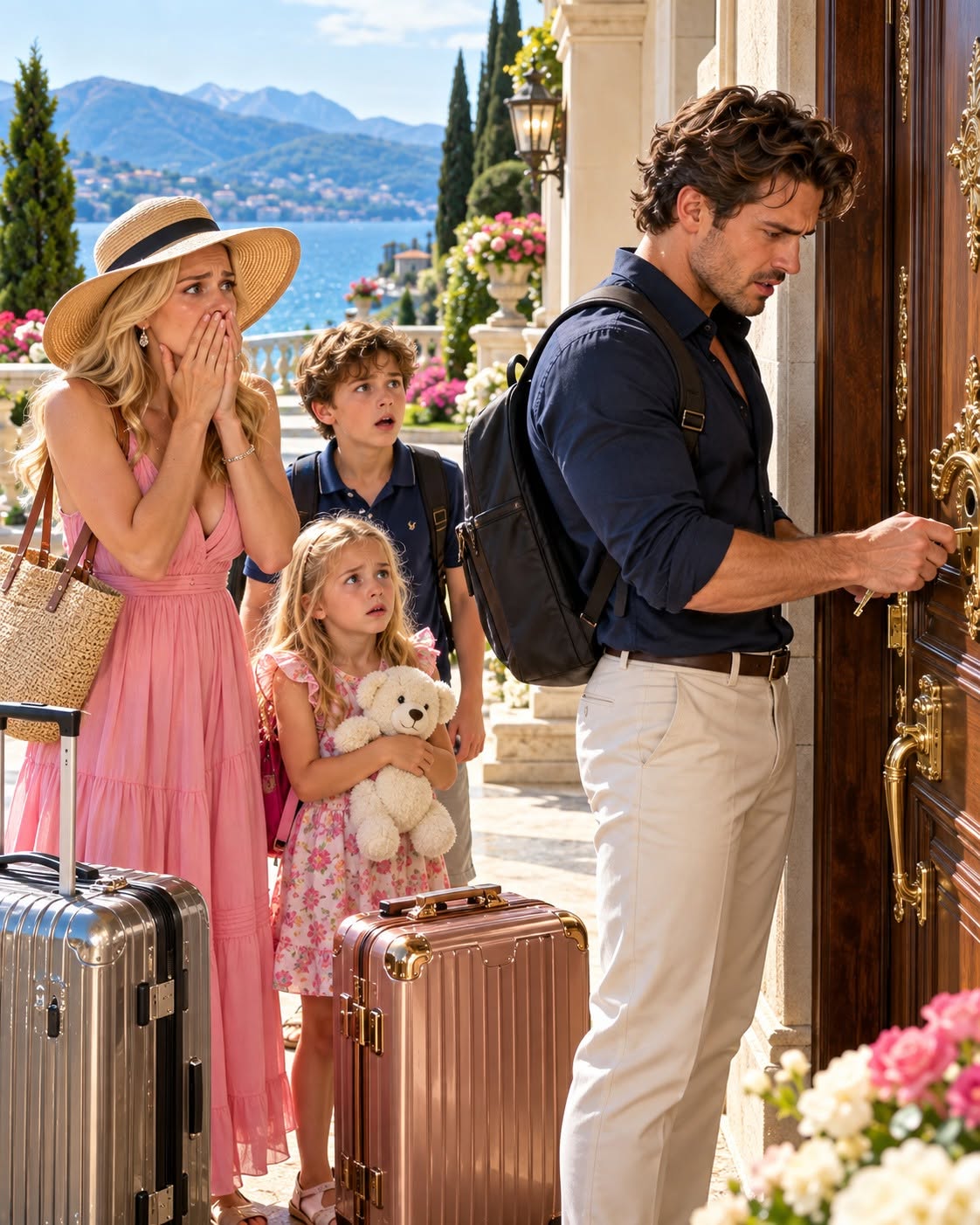
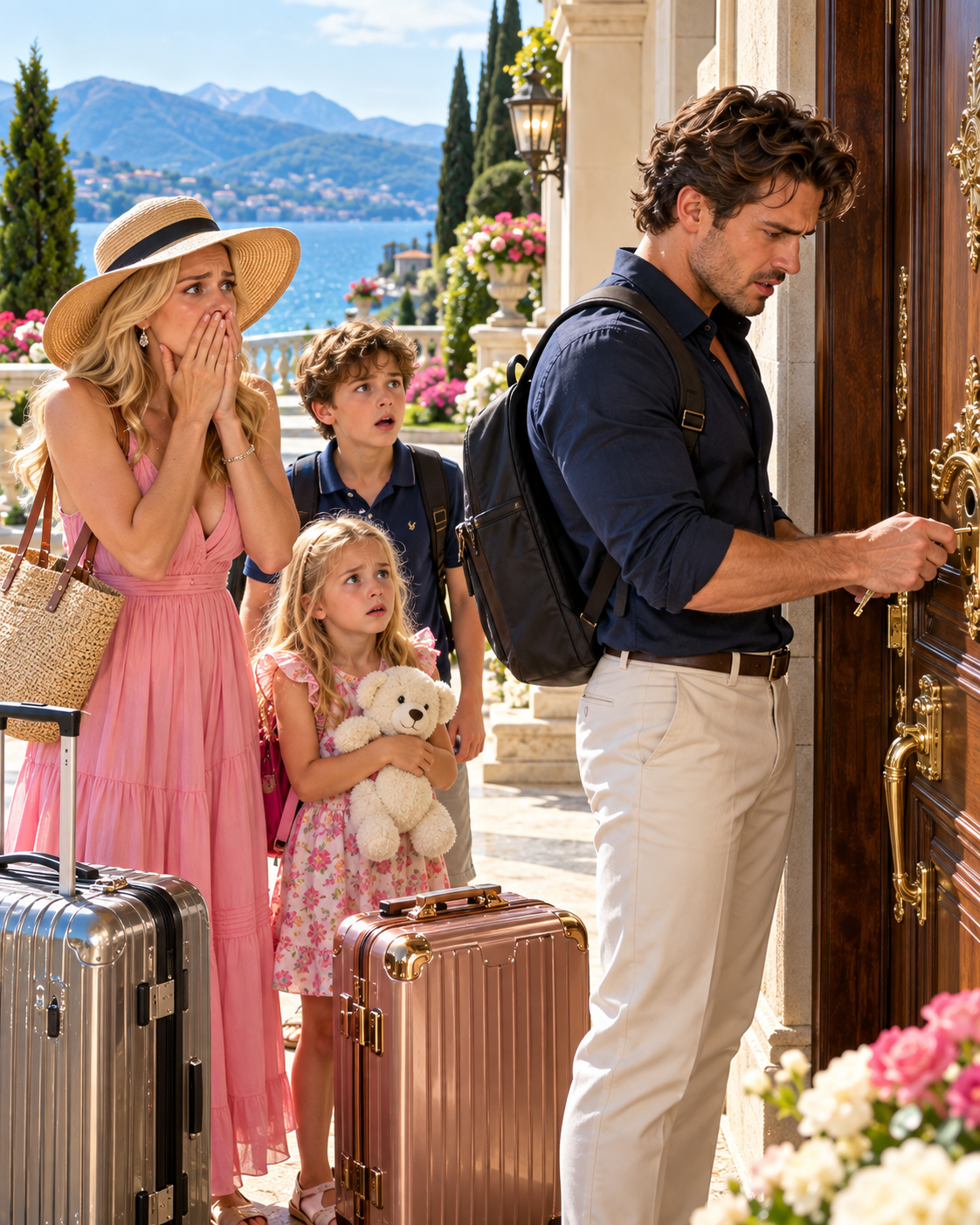
And he had absolutely no idea what would be waiting for him when he tried his key.
PART 2
Patrick called me at 4:18 that afternoon.
I knew the exact time because I was sitting on the balcony of my new condominium with a cup of coffee when my phone began vibrating across the little glass table.
I had purchased the condo three days earlier.
It was smaller than the lake house.
Much smaller.
Two bedrooms instead of five.
One balcony instead of three acres of waterfront property.
No dock.
No enormous lawn that required constant maintenance.
No guest rooms waiting for people who rarely bothered to call unless they needed something.
For the first time in decades, everything around me belonged to the life I was actually living instead of the life other people expected me to preserve for them.
My phone stopped ringing.
Ten seconds later, it started again.
Patrick.
I let it ring.
Then Megan called.
Then Patrick again.
Finally, a text appeared.
“Mom. Where are you?”
I took a sip of coffee.
Another message followed.
“There are people in the house.”
That almost made me laugh.
Of course there were people in the house.
The Hendersons owned it.
Another message.
“My key doesn’t work.”
Then:
“CALL ME.”
I waited.
Thirty seconds later:
“Did you change the locks?”
I answered that one.
“No.”
His response came instantly.
“Then why can’t I get inside?”
“Because it isn’t my house anymore.”
Nothing happened for nearly a minute.
Then my phone rang.
I answered.
Patrick didn’t say hello.
“You did WHAT?”
His voice was so loud I moved the phone away from my ear.
“I sold the house.”
“You sold the lake house?”
“Yes.”
“Our house?”
There it was.
Our house.
I looked across my balcony at the afternoon sky.
“No, Patrick. My house.”
He went silent.
Behind him, I could hear car doors shutting.
Then Megan’s voice.
“What did she say?”
Patrick ignored her.
“Mom, stop. This isn’t funny.”
“I’m not joking.”
“You can’t sell that house.”
“I already did.”
“No, you can’t.”
His voice had changed.
The anger was still there, but something else had entered it.
Panic.
“That property was supposed to stay in the family.”
“You told me that.”
“Because Dad wanted it that way.”
That hurt.
Not because it was true.
Because it wasn’t.
“Your father never said that.”
“Yes, he did.”
“No, Patrick.”
I set my coffee down.
“George and I bought that house because we wanted a place to enjoy while we were alive. We never bought it so you could decide what happened to it after we were dead.”
Silence.
Then Megan took the phone from him.
“What about our things?”
No hello.
No question about where I had moved.
No concern about whether I was safe.
Her belongings.
That was her first concern.
“They’re in storage.”
“You put our belongings in storage?”
“Yes.”
“You had no right.”
I almost admired the confidence it took to say that.
“I had no right to move your belongings out of my house?”
“You know what I mean.”
“I really don’t.”
Her voice sharpened.
“We kept things there because it was the family home.”
Again.
Those words.
“The family home.”
I had heard them so many times that I had almost forgotten how inaccurate they were.
“Megan, you have your own house.”
“That’s not the point.”
“Then what is?”
She hesitated.
And in that hesitation, I heard the truth.
The lake house was supposed to become theirs.
Not today.
Not necessarily next year.
But eventually.
They had built that certainty into their future.
Patrick came back onto the phone.
“How much did you sell it for?”
That question told me everything I needed to know.
Not why.
Not whether I was happy with the decision.
Not where I was living.
“How much?”
I smiled.
“That’s private.”
“I’m your son.”
“Yes.”
“So I deserve to know.”
“No.”
Another silence.
Then he said something that finally made the last piece fall into place.
“We planned around that house.”
I leaned back in my chair.
“What does that mean?”
“Nothing.”
“No. Explain it.”
He exhaled hard.
“Megan and I had plans.”
“I saw the plans.”
Silence.
“The remodeling folder.”
Neither of them spoke.
“The new kitchen,” I continued. “The expanded primary suite. The glass doors. Megan’s future office.”
Megan said quietly:
“You went through my things?”
“It was sitting in Patrick’s old bedroom in my house.”
“That was private.”
“So was my property.”
Patrick tried to interrupt.
“Mom—”
“No. You’re going to listen now.”
My voice wasn’t loud.
I didn’t need it to be.
“For years, I paid expenses for your family because I believed I was helping you. I paid school fees because you said things were tight. I covered your car payment when Megan changed jobs. I kept you on my phone plan because you said switching would be inconvenient. I paid for vacations because I wanted memories with my grandchildren.”
I paused.
“And then you took the vacation I helped pay for and told me I wasn’t family enough to attend.”
“That wasn’t what I said.”
“You said, ‘Megan only wants her family there.’”
Patrick went quiet.
“And Megan made the meaning even clearer.”
I could practically hear her stiffen.
“Her post said, ‘Family only. Exactly how it should be.’”
“That was just social media,” Megan said.
“No. It was honest.”
Neither of them answered.
“For once,” I continued, “I believed you.”
Patrick’s voice softened.
“Mom, we were frustrated.”
“With what?”
“Megan’s parents wanted time with the kids.”
“And I prevented that?”
“No.”
“Then why was I removed?”
He had no answer.
Megan did.
“We wanted one trip that wasn’t about you.”
I closed my eyes.
There it was.
After years of paying.
Hosting.
Babysitting.
Driving.
Helping.
Remembering birthdays.
Preparing bedrooms.
Cooking holiday dinners.
Watching their children when they needed weekends away.
I had somehow become an inconvenience in a vacation I had partly financed.
I opened my eyes again.
“Then you got exactly what you wanted.”
“What is that supposed to mean?”
“A life that isn’t about me.”
I ended the call.
For twenty minutes, my phone kept vibrating.
I turned it facedown.
Then someone knocked on my condominium door.
For one ridiculous second, I wondered if Patrick had somehow found me.
But when I opened it, my daughter-in-law wasn’t standing there.
My oldest granddaughter, Lily, was.
She was sixteen.
Still wearing the sweatshirt she had traveled home in.
Her eyes were red.
“Grandma?”
My heart sank.
“Lily?”
She stepped forward and hugged me.
I hadn’t expected that.
I wrapped my arms around her.
“What happened?”
She pulled back.
“Dad and Mom are fighting in the parking lot.”
Of course they were.
“How did you find me?”
“Dad had the address from the storage paperwork.”
I sighed.
I should have expected that.
“Where’s your brother?”
“With Grandpa and Grandma Carson.”
Megan’s parents.
I stepped aside.
“Come in.”
Lily walked slowly through the condo.
She looked around.
“This is nice.”
“Thank you.”
Then she turned toward me.
“Did you really sell the lake house?”
“Yes.”
Her face fell slightly.
“I loved that place.”
“I know.”
She looked down.
I waited for anger.
Instead she whispered:
“Are you mad at us?”
That question broke something in me that Patrick’s shouting never could.
I walked over and took her hands.
“No.”
“But the excursions—”
“That was between your parents and me.”
“Mom said you canceled everything because you were punishing us.”
“I stopped paying for expenses that belong to your parents.”
Lily looked confused.
“They said you offered.”
“I did.”
“And now you don’t want to?”
“I wanted to help. I didn’t want my help to become something everyone believed they were entitled to.”
She nodded slowly.
Then she sat on my sofa.
After a moment, she said:
“I didn’t know you were supposed to come.”
I stared at her.
“What?”
“On the cruise.”
She looked genuinely confused.
“Mom told us you decided not to go because you weren’t feeling well.”
For a second, I couldn’t speak.
“She said that?”
Lily nodded.
“She said you didn’t want us worrying about you.”
I turned toward the window.
Suddenly, the matching shirts made even more sense.
The airport photograph.
The caption.
They hadn’t simply excluded me.
They had rewritten the story before anyone could question my absence.
“Grandma?”
I turned back.
“I’m fine.”
She studied me.
“You look sad.”
“I was.”
“Because of us?”
“No.”
I sat beside her.
“Because sometimes you can spend years helping people and not realize that they’ve stopped seeing the help as love.”
She thought about that.
Then she asked:
“Are you still coming to my recital next month?”
I smiled.

“If you want me there.”
“Of course I do.”
“Then I’ll be there.”
That was the difference.
I was done buying my place in anyone’s life.
But I wasn’t withdrawing love.
Those were not the same thing.
Patrick arrived twenty minutes later.
He knocked hard enough to rattle the door.
I opened it but didn’t invite him inside.
He looked exhausted.
Megan stood behind him.
Neither looked like someone returning from a luxury Caribbean vacation.
“Lily,” Patrick said, “go downstairs.”
She stood.
Before leaving, she hugged me again.
“See you at my recital.”
“You will.”
Patrick watched her walk toward the elevator.
Then he turned back to me.
“What did you tell her?”
“The truth.”
Megan folded her arms.
“You had no business involving her.”
“I didn’t. She came here.”
Patrick rubbed his forehead.
“Can we please just talk about the house?”
“No.”
His eyes widened.
“No?”
“The house is sold. There’s nothing left to discuss.”
“What about the money?”
“There is definitely nothing to discuss about that.”
Megan stepped forward.
“We made decisions based on eventually having that property.”
“That sounds like a mistake.”
Her face hardened.
“We turned down another house two years ago because Patrick said there was no reason to buy something bigger when eventually—”
She stopped.
When eventually I died.
Nobody needed to finish the sentence.
Patrick looked at her sharply.
“Megan.”
“What? She knows.”
Yes.
I knew.
And strangely, hearing it out loud didn’t devastate me.
It liberated me.
For years, I had sensed something uncomfortable whenever Patrick talked about renovations.
Whenever Megan criticized the old cabinets.
Whenever she said the upstairs bathroom would “have to be redone eventually.”
I had ignored it because admitting the truth felt ugly.
Now there was nothing left to pretend.
“You planned your financial future around inheriting property from a woman who is still alive.”
Neither responded.
“That isn’t planning,” I said. “That’s waiting.”
Patrick looked wounded.
“That’s not fair.”
“Neither was removing me from a vacation I paid for the night before departure.”
“We handled that badly.”
It was the closest thing to an admission I had heard from him.
“Yes.”
“I’m sorry.”
Megan turned toward him.
“Patrick.”
He ignored her.
“I mean it, Mom.”
I studied my son.
For a moment, I saw the little boy who used to run down the dock with George.
The teenager who taught himself to fish.
The young man who cried at his father’s funeral.
I loved that person.
I loved the man standing before me too.
But love didn’t require pretending he had treated me well.
“I accept that you’re sorry.”
Relief crossed his face.
Then I added:
“But nothing is going back to the way it was.”
His expression changed.
“What does that mean?”
“It means you pay your own bills.”
“Mom—”
“It means I don’t finance vacations I can be removed from.”
He looked away.
“It means my money is mine. My property is mine. And any inheritance you receive someday will be a gift, not something you’re owed.”
Megan laughed bitterly.
“So you’re punishing us forever.”
“No.”
I looked directly at her.
“I’m stopping the punishment I’ve been giving myself.”
That silenced her.
Patrick stared at the floor.
Finally he asked:
“Where are our boxes?”
I gave him the storage address.
“The first month is paid.”
He looked up.
“After that?”
“You’ll need to put your own card on the account.”
Megan gave a humorless laugh.
“Of course.”
I smiled.
“Yes. Of course.”
They left.
For the first time, I didn’t follow them mentally.
I didn’t wonder whether Patrick was angry.
I didn’t worry whether Megan would complain about me to her parents.
I didn’t reach for my phone to repair the discomfort.
I simply closed the door.
Then I made another cup of coffee.
The following weeks were quieter than I expected.
Patrick didn’t call.
Neither did Megan.
But Lily did.
So did her younger brother, Caleb.
I attended Lily’s recital.
I sat three rows from the front.
Patrick and Megan were across the aisle.
We nodded politely.
Nothing more.
Afterward, Lily ran toward me carrying flowers.
“You came!”
“I told you I would.”
She hugged me.
Caleb joined us.
For several minutes, everything felt normal.
Not the old normal.
Something better.
A normal that didn’t require me to pay for admission.
Two months later, Patrick asked if we could have lunch.
Just the two of us.
I agreed.
We met at a small restaurant halfway between our homes.
He arrived early.
That alone surprised me.
For years, Patrick had treated my time as infinitely flexible.
He sat across from me and looked nervous.
“I’ve been thinking.”
I waited.
“I didn’t realize how much you were paying.”
“You knew.”
He winced.
“You’re right.”
I appreciated that correction.
“I knew each individual thing. I just never added it all together.”
“That’s how it happened to me too.”
He looked down.
“The car was almost repossessed.”
I said nothing.
“I handled it.”
“Good.”
He looked surprised.
Maybe he had expected me to offer money.
I didn’t.
He continued.
“We moved the kids to a different phone plan. Megan emptied the storage unit. We cut some things.”
“That sounds responsible.”
He nodded.
Then he looked at me.
“I was angry about the house.”
“I know.”
“I’m still sad about it.”
“I understand.”
“But I think I know why you did it.”
That mattered more than I expected.
He rubbed his hands together.
“I kept thinking Dad would have been furious.”
I waited.
“And then I remembered something.”
“What?”
“When I was twenty-three and wanted him to cosign that motorcycle loan.”
I smiled despite myself.
George had hated that motorcycle.
Patrick laughed softly.
“He said, ‘Son, my money doesn’t become yours just because you can imagine spending it.’”
My eyes filled.
That sounded exactly like George.
Patrick’s did too.
“I forgot that,” he said.
“So did I.”
He looked at me.
“I think after Dad died, you tried to fill every hole he left.”
That sentence landed gently but deeply.
Maybe he was right.
George had been the one who said no easily.
I had always been softer.
After losing him, perhaps I had confused generosity with keeping the family together.
Every bill I paid became another thread.
Every vacation another knot.
Every favor another way of convincing myself nobody would drift too far away.
But relationships held together by money weren’t really being held together.
They were being rented.
Patrick cleared his throat.
“Megan isn’t ready to apologize.”
“I know.”
“She thinks you embarrassed us.”
“I didn’t post anything publicly.”
“I told her that.”
I smiled faintly.
“She’ll have to decide what she believes.”
He nodded.
Then he asked:
“Are you happy?”
The question surprised me.
“In the condo?”
“In general.”
I thought about it.
“Yes.”
And I meant it.
I had started walking every morning.
I joined a book club.
I traveled for a week with an old friend from college.
I bought furniture because I liked it, not because Megan thought it would preserve resale value.
I stopped maintaining five bedrooms for hypothetical guests.
I stopped checking whether everyone else needed something before asking what I wanted.
“Yes,” I repeated. “I am.”
Patrick smiled.
Not broadly.
But genuinely.
“I’m glad.”
Six months after the cruise, Megan finally called.
I almost didn’t answer.
But I did.
“Hello?”
She was quiet.
Then:
“I owe you an apology.”
I sat down.
“I’m listening.”
“I shouldn’t have posted that caption.”
I waited.
“And we shouldn’t have removed you from the cruise after you helped pay for it.”
Her voice sounded uncomfortable.
Good apologies often are.
“I was selfish.”
I didn’t rescue her from the silence.
Finally she continued.
“I think I started seeing everything you did as normal instead of generous.”
“That happened.”
“And the remodeling plans…”
She exhaled.
“That was wrong.”
“Yes.”
“I’m embarrassed about it.”
“I imagine so.”
She gave a small, nervous laugh.
Then she said:
“I’m not asking you for anything.”
That sentence mattered.
“I just wanted to say I’m sorry.”
“Thank you.”
We didn’t suddenly become close.
There was no magical reconciliation.
Trust doesn’t regenerate because someone finally says the correct words.
But something changed.
Boundaries replaced assumptions.
Patrick started calling just to talk.
Megan occasionally invited me to dinner without asking me to bring my credit card.
The grandchildren continued visiting.
And gradually, our relationships began to exist without financial transactions underneath them.
A year after I sold the lake house, I drove past it.
I hadn’t planned to.
I was visiting a friend nearby and found myself taking the old road almost automatically.
The Hendersons had changed the shutters.
There were flower boxes beneath the windows.
A kayak rested beside the dock.
Through the trees, I could see someone grilling on the patio.
For a moment, grief rose inside me.
Thirty-two years of saving.
Summers with George.
Patrick jumping off the dock.
Christmas mornings.
Birthdays.
Funerals.
Arguments.
Laughter.
A lifetime had happened inside those walls.
Then I realized something.
The memories were still mine.
Selling the house hadn’t sold them.
George was still with me in every room I remembered.
My children’s childhoods still existed.
Nothing meaningful had been taken away.
I had only stopped confusing a building with a family.
I drove home to my condo.
Lily was waiting outside.
She had brought takeout.
“Dad said you like this place.”
“He finally remembers.”
She laughed.
Inside, we ate dinner on the balcony.
Later Patrick called.
Not because a payment had failed.
Not because he needed money.
Not because something was linked to my card.
He simply wanted to ask whether I wanted to come over Sunday.
I did.
Before hanging up, he said: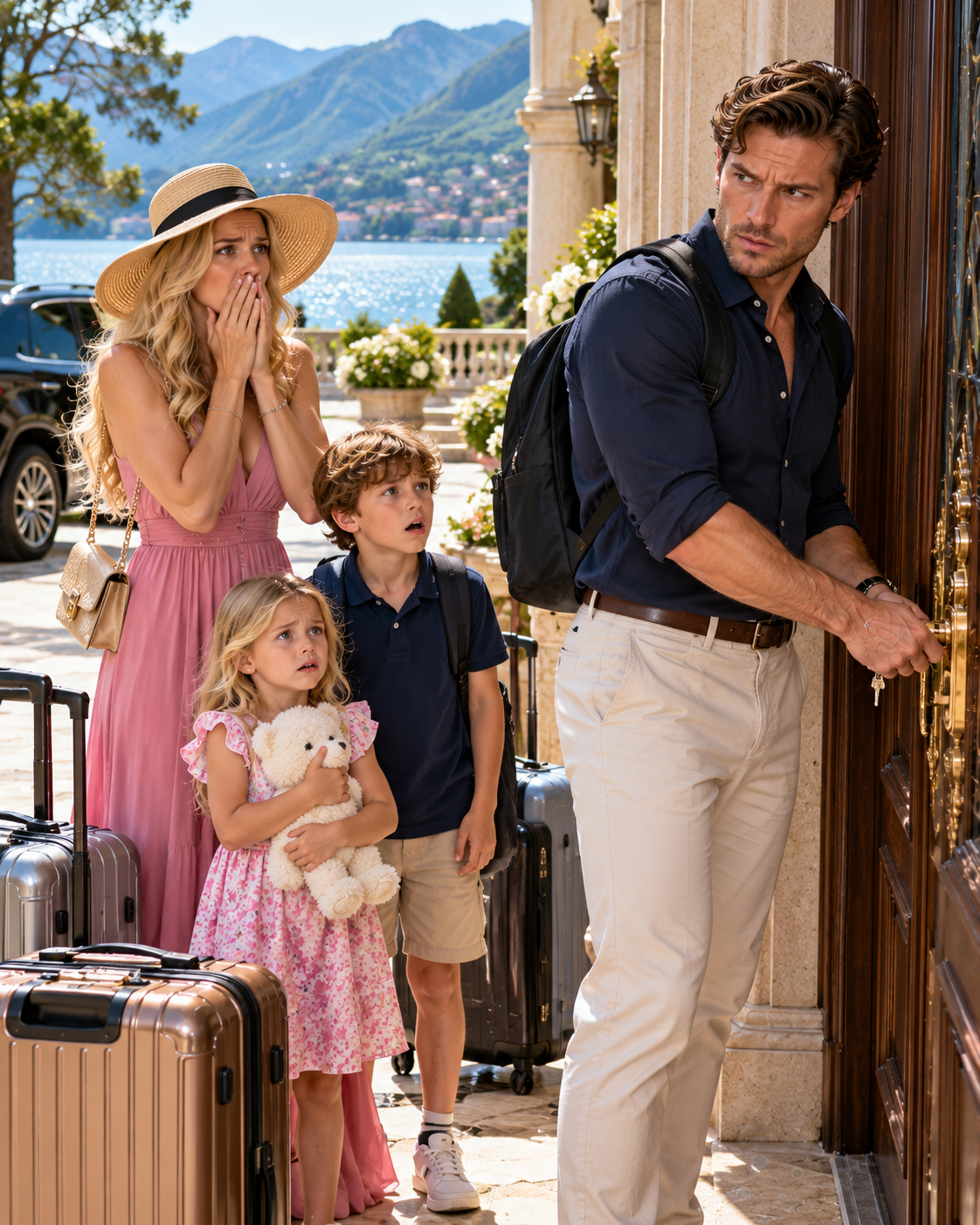
“Love you, Mom.”
“Love you too.”
I sat there for a while after the call ended.
The lake house had been beautiful.
But it had never been what made us a family.
And selling it hadn’t destroyed our family either.
If anything, it forced us to discover whether there was a family underneath all the money, property, expectations, and assumptions.
There was.
It just needed different rules.
I still help my grandchildren sometimes.
I give gifts.
I pay for experiences when I choose to.
Generosity didn’t disappear when I established boundaries.
Resentment did.
That cruise taught me something I wish I had understood years earlier.
When people become accustomed to your generosity, they can start mistaking it for an obligation.
And when you finally stop giving, they may call your boundary selfish because your sacrifice had become convenient for them.
But love is not an automatic payment.
Family is not a financial contract.
And inheritance is not property that belongs to someone before the owner is finished living.
My son once called my lake house “the family home.”
He was wrong.
A family home isn’t defined by whose name will eventually appear on the deed.
It’s defined by the people who choose to treat one another like family while everyone is still here.
I had spent years preparing to leave something valuable behind for my children.
Selling that house taught me there was something more valuable I needed to leave them.
The understanding that loving someone does not mean surrendering yourself to them.
The Hendersons got the lake house.
Patrick got a mother who finally knew how to say no.
And I got something I hadn’t realized I was missing.
My own life.
The cruise was supposed to be a family vacation.
Instead, it became the moment I finally understood who considered me family—and who merely considered my money and property part of the package.
I never regretted selling the house.
Not once.
Because sometimes the most important thing you can leave your children isn’t an inheritance.
It’s the lesson that they were never entitled to one in the first place.