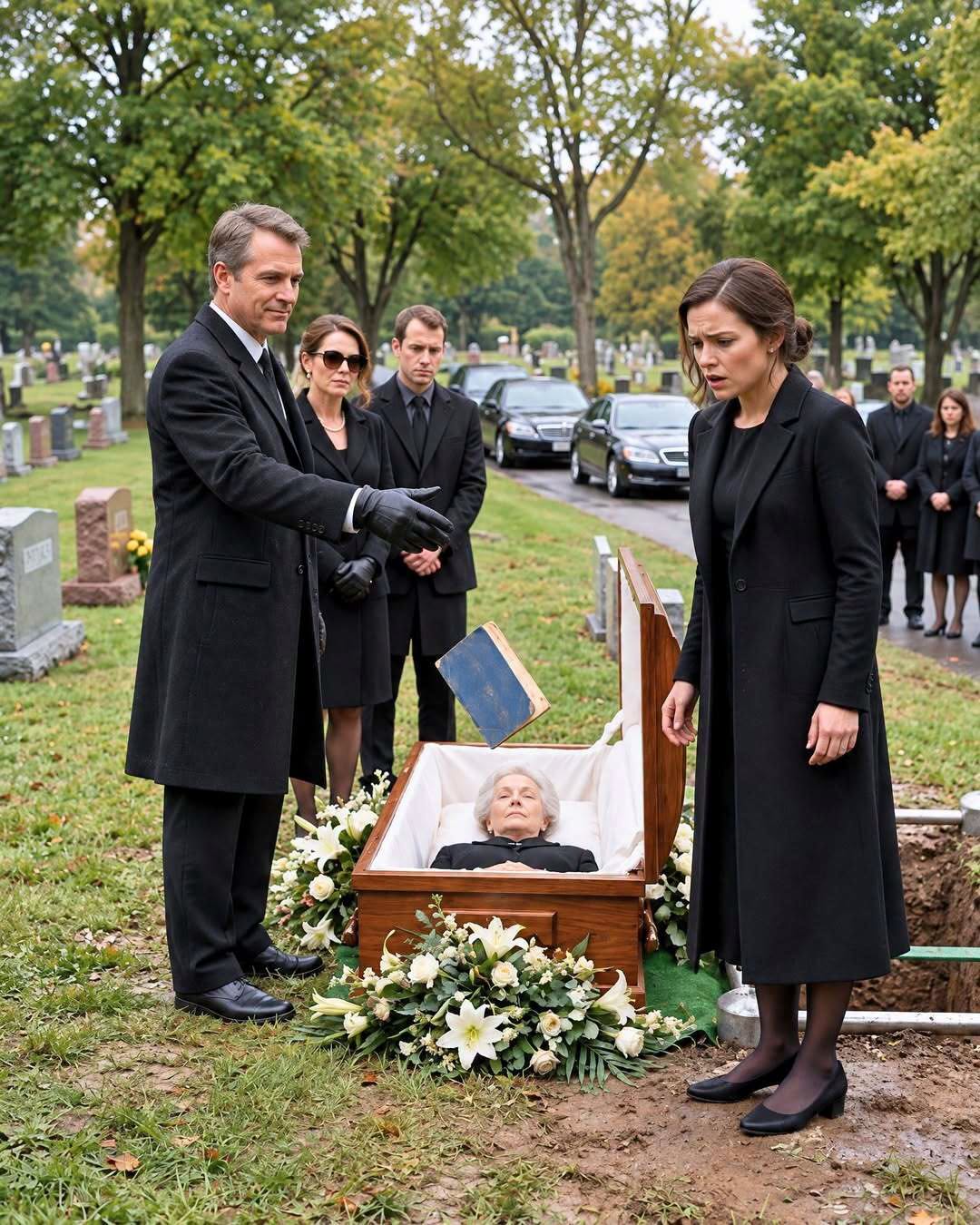
“That thing isn’t worth a cent. Let it be buried with her.”
My dad flicked the small blue passbook onto Grandma Maggie’s open casket. It landed across her chest, half-covered by damp soil and fading flowers. No one reacted. Not my uncles. Not my cousins. Not even the pastor who had just finished the final prayer at Oakfield Cemetery.
Two nights earlier, Margaret Henderson had held my hand with surprising strength and whispered, “Chloe… don’t let Richard get it.”
Richard was my father.
And the person Grandma trusted the least.
I was twenty-seven, standing beside the grave in a borrowed black dress while my inexpensive flats sank into the wet earth. Dad adjusted his gloves and gave me the same smug look I had known my entire life. It was the look he wore when he dismissed my tears as “drama,” when he helped himself to money from my college scholarship, and when Grandma had stepped between us during the worst arguments.
“There’s your inheritance, Chloe,” he said, nodding toward the casket. “An old notebook. No property. No land. No money.”
Susan, my stepmother, let out a quiet laugh behind her expensive sunglasses. Tyler, my half-brother, leaned toward me and smirked.
“If there’s fifty dollars in there, you’re buying burgers.”
A few relatives laughed with him.
I didn’t.
Grandma had kept that passbook hidden for as long as I could remember. She wrapped it in an embroidered cloth and stored it inside an old butter-cookie tin beneath her bed. Once a month, she took it to the bank while wearing the same knitted cardigan and carrying the same clasp purse.
When I was little, I sometimes saw the book resting beside the porcelain angel on her kitchen table.
“This little book matters after I’m gone,” she once told me. “But only you need to know that.”
When they began lowering her casket, Dad didn’t cry.
He simply watched the dirt fall as though he wanted to be certain something stayed buried.
One by one, the family started leaving.
I stayed behind.
I listened to footsteps crunch across the gravel. Car doors slammed. Engines started. Then the cemetery finally went quiet.
I dropped to my knees.
Using my bare hands, I dug into the damp soil until my fingers struck something firm.
The passbook.
I pulled it free, wiped the mud against my dress, and opened the cover.
Margaret Henderson.
Underneath her name, written in shaky blue ink, was a sentence I had never seen before.
“If Richard says it’s worthless, it’s because he already tried to cash it.”
I ran.
That night, I locked myself inside my small apartment near the downtown market and pushed a wooden chair beneath the doorknob. Under the harsh yellow kitchen light, I opened the passbook again.
The first entries were exactly what I expected.
Fifty dollars.
One hundred and twenty.
Three hundred.
Occasionally a thousand.
Small amounts saved over the years from baking, sewing, laundry work, and whatever else Grandma could earn.
Then the pattern changed.
There were larger withdrawals.
Transfers.
Amounts that made no sense beside the life Grandma had lived.
And next to those transactions, the same initials appeared again and again.
R.H.
Richard Henderson.
My father.
My hands were already shaking when I noticed a folded sheet tucked between two pages.
Grandma’s handwriting covered both sides.
“Chloe, if you are reading this, forgive me for waiting so long to tell you. Your father didn’t only take money from me. He also tried to take something that has belonged to you since the day you were born.”
I read the line twice.
Then I saw what she had written at the bottom.
“Do not go to the family. Do not trust Susan. Go directly to the bank. Ask about the account marked with the red stamp.”
I searched through every page until I found it.
On the final page, beside a handwritten routing code, was a faded red circle.
I didn’t sleep that night.
At eight the next morning, still wearing the same black dress stained with cemetery mud, I walked into the Main Street branch with the passbook hidden inside a paper grocery bag and wrapped in a hand towel.
Around me, everything looked ordinary.
People complained about debit cards. Someone cashed a check. A tired mother tried to calm two restless children.
My life no longer felt ordinary.
A young teller smiled politely.
“Good morning. What can I help you with?”
I unwrapped the passbook and placed it on the counter.
“It belonged to my grandmother. She died yesterday. She told me to bring it here.”
The teller typed in the account number.
She frowned.
Then she typed it again.
Her eyes moved from the monitor to the passbook, then back to me.
The color slowly drained from her face.
“Are you related to the account holder?”
“I’m her granddaughter.”
“What’s your name?”
“Chloe Henderson.”
She asked for identification.
I slid my driver’s license across the counter.
Her fingers trembled as she compared my name to whatever she was seeing on the screen.
Then she picked up the phone.
“Manager… I need you at window four.”
She paused.
“And call security.”
A second later, she made another call.
This one was to the police.
Whatever Grandma had hidden inside that account, the bank had recognized it immediately.
And suddenly, I understood why she had been so afraid of my father finding that book.
Part 2: The Bank Found What Grandma Had Hidden
The manager arrived without answering a single one of my questions.
He picked up the passbook carefully by the edges, checked my driver’s license, then leaned toward the teller’s monitor.
His expression changed almost immediately.
“Don’t touch anything,” he told her. “Leave that screen exactly as it is.”
My stomach tightened.
“Did I do something wrong?”
He looked at me and shook his head once.
“No.”
But instead of explaining, he opened the passbook and turned directly to the final page.
The faded red circle.
Grandma’s mark.
He stared at it for several seconds before looking back at the computer.
Then he turned to me.
“Please tell me your full name again.”
“Chloe Henderson.”
His eyes moved from my face to the passbook and back to the screen.
The teller no longer touched the keyboard. She stood beside him with both hands pulled away from the counter as though even pressing another key might change something important.
A few windows away, customers continued talking, completely unaware that my grandmother’s dirty little savings book had brought an entire teller station to a halt.
The manager lowered his voice.
“Ms. Henderson, I need you to do something for me.”
I waited.
“Do not call anyone in your family yet.”
That sentence hit harder than everything else.
It sounded exactly like Grandma.
Don’t go to the family.
Don’t trust Susan.
For the first time since entering the bank, I stopped wondering whether Grandma had been confused near the end.
She had known exactly what she was doing.
The manager closed the passbook.
Without another explanation, he turned toward the secured door behind the counter.
Then he carried Grandma’s book into the back office and disappeared from sight.
Part 3: The Account With My Name on It
The manager disappeared through the secured door with Grandma’s passbook, leaving me standing at the counter with the teller and a thousand questions I was apparently not allowed to ask yet.
For several minutes, no one said anything. The teller kept glancing at me as if she wanted to explain, but every time she opened her mouth, she seemed to reconsider.
Then two uniformed police officers entered the bank.
My first instinct was to step backward.
One of them, a woman in her forties with the name Ramirez on her badge, walked directly toward window four. The other officer remained near the entrance with a bank security guard.
“Chloe Henderson?”
“Yes.”
Officer Ramirez studied my face before looking at my driver’s license on the counter.
“You’re not under arrest,” she said immediately. “We were asked to come because the bank has an open fraud report connected to an account bearing your name.”
My name.
Not Grandma’s.
Mine.
Before I could respond, the manager returned with a gray-haired woman in a navy suit carrying a thick folder. She introduced herself as Elaine Mercer, regional fraud investigator for the bank.
“We need to speak somewhere private,” she said.
They took me into a small conference room behind the lobby. There was a round table, six chairs, a security camera in the corner, and a box of tissues that made me more nervous than anything else in the room.
Grandma’s muddy passbook sat inside a clear plastic sleeve in the center of the table.
Elaine opened the folder.
“Ms. Henderson, do you remember opening a custodial investment account at this bank?”
“No.”
“Do you remember signing documents here approximately six years ago authorizing Richard Henderson to act on your behalf?”
“No.”
She turned a document toward me.
At the bottom was a signature.
Chloe Marie Henderson.
It looked like mine from a distance.
Up close, it didn’t.
The C curled too far inward. The H was wrong. Whoever had signed it knew what my handwriting looked like, but not how my hand moved.
“I didn’t sign this.”
Elaine nodded as though she had expected that answer.
Officer Ramirez wrote something down.
Then Elaine placed a photograph beside the document.
It was a security-camera still from inside that very bank. My father stood at a desk beside a man I didn’t recognize. Dad looked younger, heavier, and completely relaxed.
The date in the corner was six years earlier.
“That man with your father was a notary who later lost his commission after an unrelated fraud investigation,” Elaine explained. “Your father presented documents claiming you had authorized him to manage an account established for you shortly after your birth.”
I stared at the photograph.
“What account?”
Elaine pulled another paper from the folder.
At the top was my full legal name.
Below it was an account number matching the faded routing code Grandma had circled in red.
My hands went cold.
“The original account was established twenty-seven years ago by Margaret Henderson and her late husband, Samuel Henderson.”
Grandpa Samuel had died when I was eight. I remembered almost nothing about money, but I remembered his workshop, his peppermint candy, and the way he always called me Cricket.
Elaine continued.
“Your grandfather owned a small commercial property and a regional equipment-repair company. When he sold part of the business, he and your grandmother placed money into several long-term investment accounts. One was created specifically for you.”
“How much?”
She didn’t answer immediately.
Instead, she slid another page across the table.
My eyes found the number near the bottom.
$1,863,417.22.
I read it twice.
Then a third time.
“That can’t be mine.”
“It is.”
I laughed once, but there was no humor in it.
“I live in a one-bedroom apartment. I spent last winter deciding whether I could afford to replace my brakes. My father told me Grandma had nothing.”
“Your grandmother personally lived very modestly,” Elaine said. “Most of this money was not available for ordinary spending. The account was structured to become fully controlled by you once certain age conditions were satisfied.”
“What conditions?”
“Initially twenty-five years old.”
I was twenty-seven.
I looked back at the balance.
Something didn’t make sense.
“If it became mine at twenty-five, why didn’t anyone tell me?”
Elaine’s expression changed.
“Someone tried very hard to make sure you never found out.”
She opened another section of the folder.
There were copies of letters addressed to me.
Annual notices.
Account summaries.
Requests for identity verification.
Every one of them had been sent to my father’s house.
The house I had moved out of at nineteen.
Beside several notices were postal forms redirecting my mail.
All signed by Richard Henderson.
Then I saw another document.
A change-of-address request transferring future correspondence to a post office box.
I recognized the address.
Susan had used that same post office box for her online boutique.
“Oh my God.”
Elaine waited.
“Susan knew.”
“We can’t determine what she knew from that document alone,” Officer Ramirez said carefully. “But her name appears elsewhere.”
Elaine turned another page.
There it was.
Susan Henderson.
Witness.
She had signed a statement claiming she personally watched me authorize Dad to manage the trust.
I hadn’t even lived in the same house as them when the document was supposedly signed.
My stomach twisted.
“What happened to the money?”
Elaine explained that Dad had successfully taken smaller amounts from a separate savings account Grandma maintained. Those were the withdrawals I had seen in the passbook beside the initials R.H.
But the large account was different.
Grandpa and Grandma had built restrictions into it.
Dad could not simply withdraw the money.
So he tried something else.
Six years ago, he presented paperwork claiming I had permanently transferred management authority to him. The bank rejected the request because one signature did not match records from an earlier identification document.
Three years later, he tried again.
That time he submitted a notarized affidavit stating I was mentally incapable of managing my finances.
I stopped breathing for a second.
“He said what?”
Officer Ramirez looked directly at me.
“He claimed you were financially incompetent and dependent on him for support.”
I almost laughed again.
Dad had not paid my rent once.
He hadn’t paid my tuition.
He had taken money from the scholarship account Grandma helped me build and told me I should be grateful because families shared resources.
Elaine continued.
“The second request was also rejected. Last month, someone made a third attempt.”
Last month.
While Grandma was still alive.
“What did he do?”
“This time, your father produced what appeared to be a signed declaration from Margaret Henderson stating that the original trust had been created in error and that Richard Henderson was the intended beneficiary.”
I stared at her.
“Grandma would never sign that.”
“The bank had the same concern.”
Elaine pulled out a copy.
The signature looked like Grandma’s.
But beside it was a date.
Three weeks earlier.
I remembered those weeks.
Grandma had already been in the hospital.
Her hands shook so badly she could barely hold a spoon.
There was no possibility she had produced the smooth, confident signature on that page.
“The document triggered an internal fraud review,” Elaine said. “We contacted your grandmother privately.”
My heart hammered.
“You spoke to her?”
“Yes.”
“What did she say?”
Elaine reached into the folder and removed one final envelope.
On the front, in Grandma’s handwriting, were three words.
FOR CHLOE ONLY.
“She came to this branch twelve days before she died,” Elaine said. “She asked us to place a permanent fraud restriction on the account. She also asked that if you personally appeared with the original passbook, we verify your identity and contact law enforcement.”
That was why the teller had gone pale.
Grandma had planned all of it.
The faded red circle.
The warning.
The passbook.
Even the police.
“She knew Dad would try again.”
Elaine nodded.
“She seemed certain of it.”
My hands trembled as I reached for the envelope.
Before I could open it, Officer Ramirez’s radio crackled.
The other officer said something I couldn’t make out.
Ramirez stood.
Her expression sharpened.
“What is it?”
She looked toward the conference-room door.
“Someone just entered the bank asking for you.”
I already knew who it was.
Then I heard my father’s voice outside.
“Where is my daughter?”
Part 4: The Man Grandma Had Been Afraid Of
The sound of Dad’s voice turned my entire body rigid.
For twenty-seven years, I had learned to recognize his moods before he entered a room. The cheerful voice meant he wanted something. The quiet voice meant someone was about to be punished.
This voice was different.
He was frightened.
Officer Ramirez told me to remain inside the conference room while she stepped into the lobby. Through the glass wall, I could see Dad near the entrance with Susan beside him.
Neither of them was dressed for a bank visit.
Dad still wore the same dark trousers from Grandma’s funeral. Susan had thrown a beige coat over black clothes, her hair pulled back as if they had left home in a hurry.
Dad saw me through the glass.
His face changed instantly.
He pointed.
“There she is.”
Susan grabbed his arm.
“Richard.”
He shook her off.
“What did you bring in here?” he shouted.
Customers turned.
The bank security guard moved closer.
Officer Ramirez stepped between Dad and the conference-room hallway.
“Sir, lower your voice.”
“Then you can discuss it calmly.”
Dad looked past her at the plastic sleeve containing Grandma’s passbook.
For the first time in my life, I watched him lose control without raising his voice.
His face simply emptied.
He knew.
“You dug it up,” he said.
I opened the conference-room door before anyone could stop me.
“You knew it wasn’t worthless.”
Dad’s eyes locked onto mine.
Behind him, Susan had gone completely still.
“I don’t know what they’ve told you.”
“They showed me the forged documents.”
His jaw tightened.
“They showed me the account.”
Susan whispered something under her breath.
Dad turned toward her sharply.
“Don’t.”
That one word told me more than any confession could have.
I looked at Susan.
“You signed as a witness.”
Her face crumpled.
“Chloe, it isn’t what you think.”
“You signed a statement saying you watched me give him control of my money.”
“I thought it was paperwork for Margaret.”
“My name is printed across the top.”
Dad stepped toward me.
“You have no idea how complicated this was.”
Officer Ramirez immediately raised one hand.
“Mr. Henderson, stay where you are.”
He stopped.
His attention remained fixed on me.
“Your grandfather never meant for you to have all that money without supervision.”
“You mean without you.”
“I was twenty-one the first time you forged my signature.”
His eyes flickered.
That was enough.
Officer Ramirez noticed too.
Dad realized his mistake and changed direction.
“I didn’t forge anything.”
“Then why did you tell everyone yesterday that the passbook was worthless?”
“Because it is.”
“Then why are you here?”
Silence.
For the first time, I understood what Grandma had been trying to protect me from.
It wasn’t only Dad’s temper.
It was the way he made you doubt something even while you were holding the evidence in your own hands.
Dad drew in a breath.
“Chloe, listen to me. That money came from my father’s business. My father. I worked there every summer from the time I was fourteen. I helped build that company.”
“And Grandpa still put the money in my name.”
“He made emotional decisions.”
“Grandma protected the account for twenty-seven years.”
“She was confused at the end.”
Officer Ramirez’s expression hardened slightly.
Elaine stepped out of the conference room holding the disputed declaration.
“Mr. Henderson, are you referring to this document?”
Dad glanced at it.
“I’ve never seen that.”
Susan made a sound beside him.
Not quite a gasp.
More like air leaving her lungs.
Dad turned toward her.
Too late.
Officer Ramirez noticed.
“So neither of you recognize it?” she asked.
Susan’s mouth opened.
Dad interrupted.
“We’re leaving.”
The officer moved between him and the door.
“Actually, we’d like both of you to remain for a few questions.”
Dad laughed.
“You can’t detain me because my daughter brought in an old bank book.”
“No,” Ramirez said. “But we can ask you about an active fraud investigation involving forged financial documents.”
Dad’s face reddened.
“This is ridiculous.”
Then Elaine said something that made Susan sit down.
“We also have surveillance footage from the document submission last month.”
Susan closed her eyes.
Dad didn’t move.
Elaine continued.
“The individual who delivered the declaration was recorded at our East County branch. The bank retained both the video and the identification used during the transaction.”
Susan whispered, “Richard…”
He turned on her.
“Shut up.”
The entire lobby seemed to go silent.
Officer Ramirez stepped closer.
“Mr. Henderson, don’t speak to her that way.”
Susan began crying.
Not loudly.
Not dramatically.
She simply sat in the chair near the entrance and covered her mouth with one hand.
“I told you they would check,” she whispered.
Dad stared at her.
“You don’t know what you’re saying.”
“I told you.”
“Susan.”
“You said Margaret wouldn’t live long enough to contest it.”
Nobody moved.
Dad’s expression changed.
Susan seemed to realize what she had just said.
Officer Ramirez’s partner approached from behind.
“What declaration?” Ramirez asked.
Susan shook her head rapidly.
“I need a lawyer.”
“That is your right.”
Dad took one step toward her.
The second officer immediately moved between them.
“Sir.”
Dad stopped.
Susan looked at me.
Mascara had begun streaking beneath her sunglasses.
“He said the account should have been his,” she said. “He said Samuel only put it in your name because Margaret manipulated him.”
“Susan, stop talking.”
“He told me you already knew.”
“Stop.”
“He said Chloe agreed!”
Her voice finally rose.
Several customers had moved away from the lobby.
I could barely hear them anymore.
All I could hear was Grandma two nights before she died.
Don’t let Richard find it.
Dad pointed at Susan.
“She’s upset. She doesn’t know what she’s talking about.”
Officer Ramirez asked Susan whether she wanted to speak somewhere privately.
She nodded.
Dad reached for her arm.
The officer caught his wrist before he touched her.
Everything happened quickly after that.
Dad jerked away.
The second officer ordered him to keep his hands visible.
Dad started shouting that everyone was overreacting, that this was his family, his father’s money, his mother’s account.
Then Officer Ramirez said the words I had imagined hearing a thousand times during the worst years of my childhood and somehow never expected to hear in real life.
“Richard Henderson, turn around and place your hands behind your back.”
Dad looked at me.
He didn’t look frightened anymore.
He looked betrayed.
As though I had done this to him.
“You called the police on your own father?”
I shook my head.
“No, Dad.”
I looked at Grandma’s passbook sitting behind the glass.
“Grandma did.”
The investigation lasted months.
It was not the dramatic, instant justice people imagine when they hear stories about fraud.
There were interviews.
Financial records.
Handwriting analysis.
Bank subpoenas.
Old mail-forwarding forms.
Notary records.
Copies of checks Grandma had never written.
Forensic accountants eventually reconstructed almost nine years of withdrawals from Grandma’s personal accounts.
Dad had started small.
Eight hundred dollars.
Then twelve hundred.
Then five thousand.
By the time Grandma began questioning him, he had taken more than $146,000.
Some of it paid credit-card debt.
Some went into Susan’s boutique.
Nearly thirty thousand had helped Tyler buy a truck and make a down payment on a condominium.
Tyler claimed he had never known where the money came from.
I believed him.
For all his stupid jokes, he had always been more careless than cruel.
Susan eventually admitted she had signed two false witness statements, but insisted Dad had told her everything was legally authorized.
Investigators discovered that she knew far more than she first admitted.
Emails showed Dad had sent her scans of my signature.
She had replied with one sentence.
This one looks closest.
I read that email exactly once.
That was enough.
The biggest surprise came from Grandma’s medical records.
Twelve days before she died, she had asked a hospital social worker to arrange transportation to the bank.
She hadn’t told Dad.
She hadn’t told Susan.
She had gone there wearing her knit cardigan with the embroidered flowers and carrying the same old clasp purse I remembered from childhood.
At the bank, Grandma had formally reported the suspected fraud.
She had also recorded a statement.
Elaine called me when investigators finally cleared it for release.
The next morning, I sat in the same conference room and watched Grandma appear on a laptop screen.
She looked impossibly small.
Her cardigan hung loosely around her shoulders. Her cheeks were hollow, and an oxygen tube rested beneath her nose.
But her eyes were completely clear.
“My name is Margaret Henderson,” she began. “And I’m making this statement because my son Richard believes I don’t know what he’s been doing.”
I pressed both hands over my mouth.
Grandma described the withdrawals.
The forged papers.
The missing bank letters.
The day she caught Dad searching beneath her bed for the cookie tin.
Then she talked about me.
“Chloe has spent most of her life believing she has to survive with whatever people leave her. That is partly my fault. I should have told her sooner.”
My vision blurred.
“The account was always hers. Samuel and I created it because we wanted one person in this family to have choices that could not be taken away by someone louder or stronger.”
Grandma stopped to breathe.
Then she looked directly toward the camera.
“Richard will tell Chloe she doesn’t deserve it. He will tell her she misunderstood. He will say I was confused.”
A tiny smile touched her mouth.
“I am not confused.”
I started crying.
Grandma leaned closer to the camera.
“Sweetheart, if you’re watching this, it means you found the little blue book.”
She paused.
“And if Richard told you it was worthless, then he still hasn’t learned that value and price aren’t the same thing.”
The recording ended.
I sat there long after the screen went black.
For the first time since Grandma died, I didn’t feel like she had disappeared.
I felt like she had reached across those twelve days and put her hand back into mine.
Part 5: What Grandma Actually Left Me
Dad eventually accepted a plea agreement.
The charges included financial exploitation of an elderly person, attempted fraud, forgery-related offenses, and theft connected to Grandma’s personal accounts.
Susan reached a separate agreement after cooperating with investigators and providing emails, financial records, and messages Dad had deleted from his own devices.
The legal process did not turn into the courtroom spectacle Dad always claimed it would.
There was no dramatic jury.
No surprise witness bursting through the doors.
Just documents.
Dates.
Signatures.
Bank footage.
And years of small decisions Dad had made because he believed no one would ever force him to explain them.
The court ordered restitution against assets that could be recovered.
Dad sold his boat.
Then the vacation property he and Susan had bought three years earlier.
The condominium money given to Tyler became part of a separate dispute, but Grandma’s estate attorney confirmed Tyler had not participated in the fraud itself.
He called me one night.
“I swear I didn’t know.”
“I know.”
There was a long silence.
Then he said, “I’m sorry about the funeral.”
I knew exactly what he meant.
The joke about fifty dollars.
The laughter.
Everyone standing around Grandma’s grave while Dad threw the passbook onto her casket.
“You should be.”
“I am.”
It wasn’t forgiveness.
But it was the first honest conversation we had ever had.
The trust was eventually transferred fully into my control.
The final balance, after investment changes and legal review, remained a little under $1.9 million.
The number still felt unreal.
For the first month, I barely touched it.
I paid off my remaining student loan.
I replaced my brakes.
I bought a mattress that didn’t sag in the middle.
Then I stopped.
I kept working.
I kept my apartment.
Money didn’t suddenly make me understand how to live without fear.
That took longer.
Grandma’s estate attorney eventually gave me another envelope.
Inside was a handwritten note dated eight years earlier.
Chloe,
If you ever receive this money, do not use it to prove anything to anybody.
You do not have to become rich enough to impress people who were comfortable watching you struggle.
Use it for freedom.
That was Grandma.
Even from the grave, she knew exactly which mistake I might make.
Six months later, I bought a small two-bedroom house twenty minutes outside the city.
Nothing enormous.
Nothing with marble floors or iron gates.
It had a porch, an old maple tree, and a kitchen window overlooking a patch of backyard where Grandma would have immediately started planting tomatoes.
On moving day, I placed the blue passbook on the kitchen table.
The mud stains from the cemetery were still visible along the edges.
I had thought about cleaning it.
I never did.
Those stains belonged there.
They reminded me that Dad had literally thrown away the thing that exposed him because he had been so certain nobody else understood its value.
A week after I moved in, Elaine called from the bank.
“There is one remaining item in the safe-deposit file,” she said. “Your grandmother instructed us to release it after the trust transfer was complete.”
I drove to the branch that afternoon.
This time, nobody called security.
Nobody went pale.
Elaine smiled when she saw me and carried a small box into the conference room.
Inside was the embroidered napkin Grandma used to wrap around the passbook.
Beneath it was a photograph.
Grandpa Samuel stood beside Grandma in front of their old repair shop.
Grandma looked about forty.
Grandpa held a baby.
Me.
On the back, he had written:
For Chloe.
May she always have enough to leave any place where she is not loved.
I read the sentence again.
Suddenly the account made sense in a way the balance never had.
Grandpa and Grandma had not been trying to make me wealthy.
They had been trying to make sure I could never be trapped.
I folded the photograph back into the napkin.
Elaine reached for the box.
“Would you like us to keep these items here?”
“No.”
I held them against my chest.
“I think they’ve been hidden long enough.”
A year after Grandma’s funeral, I returned to Oakfield Cemetery alone.
Spring grass covered the place where I had once dug through wet soil with my bare hands.
I brought white daisies because Grandma hated expensive funeral arrangements.
“They charge you eighty dollars for flowers that are dead by Tuesday,” she used to complain.
I sat beside her headstone.
For a while, I told her ordinary things.
I told her about my house.
My job.
The tomato plants I had managed to nearly kill.
I told her Tyler had started calling occasionally.
I even told her Dad had written me three letters from prison and that I had not opened any of them.
Then I placed my hand against her name carved into the stone.
“Everybody thought you left me nothing.”
The wind moved through the maple trees overhead.
I smiled.
“They were wrong.”
Grandma had left me money.
But that wasn’t the inheritance that changed my life.
She had left me evidence when everyone else expected silence.
She had left me a path when Dad had spent years making sure I couldn’t see one.
And most importantly, she had left me proof that the person who convinced you something is worthless is sometimes the person most terrified you’ll discover what it’s actually worth.
Dad had thrown that little blue passbook into her grave because he thought he was burying the truth with her.
Instead, Grandma had made sure I would be the one to dig it back up.
And this time, Richard Henderson couldn’t take it from me.