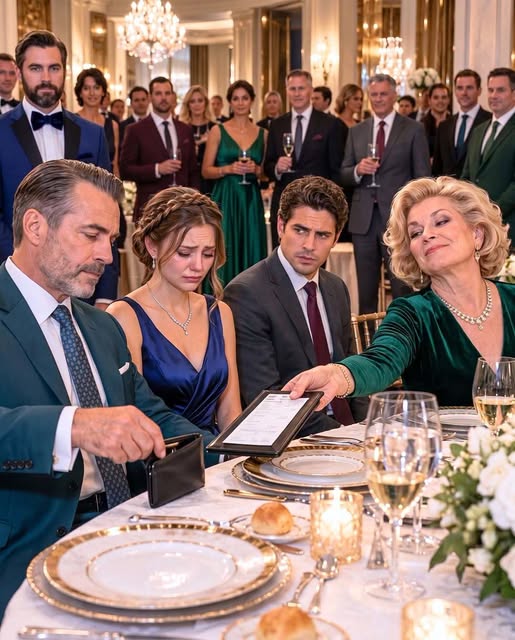
“If you want your daughter welcomed into my family, you’ll pay for it.”

The bill was placed directly in front of me after dessert, and the total at the bottom read $14,870. It covered thirty dinners, imported wine, champagne, and the private dining room Victoria Whitmore had insisted on booking for her sixtieth birthday.
She leaned back beneath the chandeliers with a satisfied smile.
For several seconds, nobody at the table moved. My daughter Emily went pale beside me, her fiancé Daniel lowered his eyes toward his plate, and Victoria added one final insult with a small laugh.
“Or perhaps you simply can’t afford it.”
A few relatives chuckled, but I looked only at Emily. Her expression made it clear that she wanted me to avoid a scene, so I stayed calm.
My name is Robert Hayes. I was fifty-eight, widowed, and apparently, in Victoria’s eyes, nothing more than a quiet suburban father who wore the same dark suit to every formal event.
For six months, she had repeatedly reminded Emily that our families were “different.” In Victoria’s language, different meant less wealthy, less connected, and ultimately less worthy of joining the Whitmores.
What she did not know was that I had spent thirty-two years building commercial real-estate companies and investing quietly. I deliberately avoided publicity, so when Victoria judged my ordinary car, conservative clothes, and habit of staying out of conversations about money, I allowed her to reach whatever conclusion she wanted.
That evening had supposedly been arranged to celebrate her birthday. Victoria had personally selected the restaurant’s largest private room, added guests at the last minute, upgraded the wine, and ordered whatever she wanted without once mentioning that I would be expected to pay.
Not until dessert.
Emily leaned toward her.
“You’re serious?”
Victoria smiled.
“Marriage joins families, darling. Your father should demonstrate commitment.”
Daniel finally tried to intervene.
“Mom, maybe this isn’t…”
“Stay out of it.”
What bothered me most was not the insult directed at me. It was the fact that Daniel obeyed.
I slowly reached toward my wallet while Victoria’s smile widened, but before I could take out a card, one of the waiters appeared beside my chair. He looked nervous enough that I immediately knew he had not come to ask how we enjoyed dinner.
“Mr. Hayes?”
“Yes?”
He leaned closer so only I could hear him.
“Sir, you need to come with me. Right now.”
Victoria laughed from across the table.
“Credit-card problem already?”
More laughter followed, but I simply stood and followed the waiter out of the private room. He led me past the kitchen doors and into the manager’s office, where the restaurant’s general manager, Marcus Bell, was waiting.
Marcus shut the door behind us and placed a printed reservation record on his desk.
“Mr. Hayes, I think you should read this before you pay anything.”
I studied the notes once, then read them again.
Victoria had not suddenly decided after dinner to embarrass me with the bill. Three weeks earlier, her assistant had instructed the restaurant to place the entire invoice beside my chair after dessert without discussing the charges with me beforehand.
There was another note beneath it.
If guest objects, Mrs. Whitmore will handle publicly.
I looked up at Marcus.
“She planned this?”
He nodded.
And that was when I realized the $14,870 bill was not the real problem.
Victoria had left a paper trail.
PART 2: THE TRAP SHE PUT IN WRITING
The reservation notes left very little room for interpretation. Victoria’s assistant had instructed the restaurant to order premium selections, present the final bill directly to me after dessert, and avoid mentioning the charges beforehand.
One line was especially clear.
If guest objects, Mrs. Whitmore will handle publicly.
Marcus turned the monitor toward me and showed me the email chain. Victoria had even asked whether the staff could place the invoice beside my chair in a way that would make the moment impossible to ignore.
She had upgraded the wine package twice and added more guests after the original reservation. By the time everything was calculated, the restaurant estimated that the evening would cost close to fifteen thousand dollars.
But Marcus had not called me into the office because of the amount.
“There’s something else.”
He pulled up the payment information Victoria had provided as backup for the reservation. The moment I saw the corporate account number, I recognized it.
Whitmore Development Group.
For almost a year, the company had been under financial pressure. I knew because my investment firm held the note on one of its largest commercial properties.
Victoria had no idea.
Her husband Charles had negotiated the financing through intermediaries, and my name had never appeared publicly because the debt was held through one of my companies. Three months earlier, Whitmore Development had violated a covenant tied to that financing, but we had chosen not to enforce it immediately while Charles tried to stabilize the business.
I stared at the account number again.
“Did they authorize company funds for this dinner?”
Marcus nodded.
“Her assistant said that if you refused to pay, we should charge the corporate account.”
For the first time that evening, I almost laughed. Victoria had spent three weeks designing a public humiliation for me and had accidentally provided written evidence that corporate money might be used for a private birthday dinner.
I asked Marcus to print every email and reservation note. Then I stepped into the hallway and called my attorney.
The conversation lasted less than five minutes.
When I returned to the private dining room, Victoria was still holding her champagne glass and wearing the same confident expression.
“Well?”
I sat down.
“Everything’s fine.”
Her eyebrows lifted.
“So you’re paying?”
I looked at the folded bill.
“Eventually.”
Victoria’s sister laughed, and Victoria leaned slightly toward me.
“I knew Emily had exaggerated your financial situation.”
Emily visibly flinched.
That was the moment the money stopped mattering to me. Fourteen thousand dollars would not damage my finances, but watching my daughter sit there while Victoria treated her like someone begging for entry into a superior family mattered far more.
I folded the bill neatly and placed it beside my plate.
“Victoria, how much do you actually know about your husband’s company?”
Her smile weakened.
“What an odd question.”
“Do you know who financed the Riverside Center acquisition?”
Charles looked up immediately.
Victoria waved one hand dismissively.
“Some investment group.”
Charles was no longer smiling.
“Hayes Capital Partners.”
Silence spread around the table.
Victoria blinked.
“I’ve never heard of them.”
Charles had.
His face changed the moment I reached into my jacket and removed a business card.
I placed it beside Victoria’s champagne glass.
ROBERT HAYES
CHAIRMAN
HAYES CAPITAL PARTNERS
Charles stared at the card and then at me.
“You’re Robert Hayes?”
“I am.”
Victoria gave a nervous laugh.
“That proves nothing.”
“You’re right.”
I glanced toward the restaurant office.
“But the emails your assistant sent tonight prove quite a lot.”
For the first time since the bill had been placed in front of me, Victoria stopped smiling.
PART 3: THE BILL WAS ONLY THE BEGINNING
Charles reached for the printed emails before Victoria could stop him. His eyes moved quickly across the pages, and the deeper he read, the more his expression changed.
“Victoria… what did you do?”
She snatched the papers back from him.
“It’s a birthday dinner.”
Charles lowered his voice, but everyone at the table could still hear him.
“You authorized the corporate account?”
“Only as backup.”
“That account is restricted.”
Several relatives suddenly became fascinated by their napkins. Victoria turned toward me instead, clearly trying to regain control of the conversation.
“This is ridiculous. You were supposed to pay.”
“Why?”
“Because your daughter is marrying into our family.”
Before I could answer, Emily pushed back her chair and stood. Her hands were trembling, but her voice did not disappear.
“No. I’m not buying my way into anything.”
Daniel immediately reached for her hand, and Victoria tried to stop him.
“Daniel, sit down.”
This time, he ignored her.
“Mom, you’ve gone too far.”
Victoria’s face hardened, but Charles cut her off before she could respond.
“Enough.”
I placed my phone on the table and explained that my attorney already had copies of the reservation instructions. The following morning, our compliance team would review whether corporate funds had been improperly pledged for a private expense.
Victoria stared at me.
“You wouldn’t.”
“I’m not doing anything to you. I’m enforcing the same rules your company already agreed to.”
Charles closed his eyes because he understood the consequences immediately. Whitmore Development was already in technical default, and my firm had been granting extensions while he tried to refinance several properties.
A compliance problem could change that patience very quickly.
Victoria’s arrogance finally gave way to fear.
“What do you want?”
It was the first respectful question she had asked me all evening.
“Nothing.”
She looked confused.
“I don’t want an apology that comes from fear, and I don’t want control over Daniel and Emily’s marriage.”
I turned toward my daughter.
“They get to decide what kind of family they want.”
Then I looked back at Victoria.
“But you will never humiliate my daughter again and call it tradition.”
The bill was still lying between us.
I picked it up.
Victoria watched closely, probably expecting me to pay after all.
Instead, I handed it to Charles.
“Your wife booked the dinner. The corporate account cannot legally be used. How you pay for it personally is your decision.”
Victoria’s anger returned instantly.
“You said you could afford it!”
“I can.”
I stood.
“That doesn’t make it mine.”
Emily rose beside me.
Daniel hesitated for only a second before standing with her.
And then the three of us walked out together, leaving Victoria at the table with the bill she had designed as a weapon.
Three weeks later, Whitmore Development’s board opened an internal review after discovering that the birthday dinner was not the only personal event for which Victoria had used company resources. What she had treated as harmless entitlement had become a pattern nobody inside the company could ignore.
PART 4: WHAT HAPPENED AFTER WE WALKED OUT
Three weeks after the dinner, Whitmore Development’s board formally opened an internal review. The investigation quickly showed that Victoria had used company resources for several personal events, not just the birthday dinner, which made it impossible for Charles or anyone else to dismiss what happened as a one-time mistake.
The consequences reached her faster than she expected. Victoria lost her unofficial role within the company and was removed from all corporate accounts, while Charles eventually sold their vacation property to reduce debt and help stabilize the business.
For the first time, the Whitmores had to deal with the financial reality they had spent years hiding behind appearances. Victoria had always acted as though status could protect her from consequences, but this time there was no private room, expensive dress, or family name strong enough to erase the paperwork.
The wedding changed too.
Emily and Daniel abandoned the grand ballroom plans, the society photographers, and almost everything Victoria had originally insisted on. Six months later, they married at a small lakeside venue with only forty guests, surrounded by people they genuinely wanted there.
Victoria attended.
She stayed quiet.
I noticed the difference immediately. There were no comments about family prestige, no instructions disguised as tradition, and no attempts to measure anyone by money or social connections.
After dinner, she approached me alone.
“I misjudged you.”
“Yes.”
She waited as though she expected me to make the moment easier for her. Perhaps she wanted forgiveness, reassurance, or some polite sentence telling her that everything was behind us.
I gave her nothing.
Not because I wanted revenge, but because I no longer felt responsible for relieving the discomfort created by someone else’s choices. Victoria had spent months treating Emily as though marriage into her family were some kind of privilege that had to be purchased, and one quiet acknowledgment did not erase that.
A year later, Emily called me on a Sunday morning.
“Dad?”
“Yeah?”
“I finally understand why you didn’t yell that night.”
I smiled.
“Why?”
She paused before answering.
“Because people like Victoria expect anger. They know how to fight anger.”
Then her voice softened.
“They don’t know what to do with someone who keeps the receipts.”
I looked across my backyard with a cup of coffee in my hand and thought about the dinner again. Victoria had expected humiliation, confrontation, and eventually surrender, but she had never considered the possibility that I would simply let her own decisions speak for themselves.
For years, she had mistaken my silence for weakness because I rarely discussed money, never corrected her assumptions, and did not compete for attention. What she learned that night was that silence and helplessness are not the same thing.
I never needed to destroy Victoria.
I never needed to embarrass her the way she tried to embarrass me.
I only stopped protecting her from the consequences of what she had chosen to do.
PART 5: THE DIFFERENCE BETWEEN SILENCE AND WEAKNESS
The months after the wedding gave me plenty of time to think about that dinner and everything that followed. Victoria had spent years measuring people by what they displayed openly, so my quiet manner, ordinary clothes, and refusal to discuss money had convinced her that I had little influence and even less power.
She had built her entire plan around that assumption. The public bill, the laughter, the comments about whether I could afford it, and even the instruction to charge Whitmore Development’s corporate account if I refused were all based on her belief that I would either pay in embarrassment or react angrily enough for her to dismiss me as unreasonable.
Instead, I did neither.
I let the documents speak.
That was the part Victoria never anticipated. She understood status, confrontation, and appearances, but she did not understand what happened when someone calmly followed the paper trail she had created herself.
By the time Whitmore Development reviewed the birthday reservation and the other personal events tied to company resources, the situation no longer depended on my opinion of her. The issue had become one of records, company rules, and decisions Victoria had made in writing.
That distinction mattered to me.
I had no interest in controlling Victoria’s future, damaging Daniel’s relationship with his parents, or making Emily choose sides. The only thing I wanted was for my daughter to stop being treated like someone who needed to earn her place in another family.
At the restaurant, I had told Victoria exactly that.
“They decide what family they want.”
For me, that was the center of everything. Emily and Daniel’s marriage belonged to them, not to Victoria, not to Charles, and certainly not to me.
Their smaller lakeside wedding proved they understood that. They stripped away the ballroom, the social expectations, and the elaborate display Victoria had wanted, then celebrated with forty people they actually chose to have around them.
When Victoria approached me afterward and admitted she had misjudged me, I did not rush to make her feel better.
“I misjudged you.”
“Yes.”
That was enough.
A year later, Emily finally explained what she had taken from that night.
“Dad, I finally understand why you didn’t yell.”
“Why?”
“Because people like Victoria expect anger. They know how to fight anger.”
Then she added the part that stayed with me.
“They don’t know what to do with someone who keeps the receipts.”
She was right.
Victoria had mistaken silence for weakness because silence had always given her room to make assumptions. What she learned that night was that a person can remain calm without surrendering and can refuse humiliation without creating a spectacle.
I never needed to ruin her.
I only stopped shielding her from the consequences of her own choices.
For years, Victoria had believed power meant making other people uncomfortable until they gave in. That dinner taught her something different.
Sometimes the strongest response is not louder than the insult.
Sometimes it is simply documented.