My Husband Stopped His Mother, Then Asked My Mother One Question

The security officers entered before my mother-in-law could reach the door.
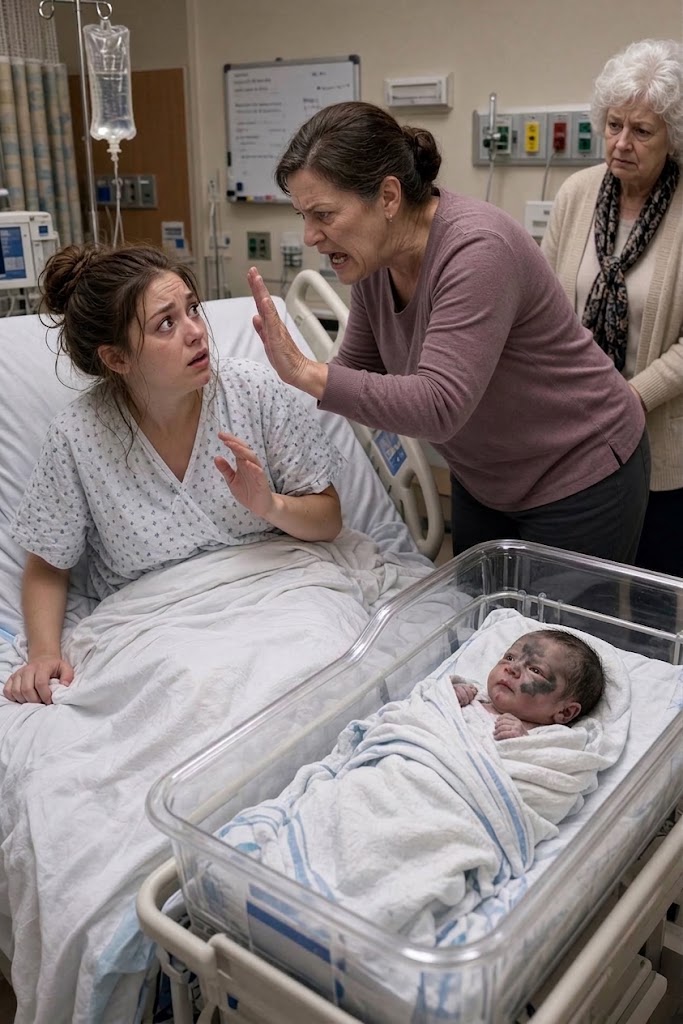
My husband pointed toward her and told them exactly what the charge nurse had confirmed: she had deliberately covered our newborn son in an unknown black substance while I was
unconscious.
For the first time since I had opened my eyes, his mother stopped shouting.
She tried to call it a misunderstanding. Then she said she had been frightened. Then she insisted she had only wanted her son to see the baby before anyone could clean him.
The charge nurse did not let her rewrite the moment.
“This incident is being documented,” she said. “You are not permitted to remain on the maternity floor.”
My mother-in-law looked at my husband as if he were supposed to rescue her.
Instead, he said, “Take her out.”
She stared at him.
“You’re choosing her over your own mother?”
He looked past her toward our son, who was being carefully cleaned beside my bed.
“I’m choosing my wife and child over the person who did this to them.”
Security escorted her into the hallway while she protested that she had only been trying to protect him.
The door closed.
For several seconds, nobody spoke.
Then my mother stepped toward my bed.
She had been silent since the nurse wiped the first streak of black pigment from my baby’s ankle. Her face was wet with tears, and the hand that had slapped me earlier was trembling at her side.
She whispered my name.
My husband moved between us.
“No,” he said. “You don’t get to hug her yet.”
My mother stopped.
He pointed toward the chair across from my bed.
“Sit down. Now tell my wife why you hit her before you even asked what happened.”
My mother lowered herself into the chair.
I looked at her, still unable to understand how quickly she had turned against me.
Twenty-nine years of knowing me had disappeared behind one accusation from another woman.
“I thought…” My mother swallowed. “I thought your husband’s mother was telling the truth.”
“About what?” I asked.
She looked toward the bassinet.
“That the baby wasn’t…”
She couldn’t finish.
My husband’s jaw tightened.
“Wasn’t what?”
My mother started crying harder.
“She said the baby didn’t look like your husband. She said something was wrong. She said your wife had deceived everyone.”
I stared at her.
“You believed that because she said it?”
“I was shocked.”
“You hit me because you were shocked?”
My mother covered her face.
“I was wrong.”
The words should have comforted me.
They didn’t.
Because the slap wasn’t the only thing hurting.
I had spent the first minutes of my son’s life surrounded by people who had already decided what I had done before anyone had bothered to ask me.
The nurse returned with my son after the examination and cleaning.
His skin was clean now. The dark pigment was gone from his cheeks and fingers. A small patch near his ankle was still being checked, but his breathing was steady, and the nurse told us there was
no immediate sign of serious injury.
I began crying again when she placed him against my chest.
My husband stood beside the bed with one hand resting gently on my shoulder.
My mother watched from the chair.
Then the charge nurse came back.
She carried a sealed bag containing the gauze, the blanket and the material removed from my son’s skin.
“We’re preserving what was found,” she said. “The hospital will complete its report.”
My husband nodded.
My mother looked at the sealed bag.
“What was it?” she asked.
“We don’t know yet.”
That answer changed something in the room.
Until then, my mother had been treating the whole thing like a family argument that had gotten out of control.
Now she understood that an unknown substance had actually been placed on a newborn child.
She looked at me.
“I should never have hit you.”
“No,” I said quietly. “You shouldn’t have.”
She nodded through her tears.
My husband didn’t say anything.
He didn’t need to.
The hospital had already documented what happened. The nurses had seen the pigment come away on the gauze. Security had removed his mother from the floor. There was no longer any room
for the accusation to survive simply because someone had shouted it loudly enough.
But one question remained.
Why had his mother done it?
My husband seemed to be asking himself the same thing.
He stepped into the hallway and made a phone call.
When he returned, his expression had changed.
“What?” I asked.
He sat beside me.
“She called my sister before she came here.”
I waited.
“She told her she was going to prove something about the baby.”
My stomach tightened.
“What exactly did she say?”
“She didn’t say what the substance was. But she told my sister she had been watching the baby since we announced the pregnancy.”
I looked down at my son.
Watching.
The word made the room feel colder.
My husband continued.
“She also told my sister she had already decided the baby wasn’t mine before he was born.”
My mother looked up sharply.
“So she planned this?”
He nodded.
“That’s what it sounds like.”
I remembered my mother-in-law’s words beside the bassinet.
Your husband needs to see what you’ve done.
She hadn’t been confused.
She hadn’t discovered something by accident.
She had arrived with a conclusion already formed and used our newborn son as the object she believed would prove it.
My husband leaned forward, elbows on his knees.
“I should have stopped her sooner,” he said.
I reached for his hand.
“You weren’t in the room.”
“I left you with my mother because I thought you were safe.”
“You couldn’t have known.”
He looked at our son.
“I know that now.”
A nurse came in again to check the baby’s vital signs.
Everything remained stable.
That was the first real relief I had felt since waking up.
But the family problem had not disappeared.
My mother was still sitting across from me.
She hadn’t left.
After several minutes, she finally spoke.
“There is something else.”
My husband looked at her.
My mother twisted her hands together.
“Your mother called me before the birth.”
I felt my chest tighten.
“When?”
“A few days ago.”
“What did she want?”
My mother hesitated.
“She wanted me to watch you.”
My husband stood.
“What does that mean?”
“She said you had become distant. She said your wife was controlling you. She said I should pay attention to whether she acted nervous when people mentioned the baby.”
I stared at my mother.
She looked ashamed.
“I didn’t tell you because I thought she was being dramatic.”
“But you listened.”
“Yes.”
“And when she accused me today, you believed her.”
My mother nodded.
“I did.”
That honesty hurt more than another excuse would have.
My husband looked toward the hallway where his mother had disappeared.
“She was building a story before our son was even born.”
Nobody answered him.
Then my phone buzzed on the bedside table.
My husband picked it up because I couldn’t easily reach it.
There were several missed calls.
All from his mother.
Then another message appeared.
He read it once and went completely still.
“What?” I asked.
He handed me the phone.
The message was short.
She had written that if he wanted the truth, he needed to check something she had left at home.
Underneath that was an address.
Our address.
My husband looked at me.
“I don’t want to leave you here alone.”
“You’re not leaving me alone.”
The nurse immediately stepped in.
“You don’t have to go anywhere tonight. If there is something at your home that concerns you, let someone else retrieve it.”
My husband nodded.
He called his sister.
She agreed to go to the house with a family friend and check what his mother had left behind.
While they were gone, I held our son.
My mother remained in the chair.
For a long time, she said nothing.
Then she stood.
“I know saying sorry isn’t enough.”
I looked at her.
“No, it isn’t.”
She nodded.
“I’ll accept whatever you need from me.”
I didn’t know what that would be yet.
Trust wasn’t something I could switch back on because the truth had finally become obvious.
My mother had slapped me.
My mother-in-law had humiliated my newborn.
And my husband had been forced to choose whether his family name mattered more than the people lying in that hospital room.
He had chosen us.
That mattered.
But it couldn’t erase what had happened.
An hour later, his sister called.
My husband answered on speaker.
“We found something,” she said.
My husband straightened.
“What?”
“There are photographs.”
“Of what?”
“A lot of them.”
My stomach dropped.
His sister continued.
“Photos of the baby things. The nursery. The hospital bag. Your wife sleeping in the living room a few weeks ago. Even screenshots of messages between you two.”
My husband closed his eyes.
“Anything else?”
“Yes.”
His sister hesitated.
“There’s a notebook.”
“What does it say?”
“I haven’t read all of it.”
“Read the important part.”
A long silence followed.
Then his sister said, “She wrote that the baby had to be exposed before you signed the birth paperwork.”
My husband looked at me.
The room went silent.
The accusation had never really been about appearance.
His mother had been trying to create doubt before the family record was finalized.
She had decided that if she could make him question me at the most vulnerable moment of my life, she could control what happened next.
But she had made one mistake.
She had done it in a hospital room filled with witnesses.
She had left physical evidence behind.
And she had done it while my husband was only minutes away.
He reached for my hand.
“I believe you,” he said.
I squeezed his fingers.
“I know.”
The next morning, the hospital finished its documentation and the pediatric team cleared our son to remain with us.
My mother-in-law was not allowed back onto the maternity floor.
My mother left only after asking whether she could visit again another day.
I told her I needed time.
She accepted that answer.
There was no dramatic reconciliation.
No speech fixed everything.
There was simply a woman who had made a terrible choice and a daughter who wasn’t ready to pretend it hadn’t happened.
My husband stayed beside me.
Before we left the hospital, he looked down at our son and then at me.
“I thought the hardest part of becoming a father would be the delivery,” he said.
Despite everything, I almost smiled.
“The delivery was easier than this.”
He gave a tired laugh.
Then he became serious again.
“I should have protected you before anyone had to ask me to.”
I shook my head.
“You protected us when it mattered.”
He looked at our son.
Then he looked toward the hospital door.
“No one gets to use him to hurt you again.”
This time, I believed him.
We left the hospital together with our baby between us.
Behind us were the reports, the photographs, the notebook and the family members who would now have to live with what they had done.
Ahead of us was something much harder than proving who had been right.
We had to decide who could still be trusted around our child.
And that decision would not be made because someone cried, apologized or shared our blood.
It would be made by what they did next.