PArt 2: Eleven dollars and forty cents was everything I had t1
PART 2
Nineteen years later, I stood outside the iron gates of the address Daniel Mercer had written on the back of that business card.
The card was still in my wallet.
The corners had softened with age. The black ink had faded to gray. I had moved apartments seven times, survived medical school, residency, fellowship, night shifts that blurred into morning rounds, and enough emergencies to understand how quickly a life could change.
But I had never thrown that card away.
Maybe because it reminded me of the cold December night when a stranger bought formula for two babies who had no idea how close they were to going hungry.
Maybe because it reminded me of the promise I had made.
“When I’m grown up, Mr. Mercer, I’ll repay you for more than the formula.”
At ten years old, I had not known what that meant.
At twenty-nine, I finally did.
Rain streaked across the windshield of my rental car as the gates opened.
I drove slowly up a long private road lined with bare winter trees.
The Mercer estate was enormous, but it did not look like a home where anyone was celebrating wealth.
Every downstairs light was burning.
Three black vehicles were parked near the entrance.
A man in a dark coat stood beneath the stone portico, waiting before I had even stopped the car.
Daniel Mercer.
I recognized him immediately.
He was older, of course.
Silver threaded the dark hair at his temples. Deep lines framed his eyes. His shoulders seemed heavier than I remembered, as though the years had placed something invisible across them.
But the eyes were the same.
Sharp.
Watchful.
And tonight, terrified.
I stepped out of the car with my medical bag.
Daniel stared at me.
“Lily?”
It was not a question.
“You remember me.”
His eyes dropped toward my hand.
I had not realized I was holding the old business card.
Daniel gave a strange, almost broken laugh.
“You kept it.”
“I told you I would remember your face.”
For one second, the feared Daniel Mercer disappeared.
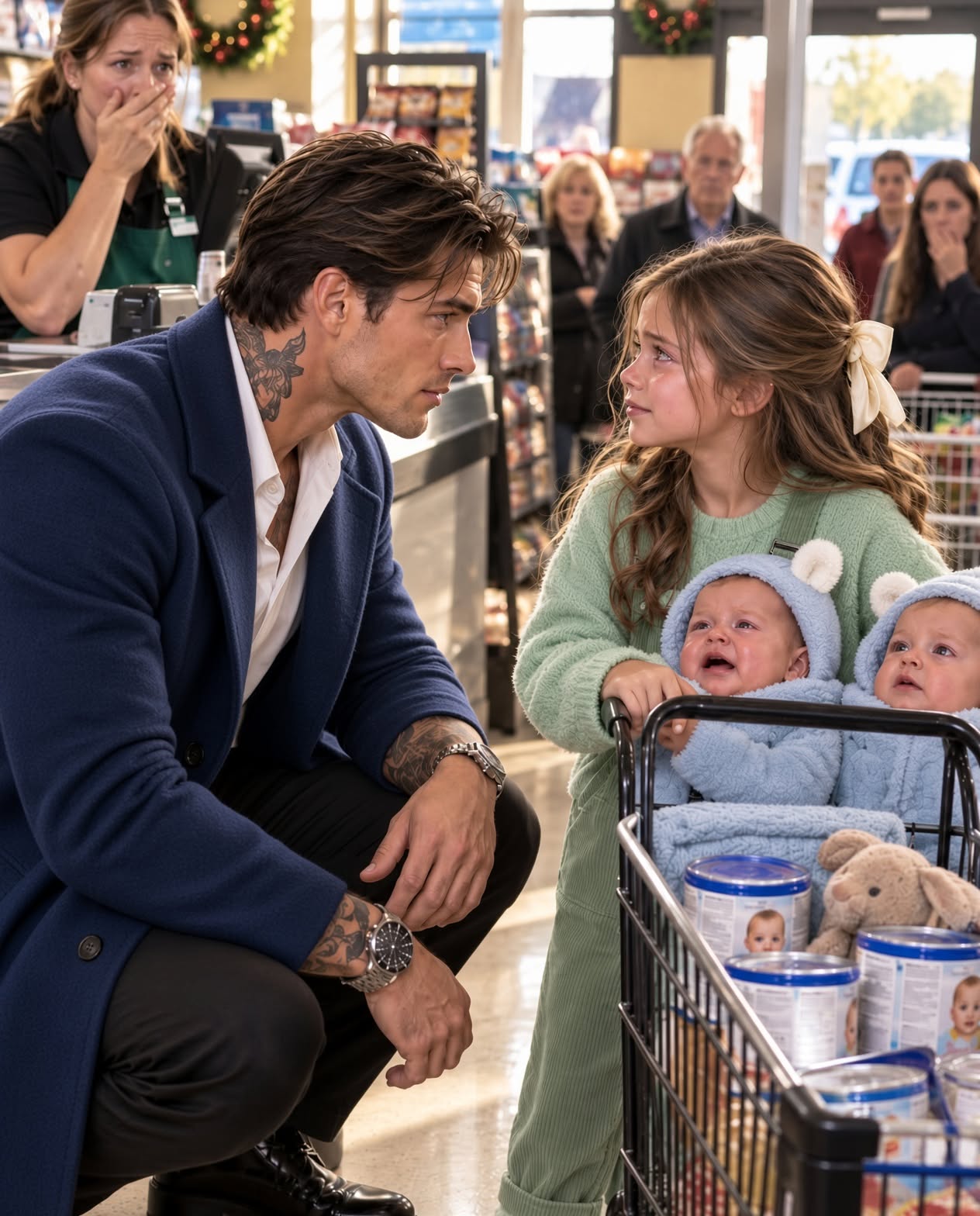
In his place stood the man who had crouched beside a ten-year-old girl in a grocery store and pretended not to notice how ashamed she was.
Then his expression hardened again.
Not with anger.
With urgency.
“Come inside.”
I followed him through a marble entrance hall.
Two employees moved silently near the staircase.
A doctor I recognized from Pittsburgh General stood beside a table covered in medical folders.
Dr. Nathan Ross.
He had called me less than six hours earlier.
“Dr. Carter,” he said, relief flashing across his face. “Thank God.”
Daniel looked between us.
“You know each other?”
“By reputation,” Nathan said.
I took off my wet coat.
“Where is Sophie?”
“Upstairs,” Daniel replied.
“How long since the last episode?”
“Forty-three minutes.”
“What happened?”
“She lost consciousness.”
“For how long?”
“Seventeen seconds.”
“You timed it?”
“I time everything now.”
His answer told me more than he probably intended.
Fear had turned Daniel Mercer into a father who counted breaths.
Nathan handed me a folder.
“Sophie Mercer. Twelve years old. Recurrent syncope. Severe congenital cardiac abnormality involving the left ventricular outflow tract and an unusually positioned coronary artery. The latest imaging revealed additional obstruction.”
I flipped quickly through the scans.
My stomach tightened.
This was worse than Nathan had described over the phone.
“Who evaluated her?”
“Three teams.”
“And?”
“Two said surgery was too risky.”
“The third?”
Nathan glanced at Daniel.
“They recommended transplant assessment.”
Daniel’s jaw clenched.
“But she may not have time to wait,” I said.
“No,” Nathan answered.
Silence settled over the room.
Daniel watched me study the scans.
I had spent most of my adult life preparing for cases like this.
Not because they were dramatic.
Because they were difficult enough that hesitation could kill someone.
“How stable is she right now?”
“Stable enough to transfer,” Nathan said.
“Then she needs to be in the hospital tonight.”
Daniel stepped forward.
“Can you operate?”
I looked at him.
“I can evaluate whether I should.”
“That wasn’t my question.”
“It’s the only responsible answer I can give you.”
His expression tightened.
I understood why people feared him.
He was used to people moving when he spoke.
Used to money turning impossible things into solvable things.
But medicine had never respected power.
“I can give you anything,” he said quietly. “Equipment. Staff. Money. Whatever you need.”
“I need none of that.”
“Then tell me what you need.”
“Time to examine your daughter.”
His face changed instantly.
“Of course.”
We climbed the staircase.
Sophie Mercer’s bedroom was at the end of a long hallway.
I expected luxury.
Instead, I found what looked like the room of an ordinary twelve-year-old girl.
Books stacked beside the bed.
A half-finished astronomy puzzle.
A purple sweater hanging over a chair.
Photographs taped around a mirror.
Sophie was sitting against several pillows, a portable monitor beside her.
She was pale.
Too pale.
But when she saw me, she smiled.
“You’re Dr. Carter.”
“I am.”
“My dad has been staring out the window for an hour waiting for you.”
Daniel looked mildly offended.
“I was not staring.”
“You absolutely were.”
Despite everything, I smiled.
Sophie noticed the medical bag.
“Are you going to tell me I’m too complicated too?”
The question hit harder than I expected.
Children listened.
Even when adults whispered.
Especially when adults whispered.
I pulled a chair beside her bed.
“I’m going to tell you the truth.”
She studied me carefully.
“Okay.”
“You have a serious problem with your heart.”
“I know.”
“Fixing it will be difficult.”
“I know that too.”
“But difficult is not the same as impossible.”
Her eyes widened slightly.
Behind me, Daniel stopped breathing for a second.
Sophie swallowed.
“So you’ll do it?”
“I haven’t decided yet.”
Her smile vanished.
I leaned closer.
“That’s because I need to make the right decision, not the fast one.”
She looked toward her father.
“Dad always wants the fast one.”
“I’m learning,” Daniel said.
“No, you’re not.”
A tiny smile returned to her face.
I listened to her heart, checked her pulse, reviewed her symptoms, then asked questions about dizziness, chest pressure, breathing, fatigue.
She answered all of them with unnerving maturity.
“When did this start getting worse?” I asked.
“About six months ago.”
“And before that?”
“I got tired sometimes.”
Daniel spoke from behind me.
“She never told me.”
Sophie looked embarrassed.
“You were busy.”
“I’m never too busy for you.”
“You were.”
The room went quiet.
Daniel looked as if she had slapped him.
Sophie immediately stared at her blanket.
“I didn’t mean—”
“Yes, you did,” Daniel said softly.
His voice changed.
“I should hear it.”
I glanced at him.
This was not the man people whispered about in boardrooms.
This was a father realizing money had not prevented his daughter from feeling alone.
I finished the exam.
“Pack an overnight bag,” I told Sophie. “We’re going to Pittsburgh Children’s.”
Her eyes widened.
“Tonight?”
“Tonight.”
Daniel stepped toward me.
“Does that mean—”
“It means I’m taking the case.”
His entire face changed.
Then I held up a hand.
“Do not thank me yet.”
He nodded.
“Understood.”
“The surgery will be dangerous.”
“I understand.”
“No, you don’t.”
He went still.
“I need you to understand this clearly. There are anatomical complications that make standard correction unsafe. There is a real possibility that once I begin, I may discover conditions that force me to change the plan.”
Daniel’s eyes stayed fixed on mine.
“Can she survive it?”
“Yes.”
“And if you do nothing?”
I looked at Sophie.
Then back at him.
“She will continue getting worse.”
That was enough.
Daniel turned toward the hallway.
“Car in five minutes.”
Sophie groaned.
“Dad.”
“What?”
“I need more than five minutes.”
“You need pajamas.”
“I need my laptop.”
“No.”
“My books.”
“One.”
“My blue blanket.”
“Yes.”
“My astronomy notebook.”
“Yes.”
“My—”
I stepped between them.
“Ten minutes.”
Sophie smiled triumphantly.
Daniel muttered something under his breath.
For the first time that night, the house almost felt normal.
I was packing my instruments when Sophie called my name.
“Dr. Carter?”
I turned.
She was holding something.
A photograph.
Small.
Old.
Its edges curled.
“I found this in Dad’s office last year.”
Daniel froze.
“Sophie.”
“What?”
“That’s private.”
“You told me private things shouldn’t be left in unlocked drawers.”
“That was not the lesson.”
She handed me the photograph anyway.
And the moment I looked at it, every sound in the room disappeared.
It was Daniel.
Nineteen years younger.
Standing outside Mercer Market.
Beside him was a woman I recognized immediately.
My mother.
Rachel Carter.
And in her arms were two newborn babies.
Owen and Noah.
My hands began shaking.
I looked again.
Maybe I was wrong.
Maybe grief had rearranged my memory.
But no.
It was her.
Same auburn hair.
Same pale freckle near her left eyebrow.
Same tiny crescent necklace she wore in every photograph Aunt Rebecca kept.
My mother had died when I was nine.
At least, that was what I had been told.
But this photograph had been taken when my brothers were infants.
Months after her supposed death.
I lifted my eyes.
“Where did you get this?”
Sophie’s smile vanished.
“Dad?”
Daniel looked as if the floor had shifted beneath him.
“Lily.”
“Where did you get this?”
His gaze moved to Sophie.
“Go pack.”
“No.”
“Sophie.”
“You always say secrets make things worse.”
Daniel closed his eyes.
For a man famous for winning negotiations, he suddenly looked cornered by a twelve-year-old.
I stepped toward him.
“That woman is my mother.”
“I know.”
My chest tightened.
“You knew my mother?”
“Yes.”
“How?”
Daniel didn’t answer.
I held up the photograph.
“She died before my brothers were born.”
“No.”
The word was barely audible.
I stared at him.
“What did you say?”
“She didn’t.”
I felt cold.
Not the ordinary kind.
The kind that begins beneath your ribs.
“My aunt told me she died in a highway accident.”
Daniel’s face darkened.
“That was what Rebecca was told too.”
I took another step.
“Stop talking like this is some puzzle. Tell me what happened.”
He glanced toward Sophie.
“Not here.”
“Here is fine.”
“Lily.”
“Nineteen years ago, you happened to be standing in a supermarket when I couldn’t afford formula. You gave me a card with this address on it. Now I arrive here and your daughter hands me a picture of you with my supposedly dead mother and my baby brothers.”
My voice broke.
“You are going to explain.”
Daniel rubbed a hand over his face.
Then he walked to the window.
For several seconds, he said nothing.
Finally, he spoke.
“Your mother came to me because she was afraid.”
“Of whom?”
“She didn’t say at first.”
“Why you?”
“We knew each other.”
“How?”
Daniel turned.
“Rachel worked for one of my companies.”
“That’s impossible.”
“It isn’t.”
“She was a nurse.”
“She was.”
He paused.
“And she did contract medical work for several industrial sites I owned.”
I tried to process it.
“Why did she bring Owen and Noah to you?”
“Because she believed someone was following her.”
Sophie sat silently on the bed.
My heart pounded.
“What happened?”
“She asked me to help her disappear for forty-eight hours.”
“Disappear?”
“She said she needed time to prove something.”
“What?”
Daniel looked toward the photograph.
“I still don’t know.”
“That makes no sense.”
“I agree.”
“You expect me to believe my mother survived an accident, secretly gave birth to twins, came to you for protection, and then vanished?”
“No.”
His answer stopped me.
“I expect you to believe something worse.”
The room seemed to shrink.
Daniel continued.
“Your mother had already given birth when she came to me. She brought Owen and Noah because she believed they were in danger.”
“What about me?”
His eyes met mine.
“You were the reason she was terrified.”
I felt the breath leave my body.
“What?”
“She kept saying your name.”
My knees weakened.
“She said, ‘If they find Lily, everything is over.’”
I gripped the edge of the chair.
“Who is ‘they’?”
“I never found out.”
“You’re lying.”
“I’m not.”
“You’re Daniel Mercer.”
The name came out sharper than I intended.
“People said you knew everything happening in Pittsburgh.”
“People exaggerated.”
“Did they?”
His expression hardened.
“I had influence. That does not mean I controlled every criminal, every official, every company, every person with money and secrets.”
“So what happened to her?”
Daniel did not answer quickly enough.
I already knew the next sentence would hurt.
“She disappeared.”
“When?”
“The night after that photograph was taken.”
“And you never saw her again?”
“No.”
“Did you look?”
“For years.”
My throat tightened.
“And my brothers?”
“She left them with Rebecca.”
“How?”
“An attorney arranged it.”
“Aunt Rebecca never told me this.”
“She didn’t know Rachel was alive.”
“That’s impossible.”
“She believed the babies had been placed temporarily by social services after Rachel’s death.”
I stared at the floor.
Memories crashed into one another.
Aunt Rebecca crying at the kitchen table.
Owen and Noah sleeping in laundry baskets because we could not afford cribs.
Bills piled beneath magnets on the refrigerator.
My childhood built around a story that might never have been true.
I looked at Daniel.
“And the supermarket?”
He looked away.
That told me everything.
“You were waiting for me.”
“Yes.”
The word landed like a stone.
“Why?”
“Because I had promised your mother I would watch you.”
My eyes burned.
“You watched me struggle?”
Daniel flinched.
“You watched a ten-year-old walk through snow carrying two infants?”
“Yes.”
“You watched me ask a cashier if I could owe seven dollars?”
His jaw tightened.
“Yes.”
Anger erupted through me.
“You could have helped us.”
“I tried.”
“No. You bought groceries once.”
“I did more than that.”
“What?”
“Your aunt’s rent was paid anonymously for fourteen months.”
I froze.
“What?”
“The heating bill that winter.”
My mouth went dry.
“The landlord suddenly canceled the eviction.”
“Yes.”
“The scholarship fund in high school.”
“Yes.”
I stared at him.
“No.”
“The hospital volunteer program.”
“No.”
“The medical school grant.”
“Stop.”
“Lily—”
“Stop!”
Sophie jumped.
I immediately lowered my voice.
Daniel stayed completely still.
“You followed me my entire life?”
“I made sure doors were open.”
“You manipulated my life.”
“I never chose the doors you walked through.”
“You paid for them.”
“Sometimes.”
“That is not the same thing?”
“No.”
His answer surprised me.
“You earned every place you reached. I only made sure money didn’t close the door first.”
I wanted to hate him.
Part of me did.
But another part remembered studying at two in the morning while working weekend shifts.
No anonymous donor had taken my exams.
No mysterious billionaire had held my hand during residency.
I had earned my career.
Still, the violation was real.
“You should have told me.”
“I wanted to.”
“When?”
“Every year.”
“That’s convenient.”
“It’s true.”
“Why didn’t you?”
Daniel looked toward Sophie.
“Because Rachel made me promise I wouldn’t.”
My anger faltered.
“What exactly did she say?”
He walked to a desk and opened the bottom drawer.
From inside, he removed a sealed plastic envelope.
Old paper rested within it.
My name was written across the front.
LILY.
The handwriting was my mother’s.
I knew it instantly.
My legs nearly gave way.
“Where did you get that?”
“She gave it to me.”
“When?”
“The day before she disappeared.”
I reached for it.
Daniel pulled it back.
“What are you doing?”
“She gave me instructions.”
I stared at him in disbelief.
“You have had a letter from my mother for nineteen years and you’re talking about instructions?”
His voice dropped.
“She told me not to give it to you unless two things happened.”
“What things?”
“You became old enough to protect yourself.”
“I’m twenty-nine.”
“I know.”
“And the second?”
Daniel looked at Sophie.
His face went pale again.
“She said the second condition would be obvious.”
I felt dread crawl across my skin.
“What does that mean?”
“I didn’t understand either.”
Then Sophie spoke.
“Dad?”
We both turned.
She was holding the photograph again.
Her brows were drawn together.
“Who’s that?”
She pointed to the far right edge.
I had been so focused on my mother and the babies that I had not noticed the reflection in the market window behind them.
A man stood across the street.
Only part of his face was visible.
Daniel took the photograph.
Every trace of color left him.
“No.”
“What?” I asked.
He moved closer to the lamp.
“No.”
“Who is he?”
Daniel stared at the reflection.
Then he looked at me.
“This photograph was taken nineteen years ago.”
“I know.”
“That man should not be there.”
“Why?”
“Because he was declared dead three years before this picture was taken.”
A chill went through me.
“Who is he?”
Daniel’s fingers tightened around the photograph.
“Elias Voss.”
The name meant nothing to me.
But Nathan, standing quietly in the doorway, suddenly dropped the medical folder he was holding.
Everyone turned.
Daniel’s eyes narrowed.
“You know that name?”
Nathan’s face had gone white.
“No.”
Daniel took one step toward him.
“You reacted.”
“I’ve heard it.”
“Where?”
Nathan swallowed.
“In medical records.”
I frowned.
“What kind of records?”
Nathan looked at me, then at Sophie.
“I shouldn’t discuss this here.”
“Discuss what?”
He hesitated.
Then said the sentence that changed everything.
“Elias Voss is listed as the biological father of Sophie Mercer.”
The room went silent.
Daniel’s expression became unreadable.
Sophie stared at Nathan.
“My father is right there.”
Nathan looked horrified.
“I meant genetically.”
Daniel crossed the room.
“What did you say?”
“I reviewed her emergency genetic screening.”
“You told me there was an irregularity.”
“There is more than an irregularity.”
Nathan opened the folder with shaking hands.
“There are restricted files attached to Sophie’s profile.”
“Restricted by whom?”
“I don’t know.”
I took the papers.
“Show me.”
Nathan pointed to a code.
I recognized it.
Not from cardiac surgery.
From a federal research database I had encountered during fellowship.
My stomach tightened.
“This is impossible.”
Daniel looked at me.
“What?”
I scanned the page.
“Sophie’s genetic profile was flagged years ago.”
“Why?”
“Because it matched another archived profile.”
Daniel’s voice became dangerously calm.
“Whose?”
I followed the identification line.
Then stopped.
My hands began trembling again.
The archived profile did not belong to Elias Voss.
It belonged to someone named Rachel Carter.
My mother.
I read the result twice.
Then a third time.
Sophie moved closer.
“What does it say?”
I couldn’t answer.
Daniel took the page from me.
His eyes moved across the numbers.
He did not understand the terminology.
But he understood percentages.
His gaze lifted.
“What does ninety-nine point eight mean?”
I looked at Sophie.
Then at Daniel.
“It means Sophie and my mother share an immediate biological relationship.”
“What kind?”
“I don’t know yet.”
Daniel’s voice broke.
“Could Rachel be her mother?”
“No. The pattern doesn’t fit.”
“Then what fits?”
I stared at the data.
There were only a handful of possibilities.
None of them made sense.
Before I could speak, my phone rang.
Unknown number.
I almost ignored it.
Then I noticed the Pittsburgh area code.
Something made me answer.
“Dr. Carter.”
Silence.
Then breathing.
Slow.
Uneven.
“Hello?”
A woman whispered my name.
“Lily?”
Every hair on my arms rose.
“Who is this?”
The breathing became shaky.
Then came a voice I had not heard since childhood.
A voice I remembered singing while washing dishes.
A voice I remembered reading bedtime stories while rain tapped the windows.
A voice that belonged to a woman I had mourned for twenty years.
“Baby,” she whispered, “don’t let Daniel open that letter.”
I stopped breathing.
Daniel stared at me.
My fingers went numb around the phone.
“Mom?”
Sophie gasped.
The line crackled.
Then my mother spoke again.
“They know you found him.”
“Found who?”
“The man in the photograph.”
“Elias Voss?”
A sharp inhale.
“Listen to me carefully.”
“Where are you?”
“There isn’t time.”
“There has been nineteen years!”
My voice cracked.
“Tell me where you are!”
“I will.”
“When?”
“When Sophie is safe.”
I looked at Daniel’s daughter.
“What does Sophie have to do with you?”
Silence.
Then my mother whispered something I would replay in my head for the rest of my life.
“Sophie was never supposed to survive past twelve.”
The call ended.
I stared at the phone.
No one moved.
Then Sophie’s cardiac monitor began shrieking.
Her knees buckled.
“Sophie!”
Daniel caught her before she hit the floor.
Her eyes rolled back.
Her skin turned gray.
I dropped beside her.
“No pulse.”
Nathan was already moving.
“Call an ambulance!”
“No time,” I snapped. “Bring the emergency kit.”
Daniel held his daughter’s hand.
“Sophie! Baby, stay with me!”
I began compressions.
One.
Two.
Three.
Everything else disappeared.
The photograph.
My mother.
The letter.
Elias Voss.
All of it.
There was only the child beneath my hands.
“Pads!”
Nathan tore open the kit.
We placed them.
The monitor showed a lethal rhythm.
“Clear.”
Sophie’s body jerked.
Nothing.
Daniel made a sound I never wanted to hear from any parent.
“Again.”
“Charging.”
“Clear!”
Shock.
The monitor flickered.
For one endless second, there was nothing.
Then a heartbeat appeared.
Weak.
Uneven.
But there.
Daniel bowed over his daughter’s hand.
I looked at Nathan.
“We operate tonight.”
His eyes widened.
“You haven’t completed planning.”
“We no longer have the luxury.”
Daniel looked up.
“Whatever you need.”
I stood.
Rain hammered the windows.
Somewhere in the room, the old photograph had fallen face down.
And beneath it sat the unopened letter my mother had written nineteen years ago.
I should have opened it then.
If I had, I might have understood why Sophie’s heart was failing.
I might have understood why Daniel Mercer had been watching me since childhood.
And I might have understood why a man officially dead for twenty-two years was standing in the background of that photograph.
But I did not open it.
Because ten minutes later, I was riding in an ambulance beside Sophie Mercer, watching her heart struggle to survive.
And as we raced toward the hospital, Daniel’s phone received a single message from an unknown number.
He showed it to me without speaking.
There were only seven words on the screen.
**IF LILY OPERATES, TELL HER THE TRUTH.**
Below it was another photograph.
Taken through the ambulance window.
Taken only seconds earlier.
Someone was following us.
And beneath the photograph was one final line.
**ASK HER WHO OWEN AND NOAH REALLY ARE.**