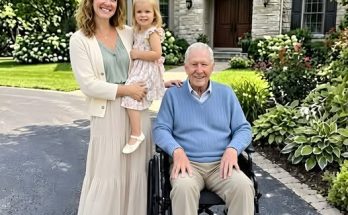
A woman humiliated my 83-year-old mother in front of an entire checkout line—then the cashier looked at her face, locked her register, and said, “Nobody leaves.” My 83-year-old mother still
insisted on doing her own grocery shopping. She had always been that way. Independent. Stubborn. Proud. Even after her knees began hurting and her hands started trembling slightly, she refused
to let me push her around like she was fragile. “I can buy six groceries without an escort,” she would tell me whenever I offered to come inside with her. That Saturday, she had finally agreed to let
me drive her to the store, but she insisted on going through the aisles herself. “You can wait in the car,” she said. “I need to find my tea.” “Mom, you don’t even like this brand.” “That’s why I’m looking
at the label.” I laughed and watched her disappear through the sliding doors. Twenty minutes later, I went inside because she had called me and said she couldn’t remember which aisle had the
canned peaches. When I found her, she was pushing a small cart with only six items inside. The store was packed. Saturday afternoon always was. Families crowded around the produce section.
Children begged their parents for candy. Shopping carts squeaked across the floor. The checkout lines stretched halfway toward the bakery. Mom chose the shortest line, but it quickly became
obvious that it wasn’t moving quickly. The elderly man in front of her had coupons. The cashier had to call for a price check. Then another customer complained about a sale item. By the time it was
finally my mother’s turn, she began struggling to find her wallet. Her hands were trembling as she searched through her purse. “It’s here somewhere,” she whispered. “Take your time,” I said. The
woman standing behind us sighed loudly. “Oh, come on.” Mom immediately apologized. “I’m sorry.” The woman shoved her overflowing cart forward. “If you’re too old to handle shopping, maybe
stay home.” Several people turned to look. I stared at her. “Excuse me?” She rolled her eyes. “I’m saying what everyone here is thinking.” Mom looked embarrassed. Her shoulders dropped. That
made me even angrier. “She’s taking thirty seconds to find her wallet.” The woman crossed her arms. “Some of us have places to be.” “Then choose another line.” “I shouldn’t have to.” Mom finally
found her wallet. “It’s okay,” she whispered to me. “Don’t make a scene.” I looked at her face. I knew that expression. It was the same expression she had worn my entire life whenever someone hurt
her and she decided her dignity mattered more than revenge. She pulled out her card and handed it to the cashier. But as the cashier reached for it, the woman behind us laughed. “Unbelievable.
We’re all standing here waiting for this?” Before I could respond, the cashier looked up. She was maybe fifty years old, with dark hair pulled into a neat bun and a small name badge that said ELENA.
Her eyes landed directly on Mom’s face. And suddenly, she froze. Not annoyed. Not confused. Stunned. She stared at Mom for several seconds. Mom looked back at her. “Is everything okay?” The
cashier didn’t answer. Instead, she quietly asked, “What’s your name?” Mom frowned. “Margaret.” Elena’s expression changed completely. Her lips parted. She immediately reached beneath the
counter. Click. The register locked. Then she switched off the conveyor belt. “Nobody leaves.” The rude woman behind us scoffed. “You have got to be kidding me.” But Elena wasn’t even looking at
her anymore. Her attention was entirely on Mom. She picked up the store phone. “Manager to register six. Now, please.” Then she lowered her voice and said something else I couldn’t hear. Mom
looked at me. “What is happening?” “I don’t know.” The woman behind us started complaining again. “This is ridiculous. I have been standing here for fifteen minutes.” Elena turned toward her.
“Ma’am, please wait.” “Wait for what?” “Please wait.” “Are you serious?” Elena’s voice became firm. “Nobody leaves until the manager arrives.” The woman looked around at the other customers.
“Can somebody tell me what’s going on?” No one answered. Then a tall man in a gray jacket hurried from the customer-service desk. He was the store manager. “Elena, what’s happening?” She
pointed toward my mother. “Ask her name.” The manager looked confused. “Why?” “Just ask.” He looked at Mom. “Ma’am, could you tell me your name?” “Margaret Collins.” The manager’s face
changed. I saw it immediately. He looked at Elena. Elena nodded. “That’s her.” “Are you sure?” “I’m sure.” The manager slowly closed the gate beside the register. “Ma’am,” he said to my mother,
“would you please come with us?” Mom stiffened. “Why?” “We need to show you something.” “Am I in trouble?” “No,” he said quickly. “Absolutely not.” “Then what is this about?” He glanced at Elena.
“Something happened here a long time ago.” My mother looked confused. “I shop here all the time.” Elena finally spoke. “Not this location.” Mom stared at her. “I don’t understand.” Elena swallowed
hard. “Twenty-seven years ago, I worked at another store.” Mom’s eyes narrowed. “Which one?” Elena named the location. My mother went completely still. I felt a chill run down my back. “That
was near the old hospital,” Mom whispered. “Yes.” Elena’s eyes filled with tears. “You saved my life.” The entire checkout line went silent. The rude woman behind us stopped complaining. Even the
manager looked at Elena as though he had never heard this story before. Mom shook her head. “I don’t remember.” “I do.” Elena wiped her cheek. “I remember every detail.” She looked at me. “Your
mother was the woman who found me.” “Found you?” I asked. Elena nodded. “I was seventeen.” She took a shaky breath. “I had run away from home.” Mom stared at her. “Elena?” “My name wasn’t
Elena then.” Mom whispered, “Lena?” Elena nodded. “Lena Rodriguez.” Mom covered her mouth. “Oh, my goodness.” The rude woman behind us stared. “Wait. You know her?” Elena looked at my
mother. “She was the first adult who ever believed me.” Mom’s eyes filled with tears. “I remember a girl.” “You found me behind the old grocery store.” Mom nodded slowly. “You were freezing.” “It
was raining.” “You had no shoes.” Elena nodded. “And you gave me your coat.” “I called the police.” “You did more than that.” Elena smiled through her tears. “You sat beside me until they came.” Mom
looked down. “I was only doing what anyone should do.” “No,” Elena whispered. “Not anyone.” She looked around the store. “You gave me your phone number. You told me to call if I ever needed
help.” Mom frowned. “Did you?” “For years.” Mom’s eyes widened. “You called?” “Once.” “I never got it.” Elena’s face tightened. “I left three messages.” She shook her head. “But I didn’t blame you.”
Mom looked devastated. “Why didn’t you call again?” “Because I was embarrassed.” “You were a child.” “I know that now.” Elena smiled. “But I didn’t then.” She turned to the manager. “I want
everyone to know why I stopped this register.” The manager nodded. “Go ahead.” Elena looked toward the rude woman. “Because twenty-seven years ago, this woman helped me when I was
invisible.” The rude woman looked uncomfortable. Elena continued. “And today, someone called her too old to shop.” She pointed gently toward my mother. “I couldn’t stand there and watch it
happen.” The woman crossed her arms. “I didn’t know.” Elena looked at her. “You didn’t know her story. That’s exactly the point.” The manager unlocked the register. “Everyone can leave.” But
nobody moved. Customers remained in line, suddenly interested in the woman they had ignored minutes earlier. Mom shook her head. “Elena, you didn’t have to do this.” “Yes, I did.” “Why?”
“Because I owe you something.” Mom smiled faintly. “You don’t owe me anything.” “You changed my life.” “You changed your own life.” Elena shook her head. “You gave me enough time to believe I
could.” She reached beneath the counter again and pulled out an old photograph. “I kept this for twenty-seven years.” It was a photograph of my mother sitting on the curb beside a teenage girl
wrapped in her coat. Mom stared at it. “Where did you get this?” “A police officer took it.” “I didn’t know.” “I found it years later in my case file.” Mom touched the photograph with trembling fingers.
“You kept it?” “Always.” The manager cleared his throat. “There’s something else.” Elena looked at him. “Should I tell her?” He nodded. Elena turned to Mom. “The company recently started a
community assistance program.” Mom smiled. “That’s wonderful.” “I nominated you.” “For what?” “For the first Lifetime Community Service Award.” Mom laughed. “Me?” “Yes.” “But I didn’t do
anything special.” Elena smiled. “That’s what people who do special things always say.” The rude woman behind us suddenly spoke. “I’m sorry.” Everyone turned. She looked at my mother. Her face
had changed. “I shouldn’t have said those things.” Mom studied her. “What is your name?” “Patricia.” “Patricia, you don’t have to apologize to me because of Elena’s story.” Patricia lowered her eyes.
“I should apologize because I was cruel.” Mom nodded. “Then I accept your apology.” Patricia wiped her eyes. “My mother is eighty-six.” Mom looked at her. “She lives with me.” “Then you know how
quickly people can become dependent.” Patricia sighed. “I was frustrated. My son was supposed to meet me here, and he didn’t show up.” Mom smiled gently. “You were having a bad day.” Patricia
shook her head. “That’s not an excuse.” “No,” Mom said. “But it can be a lesson.” Patricia nodded. “Thank you.” The line slowly began moving again. But something had changed. People weren’t
looking at my mother with impatience anymore. They were looking at her with curiosity and respect. A young woman behind Patricia approached us. “Mrs. Collins?” Mom looked at her. “Yes?” “I
heard what happened.” “I’m sorry you had to wait.” “No.” The young woman smiled. “I wanted to say thank you.” Mom looked confused. “For what?” “My grandmother is ninety-two. She still shops
alone.” “Good.” “I used to get embarrassed when she took too long.” Mom reached for her hand. “Don’t.” The young woman nodded, tears forming in her eyes. “I won’t.” Elena came around the
register and hugged my mother. “Can I ask you something?” “Of course.” “Why did you help me that night?” Mom thought for a moment. “Because I saw a scared child.” Elena nodded. “And you didn’t
judge me.” “There wasn’t anything to judge.” Elena smiled. “That’s what I remember.” Mom squeezed her hand. “What happened to your family?” Elena’s smile faded. “My mother passed away when I
was twenty-one.” Mom’s face softened. “I’m sorry.” “My father disappeared from my life.” “And you?” “I went to community college. Then nursing school.” Mom smiled. “A nurse?” “Yes.” “I always
thought you would become something important.” Elena laughed. “I don’t think you understand how much that sentence means to me.” She looked toward the manager. “I became a nurse because
of you.” “Because of me?” “You told me that night that if I ever had the chance, I should become the person who helps the scared person in the room.” Mom’s eyes widened. “I said that?” “You did.”
Elena smiled. “I never forgot.” The manager said, “Elena now oversees our community health outreach.” Mom laughed softly. “Then you certainly became important.” Elena hugged her again. “I
became useful.” Mom shook her head. “No. You became kind. That’s more important.” The story might have ended there if not for what happened the following week. Three days after the incident, I
received a phone call from the store manager. He invited my mother to a private ceremony. “We want her to come,” he said. “It’s not a publicity event. It’s for our employees.” Mom hesitated. “Why
me?” “Because many of our younger employees have never met someone who has spent a lifetime helping others without asking for anything.” Mom finally agreed. On Saturday evening, I drove her
to the store. The parking lot was nearly empty. Inside, the employees had gathered near the customer-service desk. Elena stood in front holding a framed photograph. The manager stepped
forward. “Margaret Collins, twenty-seven years ago, you helped a teenager who had nowhere to go. You probably thought you were simply doing the right thing. That teenager grew up, became a
nurse, and now helps hundreds of people every year. We believe your kindness deserves to be remembered.” He handed my mother a plaque. She looked at it and immediately began crying. “I don’t
deserve this.” Elena laughed. “You always say that.” “Because it’s true.” “Then let us deserve the chance to thank you.” Everyone applauded. Mom looked at me. “I don’t know what to say.” “Say thank
you.” She laughed through her tears. “Thank you.” After the ceremony, Elena pulled me aside. “There’s something you should know.” “What?” “Your mother doesn’t remember everything she did.”
“What do you mean?” Elena lowered her voice. “After I found her again, I spent years searching for other people she helped.” “Other people?” “Yes.” She handed me a folder. “I found twelve.” I stared
at her. “Twelve?” “People who remembered Margaret Collins.” I opened the folder. There were names, letters, photographs. A man named Thomas who said my mother had paid for his bus ticket
when he was stranded at nineteen. A woman named Susan who said Mom had helped her get into a shelter when she was pregnant. A former employee at a diner who remembered Mom leaving
money for a waitress whose child needed medicine. An elderly neighbor who said Mom had brought groceries every Tuesday for three years after her husband died. I looked at Mom. “Did you
know about all this?” She shook her head. “No.” “Why didn’t you tell me?” “Because there wasn’t anything to tell.” “Mom.” She smiled. “Kindness isn’t a trophy.” Elena nodded. “That’s why I had to
stop that register.” “Why?” I asked. “Because when that woman insulted your mother, I suddenly realized something.” “What?” “People were treating her like she was an inconvenience when she had
spent her entire life making sure other people weren’t inconvenienced by their pain.” I looked at Mom. She looked embarrassed. “You make me sound like a saint.” “You’re not a saint,” I said. “You’re
stubborn.” She laughed. “Thank you.” “You’re also kind.” She looked down. “I tried.” “You did more than try.” A month later, the store created a new program called the Margaret Cart. It allowed
elderly customers and people with disabilities to request assistance without feeling ashamed. The sign at the entrance read, “Take your time. You belong here.” Mom cried when she saw it. “They
didn’t have to name it after me.” “They wanted to.” “Why?” “Because you reminded them.” “Of what?” “That people deserve patience.” Word spread about what happened at register six. Someone
posted the story online. Within days, thousands of people had shared it. People wrote about their elderly parents. They wrote about grandparents who still insisted on doing their own shopping.
They wrote about strangers who had helped them during difficult moments. Patricia, the woman who had insulted my mother, even wrote a public apology. She said she had learned to stop judging
people based on the few seconds she saw of their lives. She became one of the volunteers for the Margaret Cart program. She and Mom became friends. Every Saturday, they met for coffee.
Patricia’s mother eventually joined them. “I never expected this,” Patricia told me one afternoon. “Neither did I.” “Your mother changed my life.” I smiled. “Apparently she has been doing that for
decades.” But the biggest surprise came six months later. Elena invited Mom to a hospital where she worked. “Why are we here?” Mom asked. “You’ll see.” She led us through the corridors and into a
small room. On the wall was a photograph of a young Elena wearing my mother’s coat. Beneath it was a plaque. “To Margaret Collins, who taught one frightened teenager that being lost doesn’t
mean being forgotten.” Mom covered her mouth. “You did this?” Elena nodded. “I wanted something permanent.” “Elena…” Mom touched the plaque. “I don’t know what to say.” “You don’t have to.”
“But I didn’t save you.” Elena smiled. “You gave me a chance to save myself.” Mom sat down. “I was just there.” “Exactly,” Elena said. “You stayed.” That word broke something open inside my mother.
She began crying. “My husband used to say that staying was the hardest thing.” “Walter?” “Yes.” “He was right.” Mom looked at the photograph. “He would have liked you.” “I wish I had met him.” “He
would have been proud.” Elena knelt beside her. “I’m proud of you.” Mom laughed softly. “At eighty-three, people don’t say that very often.” “Then they should.” On the drive home, Mom stared out
the window. “Do you know what I kept thinking about?” “What?” “That girl.” “Lena?” “Yes.” “You remembered her.” “I remembered being afraid for her.” Mom sighed. “I never knew what happened
after the police took her.” “You know now.” “I do.” She smiled. “She’s doing better than I ever imagined.” “She’s a nurse.” “A good one.” “Very good.” Mom was quiet for a while. Then she said, “That
woman at the store.” “Patricia?” “Yes.” “What about her?” “I hope she isn’t ashamed of herself.” I looked at her. “Mom, she insulted you.” “And she apologized.” “Still.” “People make mistakes.” “You
forgive everyone too easily.” Mom smiled. “No. I just don’t want someone else’s mistake to become my burden.” I thought about that sentence for a long time. My mother had been through difficult
things. She had buried her husband. She had lost friends. She had endured surgeries. She had watched people she loved grow old and die. Yet she had never allowed bitterness to become her
identity. She could have spent her remaining years angry at the world for making her slower. Instead, she insisted on carrying her own grocery basket. She insisted on writing her own birthday
cards. She insisted on cooking soup for sick neighbors. She insisted on being useful. And that Saturday at the checkout line, when someone told her she was too old to shop, she had almost
apologized for existing. That was the part I couldn’t forget. The woman behind us hadn’t just insulted her shopping speed. For a moment, she had made my mother feel like she didn’t belong in a
world she had spent eighty-three years helping build. But Elena reminded everyone of something important. Age does not erase a person’s story. Wrinkles don’t erase kindness. Shaking hands
don’t erase strength. Taking longer doesn’t mean being less valuable. And sometimes the person standing quietly in front of you has spent decades being the reason someone else survived a
terrible day. A year after the incident, Mom still did her own grocery shopping. Every Saturday. Six items. Same store. Same register when Elena was working. She had a routine. Tea. Peaches. Bread.
Apples. Soup. And one small chocolate bar she pretended was for me. “You don’t even like that kind,” I would say. “Then stop eating it.” Elena always smiled when Mom approached register six. “How
are you today, Margaret?” “Older.” “Wiser?” “Not necessarily.” “Kind?” “Always.” And Elena would laugh. Sometimes there would be a line behind them. Sometimes people would wait impatiently.
But nobody complained anymore. Not because Mom had become famous. Not because she had a plaque. Not because the store had named a program after her. They waited because they
understood. One Saturday, a little boy standing behind Mom became restless. His mother whispered, “Be patient.” The boy looked at Mom. “Why is she taking so long?” His mother bent down and
said, “Because she’s eighty-four, sweetheart. Sometimes people need a little extra time.” Mom turned around. “I’m eighty-four?” I laughed. “You turned eighty-four three months ago.” She shook her
head. “Nobody tells me anything.” The little boy smiled. “You’re old.” His mother gasped. “Honey!” But Mom laughed. “He’s right.” The boy stared at her. “Are you really old?” Mom nodded. “Very.”
“Did you see dinosaurs?” “Only the ugly ones.” He burst out laughing. His mother apologized. Mom waved her off. “He’s fine.” Then the boy asked, “Were you a princess?” Mom thought for a
moment. “No.” “A queen?” “Sometimes.” “Really?” Mom winked. “At home.” The boy looked impressed. The cashier Elena smiled. “She’s always been a queen.” Mom shook her head. “Don’t encourage
him.” The line laughed. And I realized something that day. The incident hadn’t changed my mother’s life because a cashier recognized her. It changed because she was reminded that her life
mattered even when strangers didn’t know her name. Elena had recognized something in her face that I had seen my whole life. Compassion. Resilience. A willingness to stay. The rude woman had
seen only an old woman fumbling with a wallet. Elena had seen the frightened seventeen-year-old she once was, wrapped in a coat my mother had given her. The difference wasn’t my mother’s age.
The difference was whether someone took the time to look. Years later, Elena still kept that photograph. Mom still kept the plaque. And I still remember the sound of that register locking. Click.
“Nobody leaves.” At first, I thought the words meant something terrible had happened. I thought my mother was in danger. I thought the woman behind us had caused some kind of emergency. I
never imagined that a cashier had recognized the face of someone who had once changed her life. I never imagined that one grocery trip would uncover twenty-seven years of hidden gratitude.
And I certainly never imagined that the woman who had been humiliated in front of an entire checkout line would become the reason hundreds of elderly shoppers were treated with more
patience. Mom passed away several years later, peacefully, at home, with me beside her. She was eighty-nine. On her final morning, she asked me if I had bought tea. “Yes, Mom.” “The good kind?”
“The expensive kind.” “Good.” She smiled. “And peaches?” “Yes.” “Six?” “Six.” She closed her eyes. “Then we’re ready.” I laughed through my tears. “Ready for what?” She opened her eyes one last time.
“Whatever comes next.” At her funeral, Elena stood beside me. She held the old photograph. Patricia was there too. So were dozens of people I had never met. Nurses. Neighbors. Former
employees. People my mother had helped decades earlier. Some brought flowers. Others brought handwritten notes. One man told me, “Your mother gave me a bus ticket when I had nowhere to
go.” A woman said, “She sat with me outside the hospital when I was terrified.” Another said, “She was the first person who told me I wasn’t a bad mother.” I listened to them and finally understood
why Mom never talked about any of it. She wasn’t collecting stories. She was living them. Elena spoke at the funeral. She held the microphone with both hands. “Margaret Collins taught me
something when I was seventeen,” she said. “She taught me that you don’t have to know someone’s entire story to treat them with kindness. You just have to recognize that they are human.” She
looked at me. “Your mother stayed when she could have walked away.” Then she looked toward the audience. “So today, I ask everyone here to do the same. Stay. Listen. Wait. Help. Because you
never know when the person in front of you is having the hardest day of their life.” After the service, I went home and found Mom’s purse on the kitchen chair. Her grocery list was still inside. Tea.
Peaches. Bread. Apples. Soup. Chocolate. Six items. I smiled and cried at the same time. Then I found an old photograph tucked behind the list. It was the picture of Mom and Elena from twenty-
seven years earlier. On the back, Mom had written something in her handwriting. “Never be too busy to stop.” I sat there for a long time. I thought about the checkout line. The woman who had
been impatient. The cashier who had frozen. The locked register. The words, “Nobody leaves.” And I finally understood why Elena had said them. She wasn’t stopping the customers because she
wanted to punish anyone. She was stopping the world for a few minutes so everyone could remember something we had almost forgotten. People are not obstacles. Old people are not
inconveniences. Slow hands are not worthless hands. And an eighty-three-year-old woman searching for her wallet is not someone who should be pushed aside simply because other people are in
a hurry. Sometimes the person taking the longest is carrying the longest story. Sometimes the quietest person in the room has changed more lives than anyone knows. And sometimes a stranger’s
cruel sentence can reveal the kindness of another stranger that has been waiting twenty-seven years to be acknowledged. I still shop at that store. Register six is still there. Elena eventually
became the store’s community outreach director. The Margaret Cart program expanded to several locations. Every cart has a little sign on it now. It says, “Take your time. You belong here.” I touch
that sign every time I see it. Because I know where it came from. It came from one old woman who refused to surrender her independence. One teenage girl who survived because someone
stopped. One cashier who remembered. And one Saturday afternoon when the entire checkout line was forced to slow down long enough to discover that the woman everyone thought was an
inconvenience had actually spent her entire life making the world a kinder place. So if you ever see an elderly person taking too long at a checkout counter, don’t sigh. Don’t roll your eyes. Don’t
assume they are confused. Don’t tell them to stay home. Wait. Smile. Offer to help if they want it. Because you don’t know their story. You don’t know who they raised, who they saved, who they
encouraged, who they sat beside in the darkest hour, or whose life they quietly changed decades ago. And you never know when the cashier might look up, recognize their face, lock the register,
and say, “Nobody leaves.” Because sometimes the world needs to stop for a moment—not because something has gone wrong, but because someone who spent a lifetime giving kindness finally
deserves to receive some back.